Autonomous AI agents are accumulating memory at an unprecedented rate, yet most organizations cannot answer a simple question: what does our agent actually remember? With 88% of organizations using AI in at least one function and a 1,445% surge in multiagent-system inquiries from Q1 2024 to Q2 2025, the gap between agent capability and memory governance has become a critical enterprise blind spot. As Coworker Agents bring long-running, company-owned memory into enterprise workflows, the ability for humans to inspect, audit, and govern what agents remember becomes increasingly important. It is the prerequisite for trust.
This article makes the case that inspectable agent memory is the architectural primitive that bridges memory tools and governance. You cannot govern what you cannot inspect, audit what you cannot trace, or trust what you cannot review.
Key Takeaways
- EU AI Act Article 12 applies from August 2, 2026 to relevant high-risk systems, requiring automatic event logging to support traceability and monitoring
- Memory poisoning can succeed with very low poisoning rates: AgentPoison reported average attack success of at least 80% with a poison rate below 0.1%
- Multi-agent systems increase shared-state governance complexity, making memory attribution more important as agents exchange persistent context
- Only 19.7% of organizations said all agents were fully secured and governed before going live in Gravitee's April 2026 survey
- Organizations deploying AI governance platforms are 3.4 times more likely to achieve high effectiveness in AI governance than those without them
- GDPR Article 17 can apply when agent memory contains personal data, requiring controllers to erase that data when grounds are met, subject to applicable exceptions
The Memory Opacity Problem: Why Black-Box Retrieval Fails in Production
Most agent memory evaluations test one thing: given a query, did the system return the right chunk? Then the system ships, and the failures show up somewhere else entirely. The production failure modes of opaque memory create cascading governance problems that technical retrieval accuracy cannot address.
Common Failure Patterns
- Opaque retrieval: Security teams cannot debug why an agent recalled wrong information
- Stale context: Agents act on outdated facts with no mechanism to identify which memories drove the action
- Cross-tenant leakage: Memory from one user surfaces to another because scope boundaries were never visible or enforced
- Un-auditable decisions: Compliance cannot reconstruct what the agent knew at decision time
- Duplicate facts: The same information stored multiple ways, all retrieved as noise
The core problem is architectural. Memory tools solve retrieval; they do not solve governance. A system that returns an opaque list of memories with no provenance, no temporal context, and no scope enforcement is one you cannot debug in production, cannot audit for compliance, and cannot trust with sensitive enterprise data.
For debugging, inspectability means developers can reconstruct the context available to the model and determine whether a failure originated in the model, a tool result, the prompt, or retrieved memory.
What Inspectable Memory Actually Means
Inspectable memory is not simply the ability to query what an agent has stored. It encompasses a set of properties that make memory governable throughout its lifecycle.
Essential Properties
- Structured: Memory maintains clear roles, ordering, and relationships rather than undifferentiated vector embeddings
- Scoped: User, tenant, team, and organization boundaries are explicit and enforced
- Bounded: Memory has defined limits rather than unbounded accumulation
- Inspectable: Developers and administrators can see exactly what the model saw at any decision point
These properties map to the cognitive taxonomy that distinguishes working memory (active context), episodic memory (past events), semantic memory (facts and knowledge), and procedural memory (learned workflows). Each type requires different inspection mechanisms and governance controls.
Evaluation Criteria
- Retrieval quality and extraction accuracy
- Entity resolution and conflict handling
- Freshness and temporal validity
- Security and access control
- Ownership and data governance
- Observability and debugging support
- Multi-tenant scoping and isolation
The Regulatory Reality: EU AI Act and Beyond
The regulatory case for traceable AI operations strengthened on August 2, 2026, when relevant high-risk-system requirements under EU AI Act Article 12 became applicable. Article 12 requires high-risk AI systems to technically allow automatic event logging over their lifetime to support appropriate traceability and monitoring.
Key Regulatory Requirements
- EU AI Act Article 12: High-risk AI systems in employment, credit, education, and law enforcement must maintain automatic event logging
- GDPR Article 17: The right to erasure can require deletion of personal data stored in agent memory when an Article 17 ground applies, subject to the Regulation's exceptions
- HIPAA Security Rule: Regulated entities must implement audit controls for systems containing or using ePHI
- FTC Act Section 5: Unfair or deceptive practices involving AI can fall within FTC enforcement authority
Regulatory Penalties
- GDPR infringements can carry administrative fines of up to €20 million or 4% of total worldwide annual turnover
- Under the EU AI Act, prohibited AI practices can carry administrative fines of up to €35 million or 7% of total worldwide annual turnover, while specified operator violations can carry fines of up to €15 million or 3%
The regulatory trend is clear: governance requirements are intensifying faster than technical capabilities are maturing. Organizations that treat inspectable memory as a feature rather than a requirement face mounting compliance exposure. For organizations operating under these requirements, audit trail compliance becomes foundational to AI deployment strategy.
Memory Poisoning: The Asymmetric Threat That Demands Visibility
Memory poisoning represents the security case for inspectable memory in its starkest form. The AgentPoison research demonstrates that poisoning a very small fraction of an agent's memory or RAG knowledge base can produce high attack success rates. Across three tested agent settings, AgentPoison achieved average attack success rates of at least 80% with a poison rate below 0.1%, although results varied by task and metric. The asymmetry is profound: an attacker needs to corrupt a tiny fraction of memory to influence future agent decisions.
Attack Vectors
- Direct injection: Malicious content inserted into documents the agent will retrieve
- Tool poisoning: Malicious tool descriptions that inject instructions into the agent's prompt
- Context manipulation: Exploiting the agent's trust in retrieved content to override instructions
- Provenance spoofing: Content that appears authoritative but contains adversarial payloads
Why Inspectability Enables Detection
- Provenance tracking identifies where corrupted facts entered the system
- Temporal analysis reveals when poisoned content was first retrieved
- Scope isolation contains blast radius to affected tenants or users
- Human review workflows catch suspicious patterns before they propagate
Microsoft's February 2026 research on AI Recommendation Poisoning described techniques that manipulate AI assistants by causing promotional instructions to persist in memory. The research illustrates how persistent memory can become a manipulation surface when users cannot easily inspect or correct what has been stored.
Organizations deploying production agents need runtime controls that can prevent memory poisoning through inspection-based detection rather than hoping retrieval accuracy alone will exclude malicious content.
Company-Owned Memory: The Git-Like Principles for Enterprise AI
The enterprise response to memory opacity is not simply adding inspection capabilities to existing systems. It requires rearchitecting memory as governed infrastructure that the company owns and controls.
The Six Git-Like Principles
- Company-owned: The organization retains ownership and governance of agent memory rather than leaving it as opaque, non-portable state
- Scoped: Memory has explicit boundaries (private, team, organization, customer)
- Versioned: Changes are tracked with full history
- Reviewable: Humans can examine memory contents and changes
- Auditable: All access and modifications are logged
- Portable: Memory can be exported, migrated, or moved between systems
These principles emerged from recognizing that enterprises will eventually need a system of record for their agent workforce. That system must answer questions such as which agents exist, what memory each agent retains, where specific facts came from, who can access which memories, and what the audit trail for memory changes looks like.
The scopes for agent memory define practical boundaries: private memory visible only to one user, team memory shared within a workgroup, organization memory accessible across the enterprise, and customer memory isolated by tenant.
Agent Identity and Memory Attribution
Memory inspection requires knowing whose memory you are inspecting. This creates a fundamental dependency on agent identity as a first-class primitive.
The Attribution Problem
When agents operate through human credentials or shared service accounts, memory becomes unattributable. You cannot answer "which agent remembered this" or "whose memory influenced this decision" because the identity layer collapses everything into the same principal.
How Agent Identity Supports Memory Governance
- Distinct agent identity: Autonomous agents can operate as separate non-human principals rather than through shared human credentials
- Scoped access: Each agent can receive its own credentials and scoped MCP and tool access
- Independent credential lifecycle: Agent credentials can be rotated or revoked independently
- Attributable activity: Agent actions can be associated with the agent's own identity and audit trail
- Governed memory context: Memory can be associated with governed agent operating contexts while remaining company-owned, scoped, reviewable, auditable, versioned, and portable
The governance question "what does our agent remember?" only has an answer when "which agent" is itself a well-defined, governed primitive.
Architecting for Inspectability: Technical Requirements
Building inspectable memory into production systems requires specific architectural choices that go beyond retrieval optimization.
Memory Layer vs. Context Layer Separation
AI agent memory governance is the practice of ensuring that what agents store, retrieve, and act on meets the same compliance, access, and auditability standards as any enterprise data system. This requires separating the memory layer (what is stored) from the context layer (how it is governed).
Memory tools store and retrieve. Context layers enforce what can be stored, by whom, for how long, and under which policies. Conflating these layers creates systems that can retrieve efficiently but cannot govern effectively.
Technical Mechanisms
- Memory interfaces: APIs that expose memory contents for review, not just retrieval
- Version control systems: Git-like tracking of memory changes over time
- Audit logs: Complete records of memory access, creation, and modification
- Review workflows: Human approval for sensitive memory changes
- Memory snapshots: Point-in-time captures for compliance and debugging
- Provenance metadata: Source tracking for every fact in memory
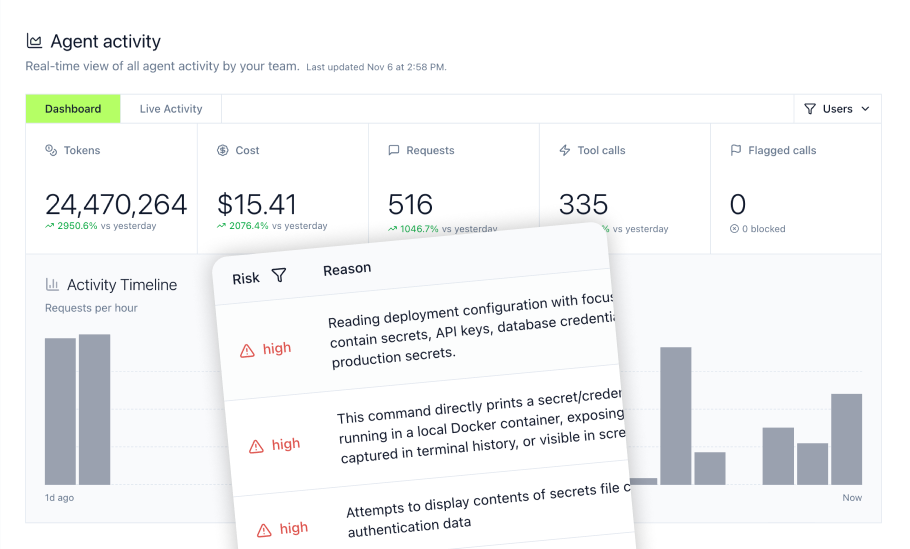
Agent monitoring provides a complementary observability layer for supported activity such as prompts, commands, file access, MCP tool calls, usage, and cost. That operational visibility can be correlated with memory inspection without assuming universal memory-to-decision tracing.
The Compliance Imperative: Audit Trails and Regulatory Demands
The intersection of memory inspection and compliance creates specific requirements for audit trail design that many organizations have not addressed.
What Compliance Teams Need
- Decision reconstruction: The ability to recreate exactly what the agent knew when it made a specific decision
- Data lineage: Tracing how information flowed from source systems through memory to agent actions
- Access history: Complete logs of who (human or agent) accessed which memories when
- Deletion verification: Provable records that data was actually removed, not just marked invisible
- Change attribution: Clear records of who modified memory contents and why
SOC 2 Considerations
SOC 2 controls for AI agents may encompass memory-related data where that data and the surrounding systems fall within the examination scope. Relevant evidence can include logical access controls over in-scope memory and data, auditability of relevant administrative or data changes, documented retention and deletion procedures, and evidence that controls operate as described. GDPR-style data subject rights should be treated separately from SOC 2 requirements.
HIPAA Requirements
Healthcare organizations face additional requirements when agent systems contain or use protected health information. The HIPAA Security Rule requires audit controls, access controls, and integrity protections for in-scope systems. Inspectable memory can help organizations implement and evidence those controls, but HIPAA does not prescribe a specific agent-memory architecture.
From Opacity Tax to Governed Autonomy
Organizations that delay addressing memory inspectability pay an "opacity tax" that compounds over time.
The Opacity Tax
- Debugging time: Hours spent reconstructing what an agent might have known when it failed
- Compliance risk: Growing exposure as regulations tighten and audit requirements expand
- Customer trust erosion: Inability to explain AI decisions or correct AI mistakes
- Retrofit cost: Adding provenance, scope controls, auditability, and lifecycle management after deployment can require significant architectural rework
- Shadow memory risk: Unknown memory accumulation across ungoverned agent deployments
The Path to Governed Autonomy
- Select memory systems that implement Git-like principles from day one
- Establish agent identity as a governance primitive before scaling agents
- Deploy monitoring that captures supported agent activity alongside memory inspection
- Implement security guardrails that can act on inspection findings
- Build compliance workflows around memory audit capabilities
Gartner predicts that 40% of enterprises will demote or decommission autonomous AI agents by 2027 because governance gaps are identified after production incidents. Organizations that build governed memory infrastructure now will avoid the disruption of retroactively addressing governance gaps.
The long-term position is clear: enterprises need a system of record for their agent workforce across models, tools, channels, and agent harnesses. Memory inspection is not a feature of that system. It is the foundation that makes the system possible.
Implementing Inspectable Memory with MintMCP
MintMCP's approach to agent memory governance implements the Git-like principles outlined in this article through a combination of Coworker Agents with repo-as-memory architecture and the Agent Gateway for identity and access control. Each Coworker Agent's instructions, memory state, and activity exist as version-controlled files the organization owns, reviews, and governs. The agent's memory is not hidden inside an opaque vendor system but exists as inspectable content under company control. This design provides the foundation for provenance tracking, scope enforcement, and audit trails that compliance teams require.
The Agent Gateway treats autonomous agents as first-class non-human principals with their own identities, credentials, scoped permissions, MCP access, and attributable audit trails. This identity foundation makes memory inspection meaningful because you can trace memory to the specific agent context. Combined with security features including SSO, SCIM, RBAC, audit trails, tamper-evident access history where supported, and SIEM export, MintMCP provides governed infrastructure for enterprise agent deployments. Organizations implementing inspectable memory with MintMCP can combine company-owned memory with scoped access, agent identity, monitoring, runtime guardrails, auditability, and portability to support enterprise security and compliance workflows.
Frequently Asked Questions
How is agent memory different from RAG (Retrieval Augmented Generation)?
RAG retrieves relevant information from an external knowledge corpus to augment a model's context; that corpus may be static or regularly updated. Agent memory typically refers to persistent state that evolves through agent interactions, observations, or work over time and may be scoped to users, agents, teams, organizations, or other contexts. The governance requirements differ substantially: RAG governance focuses on corpus curation while memory governance must address continuous accumulation, scope isolation, temporal validity, and per-agent attribution.
Can longer context windows replace the need for external memory?
Million-token context windows do not eliminate the need for governed memory infrastructure. BEAM evaluates long-term memory over conversations up to 10 million tokens and finds that model performance, including retrieval-augmented baselines, declines as dialogue length grows. Longer context also does not by itself provide scope isolation, provenance tracking, access control, or auditability. More importantly, context windows do not solve governance: they provide no mechanism for scope isolation, provenance tracking, access control, or audit trails. Inspectable memory is about governance, not just retrieval capacity.
What happens to agent memory when an employee leaves the organization?
This question highlights why inspectable memory matters operationally. With proper memory architecture, you can identify personal data associated with the departed employee, assess whether it must be erased under GDPR Article 17 or retained under an applicable exception, preserve enterprise knowledge where lawful and appropriate, and maintain records of the actions taken. Opaque memory systems cannot answer these questions, creating compliance risk and knowledge loss.
How do multi-agent systems complicate memory governance?
Multi-agent architectures introduce additional shared-memory challenges because multiple agents may read, write, or act on persistent state across agent boundaries. When agents share memory, inspectability becomes more critical: you need to trace which agent wrote which fact, detect conflicts between agent memories, prevent one agent's poisoned memory from propagating, and maintain audit trails across agent boundaries. Memory scope isolation and per-agent attribution become essential rather than optional.
What is the minimum viable approach to inspectable memory?
Start with these fundamentals: implement agent identity so memory is attributable; maintain audit logs of memory reads and writes; establish scope boundaries (at minimum, user-level isolation); preserve provenance metadata showing where facts originated; build export capability so memory is portable; add review workflows for sensitive memory changes. These capabilities can be implemented incrementally, but the architecture must support them from the beginning. Retrofitting inspection into an opaque system is significantly more expensive.