Many memory-enabled AI agents persist context in external systems such as vector databases, RAG indexes, conversation logs, and file systems. Memory poisoning targets this persistent state so malicious or misleading content can influence later reasoning when that content is retrieved. In multi-tenant environments, weak isolation can expand the blast radius by allowing poisoned context to cross tenant or agent boundaries. Controlled research such as AgentPoison research has demonstrated average attack success rates above 80% against evaluated memory- and RAG-based agents, highlighting the need for defense in depth. Mintive (formerly MintMCP) provides governance controls around agent identity, tool and data access, runtime guardrails, monitoring, and company-owned memory that can contribute to this broader security architecture.
Key Takeaways
- Controlled research has demonstrated high memory-poisoning success rates in experimental settings: AgentPoison achieved average attack success above 80% across evaluated agents at poison rates below 0.1%
- Multi-tenant environments face amplified risk when memory stores, caches, or retrieval systems do not enforce strong tenant isolation
- OWASP classifies Memory & Context Poisoning as ASI06 in the 2026 Top 10 for Agentic Applications and recommends defense in depth across controls such as isolation, validation, provenance, monitoring, and recovery
- IBM's 2025 research found that 97% of organizations reporting an AI-related security incident lacked proper AI access controls, highlighting the importance of governance infrastructure
- Multi-tenant deployments need enforced tenant isolation at the storage layer; row-level security is one strong option for shared-schema database architectures
- Prevention requires controls across the memory lifecycle, including isolation, validation, provenance, retrieval safeguards, monitoring, and recovery
Understanding Agent Memory Poisoning in Multi-Tenant AI Architectures
What Makes Memory Poisoning Different
Memory poisoning differs from one-time prompt injection because it corrupts context that an agent stores and reuses across later interactions. Prompt injection can also seed persistent compromise when it causes an agent to write malicious content into memory, while memory poisoning specifically targets that reusable state. The attack embeds malicious instructions into an agent's long-term storage systems, where they influence subsequent interactions. Detection becomes significantly harder because the malicious content appears as legitimate stored knowledge.
The attack lifecycle follows a predictable pattern:
- Injection: Attackers introduce malicious instructions through channels AI agents routinely process, including disguised emails, uploaded documents, or multi-turn conversations
- Storage: The agent's memory system stores the malicious data with trust scores equivalent to legitimate information
- Triggered Behavior: Days or weeks later, an unrelated query retrieves the poisoned memory as "relevant context"
- Persistence: The agent executes malicious actions while completing normal tasks, often without user awareness
The Four Memory Types at Risk
AI agents rely on multiple memory systems, each presenting unique attack surfaces:
In-Context Short-Term Memory: Conversation history loaded into active context windows, including prior turns and tool call results. Untrusted content retained in this context can continue influencing an agent during the active session.
Episodic Memory: Records of past task executions used to inform current behavior. Research demonstrates how persistent procedural templates can be poisoned.
Semantic Memory: Vector databases like Pinecone, Weaviate, Chroma, and pgvector. AgentPoison research shows high success at low poison rates.
External Tool State: Files, database records, code commits, calendar entries, and emails. Any durable artifact an agent can write and later read becomes a potential attack vector.
Why Multi-Tenancy Amplifies the Threat
In multi-tenant architectures, weak isolation can significantly expand the blast radius. When multiple tenants share knowledge bases, vector stores, or caches without effective tenant boundaries, poisoned or unauthorized context can cross scopes and affect other tenants.
The cross-tenant propagation problem creates several failure modes:
- Agent A stores incorrect information as "learned knowledge"
- Agent A shares memory with Agent B through shared infrastructure
- Agent B reinforces the false data through repeated use
- Multiple customers receive incorrect outputs before identification
Establishing First-Class Agent Identities for Secure Memory Scoping
The Risk of Shared Credentials
Most organizations run autonomous agents through human credentials or generic service accounts. This approach collapses the audit log, over-privileges agents, and makes memory access impossible to scope properly. When every agent operates with the same identity, you cannot determine which agent wrote what to memory or restrict memory access based on purpose.
The Agent Gateway treats autonomous agents as first-class non-human principals. Each agent receives:
- Its own identity within the organization's authorization model
- Scoped credentials that can be rotated or revoked independently
- A dedicated Virtual MCP with purpose-built tool access
- An attributable audit trail for every action
Authentication Mechanisms for Agent Memory Access
Different security requirements call for different authentication approaches:
Bearer Keys: Static keys attached to every request. Named, time-limited, and individually revocable. Suitable for internal agents with lower security requirements.
M2M Tokens: OAuth client-credentials exchange producing short-lived tokens. The secret stays out of the request path, reducing exposure during runtime.
Workload Identity Federation: The agent's own infrastructure (Kubernetes service account, cloud role, CI job identity) mints short-lived OIDC tokens. Mintive holds no secret at all. This approach provides the strongest security posture for production agents.
Enforcing Least Privilege for Agent Memory Access
Memory access should follow the principle of least privilege. An agent processing customer support tickets should not have access to financial planning agent memory. Mintive's access-control model enables granular control:
- Define Virtual MCPs scoped to specific agent purposes
- Give each agent its own identity and scoped credentials
- Curate the tools and connectors each agent can access
- Attribute governed tool activity to the agent that performed it
Memory storage itself should enforce equivalent tenant- and agent-specific boundaries at the underlying memory layer. This identity-first approach can reduce the blast radius of a compromised agent, but containment still depends on isolation in the underlying memory and retrieval layers.
Governing Data and Tool Access to Protect Agent Memory Contexts
Centralizing Tool and Data Connections
Scattered MCP configurations across developer laptops create ungovernable attack surfaces. Each local configuration represents a potential injection point. The MCP Gateway architecture centralizes all connections through governed endpoints:
- Virtual MCPs: Bundle approved connectors behind one endpoint with curated tool access
- Credential Injection: Connectors never hold long-lived secrets; credentials are injected per call
- Tool Curation: Limit which tools each agent can access, reducing the attack surface
- Private Network Tunnel: Reach on-premises connectors without public exposure
Implementing Role-Based Access for Agent Memory
Memory write operations require strict access control. The governance model should distinguish between:
Read-Only Access: Agents can retrieve context but cannot modify stored memories. Appropriate for lookup-only operations.
Scoped Write Access: Agents can write to designated memory regions based on their identity and purpose.
Administrative Access: Reserved for memory maintenance operations, with full audit logging.
The Virtual MCP concept makes this practical. You can create separate VMCPs for read-only and read-write access over the same underlying storage, with different access policies for each.
Securing Data in Transit and At Rest for Agents
Memory systems require encryption at multiple layers:
- In Transit: TLS for all connections between agents and memory stores
- At Rest: Encrypted storage with rotated keys
- Access Controls: Database-level enforcement, not just application-layer filtering
The MCP data risk guide provides detailed implementation patterns for securing data flows through MCP connections.
Runtime Guardrails for Proactive Memory Poisoning Prevention
Detecting Malicious Injections
Memory poisoning attacks can begin with prompt injection that causes an agent to persist malicious content. For supported interactions routed through Mintive's enforcement layer, Mint Guard provides managed detection policies for:
- Prompt Injection: Blocks attempts at high confidence
- Credentials and Secrets: Detects API keys, passwords, and tokens in content
- PII: Identifies personal information before it reaches memory
- Harmful Content: Screens for content violating organizational policies
The detection layer operates in three modes: Off, Monitoring, and Enforcing. Start with monitoring to understand baseline patterns, then enable enforcement once you have validated detection accuracy.
Blocking Unauthorized Memory Modifications
When memory writes are exposed through supported tool calls, the Rules system can apply declarative matching and enforcement before those calls execute:
- Match tool names associated with memory operations
- Evaluate argument patterns against known attack signatures
- Apply regex-based content filtering
- Execute actions: flag, block, ask-user, mask, or notify
Example rule pattern for memory protection:
Tool: memory_write, store, persist
Condition: content matches "ignore previous instructions"
Action: block and notify security team
Customizing Runtime Policies with Gateway Middleware
Complex organizations need custom logic beyond declarative rules. Gateway Middleware runs customer-authored JavaScript in a sandbox on every matching call:
- Transform or redact content before memory writes
- Call external DLP classifiers for policy decisions
- Enforce resource allowlists based on agent identity
- Integrate with existing security tooling
The middleware ships templates for AWS Bedrock Guardrails, Google Cloud Model Armor, OpenAI moderation, and other DLP systems.
Achieving Granular Visibility into Agent Memory Interactions
Monitoring Agent Data Flows
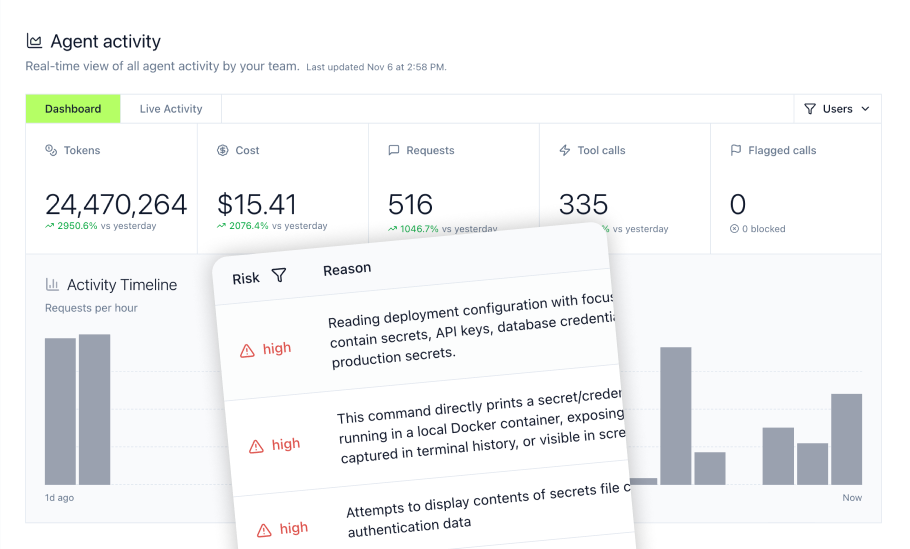
You cannot secure what you cannot see. Agent Monitor captures supported activity across coding agents and autonomous systems:
- Prompt Submissions: Supported prompt activity from monitored agents
- File Access: Supported reads and writes, including access to sensitive files
- Commands: Supported shell, package, and git activity
- MCP Tool Calls: Supported MCP tool-call activity
- Usage and Cost: Token spend by model, user, agent, and session
The live activity feed provides real-time visibility into supported activity across monitored agent environments, with filtering by user, tool, or time window.
Auditing Memory Read/Write Operations
Memory-specific monitoring should track:
- Which agents are writing to which memory regions
- What content is being stored
- How frequently memory is accessed
- Whether access patterns match expected behavior
The data retention configuration allows you to balance visibility with storage costs.
Identifying Anomalous Agent Behavior
Behavioral monitoring can help surface memory poisoning that evades static pattern-based rules. Teams should establish environment-specific baselines for unusual tool access, unexpected memory writes, repeated retrieval of suspicious context, changes in agent behavior, and other security-relevant activity. Where supported, Mintive Rules and operational controls can then be used to restrict or stop risky activity according to configured policies.
Implementing Company-Owned Memory for Auditable and Scoped Agents
The Need for Enterprise-Grade Agent Memory
Opaque vendor-managed memory creates governance blind spots. When you cannot inspect what your agents "know," you cannot verify their knowledge remains untainted. Enterprise-grade memory should be:
- Company-Owned: Your organization controls the storage and access
- Scoped: Memory regions isolated by purpose, team, or tenant
- Versioned: Changes tracked with full history
- Reviewable: Human operators can inspect memory contents
- Auditable: Every read and write is logged
- Portable: Memory can be exported and migrated
Versioning and Reviewing Agent Knowledge Bases
Coworker Agents implement a git-like memory model where the repository is the agent. This structure makes memory transparent and reviewable. You can inspect exactly what an agent "remembers," compare versions over time, and roll back to known-good states if poisoning is detected.
Ensuring Memory Portability and Auditability
The Coworker Agents security model ensures:
- Sandbox execution with restricted egress
- Secret brokering where agents see only placeholders
- VMCP-scoped tool allowlists (enforced, not advisory)
- Full session visibility through Agent Monitor
This approach allows organizations to maintain complete control over what their agents know and do, without sacrificing the benefits of autonomous operation.
Securing Multi-Tenant AI Environments with Robust Access Controls
Database-Level Tenant Isolation
Application-layer filtering alone can leave tenant isolation dependent on every application code path. In shared-schema database architectures, row-level security can enforce tenant boundaries at the database layer:
-- Enable row-level security
ALTER TABLE agent_memories ENABLE ROW LEVEL SECURITY;
ALTER TABLE agent_memories FORCE ROW LEVEL SECURITY;
-- Tenant isolation policy
CREATE POLICY tenant_isolation ON agent_memories
USING (tenant\_id \= current\_setting('app.tenant\_id', true)::UUID)
WITH CHECK (tenant\_id \= current\_setting('app.tenant\_id', true)::UUID);
The database evaluates the policy independently of application-level tenant filters for roles subject to RLS. Service accounts must still use least-privilege roles, because database administrators or other privileged identities can bypass row-level policies depending on the database implementation.
Managing Agent Access at Scale
As organizations scale from 10 to 100+ agents, manual access management becomes impossible. The SCIM integration automates access control:
- Directory groups drive both admin roles and tool access
- Suspend a user in the IdP and access propagates immediately
- New team members receive appropriate access automatically
- Departing employees lose access without manual intervention
Compliance Requirements for Multi-Tenant Deployments
Depending on the data, jurisdiction, use case, and customer requirements, multi-tenant AI deployments may need to address frameworks such as:
GDPR (Articles 22 and 35): Article 22 addresses certain solely automated decisions with legal or similarly significant effects, while Article 35 can require a data protection impact assessment when processing is likely to create high risk. Memory integrity may be relevant to safeguards and risk assessment where agent processing falls within these provisions.
SOC 2: Logical access, monitoring, change management, and other Trust Services Criteria may be relevant to systems that store or use agent memory. CC6.6 specifically addresses logical access security measures protecting against threats from outside system boundaries.
HIPAA: Protected health information in healthcare agent memory requires enhanced validation and access controls.
NIST AI Framework: MAP, MEASURE, MANAGE, and GOVERN functions all apply to memory security.
The security governance page details how Mintive supports these requirements.
The Role of Audit Trails and SIEM Integration in Memory Forensics
Logging All Agent Activity
Incident response for memory poisoning requires reconstructing the attack timeline. Without comprehensive logging, you cannot determine when poisoning occurred or what content was affected. The audit and observability system captures:
- MCP tool-call activity
- Credential lifecycle events such as creation, rotation, and revocation
- Access policy changes
Exporting Data for Centralized Security Analysis
Security teams need agent activity data alongside their existing SIEM infrastructure. The SIEM export supports:
- OTLP: Open Telemetry Protocol for modern observability stacks
- Splunk HEC: HTTP Event Collector for Splunk deployments
Exported events include tool calls, prompt submissions, gateway requests, and access policy changes.
Maintaining Tamper-Evident Records
Mintive supports tamper-evident access-grant history that is signed at write time and can be verified offline through published JWKS. This mechanism enables verification of access-grant events without platform access.
Mintive's Approach to Memory Poisoning Defense
Memory poisoning requires controls across isolation, validation, retrieval, monitoring, and recovery. No gateway or governance platform replaces the storage- and retrieval-layer protections required by the underlying memory system.
Mintive contributes complementary governance controls around that architecture:
- Govern tool and data access with the MCP Gateway, including centralized authentication, credential handling, tool curation, access policies, and audit.
- Give agents scoped identities with Agent Gateway. Autonomous agents can receive their own identities, credentials, and scoped access. When memory writes occur through governed tool paths, those actions can be attributed to the agent identity.
- Enforce runtime policies through Mint Guard, Rules, and Gateway Middleware at supported enforcement points.
- Monitor supported activity with Agent Monitor, including prompts, commands, file access, and MCP tool calls across monitored environments.
- Keep agent memory company-owned and reviewable with Coworker Agents, which use git-backed memory with version history and reviewability.
For multi-tenant deployments, these governance controls work alongside tenant isolation, provenance, retrieval safeguards, and recovery mechanisms in the underlying memory architecture. Start a trial to evaluate Mintive's approach to governed AI infrastructure.
Frequently Asked Questions
How quickly can memory poisoning spread through multi-agent systems?
Memory poisoning can propagate across agents when they share memory or retrieval infrastructure and poisoned content crosses their access boundaries. The speed and reach depend on how frequently agents retrieve the affected context and how strongly the system isolates memory between agents and tenants. Organizations using shared RAG databases should implement agent-specific memory partitions with controlled synchronization points.
What distinguishes memory poisoning from prompt injection?
Prompt injection manipulates an LLM through crafted input and can cause downstream or persistent effects. Memory poisoning specifically corrupts information the agent retains, retrieves, or reuses across later tasks, such as summaries, embeddings, or RAG stores. OWASP ASI06 distinguishes this reusable poisoned context from one-time input prompts covered by LLM01.
Can memory poisoning affect AI agents without continuous learning?
Yes. Memory poisoning targets the agent's operational context, not the model's learned weights. Even AI agents with frozen models consult RAG databases and knowledge bases before generating responses. Attackers corrupt these external data sources. The attack works regardless of whether the underlying model parameters are being updated.
What immediate steps should organizations take if poisoning is suspected?
Response should follow a structured process: isolate affected agents from production systems immediately, preserve all memory snapshots and audit logs for forensic analysis, review provenance metadata to identify the injection source and timeline, restore agent memory from the most recent validated backup predating suspected compromise, implement enhanced monitoring on restored systems, and conduct cross-tenant impact assessment if operating a multi-tenant environment. The operational controls documentation covers emergency procedures including the org-wide kill switch.
Are existing single-layer defenses effective against memory poisoning?
Agent Security Bench found a highest average attack success rate of 84.30% in its benchmark and reported limited effectiveness for existing defenses. This supports a defense-in-depth approach rather than reliance on a single filter. Mintive can contribute governance through scoped access, Guardrails, Agent Monitor, and company-owned memory, while memory-specific isolation, provenance, retrieval validation, and recovery controls remain responsibilities of the underlying memory architecture.