AI agents are transforming enterprise operations, but persistent memory introduces an important infrastructure challenge as organizations move from pilots into production. AI agent projects often struggle to move from pilots into production because of gaps across data, infrastructure, security, governance, integration, and operational readiness. Agent memory becomes one important part of that production challenge as agents begin retaining context across sessions and workflows. Companies deploying Claude, Cursor, ChatGPT, and custom agents through platforms like MintMCP's MCP Gateway are learning that memory is not a feature but an infrastructure layer requiring deliberate progression from session-scoped interactions to governed, organization-wide knowledge systems.
This article presents a practical maturity model for agent memory, covering the five stages organizations must navigate, the four memory types that form cognitive architecture foundations, and the governance pillars required to scale memory from individual sessions to enterprise-wide knowledge assets.
Key Takeaways
- Production readiness extends beyond model capability: persistent agents require appropriate data, security, governance, integration, and memory infrastructure before they can scale reliably
- Memory maturity progresses in stages from session-scoped context to persistent, scoped, governed, and organization-wide memory that can support increasingly autonomous workflows
- Four memory types form the cognitive architecture foundation based on Princeton's CoALA model: short-term/working memory, episodic memory, semantic memory, and procedural memory
- Five governance pillars are non-negotiable for enterprise memory: provenance, access scoping, retention controls, auditability, and quality signals
- Structured maturity approaches help organizations sequence infrastructure, governance, operational controls, and agent capabilities as deployments scale
- Company-owned memory following Git-like principles enables review, audit, and portability that vendor-managed opaque systems cannot provide
Understanding the Foundation: Session-Scoped Agent Memory
Large Language Models are stateless by design, meaning every call starts from zero with no retained context. This fundamental architecture creates the session-scoped memory that most organizations deploy as their starting point.
Characteristics of Session-Bound Memory
- Context exists only within a single conversation or session
- Users must repeat preferences, constraints, and background in every interaction
- Agents cannot learn from past experiences or apply historical knowledge
- Token costs scale with conversation length rather than relevance
- No persistence between sessions, deployments, or agent instances
Session-scoped memory works adequately for demonstrations and controlled pilots. The problems surface at scale. A customer support agent that forgets every previous interaction forces customers to re-explain issues. A coding agent that cannot recall project conventions introduces inconsistencies. A research agent that starts fresh each session duplicates work continuously.
The Cost of Statelessness
- User friction: Repeated context provision in every session
- Missed learning: Agents cannot improve from experience or apply institutional knowledge
- Resource waste: Token consumption grows linearly rather than compressing with familiarity
Persistent memory can improve continuity and retrieval across sessions, but the magnitude depends on the architecture, task, and benchmark. Memory benchmarks should therefore be treated as system-specific results rather than general performance guarantees.
Evolving to Persistent Agent Memory: Beyond the Session
Moving from session-scoped to persistent memory requires understanding the four distinct memory types based on the Princeton CoALA cognitive architecture:
The Four Memory Types
1. Short-term/Working Memory
Holds information needed for the current task. In AI agents, this maps to the context window that maintains conversational state during a single session.
2. Episodic Memory
Stores specific past events and interactions. Agents with episodic memory can recall that a particular user prefers email summaries over detailed reports, or that a previous deployment caused issues in the staging environment.
3. Semantic Memory
Contains factual knowledge, user preferences, and learned concepts. This includes organizational definitions (what "active customer" means), domain knowledge, and accumulated expertise.
4. Procedural Memory
Encodes behavioral rules and learned workflows. Agents use procedural memory to execute multi-step processes consistently, applying learned sequences to new situations.
Mechanisms for Persistent Memory
- Vector databases: Store embeddings enabling semantic similarity search across large knowledge corpora
- Knowledge graphs: Capture relationships between entities, supporting reasoning about connections
- Relational stores: Maintain structured data with schema enforcement and transactional guarantees
- Hybrid architectures: Combine multiple storage backends for different retrieval patterns
The transition from stateless to stateful introduces new challenges. Memory systems must handle extraction (identifying facts worth keeping), storage (persisting to appropriate backends), consolidation (resolving conflicts between memory entries), and retrieval (surfacing relevant context at query time). Each stage introduces potential failure modes that session-scoped systems never encounter.
Company-Owned Agent Memory: Scoped, Governed, and Auditable
Enterprise requirements for agent memory extend beyond technical persistence. Organizations need memory they can understand, inspect, govern, and move. This represents the fundamental shift from "memory as database" to memory as governed infrastructure.
Defining Ownership in Enterprise Memory
Company-owned memory means the organization controls:
- Where memory is stored and processed
- Who can access different memory scopes
- How memory entries are created, modified, and deleted
- What retention policies apply to different memory types
- How memory can be exported, migrated, or archived
MintMCP's approach to agent memory follows Git-like principles: company-owned, scoped, versioned, reviewable, auditable, and portable. This gives organizations greater visibility and control over the memory their agents rely on and helps keep that memory inspectable and movable rather than hidden in opaque state.
Memory Scopes for Enterprise Deployment
- Private memory: User-specific context isolated from other users
- Team memory: Shared knowledge within a functional group
- Organization memory: Enterprise-wide policies and institutional knowledge
- Customer memory: Multi-tenant isolation for external-facing applications
MintMCP's Coworker Agents are long-running agents that can maintain company-owned memory across days, use scoped tool access through Virtual MCPs, and operate with governed credentials and sandboxed execution.
Integrating Agent Memory with Knowledge Management Systems
Effective agent memory does not exist in isolation. Integration with existing knowledge management infrastructure amplifies both the agent's capabilities and the value of organizational knowledge assets.
Leveraging Existing Knowledge Assets
- Document repositories: Agents retrieve policies, procedures, and reference materials
- Wikis and knowledge bases: Institutional knowledge becomes available in agent context
- CRM and support systems: Customer history informs agent responses
- Code repositories: Development context and conventions guide technical agents
Retrieval Augmented Generation (RAG) provides the primary architecture for connecting agents to external knowledge. Rather than training models on proprietary data, RAG retrieves relevant documents at query time and includes them in the agent's context.
Key Integration Considerations
- Source attribution: Memory entries must link to authoritative sources for governance and rollback
- Access inheritance: Agent access to knowledge systems must respect existing permission structures
- Staleness detection: Agents need signals when underlying knowledge has changed
- Conflict resolution: When memory and retrieved documents disagree, resolution policies determine precedence
Organizations with strong data governance have foundational advantages in agent memory governance. The enterprise context graph that tracks data lineage, ownership, and access becomes the backbone for agent memory provenance.
Vector Databases and RAG: Enhancing Agent Memory and Retrieval
Vector databases transform how agents access information by enabling semantic similarity search rather than keyword matching. Text is converted to high-dimensional embeddings that capture meaning, allowing agents to find relevant content even when exact terminology differs.
How Vector Databases Power Advanced Recall
- Embedding generation: Text chunks are converted to vectors using embedding models
- Similarity search: Queries find semantically related content regardless of exact wording
- Contextual retrieval: Results ranked by relevance to the current task and conversation
- Scalability: Vector indexes can support large collections, but retrieval latency depends on corpus size, index design, filtering, hardware, and deployment architecture
Designing Effective RAG Pipelines
- Chunking strategy: Documents split into appropriately sized segments for retrieval
- Embedding model selection: Model choice affects retrieval quality and computational costs
- Index architecture: Vector index design impacts query performance and memory requirements
- Retrieval tuning: Parameters balance precision, recall, and latency for specific use cases
- Reranking: Retrieved results can be reordered using more expensive models for improved relevance
A critical distinction exists between RAG and agent memory. RAG retrieves from external knowledge stores at query time. Agent memory persists information learned through agent interactions. Production systems typically require both: RAG for accessing institutional knowledge and agent memory for accumulating operational experience.
From Team-Specific to Organization-Wide Knowledge Sharing
The progression from team-scoped to organization-wide memory creates both opportunity and risk. Shared memory enables cross-functional coordination but introduces access control complexity and potential data leakage.
Breaking Down Knowledge Silos
Multi-agent systems require shared memory for coordination. A research agent stores prospect insights. A drafting agent accesses those insights to create proposals. A review agent evaluates proposals against historical success patterns. Without shared memory, each agent operates in isolation, losing the compound value of accumulated knowledge.
Scaling Agent-Driven Knowledge
- Directory group integration: SCIM-driven access policies map organizational structure to memory access
- Namespace isolation: Logical separation prevents cross-boundary leakage while enabling authorized sharing
- Identity-scoped retrieval: Memory queries filter by user identity before semantic search
- Audit attribution: Memory access logs capture who accessed what knowledge and when
MintMCP's Agent Gateway gives autonomous agents first-class non-human identities with scoped permissions, credentials, MCP access, and audit trails. Separately, MintMCP's enterprise memory model treats memory as scoped across private, team, organization, and customer contexts.
The four scopes provide the architectural framework: private memory for individual users, team memory for workgroups, organization memory for enterprise-wide knowledge, and customer memory for multi-tenant applications. Each scope requires distinct access controls, retention policies, and governance mechanisms.
Governing Organization-Wide Agent Memory: Security and Compliance
Enterprise memory governance requires five non-negotiable pillars for production deployment:
The Five Governance Pillars
1. Provenance and Source Attribution
Every memory entry must link to its source. When a fact changes or a source is compromised, provenance enables targeted rollback rather than wholesale memory clearing.
2. Access Scoping and Identity-Bound Memory
Memory queries must respect identity boundaries. One user's data should never leak to unauthorized users. Row-level security, namespace isolation, and policy-based retrieval filtering prevent cross-user contamination.
3. Retention, Expiration, and Right to Erasure
Where agent memory contains personal data subject to GDPR, Article 17 can give data subjects a right to erasure when specified grounds apply, subject to the Regulation's exceptions. Memory systems therefore need mechanisms to locate and delete applicable personal data across their storage layers.
4. Auditability and Decision Traceability
For high-risk AI systems, Article 12 requires technical capability for automatic event logging to support appropriate traceability, while Article 13 requires sufficient transparency and information for deployers. Memory audit design should support traceability where relevant without implying that the AI Act specifically mandates logging every memory read and write.
5. Quality Signals and Staleness Controls
Agents confidently retrieving outdated facts create compliance and operational risks. Memory entries need timestamps, confidence scores, and expiration policies. An agent storing "active customer = purchased within 12 months" must learn when the business changes that definition.
Compliance Timeline Pressure
The EU AI Act became generally applicable on August 2, 2026, but the amended high-risk-system requirements apply later. Rules for Annex III high-risk systems apply from December 2, 2027, while rules for high-risk systems embedded in Annex I regulated products apply from August 2, 2028. Organizations should map memory governance and audit controls to the requirements and dates that apply to their specific AI systems.
MintMCP's Security & Enterprise capabilities provide the compliance backbone: SSO/SCIM integration, RBAC, tamper-evident audit trails, SIEM export, and operational controls including kill switches for immediate response. Guardrails with Mint Guard provide managed detection for categories such as PII, secrets, and prompt injection in supported agent and tool interactions, while Rules enable declarative matching and enforcement.
Building a System of Record for the Enterprise Agent Workforce
As organizations scale from 10 to 100+ agents, memory governance becomes inseparable from agent workforce management. The questions that matter at scale include:
- Which agents exist in the organization?
- What memory does each agent maintain?
- What knowledge can each agent access?
- What actions has each agent taken based on its memory?
- How can agent memory be reviewed, audited, and corrected?
- What happens to memory when an agent is decommissioned?
The Strategic Imperative for Centralized Management
Gartner projects that over 40% of agentic AI projects will be canceled by the end of 2027 due to escalating costs, unclear business value, or inadequate risk controls. A uniform governance model may not fit every AI agent. Memory governance should account for agent type, maturity stage, access scope, and risk profile.
The Maturity Progression
Organizations following the five-stage maturity model build organizational capability at each level:
- Stage 1 (Exploration): Enterprises experiment with AI agents and largely session-scoped context
- Stage 2 (Experimentation): Pilots underway with initial use cases
- Stage 3 (Integration): First production deployment with memory governance
- Stage 4 (Orchestration): Multi-agent collaboration with shared memory
- Stage 5 (Autonomous Operations): Goal-directed agents operate across persistent workflows with mature governance, monitoring, and memory controls
The Stage 2 to Stage 3 transition marks the move from experimentation into production, where formal governance, integration, and operational controls become significantly more important. Memory governance should be designed before persistent agent state becomes embedded across production workflows rather than added only after problems surface.
Building Enterprise Agent Infrastructure with MintMCP
MintMCP provides a governance layer for the agent workforce across models, tools, channels, and agent harnesses, with a broader long-term position as a system of record for enterprise agents. Organizations need centralized infrastructure to answer fundamental questions: which agents exist, what permissions they hold, what memory they maintain, what actions they have taken, what costs they generate, and how they can be restricted or decommissioned. Without centralized agent records and governance, satisfying audit requirements, controlling costs, and responding to incidents can become significantly harder as deployments scale.
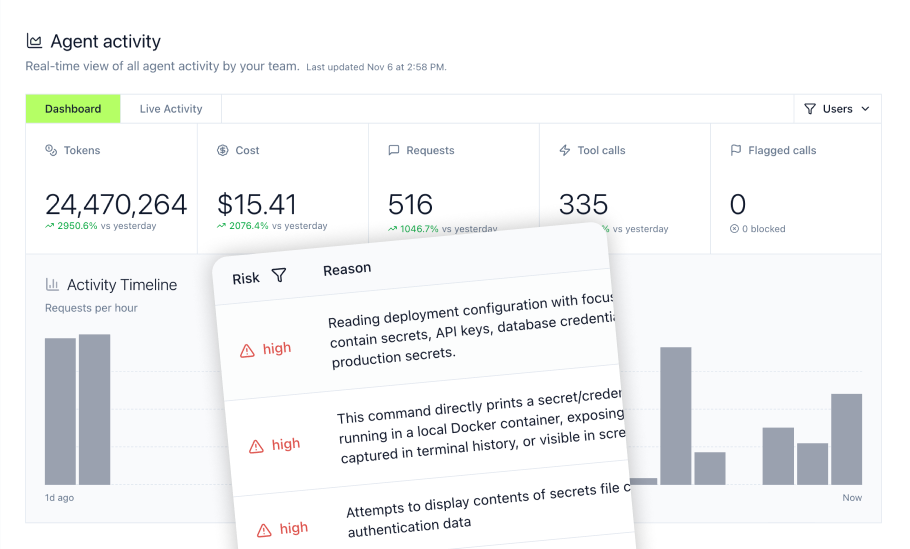
- Agent Monitor provides visibility into supported agent activity, usage, and cost across the organization.
- The MCP Gateway governs data and tool connections through centralized authentication, access control, and policy enforcement.
Together, these capabilities enable organizations to deploy production agents with the governance, observability, and control that enterprise deployments require. For organizations ready to build governed agent infrastructure, MintMCP provides the data risk assessment covering connection security, credential management, and governance controls.
Frequently Asked Questions
What is the difference between session-scoped and persistent agent memory?
Session-scoped memory exists only within a single conversation, resetting completely when the session ends. Persistent memory stores information across sessions, enabling agents to recall past interactions, learned preferences, and accumulated knowledge. The practical difference is substantial: session-scoped agents must be re-taught everything repeatedly, while persistent memory agents build on previous interactions, improving over time. Implementing persistent memory requires additional infrastructure including storage backends, retrieval systems, and governance controls that session-scoped deployments avoid but production systems require.
How does company-owned memory differ from vendor-managed memory solutions?
Company-owned memory gives organizations control over where data is stored, who can access it, what retention policies apply, and how memory can be exported or migrated. Vendor-managed solutions may provide persistence but often lack the transparency, auditability, and portability enterprises require. The key differences include visibility into what agents have learned, ability to audit memory access patterns, capacity to review and correct memory entries, and freedom to move memory between systems without rebuilding. Company-owned memory following Git-like principles provides version history and supports organizational governance requirements.
What role do vector databases play in advanced agent memory systems?
Vector databases enable semantic similarity search, allowing agents to find relevant content based on meaning rather than exact keyword matches. Text is converted to high-dimensional embeddings that capture semantic relationships. When an agent needs information, queries find conceptually related content regardless of terminology differences. This capability is essential for retrieval augmented generation, where agents access external knowledge stores at query time. Vector databases can support large collections, but retrieval latency depends on corpus size, index design, filtering, hardware, and deployment architecture.
How can enterprises ensure security and compliance of organization-wide agent knowledge?
Enterprise compliance requires five governance pillars: provenance linking memory to sources, access scoping with identity-based memory isolation, retention controls supporting erasure requests where applicable, auditability through comprehensive access logs, and quality signals for staleness detection. Technical implementation includes RBAC enforced at the memory layer, namespace isolation preventing cross-boundary leakage, SIEM export for security monitoring, and tamper-evident audit trails for compliance reporting. With EU AI Act requirements approaching in 2027 and 2028, organizations need these capabilities as baseline infrastructure.
What makes the Stage 2 to Stage 3 transition difficult?
Moving from pilots into production exposes data quality, staleness, access-control, security, integration, and governance problems that controlled experiments may not reveal. Persistent memory adds another lifecycle to govern because stored context can survive across sessions and influence future agent behavior. Specific failure modes include memory poisoning where corrupted entries persist, staleness where outdated definitions remain active, access control violations where shared memory leaks user data, and missing audit trails where compliance requirements cannot be satisfied. Success requires implementing governance infrastructure before production deployment.