Multi-agent systems represent the next evolution in enterprise AI deployment, but their effectiveness depends entirely on one critical infrastructure decision: how agents share, store, and coordinate memory. With 36.9% of multi-agent failures classified as inter-agent misalignment, organizations cannot treat shared state and memory coordination as an afterthought. Building a governed, scalable memory architecture requires understanding distinct memory layers, implementing proper scoping, and ensuring that enterprise agent memory remains company-owned, auditable, and portable rather than locked inside opaque vendor systems.
This article provides actionable guidance for building robust memory architectures specifically designed for multi-agent systems, covering architectural patterns, vector database integration, access controls, security considerations, and operational management for persistent agents.
Key Takeaways
- Multi-agent memory architecture determines whether agents operate as a cohesive team or isolated, forgetful individuals that duplicate work and contradict each other
- Hierarchical memory provides one practical way to balance shared coordination with private or role-scoped memory in multi-agent deployments
- Temporal knowledge graphs can explicitly represent when facts become valid or obsolete, which is useful for time-sensitive reasoning in financial, legal, and healthcare use cases
- Memory scoping across user, session, agent, and application levels prevents context pollution when multiple agents write to shared stores
- Selective retrieval can substantially reduce context usage: Mem0 reported more than 90% lower token cost than a full-context method in its evaluation
- Company-owned memory following Git-like principles enables organizations to inspect, govern, version, and move the memory their agents rely on
Understanding the Core Need for Memory in Multi-Agent Systems
Multi-agent memory differs fundamentally from single-agent memory because it must address coordination challenges when specialized agents collaborate on evolving state without duplicating work or contradicting each other. The architecture combines storage substrates (vector databases, knowledge graphs, key-value stores), retrieval mechanisms, and agent control logic to enable persistent, governed memory across agent teams.
Why Agents Need Memory
Without memory, agents cannot maintain context across sessions, learn from previous interactions, or coordinate effectively with other agents. A billing agent and support agent working on the same customer account need shared access to relevant history while maintaining appropriate isolation. Memory enables agents to:
- Persist context across sessions and workdays
- Recall relevant information from previous interactions
- Coordinate state updates with other agents
- Avoid redundant API calls and duplicated work
Distinguishing Memory Types
Multi-agent architectures require three distinct memory layers:
- Short-term memory: Active task context held in the LLM context window, lost when the session ends
- Long-term memory: Cross-session recall stored in vector databases, knowledge graphs, or key-value stores
- Shared team memory: Multi-agent coordination state enabling handoffs without context loss
Each layer serves a different purpose, and production systems typically combine all three through hierarchical architectures that balance coordination with appropriate isolation.
Key Principles for Company-Owned and Governed Agent Memory
Enterprise agent memory should be treated as governed infrastructure, not just a retrieval layer. Organizations deploying multi-agent systems need memory that can be scoped, owned, reviewed, audited, versioned, and moved rather than hidden inside an opaque vendor system.
Ensuring Data Ownership
Memory should follow Git-like principles where the organization maintains full ownership and portability. This means:
- Version history: Every memory update tracked with timestamps and source attribution
- Reviewable state: Instructions, memory content, and operating context are inspectable
- Portable format: Memory can be exported and migrated without vendor lock-in
- Scoped access: Private, team, organization, and customer contexts remain properly segregated
MintMCP's Coworker Agents implement this principle directly, with the repo serving as the agent's memory. Configuration, instructions, memory (via progress.md), and audit logs are all reviewable files that the company owns.
Implementing Version Control
Every memory write should include:
- Source agent identification
- Timestamp of the update
- Confidence level or verification status
- Previous value for temporal reasoning
- Audit trail for compliance requirements
Without this provenance tracking, organizations cannot answer basic governance questions: Who wrote this fact? When was it updated? Has it been verified? What was the previous value?
Designing Scalable Agent Memory Architectures
Memory architecture selection depends on the number of agents, consistency requirements, coordination overhead tolerance, and temporal reasoning needs. Five primary patterns address different enterprise scenarios.
Architectural Patterns
Pattern 1: In-Process Memory Only
Everything lives in the LLM context window with no external storage. This avoids retrieval infrastructure but can become expensive and slow as conversation history grows. Use for stateless single-turn tasks, prototypes, or privacy-isolated runs.
Pattern 2: Flat External Vector Store
A vector database can handle semantic retrieval from externally stored memories, reducing the amount of history sent to the model on each request. Use for conversational agents needing cross-session recall where semantic retrieval is sufficient.
Pattern 3: Hierarchical Memory
Three memory scopes work together:
- Global tier for team-wide knowledge and shared decisions
- Group or role tier for task-scoped, department-specific context
- Private tier for agent-specific working memory
This pattern provides one practical way to balance shared coordination with private or role-scoped memory in multi-agent deployments.
Pattern 4: Temporal Knowledge Graph
Facts are stored with temporal metadata or graph relationships that represent when information became valid or was superseded. This makes temporal architectures useful when queries require "what was true when?" reasoning or when audit trails need to track changing facts over time.
Pattern 5: Enterprise Context Layer
A governed metadata graph can serve as organizational context, connecting agents to enterprise data catalogs with lineage, glossary definitions, and policies. In a 145-query evaluation, Atlan and Snowflake reported a 3x text-to-SQL accuracy uplift when agents received enriched metadata instead of bare schemas. Use this pattern when agents need governed organizational context across data systems.
Balancing Centralized vs Distributed Memory
Coordination overhead scales quadratically with agent count: 3 agents need 3 communication paths; 10 agents need 45. Architecture selection must account for this scaling:
Centralized Memory
- Best for 2-5 agents requiring strong consistency
- Low coordination overhead (linear scaling)
Distributed Memory
- Best for privacy-sensitive or large-scale deployments
- High coordination overhead (quadratic scaling)
Hierarchical Memory
- Best for production systems with 5+ agents
- Medium coordination overhead (configurable)
Leveraging Vector Databases for Efficient Agent Memory Retrieval
Vector databases enable semantic search across agent memory by converting text into embeddings and retrieving contextually similar information. For multi-agent systems, vector stores serve as the primary substrate for long-term memory retrieval.
How Vector Databases Enhance RAG
Retrieval-augmented generation (RAG) becomes critical when agents need to access information beyond their context window. Vector databases enable:
- Semantic search: Find relevant memories based on meaning rather than exact keyword match
- Scalable retrieval: Index millions of memory entries with sub-second query times
- Embedding-based similarity: Retrieve contextually relevant information even when phrasing differs
However, flat semantic retrieval does not inherently model when a fact became valid or was superseded. Teams can add timestamps, metadata filtering, temporal retrieval logic, or knowledge graphs when time-sensitive queries require explicit reasoning over changing facts.
Choosing the Right Vector Database
Common options include Pinecone, Qdrant, Chroma, and pgvector. Selection criteria should include:
- Namespace isolation: Can memories be properly scoped by user, agent, and application?
- Metadata filtering: Can queries filter by source agent, timestamp, or confidence level?
- Scalability: Will the solution handle growth from 10 to 100+ agents?
- Self-hosting options: Does enterprise governance require on-premise deployment?
Implementing Memory Scoping and Access Controls for Multi-Agent Systems
Memory scoping helps reduce context pollution and cross-agent leakage by preventing unrelated or unauthorized state from being retrieved across memory boundaries. Without proper boundaries, one agent's hallucinated fact can pollute every other agent's context when shared memory lacks validation.
Defining Memory Boundaries
Effective memory scoping requires multiple dimensions:
- User scope: Customer-specific memories isolated from other customers
- Agent scope: Each agent's working memory segregated from others
- Session scope: Current conversation context separate from historical data
- Application scope: Different use cases maintain distinct memory pools
Implementation example for scoped filtering:
# Billing agent stores scoped fact
client.add(

    "Customer upgraded to Pro plan on Feb 3",

    user_id="cust_123",

    agent_id="billing_agent"

)
# Support agent query with scope filtering
support_results = client.search(

    "What plan is customer on?",

    filters={"AND": [{"user_id": "cust_123"}, {"agent_id": "support_agent"}]}

)
# Returns empty (scoped isolation prevents cross-agent leakage)
Enforcing Fine-Grained Access
MintMCP's Agent Gateway gives autonomous agents first-class non-human identities, scoped permissions, credentials, MCP access, and attributable audit trails, while memory systems can use those identities as part of their own access-control model. Each agent can have:
- Its own identity
- Scoped permissions
- Independent credential rotation
- Attributable audit trail
- Defined memory context
The MCP Gateway extends this through Virtual MCPs that bundle approved connectors and curated tool surfaces behind governed endpoints for particular teams, roles, use cases, or agents. Directory groups drive membership through SCIM, enabling consistent access policies without requiring every employee to configure each server separately.
Security and Compliance in Agent Memory Management
Agent memory creates new attack surfaces: prompt injection, memory poisoning, cross-agent data leakage, and privilege escalation. Security teams must implement controls at the memory layer itself.
Protecting Sensitive Data
Key threats and mitigations:
Memory Poisoning
- Threat: Misbehaving agent writes malicious content to shared store
- Mitigation: Provenance tracking, write policies, review gates
Cross-Agent Leakage
- Threat: Agent A accesses Agent B's tenant data
- Mitigation: Namespace isolation, zero-trust memory access
Privilege Escalation
- Threat: Agent uses memory access for unintended capabilities
- Mitigation: Least-privilege design, RBAC at retrieval layer
Preventing memory poisoning requires input sanitization, role-based instruction isolation, and sandboxed tool execution. MintMCP's Guardrails layer provides runtime controls through Mint Guard for managed detection policies, Rules for declarative matching and enforcement, and Gateway Middleware for customer-authored logic and DLP integrations. Sandboxed execution is a separate capability used by Coworker Agents.
Ensuring Auditability and Compliance
Enterprise deployments require:
- Tamper-evident records: Maintain verifiable history for relevant access, identity, and policy events where supported
- SIEM export: Tool calls, prompt submissions, and access-policy changes exportable via OTLP or Splunk HEC
- Data retention policies: Configurable retention with GDPR right-to-deletion support
- Encryption: Data encrypted in transit and at rest
MintMCP provides SOC 2 Type II audited infrastructure with audit trails covering tool calls, credential lifecycle events, and access-policy changes, establishing baseline enterprise assurance for governed agent deployments.
Memory Management for Long-Running and Persistent Agents
Persistent agents that operate across days or weeks require memory architectures that support state recovery, checkpointing, and work continuation.
Enabling Agents to Continue Work
Long-running agents need:
- Checkpointing: Regular state snapshots enabling recovery from failures
- State serialization: Memory format that survives process restarts
- Resume capabilities: Ability to pick up work where it left off
- Session management: Context switching between tasks without memory loss
MintMCP's Coworker Agents implement this through repo-as-memory architecture. The progress.md file tracks ongoing work, enabling agents to continue tasks across days. Agents can be triggered through Slack, schedules, or manual runs while maintaining governed tool access through scoped Virtual MCPs.
Designing for Resilience
Production systems should implement:
- Periodic memory summarization to prevent context bloat
- Incremental persistence rather than full-state writes
- Failover mechanisms when primary memory stores become unavailable
- Garbage collection for outdated or superseded facts
Monitoring and Debugging Agent Memory
Visibility into memory operations enables debugging coordination failures and optimizing retrieval performance.
Gaining Visibility into Activity
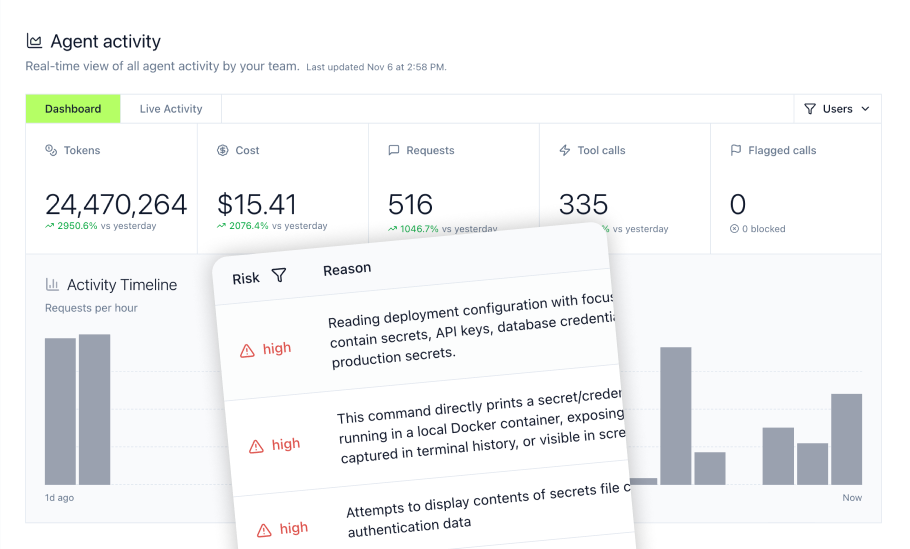
Agent Monitor provides organizational visibility into supported AI-agent activity including:
- Prompt submissions
- MCP tool calls
- File access patterns
- Token usage and cost attribution
Live activity visibility with filtering by user, agent, tool, or time enables security teams to identify memory-related issues before they compound.
Troubleshooting Memory Issues
Common memory debugging scenarios:
- Contradiction detection: Agent outputs conflicting information due to unvalidated memory writes
- Retrieval failures: Relevant memories exist but are not surfaced due to embedding quality or filtering issues
- Context pollution: Agent receives irrelevant memories from other scopes
- Temporal confusion: Agent references outdated facts because temporal context is missing
For each scenario, audit logs should identify the source agent, the memory content involved, and the access pattern that led to the issue.
Building Production Memory Architecture with MintMCP
Organizations building multi-agent systems need memory infrastructure that balances autonomous agent operation with enterprise governance. MintMCP addresses this through an integrated approach that treats enterprise agent memory as company-owned infrastructure rather than an opaque vendor service.
The platform provides three foundational capabilities for governed multi-agent memory:
- Agent identity and access control through Agent Gateway, enabling each agent to operate with scoped credentials, attributable actions, and memory context boundaries that prevent cross-agent leakage
- Company-owned memory through Coworker Agents, where the repository itself serves as the agent's memory store with reviewable
progress.mdfiles, version history, and portable state that organizations fully own - Runtime guardrails and monitoring through Mint Guard for managed detection, Rules for declarative policies, and Agent Monitor for supported prompts, commands, file access, MCP tool calls, usage, and token costs
This architecture enables teams to deploy persistent agents while treating memory as governed infrastructure rather than a black box. MintMCP's approach emphasizes company-owned agent memory that is scoped, versioned, reviewable, auditable, and portable alongside governed agent identities, credentials, and tool access.
Frequently Asked Questions
Can agents share memory safely, and how should that sharing be governed?
Agents can share memory through hierarchical architectures that define clear boundaries between private, team, and organization contexts. Safe sharing requires write validation gates that check for contradictions before committing to shared stores, provenance tracking that identifies the source agent for every memory entry, RBAC policies that control which agents can read from and write to specific memory scopes, and conflict resolution mechanisms when agents write contradictory facts. The key principle is that sharing should be explicit and governed rather than default and unrestricted.
What causes the substantial token cost reduction when using selective retrieval versus full context passing?
Full context passing means including the entire conversation history in every LLM call, which compounds token costs rapidly. Selective retrieval with smart memory systems instead surfaces only the relevant context for each query through semantic search. Instead of passing tens of thousands of tokens of full history, the system retrieves the most relevant memory entries, typically a few thousand tokens. This targeted retrieval reduces input tokens substantially while often improving response quality because the model receives focused, relevant context rather than a large volume of potentially irrelevant history.
How do I migrate from a flat vector store to a hierarchical or temporal architecture?
Migration requires careful planning to avoid memory loss or corruption. Start by implementing namespace isolation in your existing vector store to separate memories by user, agent, and session scope. Then add metadata fields for provenance including source agent, timestamp, and confidence. For temporal migration, backfill validity windows for existing facts based on creation timestamps. Run both architectures in parallel during transition, writing to both and comparing retrieval results. Once confidence is established, deprecate the flat store. Migration timing depends on memory volume, schema complexity, provenance requirements, validation depth, and whether both architectures run in parallel during the transition.
What governance capabilities do conversation memory frameworks typically not provide?
Conversation-memory frameworks such as Mem0, Zep, and LangChain primarily focus on persistence, retrieval, and application memory rather than serving as complete organizational-governance systems. Enterprises may therefore need additional infrastructure for governed business definitions, data lineage, cross-system entity resolution, retention policies, and other controls required by their data-governance model. This typically means adding a separate context layer for governed organizational memory alongside conversation memory frameworks.
How should I handle memory for agents that interact with sensitive customer data?
Customer-facing agents require additional memory governance including PII detection before memory writes to prevent storing sensitive data inappropriately, customer-scoped memory isolation so one customer's data never surfaces for another, retention policies aligned with data protection regulations, encryption at rest and in transit for all memory stores, and audit trails that track every memory access for compliance reporting. Consider whether customer data needs to be stored in memory at all or whether it can be retrieved on-demand from governed systems of record through controlled API calls with proper scoping and access controls.