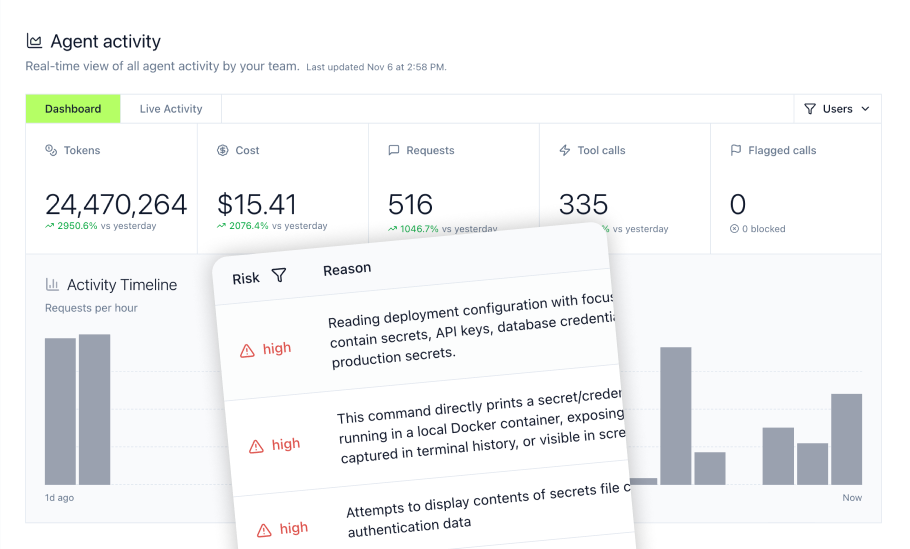
Data-driven insights revealing how comprehensive audit trails transform enterprise AI governance, reduce compliance costs, and deliver measurable ROI for organizations deploying AI at scale
Enterprise AI deployments without proper audit trails operate as black boxes—creating substantial security, compliance, and governance risks. Organizations face mounting regulatory pressure from SOC2, HIPAA, and GDPR requirements while AI adoption accelerates across every business function. MintMCP's MCP Gateway provides complete audit trails of every MCP interaction, access request, and configuration change—turning shadow AI into sanctioned AI with enterprise-grade governance. The data proves that organizations implementing comprehensive audit logging achieve faster compliance certifications, reduced breach costs, and substantial operational savings. This analysis examines market growth, compliance adoption rates, ROI metrics, non-compliance risks, and governance trends shaping enterprise AI audit trail requirements in 2025.
Key takeaways
- Market growth validates governance investment – The enterprise AI governance market reached $2.2 billion in 2025 and is projected to reach $9.5 billion by 2035, demonstrating 15.8% CAGR
- Compliance adoption accelerates rapidly – 76% of organizations plan to pursue an AI audit or certification within the next two years
- Audit trails deliver measurable ROI – Organizations implementing comprehensive audit trail infrastructure achieve significant returns through reduced compliance costs, faster certifications, and operational efficiency gains
- Non-compliance costs are substantial – Data breaches involving noncompliance averaged $4.61 million in 2025 (about $174,000 higher than the average breach)
- Enterprise AI use demands governance – AI usage in enterprises increased 595% in 2024, making audit trails essential for visibility and control
- Technology investment is rising – 82% of companies plan increased investment in compliance technology to manage audit and governance requirements
Market growth and governance investment statistics
1. The enterprise AI governance and compliance market is valued at $2.2 billion in 2025
Market analysis confirms unprecedented investment in AI governance infrastructure as organizations recognize audit trails as foundational requirements. This valuation represents 450% growth from $0.4 billion in 2020, reflecting mainstream enterprise adoption of governance platforms. The expansion stems from regulatory pressure, proven ROI from early adopters, and competitive necessity as AI tools proliferate across business functions.
2. The enterprise AI governance market is projected to reach $9.5 billion by 2035
Industry projections show the governance market nearly quadrupling over the next decade as compliance requirements intensify globally. This growth trajectory accounts for expanding AI use cases, stricter regulatory frameworks, and increasing sophistication of audit trail requirements. Organizations delaying governance investments risk falling behind competitors who establish robust compliance foundations early.
3. The AI governance market demonstrates 15.8% compound annual growth rate through 2035
Sustained 15.8% CAGR growth validates audit trail infrastructure as strategic priority rather than optional technology. This rate exceeds most enterprise software categories, reflecting urgent demand for solutions that provide visibility into AI tool usage and data access. The acceleration stems from executive-level recognition that ungoverned AI creates unacceptable compliance exposure.
4. The AI governance market is expected to grow at 35.74% CAGR from 2025 to 2034
Precedence Research data projects even faster growth in AI governance specifically, reaching $4,834.44 million by 2034 from $309.01 million in 2025. This aggressive expansion reflects regulatory momentum worldwide and enterprise recognition that audit trails enable rather than constrain AI adoption. Organizations with robust governance deploy AI tools faster and more confidently.
5. The u.S. AI governance market is projected to reach $1,073.61 million by 2034
The U.S. market specifically shows strong growth from $67.06 million in 2025, driven by SOC2 requirements and state-level privacy regulations. American enterprises face particularly complex compliance landscapes requiring comprehensive audit capabilities. This regional growth validates the need for platforms providing complete audit logs for SOC2, HIPAA, and GDPR compliance.
Compliance adoption and certification statistics
6. 53% of organizations intend to pursue an AI audit or certification within the next year
Compliance benchmark data shows the majority of organizations actively planning AI-specific audits in 2025. This surge reflects both regulatory requirements and customer demands for verified AI governance. Audit trail completeness directly determines certification success—organizations lacking comprehensive logging face extended timelines and failed assessments.
7. 76% of organizations plan to pursue an AI audit or certification within the next two years
The two-year adoption window demonstrates AI governance has transitioned from competitive advantage to baseline requirement. Three-quarters of organizations recognize audit certifications will become table stakes for enterprise sales and regulatory compliance. Platforms like MintMCP's LLM Proxy provide the command history and tool call tracking required for successful certification.
8. 81% of organizations report current or planned ISO 27001 certifications in 2025
Certification planning data jumped from 67% in 2024, indicating accelerating security compliance priorities. ISO 27001 requires comprehensive audit trails documenting access controls, configuration changes, and security events. This 14-point increase in one year reflects organizations recognizing audit infrastructure as a prerequisite for security certifications.
9. 58% of organizations reported conducting four or more audits in 2025
Audit frequency data reveals enterprise organizations face multiple concurrent compliance requirements annually. This audit volume demands automated audit trail generation rather than manual documentation—organizations relying on spreadsheets and screenshots cannot sustain four-plus annual audits efficiently. Centralized governance platforms reduce audit preparation time significantly.
10. 92% of organizations reported conducting at least two audits or assessments in 2025
Near-universal audit activity confirms compliance has become an ongoing operational requirement rather than periodic event. Organizations need continuous audit trail generation rather than point-in-time documentation. This reality validates always-on monitoring approaches that capture every AI tool interaction for compliance evidence.
11. 65% of risk and compliance professionals say AI is important to their compliance program
Professional survey data indicates AI has moved from IT concern to compliance priority. This shift reflects both the need to govern AI usage and the opportunity to use AI for compliance automation. Compliance teams increasingly demand visibility into AI tool calls, data access patterns, and policy enforcement—capabilities requiring comprehensive audit infrastructure.
12. Among software firms, 61% intend to pursue AI audit or certification within the next year
Technology sector adoption leads other industries in AI governance certification planning. Software companies face dual pressure: demonstrating their own AI governance and meeting customer requirements for AI compliance. This sector-specific acceleration indicates audit trail requirements will spread to customers across all industries.
Cost savings and ROI statistics
13. 71% of enterprise companies spend over $100,000 on audits each year
Audit cost data quantifies the significant financial burden of compliance activities. These costs include auditor fees, internal staff time, documentation preparation, and remediation efforts. Automated audit trail generation reduces this burden substantially by eliminating manual evidence collection and enabling auditor self-service access to compliance data.
14. Organizations with comprehensive audit trail systems demonstrate measurable ROI through reduced compliance costs and faster certifications
Organizations implementing robust audit and observability infrastructure achieve substantial returns through automated documentation, reduced audit preparation time, and faster issue identification preventing expensive remediation. These savings compound through continuous improvement enabled by comprehensive logging and real-time monitoring capabilities.
Non-Compliance risk statistics
15. Data breaches involving noncompliance with regulations cost $4.44 million on average globally
IBM breach research quantifies the direct financial impact of inadequate compliance programs. This figure represents total breach costs including detection, response, notification, legal expenses, and business disruption. Organizations with comprehensive audit trails identify breaches faster and demonstrate due diligence that can reduce regulatory penalties.
16. Organizations with high levels of shadow AI can face materially higher breach costs
Cost differential analysis isolates the substantial premium organizations pay when breaches involve ungoverned AI deployments. This additional cost stems from extended investigation timelines, regulatory penalties, and increased legal exposure. Comprehensive audit trails can eliminate this premium by demonstrating governance controls were in place and functioning.
17. 85% of executives feel that compliance requirements have become more complex in the last three years
Executive survey data confirms organizations face a growing compliance burden requiring sophisticated infrastructure. This complexity stems from proliferating regulations, expanding AI use cases, and increased scrutiny of data practices. Manual compliance approaches cannot scale with this complexity—automated audit trails become essential infrastructure.
18. 72% of executives said increasing compliance complexity negatively impacted their company's profitability
Financial impact research links compliance burden directly to business performance. This profitability impact validates investment in automation that reduces compliance overhead. Organizations using centralized governance platforms convert compliance from cost center to competitive advantage by demonstrating superior risk management to customers and partners.
19. 69% of organizations find regulations too complex or experience difficulty verifying third-party compliance
Compliance challenge data reveals substantial execution difficulties despite good intentions. This challenge particularly impacts organizations using AI tools from multiple vendors without unified governance. Centralized audit logging across all AI tool interactions simplifies third-party verification and regulatory reporting.
Enterprise AI adoption statistics
20. 80% of large organizations have integrated AI into their core business processes as of 2025
Enterprise adoption data confirms AI has become mainstream infrastructure requiring governance at scale. This 80% penetration means audit trail requirements apply to nearly all large enterprises, not just technology innovators. Organizations cannot ignore AI governance when four in five businesses depend on AI tools for core operations.
21. 78% of surveyed organizations used AI in 2024, compared to 55% in 2023
Year-over-year adoption growth from 55% to 78% demonstrates accelerating AI deployment across industries. This 23-point increase in one year outpaces governance infrastructure deployment, creating compliance gaps. Organizations adopting AI without corresponding audit capabilities accumulate technical debt requiring expensive remediation.
22. Enterprise AI use increased by 595% in 2024
Usage growth data quantifies the explosive expansion of AI tool usage within organizations. This nearly 6x increase means audit trail requirements scaled proportionally—organizations need infrastructure handling dramatically higher volumes of AI interactions. Point solutions cannot accommodate this growth; enterprise platforms with real-time monitoring become essential.
23. Over 1,000 AI regulations and initiatives are under consideration across 69 countries
Regulatory landscape analysis reveals global proliferation of AI governance requirements. This regulatory volume demands audit infrastructure flexible enough to accommodate varying jurisdictional requirements. Organizations operating internationally need comprehensive audit trails supporting multiple compliance frameworks simultaneously.
Governance and transparency statistics
24. 77% of global c-suite leaders believe compliance contributes significantly to company objectives
Executive perception research demonstrates compliance has evolved from cost center to strategic enabler. This leadership recognition drives investment in governance infrastructure that supports business growth rather than constraining it. Comprehensive audit trails enable faster customer onboarding, smoother partner integrations, and accelerated regulatory approvals.
25. 82% of companies plan to invest more in technology to drive compliance activities
Investment intention data confirms widespread commitment to automation and tooling for compliance management. This 82% planned investment increase validates governance platform market growth projections. Organizations recognize manual compliance processes cannot scale with expanding AI usage and regulatory requirements—purpose-built infrastructure becomes essential.
Strategic implementation insights
Audit trail compliance works best when governance infrastructure deploys alongside AI tools rather than retrofitting after incidents occur. Organizations achieving fastest ROI implement comprehensive logging from day one, capturing every tool call, data access, and configuration change automatically.
Here's how to maximize compliance outcomes:
- Start by mapping regulatory requirements across SOC2, HIPAA, GDPR, and industry-specific frameworks
- Deploy centralized governance platforms providing unified audit trails across all AI tools and MCP servers
- Enable real-time monitoring with automated alerting for policy violations and anomalous access patterns
- Establish role-based access controls limiting tool permissions to minimum required capabilities
- Maintain continuous audit readiness rather than periodic compliance pushes
Brands highlighted in MintMCP's documentation demonstrate what happens when governance infrastructure aligns with deployment strategy—compliance becomes enabler rather than obstacle, audit preparation shrinks from weeks to hours, and organizations gain confidence deploying AI tools knowing complete visibility exists.
Frequently asked questions
What is an audit trail in the context of enterprise AI?
An audit trail is a comprehensive record of every AI tool interaction, data access request, user action, and system configuration change. In enterprise AI contexts, audit trails capture which users accessed which tools, what data the AI agents queried, and what actions they executed. This documentation enables compliance verification, security investigation, and governance oversight across distributed AI deployments.
How does MintMCP help organizations meet SOC2 HIPAA and GDPR compliance requirements?
MintMCP Gateway provides complete audit logs capturing every MCP interaction, access request, and configuration change. The platform is SOC2 Type II certified with HIPAA compliance options and GDPR-compliant data residency controls. Real-time monitoring dashboards enable continuous compliance visibility while automated reporting streamlines audit preparation from weeks to hours.
What is shadow AI and how do audit trails help manage IT?
Shadow AI refers to AI tools employees deploy without IT oversight—creating compliance blind spots and security risks. Shadow AI grows 120% year-over-year as employees adopt AI tools faster than governance programs expand. Comprehensive audit trails provide visibility into all AI usage, enabling organizations to identify unsanctioned tools and bring them under governance without disrupting productivity.
Does MintMCP provide real-time visibility into AI tool usage for compliance purposes?
Yes. MintMCP's MCP Gateway and LLM Proxy both provide real-time monitoring with live dashboards showing server health, usage patterns, and security alerts. The platform tracks every tool call, bash command, and file access from AI agents. This continuous visibility enables proactive compliance management rather than reactive audit responses, reducing compliance risk and accelerating certification timelines.
Can MintMCP monitor and log actions from all types of AI agents and tools?
MintMCP supports Claude, ChatGPT, Microsoft Copilot, Cursor, Gemini, and all MCP-compatible agents through unified governance infrastructure. The platform provides complete audit trails regardless of which AI client employees use, ensuring consistent compliance coverage across heterogeneous AI environments. This multi-client support eliminates governance gaps that occur when organizations deploy different tools for different teams.