The separation between control plane and data plane represents a fundamental architectural pattern that enterprises deploying AI agents cannot afford to ignore. Gartner predicts that by 2028, an average global Fortune 500 enterprise will have over 150,000 AI agents in use, up from fewer than 15 in 2025, creating significant agent sprawl and governance complexity. An MCP Gateway is one control-plane component for governed tool and data connections, centralizing authentication, access policies, credentials, tool curation, and audit. MintMCP's broader control layer also includes Agent Gateway for agent identity, Agent Monitor for supported agent activity, Guardrails for runtime enforcement, and Security & Enterprise controls.
This article explains what control plane and data plane mean for AI infrastructure, why this separation matters for enterprise security and compliance, and how to implement these architectural patterns effectively.
Key Takeaways
- The control plane decides what AI agents are allowed to do (identity, policy, authorization, audit) while the data plane executes the actual work (model inference, tool calls, data processing)
- Forrester introduced its view of the agent control plane in December 2025, and a February 2026 poll of 47 technology vendors found that 79% of participating vendors recognized agent control planes as a meaningful and distinct product category
- Gartner projects enterprise spending on AI agent management platform technology will exceed $15 billion by 2029
- A 2025 SailPoint survey found that 80% of surveyed organizations using AI agents reported that their agents had taken unintended actions
- 98% of organizations report unsanctioned AI use (shadow AI), making visibility through a unified governance layer essential
- Real cost consequences exist: Uber's CTO said the company had exhausted its 2026 budget for AI coding tools by April as adoption and usage costs grew faster than expected
Understanding the AI Infrastructure Landscape: Control Plane vs Data Plane
The control plane versus data plane distinction originates from networking architecture, where the control plane routes traffic and enforces policies while the data plane moves packets. Kubernetes brought this pattern to container orchestration, with the control plane scheduling workloads while worker nodes execute them. As enterprises scale AI deployments across Claude, Cursor, ChatGPT, Gemini, and Copilot, this same architectural separation has become essential for AI agent governance.
The core distinction:
- Control Plane: Decides what is allowed through identity management, policy enforcement, authorization rules, and audit logging
- Data Plane: Executes the work through model inference, tool calls, API requests, and data processing
This separation matters because it creates a governance layer that operates independently from the systems being governed. When enforcement sits outside an agent's own code and all relevant access paths are mediated, it can prevent the agent from exceeding its authorized scope on those governed paths.
Why This Separation Matters
Control plane and data plane separation provides three structural benefits for AI infrastructure:
- Independent scaling: Governance complexity can grow without affecting inference throughput
- Resilience: Some architectures can cache last-known-good policy so selected data-plane operations continue during brief control-plane outages, depending on the authorization model and failover design
- Security isolation: Compromising an inference endpoint doesn't expose policy configuration or the audit system
One common conceptual architecture places AI applications and agents above a governance layer that handles identity, gateways, policy, and observability, with models, SaaS apps, APIs, and databases as downstream destinations. This is a useful reference model, not a universal standard.
The Control Plane: Orchestrating AI System Governance
The AI control plane answers the fundamental governance questions that security and platform teams need addressed before deploying agents at scale: Who is acting? What are they allowed to do? What did they actually do? How can we stop unauthorized actions?
Core Control Plane Functions
The control plane provides five essential capabilities for AI governance:
- Governance & Policy
Enforces access controls, sensitivity rules, and data contracts at design and runtime. Without unified governance, agents inherit ungoverned data and policies drift across teams. - Identity Management
Verifies agent identity, propagates per-user permissions, manages credentials. Prevents agents from acting as shared service accounts that cannot be audited. - Observability
Captures full lifecycle traces showing context served, policies evaluated, and outcomes recorded. Standard telemetry records what happened but cannot judge if it was acceptable. - Context Management
Serves governed business context (definitions, policies, lineage) to agents. Most AI failures are context failures from bad data, stale definitions, or no grounding. - Gateway Enforcement
Inspects and blocks unauthorized requests in real time through AI and MCP gateways. You cannot enforce policy on a request you never saw.
Centralizing Policies and Permissions
A properly implemented control plane centralizes tool access through mechanisms like Virtual MCPs (VMCPs), which bundle approved connectors and a curated tool surface behind one governed endpoint for a particular team, role, or agent. This approach means users connect once instead of configuring each server individually, with directory groups driving membership through SCIM.
MintMCP's MCP Gateway embodies these control plane functions by centralizing connectors, authentication, credentials, tool curation, access policies, and audit behind governed endpoints. The gateway authenticates users through your IdP, curates which tools each role can see, injects the right credentials per call, routes to the right connector, and logs everything.
The Data Plane: Executing AI Operations and Workflows
While the control plane governs, the data plane performs the actual work that delivers business value. This is where model inference happens, tool calls execute, and business processes complete.
Key Data Plane Functions
The data plane handles four primary categories of AI execution:
- Model Inference
LLMs process prompts and generate completions. This is the primary AI workload where speed and cost are critical. - Tool Execution
Agents invoke APIs, update systems, retrieve data. This is where agents take real actions in enterprise systems. - Business Process
Multi-step workflows like "process refund" or "onboard employee." Pre-built enterprise skills reduce fragile API improvisation. - Data Processing
Embedding pipelines, transformations, RAG retrieval. Supports agent reasoning with governed enterprise data.
How the Data Plane Facilitates Agent Activity
Every prompt, response, and tool call flows through the data plane. When an AI coding agent reads a file, executes a command, or calls an MCP tool, that action happens in the data plane. The control plane determines whether the action should be allowed; the data plane actually performs it.
MintMCP's Coworker Agents operate within this data plane layer as long-running agents that work alongside employees. They can operate through Slack, run on schedules or manual triggers, maintain company-owned memory, and continue work across days, all while the control plane governs their tool access, credentials, and audit trails.
Distinguishing Control Plane and Data Plane in AI Infrastructure
The distinction between control plane and data plane creates a separation of concerns that enables secure, scalable AI deployments. Understanding where each layer operates helps teams architect systems that can grow without compromising governance.
Architecture Comparison
The control plane and data plane differ across five critical dimensions:
- Primary Function
Control plane decides what is allowed; data plane executes the work. - Key Operations
Control plane handles identity verification, policy enforcement, audit logging. Data plane handles model inference, tool calls, data processing. - Scaling Concern
Control plane scales with policy complexity and audit volume. Data plane scales with throughput and latency requirements. - Failure Impact
Control plane failure may block new requests; cached rules can keep data plane running. Data plane failure stops work completely with no inference or tool execution. - Security Focus
Control plane focuses on who has access and what they can do. Data plane focuses on protecting data in transit and execution integrity.
The Three-Plane Control Problem
Research identifies three distinct control problems that must work as one loop:
- Identity plane: Who is acting, with what authority, on whose behalf?
- Observability plane: What happened, and was it any good?
- Security plane: What is allowed, and how do we stop what isn't?
The critical insight is that these three planes only become a control plane when they run as one loop over a shared, identity-keyed record. Three separate vendor tools will not reconcile at the moment of audit or incident.
MintMCP's approach separates MCP Gateway (which governs traffic routed through governed MCP connections) from Agent Monitor (which provides visibility into supported agent activity beyond gateway traffic). This two-layer visibility addresses both the control plane governance needs and data plane observability requirements.
Governing Autonomous Agents: Control Plane for Non-Human Identities
As enterprises scale from 10 to 100+ agents, the question "who did what" becomes the central governance challenge. Autonomous agents require first-class identities separate from the humans who created them, with their own credentials, scoped permissions, and attributable audit trails.
Why Dedicated Agent Identities Matter
The traditional approach of agents operating through human credentials or shared service accounts creates several problems:
- Collapsed audit logs: Cannot distinguish agent versus human actions
- Over-privileged agents: Inherit whatever permissions the credential holder has
- Broken rotation: Changing one credential affects multiple agents
- Single points of failure: If the human account freezes, agent operations stop
Authentication Mechanisms for Agent Identity
Three authentication approaches provide increasing security levels:
- Bearer Keys
Static key on every request; named, has expiry, individually revocable. Provides basic security. - M2M Tokens
OAuth client-credentials exchange for short-lived tokens; secret stays out of the request path. Provides intermediate security. - Workload Identity Federation
Agent's own infrastructure (K8s service account, cloud role, CI job identity) mints short-lived OIDC tokens; no secret held. Provides advanced security.
MintMCP's Agent Gateway treats autonomous agents as first-class non-human principals. Each agent can have its own identity, credentials, scoped MCP access, independent credential expiration or rotation, independent revocation, and an attributable audit trail. This addresses the core non-human identity management requirements that enterprises face when deploying agents at scale.
Securing Autonomous Agents with a Strong Control Plane
The control plane for agent identity answers critical governance questions:
- Which agent is acting?
- What credentials does it use?
- What tools can it access?
- What permissions apply?
- How can its access be rotated or revoked?
- How is its activity attributed?
- What memory and operating context belong to it?
These questions become essential when agents operate independently of human supervision. An autonomous agent should not operate through whichever employee credential or shared API key happens to be available.
Implementing Robust AI Infrastructure Security with a Strong Control Plane
AI agent security requires runtime controls that determine whether an action should be allowed, not just visibility into what happened after the fact.
Control Plane Security Capabilities
MintMCP provides comprehensive security capabilities across three layers:
Identity and Access Controls
- SSO integration with Okta, Microsoft Entra ID, Google Workspace
- SCIM provisioning where directory groups drive both admin roles and tool access
- RBAC with org-level roles for administrative reach and VMCP access policies for tool reach
Audit and Compliance
- Audit logging for tool calls, credential lifecycle events, and access-policy changes, with tamper-evident access-grant history signed at write time
- SIEM export through OTLP or Splunk HEC for tool calls, prompt submissions, gateway requests, and access-policy changes
- Complete, signed, exportable audit records
Runtime Guardrails
MintMCP provides three coexisting layers for runtime security controls:
- Mint Guard: Managed detection policies for prompt injection, secrets, PII, and harmful content with monitoring and enforcing modes
- Rules: Declarative matching on tool names, argument patterns, or content with actions including flag, block, ask, mask, or notify
- Gateway Middleware: Customer-authored JavaScript for transformations, DLP integrations, external classifiers, redaction, and custom policy enforcement
MintMCP is SOC 2 Type II audited, compliant with HIPAA standards, penetration tested, and provides enterprise controls including SSO, RBAC, audit trails, SIEM export, encryption, and data residency options.
Regulatory Drivers for Control Plane Adoption
Several regulatory and standards frameworks increase demand for governance capabilities relevant to AI control planes:
EU AI Act
General application from August 2, 2026; Annex III high-risk rules from December 2, 2027; high-risk systems embedded in regulated products from August 2, 2028. Requires risk management, logging, documentation, human oversight, and other obligations for covered high-risk systems.
US Banking Model Risk Guidance (SR 26-2 / OCC 2026-13)
Revised April 17, 2026. Requires risk-based model governance, validation, monitoring, and controls. Generative AI and agentic AI are explicitly outside the scope of this guidance.
HIPAA Security Rule
Ongoing requirements for access control, audit controls, integrity, authentication, and transmission security for ePHI.
ISO/IEC 42001:2023
Published standard with AI management system requirements for governance, risk management, accountability, monitoring, and continual improvement.
Optimizing AI Operations: Cloud Infrastructure and Control Plane Efficiency
Cloud infrastructure provides the foundation for scalable AI control plane implementations. The control plane can run as a managed service while the data plane executes workloads across various cloud environments.
Deployment Considerations
Organizations can choose from several deployment models based on their requirements:
- Managed SaaS: Fastest time to value; vendor handles infrastructure, updates, and scaling
- VPC deployment: Control plane runs in customer's cloud environment for data residency requirements
- Hybrid: Control plane SaaS with data plane components on customer infrastructure
- Self-hosted: Full customer control for air-gapped or highly regulated environments
Scaling the Control Plane
The separation between control and data planes enables independent scaling. As policy complexity grows (more rules, more agents, more audit volume), the control plane scales without affecting inference throughput. In architectures designed for it, last-known-good policies can be cached so selected data-plane operations continue during brief control-plane outages.
Organizations should establish governed access, identity, policy, and audit before agent adoption becomes difficult to inventory and retrofit. Early control plane deployment creates a foundation for expanding governance as agent use scales.
Measuring and Monitoring AI: Data Plane Visibility and Cost Management
Visibility into data plane activity enables organizations to understand what their AI agents actually do, identify problems before they escalate, and manage costs effectively.
Gaining Insights from AI Data Plane Activity
Agent Monitor capabilities should capture:
- Prompts: What instructions agents receive
- File access: Which files agents read (including sensitive files like .env and SSH keys)
- Commands: Shell commands, package installations, git operations
- MCP tool calls: Which tools agents invoke and with what arguments
- Outcomes: Results of tool calls and model responses
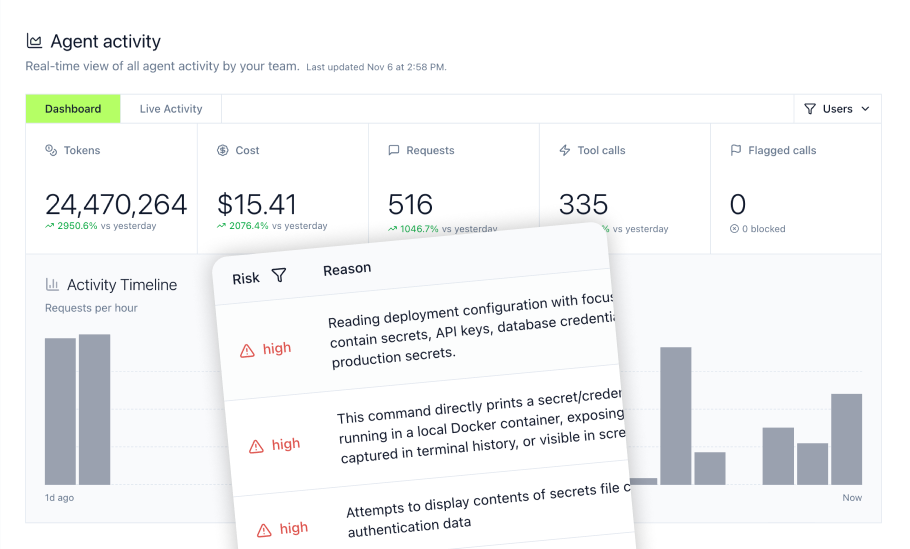
This visibility can extend beyond traffic routed through MintMCP's MCP Gateway, but coverage varies by supported client, agent, and hook phase. MintMCP's Agent Monitor provides live activity visibility, filtering by user, agent, tool, or time, security rules where supported, usage and cost analysis, and SIEM export for centralized security visibility.
Cost Optimization through AI Monitoring
Without visibility into token consumption and agent activity, organizations face significant cost risk. One widely reported example: Uber's CTO said the company had exhausted its 2026 budget for AI coding tools by April as adoption and usage costs grew faster than expected.
MintMCP provides cost visibility capabilities:
- Token tracking: Usage and spend by model, user, agent, and session
- Human vs agent attribution: Distinguish usage and costs by actor type
- Cache analysis: Track cache-hit rates alongside token usage
- Chargeback visibility: Attribute usage and cost across users, agents, models, and sessions
Token savings depend on workload design, model choice, caching, tool use, and orchestration patterns, so cost-reduction percentages should be treated as workload-specific unless backed by a directly verifiable case study.
Building a Future-Proof AI Architecture: Integrating Control and Data Planes
The long-term position for enterprise AI governance is a unified system of record for the agent workforce across models, tools, channels, and agent harnesses.
Designing Scalable and Secure AI Systems
A future-proof architecture integrates control and data planes to answer critical questions:
- Which agents exist?
- Who owns or operates them?
- Which systems can they access?
- What credentials and permissions do they use?
- What actions have they taken?
- What memory do they retain?
- Which security policies apply?
- How much usage or cost do they generate?
- How can they be restricted or shut down?
Critical Success Factors
Organizations should follow these principles when implementing AI control plane architecture:
- Establish governance before sprawl: Deploy governed access, identity, policy, and audit before agent adoption becomes difficult to inventory and retrofit
- Unify the three planes: Identity, observability, and security must work as one loop over a shared spine
- Separate control from data: Keep governance logic separate from execution so compromised agents cannot bypass their own controls
- Start with enforcement, not dashboards: Monitoring tells you what happened; control plane stops unauthorized actions before they happen
- Choose vendor-neutral architecture: Model vendors will change; the control plane should govern across all providers
Red Flags to Watch
Several architectural choices can undermine effective control plane governance:
- Independent review: For regulated or high-risk use cases, separate evaluation and validation from the team or system being evaluated where applicable. Requirements vary by framework, and current U.S. banking model-risk guidance explicitly excludes generative and agentic AI models from its scope
- API keys as identity: Shared service accounts mean you cannot answer "who did this agent act as" with per-user specificity
- Policy in prompts: Telling a model to refuse bad instructions is mitigation, not control; compromised models ignore prompts
- Observability without evaluation: Quality or compliance judgments generally require evaluation or policy logic layered on top of telemetry rather than observability alone
- Gateway lock-in: Control plane tied to a single cloud provider forces architectural decisions around vendor relationships
MintMCP: Your Governance Layer for Enterprise AI Agents
MintMCP provides the control plane infrastructure enterprises need to govern AI agents at scale. As the governance layer for the enterprise agent workforce, MintMCP delivers vendor-neutral governance across Claude, Cursor, ChatGPT, Gemini, and Copilot without rebuilding identity, permissions, audit, monitoring, or data governance infrastructure each time you change models or clients.
The platform separates control plane governance from data plane execution through three integrated components:
- MCP Gateway for Tool Governance
Centralizes MCP connections, authentication, credentials, tool curation, access policies, and audit. Teams connect once through Virtual MCPs instead of configuring each server individually, with directory groups driving membership and access. - Agent Gateway for Identity
Treats autonomous agents as first-class non-human principals with their own identities, credentials, scoped MCP access, independent credential rotation, and attributable audit trails. Addresses the core non-human identity management requirements for enterprise agent deployments. - Agent Monitor for Visibility
Extends observability beyond gateway traffic to provide live activity feeds, security rules, usage and cost analysis, and SIEM export. Coverage varies by supported client and agent but enables centralized visibility across your AI operations.
For teams beginning their control plane journey, start with a specific use case like PII redaction or cost controls that delivers immediate compliance value with straightforward implementation. This creates a foundation for expanding control plane governance as agent deployments scale. Learn more about MCP data risk assessment and AI agent security best practices.
Frequently Asked Questions
What happens if the control plane goes down? Do all AI agents stop working?
Not necessarily. Well-designed control plane architectures include resilience mechanisms. Some systems can cache last-known-good policy rules, allowing the data plane to continue operating with previously authorized permissions during brief control plane outages. However, new requests requiring fresh authorization decisions may be blocked until the control plane recovers. This is an intentional security feature: when the system cannot verify authorization status, it fails closed rather than allowing potentially unauthorized actions. The specific behavior depends on your architecture's failover design and authorization model.
How does control plane architecture differ from traditional API gateway patterns?
Traditional API gateways focus primarily on traffic management, rate limiting, and basic authentication for synchronous request-response patterns. AI control planes can add identity management for non-human principals, contextual policy enforcement, auditability, and observability. Quality or compliance judgments generally require evaluation or policy logic layered on top of telemetry rather than observability alone. Additionally, AI control planes must handle the unpredictability of autonomous agents that decide at runtime which tools to call, whereas traditional API gateways assume deterministic application behavior.
Can I use the same control plane for human users and autonomous agents?
Yes, and this is the recommended approach. Using the same authorization model for both humans and agents means that rules, middleware, audit trails, and identity forwarding work consistently across all principals. The key difference is that agents receive their own non-human identities with scoped permissions and independent credential lifecycle management through systems like MintMCP's Agent Gateway. This unified model simplifies governance while maintaining clear attribution: every action, whether from a human or agent, flows through the same policy enforcement and appears in the same audit trail.
How do I know if my organization needs a formal control plane versus simpler governance?
Consider a formal control plane when agent deployments span multiple teams or systems, require non-human identity and scoped permissions, touch regulated or sensitive data, use multiple AI providers, or need centralized audit and runtime policy enforcement. The MCP data risk assessment guide can help evaluate your organization's specific exposure. If you cannot reliably answer "which agents have access to customer data and what can they do with it," centralized governance may be warranted. Organizations in regulated industries like finance and healthcare typically require formal control planes earlier in their AI adoption journey.
What is the relationship between MCP gateways and AI control planes?
An MCP gateway is a specific control plane component that governs Model Context Protocol traffic between AI clients and tool servers. It handles authentication, credential injection, tool-level authorization, and audit logging for MCP calls. A complete AI control plane typically includes an MCP gateway for tool traffic, an LLM gateway for model calls, identity management for non-human principals, policy enforcement, and observability. MintMCP's MCP Gateway serves as the tool-access control plane while Agent Gateway extends governance to agent identities and Agent Monitor provides data plane visibility. Together, these components form an integrated control plane for enterprise AI.