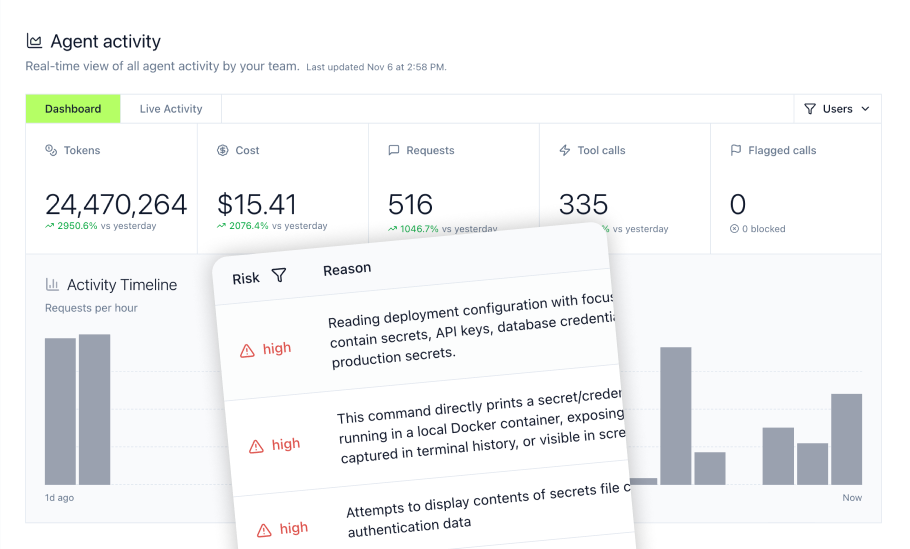
Enterprises spend months evaluating GPT-5 versus Claude 4 versus Gemini, debating context windows and benchmark scores, while the infrastructure that actually determines whether AI agents succeed or fail in production remains an afterthought. The model is not your biggest risk. Ungoverned agents running across your systems with shared credentials, no audit trail, and no cost controls represent the actual threat to your AI investment. An MCP Gateway provides the governance layer that transforms experimental AI agents into production-ready enterprise systems, handling authentication, tool-level access control, and audit logging while you focus on building value.
This article explains what an agent control plane is, why it matters more than model selection for enterprise success, and how to implement one that prevents the security incidents, cost runaways, and compliance failures that derail AI deployments.
Key Takeaways
- Control planes govern what agents can access, not what they can think. Model intelligence means nothing if agents cannot safely connect to your databases, APIs, and internal systems. The governance layer determines whether AI deployments succeed or fail in production.
- Agent sprawl is now the primary security concern. Gartner projects that the average global Fortune 500 enterprise will grow from fewer than 15 AI agents in 2025 to more than 150,000 by 2028, creating significant IT complexity and management challenges.
- Project cancellations follow governance gaps. Over 40% of agentic AI projects will be canceled by the end of 2027 because of escalating costs, unclear business value, or inadequate risk controls. Control plane adoption helps separate projects that scale from projects that get shut down.
- Observability tells you what happened. Control planes prevent it. The difference between monitoring and enforcement is timing. Flagging a credential leak after it occurs is fundamentally different from blocking it at runtime.
- Shadow AI detection extends governance beyond the gateway. Agents running in developer tools like Cursor and Claude Code operate outside traditional security perimeters. Modern control planes detect and govern this off-gateway activity.
- The agent control plane market is formalizing. Forrester announced formal evaluation of the category in 2026, signaling that agent control planes are moving from an emerging pattern into a more defined enterprise software category.
What is an AI Agent Control Plane and Why is it Essential for Enterprise AI?
The term "control plane" originates from networking architecture, where it describes the layer that decides where packets go while the data plane actually moves them. Applied to AI agents, a control plane handles the governance decisions: which agents can run, what tools they can access, what data they can read or write, and what audit trail their actions generate.
Defining the Agent Control Plane
An agent control plane provides:
- Centralized policy enforcement for tool access, rate limits, and data permissions
- Identity management that treats each agent as a distinct principal with scoped credentials
- Audit logging that captures every tool call, prompt, and response with user attribution
- Real-time guardrails that block risky operations before they execute
The critical distinction from basic monitoring tools: control planes enforce policy at runtime, not after the fact. When an agent attempts to access a database it should not touch, the control plane blocks the request before data leaves your systems.
Bridging the Gap: From Model to Production
Enterprises face what practitioners call the "last mile problem" in AI deployment. The model itself may perform brilliantly in benchmarks, but connecting it to production systems, internal databases, CRM platforms, and code repositories requires secure, governed access that most AI tools do not provide out of the box.
MintMCP addresses this through Virtual MCP Bundles, which package tool access, policy enforcement, and audit logging into single governance units per team or role. Each AI agent receives its own persistent identity with scoped credentials that can be rotated independently.
Securing Your AI Agents: Preventing PII Exposure and Credential Leakage
Gartner projects that agent sprawl will intensify quickly, with the average global Fortune 500 enterprise moving from fewer than 15 AI agents in 2025 to more than 150,000 by 2028. This is not a distant planning issue. It is becoming a near-term governance problem for enterprise AI.
The Vulnerabilities of Ungoverned AI Agents
Without governance infrastructure, agents create exposure across multiple vectors:
- PII exposure: Agents processing customer data may include sensitive information in prompts sent to external model providers
- Credential leakage: Shared API keys and service account tokens expand blast radius when compromised
- Prompt injection: Malicious inputs can manipulate agents into executing unintended operations
- Cost runaway: Agents in loops can exhaust cloud budgets in hours
The consequences are not theoretical. Gartner cites escalating costs, unclear business value, and inadequate risk controls as major reasons enterprise agentic AI projects fail to reach production. Without runtime enforcement, teams often discover these issues only after cost, security, or compliance exposure has already occurred.
Implementing Zero-Trust for AI
Enterprise security teams increasingly apply zero-trust principles to AI agents, requiring:
- Authentication per request: No default access assumptions
- Least-privilege tool access: Agents get only the capabilities they need
- Per-agent credentials: Individual identity for audit attribution and credential hygiene
- Real-time policy enforcement: Block risky operations, not just log them
MintMCP's Agent Monitor detects PII exposure, credential leakage, risky bash commands, and prompt injection attempts using built-in rules. Custom guardrail policies support block, flag, or alert actions depending on risk severity. For organizations with existing DLP investments, middleware hooks integrate with Bedrock Guardrails, GCP DLP, Microsoft Purview, Nightfall, and Skyflow.
Claude Tag and Coworker Agents: The Next Evolution in Enterprise AI
Claude Tag represents Anthropic's approach to Slack-based agent collaboration, where teams can tag Claude into channels, connect it to selected tools and data, and delegate work. As enterprises explore coworker agents that maintain context and operate with delegated authority, the governance requirements intensify.
Why Coworker Agents Need Control Planes
Coworker agents are long-running, Slack-native agents that hold memory, continue work across days, and operate alongside employees. They differ from simple chatbots in critical ways:
- Persistent memory across sessions requires careful data governance
- Delegated authority to act on behalf of users demands strong authentication
- Long-running workflows need cost controls and circuit breakers
- Cross-team visibility requires centralized audit trails
MintMCP's Agent Gateway works well with Claude Tag and similar coworker agent patterns because MintMCP's MCP agent identity connects cleanly. Each agent receives its own credentials, policy scope, and audit trail, regardless of which AI model powers it.
Taking Ownership of Your Agent Infrastructure
MintMCP's coworker agent feature extends this approach, letting enterprises:
- Own their agent memory system instead of relying on vendor-controlled storage
- Own their MCP data governance with policies that match internal security requirements
- Choose which AI models to use instead of being tied to a single provider
- Use cost-efficient model options such as GLM-5.2 or other alternatives
This flexibility matters as coworker agents become more sophisticated. The governance layer that manages agent identities, tool access, and data connections determines whether these systems can operate safely at scale.
Why AI Automation Requires Advanced Orchestration and Governance
Forrester's agent control plane framing emphasizes that governance needs to sit outside build and orchestration layers so enterprises can maintain independent visibility, consistent policy enforcement, and runtime control.
Automating Responsibly: The Governance Layer
Enterprise AI automation spans multiple use cases, each with distinct governance requirements:
- Data analysis agents querying databases need read-only access with PII masking
- Customer support agents accessing CRM require identity forwarding to maintain permission boundaries
- Development workflow agents connecting to GitHub and CI/CD need scoped write access with approval gates
- Compliance teams require audit-ready logs showing every agent action with full context
Without a governance layer, each integration becomes a custom security project. With a control plane, policy enforcement applies consistently across all agent types and all connected systems.
Orchestrating Complex Agent Workflows
Modern agent deployments involve multi-step workflows where one agent's output feeds another agent's input. Provenance tracking across these workflows becomes essential for compliance investigations. MintMCP captures full conversation-level logging including prompts, tool calls, responses, and context with per-user attribution, configurable retention, and export to SIEM platforms like Sentinel and Splunk.
Routine task automation can create meaningful efficiency gains when agents have proper infrastructure, but those gains require a governance foundation that remains sustainable as usage scales.
Centralized Management of AI Agent Infrastructure and Access Controls
Managing agent infrastructure without centralization creates the same operational burden that drove API gateway adoption in the previous decade. Each agent connection requires its own authentication setup, credential rotation schedule, access policy, and audit mechanism.
The Backbone of Agent Operations
MintMCP Gateway centralizes MCP server management across three deployment scenarios:
- Prebuilt connector catalog: Hundreds of prebuilt connectors, including Salesforce, GitHub, Slack, HubSpot, Notion, Linear, Gmail, and Stripe, can be packaged into governed MCP endpoints
- Hosted custom servers: STDIO-based MCP servers from the community ecosystem run in MintMCP's managed runtime with OAuth wrapping
- Virtual MCPs: Bundle multiple servers with role-based tool access into single endpoints per team
The authentication layer supports OAuth 2.0 and SAML, integrating with enterprise identity providers. Automatic credential rotation eliminates manual key management. Rate limiting per user and team prevents both abuse and accidental cost runaway.
Simplifying Enterprise AI Deployment
Tool-level access control enables granular permissions that match enterprise security requirements. An agent can have database read access without write permissions. It can access Slack for notifications without accessing email. Permission boundaries apply per-agent, not per-user, so an agent's capabilities never exceed what its use case requires.
For platform engineering teams, REST APIs and SDKs enable programmatic management for CI/CD integration and infrastructure-as-code workflows. The architecture documentation details how MintMCP fits into existing enterprise infrastructure.
Beyond the Gateway: Detecting Shadow AI and Off-Gateway Agent Activity
Gateway-only solutions leave a critical blind spot: agents running directly on developer machines. Cursor, Claude Code, and similar tools execute locally, outside any centralized control point. This creates "shadow AI" exposure similar to shadow IT concerns of the previous decade.
The Hidden Risks of Unmonitored Agents
Developer tools with AI capabilities operate with the developer's full local permissions. They read codebases, execute shell commands, access local credentials, and communicate with external services. Without visibility into this activity, security teams cannot answer basic questions about data access, command execution, or network communication.
Extending Control Plane Reach with MDM
MintMCP's Agent Monitor addresses this through hooks in Cursor and Claude Code that capture local agent activity. MDM integration enables push of detect-only or enforce-mode configurations to developer machines for consistent policy application. Organizations can start with visibility into off-gateway usage patterns before deciding which activities require blocking.
This extends the control plane beyond the traditional gateway perimeter. Security teams gain org-level analytics on MCP adoption, usage patterns by team and tool, latency monitoring, and error tracking. The security overview details the full scope of Agent Monitor capabilities.
The Role of API Gateways and Orchestration in the AI Agent Ecosystem
The Model Context Protocol (MCP) establishes a standard interface for AI-to-tool communication using JSON-RPC 2.0 message encoding over UTF-8. This standardization enables the agent control plane to sit between any MCP-compatible client and any MCP server, regardless of vendor.
Standardizing Communication: The MCP Protocol
MCP supports two primary transport mechanisms in the 2025 specification:
- STDIO: Local subprocess-based servers
- Streamable HTTP: Remote servers using HTTP POST and GET, with optional SSE for streaming server messages
For current MCP implementations, Streamable HTTP is the safer default to reference, while older HTTP+SSE transport should be treated as legacy wording.
An MCP gateway normalizes these transports, presenting a single authenticated endpoint to clients while handling upstream protocol variations. OAuth brokering lets MintMCP expose a unified OAuth interface to clients while handling connector-specific authentication behind the gateway.
Building an Extensible Agent Infrastructure
For enterprises with existing security tool investments, the middleware architecture matters. MintMCP supports custom policy code execution on every tool call, enabling inline DLP integration. Pre- and post-phase hooks can transform, mask, or block requests based on content inspection.
Containerized sandbox execution runs untrusted MCP server code with input/output inspection. Immutable audit records support compliance investigations. The zero-trust architecture requires authentication and authorization per request with no default access assumptions.
The MCP ecosystem has seen significant adoption, and Anthropic donated the protocol to the Linux Foundation's Agentic AI Foundation in December 2025 to support long-term stability and vendor-neutral governance.
From Models to Solutions: Tailoring AI Agents for Specific Business Needs
Model selection matters less when the governance layer can apply consistent access controls across the AI systems your teams already use, including Claude, Cursor, ChatGPT, Gemini, and Copilot. The control plane that governs tool and data access is what determines whether those systems can run safely in production.
Unlocking Industry-Specific AI Applications
Different industries require different governance configurations:
- Financial services: Complete audit trails, access governance, regulatory review support, and deployment controls aligned to internal security requirements
- Healthcare: PHI protection, minimum necessary access, compliance with HIPAA standards
- Technology: Developer productivity tools, code repository access, CI/CD integration
- Data-intensive analytics: Snowflake, Elasticsearch, and data warehouse connections
MintMCP serves these verticals with SOC 2 Type II audited controls, continuous compliance monitoring via Drata, compliance with HIPAA standards, BAA support, penetration tested infrastructure, encryption in transit and at rest, and data residency options.
Customizing Agent Behavior and Access
Virtual MCP Bundles enable role-based tool access where each bundle ties SCIM group membership to curated MCP server lists, custom policy rules, and isolated audit trails. Agent Bundles extend this model to non-human principals, giving each deployed agent its own rotatable credentials and permission scope independent of creator access level.
VMCP abstraction reduces onboarding complexity by letting teams connect to one governed endpoint instead of configuring separate MCP servers, credentials, and policies for every use case.
The Last Mile Problem in Enterprise AI and How to Solve It
The last mile problem in enterprise AI describes the gap between model capability and production deployment. Models that excel at reasoning and generation still need infrastructure to connect safely to the systems where work happens.
Connecting AI to Your Core Business
Without governed access infrastructure, each agent integration requires:
- Custom authentication implementation
- Manual credential management and rotation
- Per-integration audit logging
- Individual rate limiting and cost controls
- Separate compliance documentation
This engineering overhead delays deployment, increases maintenance burden, and introduces inconsistency across integrations.
Overcoming Integration Challenges for AI Agents
MintMCP's approach addresses the last mile through:
- Pre-built connectors: Hundreds of prebuilt connectors can be packaged into governed MCP endpoints
- Hosted runtime: Custom servers run in managed infrastructure
- OAuth brokering: Authentication handled at the gateway layer
- Unified audit: Single log stream for all agent activity
- Policy inheritance: Org-level policies cascade to team-level bundles
When each integration requires separate credential management, the operational overhead scales linearly with the number of connected systems. Centralized credential handling reduces that burden by making authentication, rotation, and audit logging part of the gateway layer.
Comparing AI Agent Control Plane Solutions: Key Differentiators
Forrester announced formal evaluation of the agent control plane market in 2026, signaling category maturation. Key evaluation criteria include governance capabilities, observability depth, identity management, and deployment flexibility.
What to Look for in an Agent Control Plane
When evaluating control plane solutions, consider:
- Bundle architecture: Does the solution package governance into deployable units, or require separate configuration of plugins, access rules, and credentials?
- Per-agent identity: Does each agent receive independent credentials, or do agents share service account tokens?
- Policy flexibility: Does the solution support custom policy code, or only declarative rules?
- Shadow AI detection: Does visibility extend beyond the gateway to developer tools?
- Server catalog depth: How many pre-built connectors are available?
Standing Out in a Crowded Market
MintMCP differentiates through several architectural decisions:
- Bundle simplicity: Single governance units versus three-object configuration models requiring separate Plugin, Access Rule, and Agent Account objects
- Per-agent OAuth: Individual agent credentials versus shared Virtual Account Tokens
- Custom policy hooks: JavaScript sandbox execution versus declarative-only policy languages
- Shadow AI detection: Agent Monitor hooks in Cursor and Claude Code versus gateway-only visibility
- 10,000+ MCP server catalog coverage: Broad discovery and packaging surface for MCP servers, with governance applied through MintMCP bundles
The control plane layer sits between your AI investments and your enterprise systems. The tool governance documentation details how MintMCP implements each capability.
Why MintMCP is the Enterprise Control Plane for Production AI
As enterprises move from AI experimentation to production deployment, the infrastructure that governs agent access becomes the critical success factor. Model capabilities will continue to converge across providers, but the governance layer that manages identities, enforces policies, and maintains audit trails determines whether AI systems can operate safely at scale.
MintMCP provides the enterprise control plane specifically designed for the Model Context Protocol ecosystem. By packaging tool access, policy enforcement, and audit logging into Virtual MCP Bundles, MintMCP eliminates the credential sprawl, compliance gaps, and operational overhead that derail AI projects.
The platform's architecture reflects lessons learned from API gateway evolution. Just as modern enterprises standardized on centralized API management instead of point-to-point integrations, AI agent infrastructure requires the same governance centralization. MintMCP's approach treats each agent as a distinct principal with scoped permissions, rotatable credentials, and complete audit trails, while giving teams the flexibility to choose their AI models, own their agent memory systems, and maintain data governance that matches internal security requirements.
For enterprises evaluating control plane solutions, the key differentiators are not in compliance checkboxes or connector counts alone. They are in architectural decisions that determine whether governance scales with agent adoption, whether policies can adapt to new use cases without engineering bottlenecks, and whether security teams can extend visibility beyond the gateway to shadow AI running on developer machines.
The agent control plane market is formalizing quickly. Organizations that establish governance infrastructure now will be positioned to scale AI adoption safely. Those that defer governance will face the same agent sprawl, cost overruns, and security incidents that are already driving project cancellations across the enterprise AI landscape.
Frequently Asked Questions
How does an agent control plane differ from an LLM gateway or router?
LLM gateways and routers handle model selection, load balancing, and prompt routing between different AI providers. They optimize which model receives a request and how responses are cached or retried. Agent control planes operate at a different layer, governing what tools and data sources agents can access, enforcing policies on those connections, and logging agent actions for compliance. An enterprise might use both: an LLM gateway for model traffic optimization and an agent control plane for governance of agent-to-system connections. MintMCP focuses on the governance layer, complementing rather than replacing LLM routing infrastructure.
What is the typical implementation timeline for an enterprise control plane deployment?
Implementation timelines vary based on deployment model and existing infrastructure. MintMCP's managed SaaS deployment enables initial connectivity within days using pre-built connectors. Teams typically progress through phases: Phase 1 establishes observability with logging and monitoring for existing agent activity. Phase 2 implements access controls with tool-level permissions and identity integration. Phase 3 enables enforcement with runtime policy blocking and automated remediation. Organizations with complex compliance requirements or custom connector needs should plan for a phased rollout before treating all governance capabilities as fully production-ready.
What compliance documentation should we expect from a control plane vendor?
Enterprise deployments require verifiable compliance posture. At minimum, evaluate vendors for SOC 2 Type II audited controls, penetration testing reports, data residency options matching your geographic requirements, and encryption documentation for data in transit and at rest. For regulated industries, additional requirements apply: documentation for compliance with HIPAA standards, BAA support for healthcare, specific audit trail retention capabilities for financial services, and data sovereignty review for government contracts. MintMCP maintains a Trust Center with security documentation access and offers enterprise security review calls for detailed compliance discussions. MintMCP signs BAAs.