As enterprises deploy AI agents faster than they can govern them, infrastructure requirements now span both model traffic management and MCP governance. Cloudflare AI Gateway provides capabilities including caching, analytics, rate limiting, routing, spend controls, guardrails, and observability, while Cloudflare One MCP server portals add centralized MCP access, curated tool surfaces, identity-based policies, activity logging, DLP routing, and machine-to-machine access. This article examines the AI gateway landscape and compares these approaches with platforms focused on first-class agent identity, governed connector operations, broader agent monitoring, and runtime policy enforcement.
Key Takeaways
- MCP-native governance addresses the gap between basic AI traffic routing and enterprise requirements for tool-level permissions, agent identities, and attributable audit trails
- Virtual MCP bundles enable role-based tool surfaces where engineering, security, and sales teams each access different curated toolsets through one governed endpoint
- Per-agent credentials allow autonomous agents to receive their own identities, scoped permissions, and independently revocable access rather than inheriting human credentials
- Centralized identity, access, and audit controls support regulated AI deployments by giving security teams clearer attribution, policy enforcement, and evidence for compliance workflows
- Runtime guardrails including prompt injection detection, PII screening, and DLP integration can detect risky activity and, where enforcement is supported, block or modify actions before they execute
- Two-layer visibility separates gateway governance from broader agent activity monitoring, capturing prompts, file access, commands, and MCP tool calls across multiple AI clients
Understanding the Need for Broader AI Governance
The Evolving Landscape of Enterprise AI
Enterprise AI adoption has shifted from experimental deployments to production workloads where AI agents operate autonomously across organizational systems. This shift creates governance challenges:
- Tool access proliferation - Agents can call any connected tool at runtime based on their own reasoning, creating unpredictable data access patterns
- Credential sprawl - API keys scattered across developer laptops and agent configurations create security blind spots
- Attribution gaps - When agents operate through shared credentials, audit logs cannot distinguish which agent or user initiated specific actions
- Configuration drift - Each developer configuring MCP servers locally results in inconsistent security postures
Why Traditional Infrastructure Falls Short
AI traffic gateways address concerns such as request routing, caching, rate limiting, cost controls, and model observability. MCP-aware infrastructure can extend governance into tool access, identity, logging, and policy enforcement. The broader governance question remains: what should this agent be allowed to do?
The Model Context Protocol introduces additional complexity. MCP servers expose tools that agents can discover and call dynamically. Enterprise MCP security requires:
- Tool-level access policies controlling which tools each role or agent can invoke
- Credential injection keeping secrets out of agent configurations
- Audit trails capturing every tool call with full attribution
- Runtime controls screening arguments and results for sensitive content
Key Challenges in Governing AI Systems
The Rise of Ungoverned AI Adoption
Organizations face a recurring problem: employees and teams adopt AI tools faster than security and platform teams can establish governance frameworks. This shadow AI pattern creates multiple risk vectors:
- No visibility - Security teams cannot see which AI tools employees use or what data those tools access
- No accountability - Actions taken by agents cannot be traced to specific users or purposes
- No consistency - Each tool operates with different permission models, logging capabilities, and security controls
- No recourse - When something goes wrong, there is no centralized way to stop agent activity or revoke access
Security Gaps in AI Client Usage
Modern AI clients introduce security considerations that extend beyond model access. Key security vulnerabilities include:
- Prompt injection attacks - Malicious content in tool descriptions or retrieved documents can hijack agent behavior
- Credential exfiltration - Agents with file system access can read
.envfiles, SSH keys, and other sensitive credentials - Data leakage - Agents may inadvertently send proprietary information to external services
- Destructive operations - Agents can execute commands or modify data without adequate safeguards
The OWASP agentic AI security framework identifies these risks as top priorities for enterprise deployments.
AI Inference at the Edge
Optimizing Edge Performance
Edge computing for AI workloads offers latency benefits for inference-heavy applications. Cloudflare Workers AI provides edge inference capabilities in 200+ cities, while Cloudflare's broader global network spans 330+ cities. This architecture suits applications requiring:
- Low-latency model responses for user-facing features
- Geographic distribution for global applications
- Integration with existing CDN and edge security infrastructure
However, edge inference addresses a different problem than AI governance. Reducing inference latency does not solve the question of which tools an agent can access or how to attribute its actions.
Security Considerations for Edge AI
Edge deployments introduce their own security considerations:
- Data locality - Inference requests may process sensitive data across multiple jurisdictions
- Model security - Deployed models require protection against extraction or tampering
- Request isolation - Multi-tenant edge environments must prevent cross-contamination between requests
For organizations whose primary concern is governing what AI agents can do with enterprise tools and data, edge inference capabilities are orthogonal to their core requirements.
Centralized AI Governance Through Virtual MCPs
The Virtual MCP Advantage
The MCP Gateway architecture addresses governance through a key abstraction: the Virtual MCP (VMCP). A Virtual MCP bundles approved connectors and a curated tool surface behind one governed endpoint for a particular team, role, use case, or agent.
This approach transforms AI governance from per-user, per-tool configuration into role-based policy administration:
- One endpoint per role - Engineering connects to one VMCP that exposes development tools; Sales connects to another that exposes CRM and communication tools
- SCIM-driven membership - Directory groups automatically control who can access each Virtual MCP
- Curated tool surfaces - Administrators define which tools each role can see, reducing context window bloat and preventing unauthorized access
- Unified audit - All tool calls through a VMCP share a common audit log with full attribution
Granular Access Control for AI Tools
Tool-level access control goes beyond model routing. MCP-native governance can:
- Expose read-only tools to analysts through one Virtual MCP
- Expose write tools to data engineers through another Virtual MCP
- Enforce tool-level policies that block destructive operations for certain roles
- Log every query with the specific user and tool involved
This granular control addresses the enterprise requirement for least-privilege access to AI tool capabilities. Organizations can assess MCP data risk and implement appropriate controls through Virtual MCPs.
Identity and Permissions for Autonomous Agents
Assigning Unique Identities to AI Agents
When autonomous agents operate independently, the question "who did what" becomes central to governance. The Agent Gateway treats autonomous agents as first-class non-human principals. Each agent receives:
- Its own identity - A named, organization-scoped principal separate from human users
- Its own credentials - Bearer keys, M2M tokens, or workload identity federation depending on security requirements
- Its own MCP access - A Virtual MCP scoped specifically to that agent's approved tools
- Its own audit trail - Every action attributable to the specific agent
Beyond Shared Credentials for AI
The alternative to per-agent identity is the current enterprise default: agents operate through whichever human credential or shared API key happens to be available. This approach fails enterprise governance requirements:
- Audit collapse - When multiple agents share a credential, their actions become indistinguishable in logs
- Over-privileging - Agents inherit permissions broader than their actual needs
- Rotation challenges - Changing a shared credential disrupts all agents using it
- Revocation gaps - Disabling one agent requires credential changes that affect others
MintMCP's agent identity model supports authentication mechanisms ranging from simple bearer keys to workload identity federation where the agent's own infrastructure mints short-lived OIDC tokens.
Real-time Visibility and Monitoring of AI Agent Activity
Tracking Agent Actions and Costs
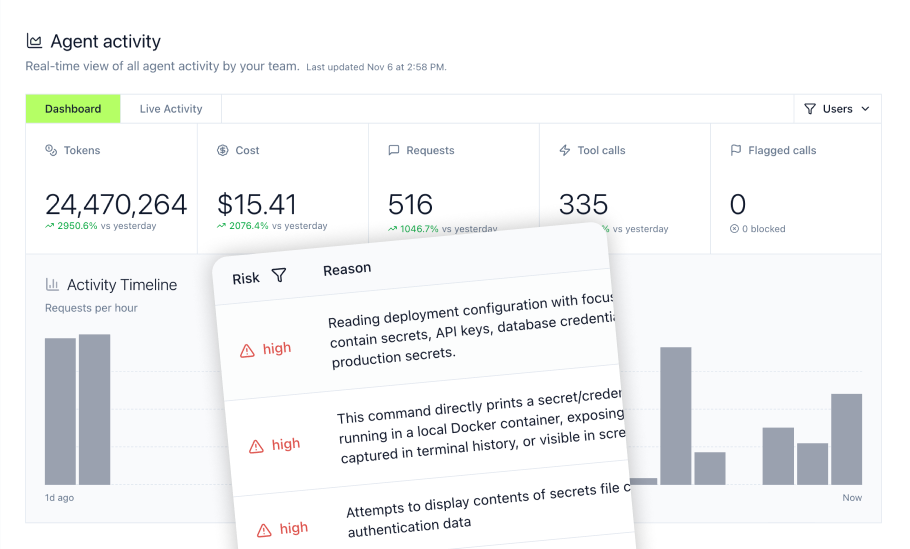
Agent Monitor provides visibility into supported AI agent activity beyond gateway traffic. The system captures:
- Prompt submissions - What users and agents ask AI systems to do
- File access - Which files agents read, including sensitive locations like
.envand SSH key directories - Commands - Shell commands, package installations, and git operations
- MCP tool calls - Supported MCP tool-call activity
- Token usage - Model consumption by user, agent, and session
This visibility enables security monitoring, cost attribution, compliance documentation, and operational awareness of how AI agents are actually being used.
Detecting Shadow AI
Agent Monitor addresses the shadow AI problem by providing visibility into supported agent activity, including activity that does not flow through governed endpoints. Agent Monitor can detect MCP tool use even when the MCP server is not connected through MintMCP's Gateway.
This two-layer approach separates concerns:
- MCP Gateway - Governs traffic routed through governed MCP connections
- Agent Monitor - Provides visibility into supported local and agent activity
Coverage varies by client, agent, and hook phase. The goal is organizational awareness of AI agent behavior across the heterogeneous client landscape that enterprises actually operate.
Runtime Guardrails for Enterprise AI Operations
Preventing AI Misuse with Runtime Policies
Visibility alone does not prevent harm. Organizations need runtime controls that determine whether an action should be allowed before it executes. Guardrails operate through three complementary layers:
Mint Guard provides managed detection policies for:
- Prompt injection: Detects prompt-injection patterns and can block high-confidence detections when enforcement is enabled
- Credentials and secrets: Detects API keys, tokens, and passwords in tool arguments or results
- PII: Identifies personally identifiable information before it leaves the organization
- Harmful content: Screens for policy violations in agent interactions
Rules enable declarative matching and enforcement:
- Tool name conditions: Block or require approval for specific tools
- Argument patterns: Match regex patterns in tool inputs
- Content matching: Detect specific terms or data patterns
- Actions: Flag, block, ask user, mask, or notify based on rule matches
Gateway Middleware supports customer-authored logic for:
- DLP integrations: Connect to existing data loss prevention systems
- External classifiers: Route content through custom ML models
- Resource allowlists: Restrict tool access to approved resources
- Custom transformations: Redact, rewrite, or modify tool calls as needed
Customizing Security with Gateway Middleware
Gateway Middleware runs customer-authored JavaScript in a sandbox environment, enabling organizations to implement policies specific to their requirements. Pre-built templates support integration with AWS Bedrock Guardrails, Google Cloud Model Armor, OpenAI moderation, and third-party DLP systems.
Gateway Middleware lets organizations apply customer-authored policy logic and integrate supported external DLP or classification systems directly into governed MCP traffic.
Building and Operating Custom AI Connectors
Extending AI Capabilities
Enterprise systems require custom connectors beyond standard integrations. MintMCP supports multiple connector deployment models:
- Hosted connectors - MintMCP operates supported connector instances
- Remote connectors - Organizations run their own MCP servers with MintMCP providing governance, authentication, and monitoring
- Custom connectors - Purpose-built connectors for proprietary systems deployed through the hosted CLI or Docker
- STDIO connectors - Local connector processes with OAuth brokering support
The Flexibility of Connector Deployment
Each deployment model addresses different requirements:
Hosted connectors suit organizations that want:
- MintMCP to operate supported connector runtimes on their behalf
- Centralized authentication and credential handling
- Less customer-managed connector runtime infrastructure
Remote connectors suit organizations that need:
- Connectors running within their own network perimeter
- Custom configurations not available in hosted versions
- Integration with on-premises systems through private network tunnels
Custom connectors enable:
- Integration with proprietary APIs and internal systems
- Specialized tool implementations not available in the connector catalog
- Extension of governance to custom agentic workflows
The MCP server configuration guides cover setup for popular enterprise integrations including Snowflake, Salesforce, GitHub, Slack, and dozens of other systems.
Enterprise-Grade Security and Compliance
Achieving AI Compliance and Auditability
Regulated industries require documented evidence that AI systems operate within defined boundaries. MintMCP provides:
SOC 2 Type II audited with continuous compliance monitoring. The Trust Center documents security controls, penetration testing, and compliance status.
Compliant with HIPAA standards, with Business Associate Agreements available for customers handling protected health information.
Audit trail completeness capturing:
- Every tool call with arguments and results
- Credential lifecycle events (creation, rotation, revocation)
- Access policy changes with administrator attribution
- Tamper-evident access-grant history signed at write time
SIEM export supporting OTLP and Splunk HEC for integration with existing security operations infrastructure.
Strengthening AI Security with Controls
Enterprise security infrastructure includes:
- SSO integration - Okta, Entra ID, and Google authentication with directory-driven access policies
- SCIM provisioning - Automatic user and group synchronization from identity providers
- RBAC - Organization-level roles for administrative access plus VMCP-level access policies for tool access
- Operational controls - Organization-wide kill switch, per-VMCP disable, connector restart, and credential rotation
- Configuration as code - Declarative management of gateway configuration and global rules
These capabilities address the enterprise AI security requirements that platform and security teams face when deploying AI agents at scale. Organizations should also review AI risk management frameworks and AI governance standards when building their compliance programs.
Comparing Alternative Approaches
How the Approaches Differ
The AI infrastructure landscape includes products optimized for different layers of the stack. Edge inference platforms focus on globally distributed model execution and latency. LLM routing gateways focus on model access, routing, cost controls, and observability. MCP and agent-governance platforms focus on governed tool access, identity, permissions, auditability, connector operations, monitoring, and runtime policy enforcement.
Platform Selection Considerations
Key evaluation criteria include:
- Access Control - Can you control which tools each role or agent accesses?
- Agent Identity - Can each agent receive its own credential and audit trail?
- Credential Management - Are secrets injected per-call or stored in configurations?
- Audit Completeness - Does every tool call get logged with full attribution?
- Runtime Controls - Can you block dangerous actions before they execute?
- Connector Operations - Who runs and maintains the connector infrastructure?
- Compliance - Is the platform SOC 2 Type II audited with HIPAA support?
Organizations evaluating AI gateways for enterprises should map these requirements against their specific governance, security, and operational needs.
Why MintMCP for Enterprise AI Governance
MintMCP provides a comprehensive platform for organizations that need governed AI agent deployments at scale. The platform addresses the full lifecycle of AI governance through integrated capabilities.
Virtual MCPs centralize tool access behind role-specific endpoints with curated surfaces, SCIM-driven membership, and unified audit trails. Agent identities give each autonomous agent its own credential, permissions, and attributable activity log. Gateway middleware and managed detection policies enable runtime enforcement of security policies including prompt injection detection, PII screening, and DLP integration. Organizations can deploy hosted, remote, custom, and STDIO connectors while maintaining consistent governance across all tool access. Agent Monitor provides visibility into prompts, file access, commands, and token consumption across supported AI clients, addressing shadow AI through comprehensive monitoring. These controls centralize identity, access policy, audit, credential lifecycle management, and operational response across governed AI activity.
Frequently Asked Questions
How does MCP governance differ from API gateway capabilities?
API gateways optimize for request routing, rate limiting, and caching at the HTTP layer. MCP governance operates at the tool layer, controlling which specific tools within an MCP server each role or agent can invoke. This includes understanding tool semantics such as read versus write operations, inspecting tool arguments for sensitive content, and maintaining audit trails at the tool-call level rather than the request level. Generic HTTP gateways can operate primarily at the request and endpoint layer, while MCP-aware products can apply controls to MCP servers, tools, prompts, and related activity.
Can organizations use both edge AI platforms and MCP gateways?
Yes, these platforms serve complementary purposes. Edge AI platforms optimize inference latency and model distribution. MCP gateways govern tool access, agent identity, and audit trails. Organizations often use both: edge platforms for model inference and MCP gateways for governing how agents interact with enterprise tools and data. The integration path involves layering MCP governance onto existing AI infrastructure rather than replacing inference capabilities.
What authentication methods do agent identities support?
Agent identity authentication ranges from simple to highly secure approaches. Bearer keys provide static credentials suitable for development and testing. OAuth client-credentials flows enable short-lived token exchange where secrets stay out of request paths. Workload identity federation allows agent infrastructure such as Kubernetes service accounts, cloud IAM roles, or CI job identities to mint OIDC tokens that MintMCP accepts without holding any secret. Organizations can choose authentication methods based on their security requirements and infrastructure capabilities.
How do guardrails handle false positives in content screening?
Mint Guard supports Off, Monitoring, and Enforcing modes, allowing organizations to observe detections before enabling enforcement. Separately, Rules support actions such as flag, block, ask, mask, or notify where supported, with conditions that can match tool names, arguments, content, or regex patterns. Gateway Middleware can add customer-authored logic and external classifiers when more contextual policy decisions are required. Organizations typically start in monitoring mode to understand detection patterns, then refine rules and enable enforcement incrementally.
How does Virtual MCP configuration scale across large organizations?
Virtual MCPs support configuration as code for declarative management across environments. SCIM integration means directory group membership automatically controls VMCP access without per-user configuration. Organizations typically create VMCPs aligned with roles such as engineering, security, or data science, or use cases such as customer support or financial analysis, and let directory group membership handle individual access. Changes to VMCP configuration automatically propagate to all users with access, eliminating per-user update requirements.