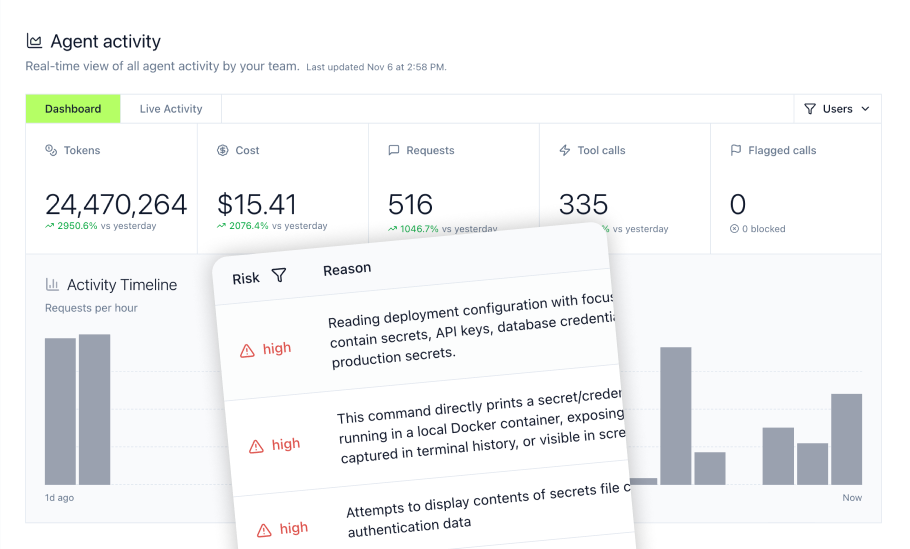
Selecting the right MCP gateway determines whether your AI coworker agents become governed production infrastructure or remain ungoverned experiments. With a Tray.ai survey finding that 86% of enterprises require tech stack upgrades to properly deploy AI agents, organizations need gateways that provide centralized authentication, real-time monitoring, and enterprise-grade governance for agents that work alongside employees.
The Model Context Protocol has shifted from its November 2024 introduction into a widely adopted integration layer for production AI agents, with over 97 million monthly SDK downloads and more than 177,000 registered tools in recent MCP security research. AI coworker agents represent a specific category within this ecosystem: long-running agents that live in Slack, hold memory, continue work across days, and operate alongside employees. Governing these agents requires both an MCP Gateway for data and tool connections and an Agent Gateway for identities, permissions, memory, and monitoring, especially as MCP security research highlights risks across tool access, verification, and runtime policy enforcement.
Key Takeaways
- MintMCP combines MCP Gateway and Agent Gateway capabilities, giving teams governed data and tool connections plus agent-specific identity, permissions, memory, and monitoring
- AI coworker agents need more than basic MCP connectivity because they are long-running, hold memory, continue work across days, and operate alongside employees
- Enterprise MCP gateway evaluation should prioritize SSO, SCIM-driven RBAC, tool-level policy, audit logs, hosted connector options, and per-agent identity controls
- Managed gateway platforms can reduce operational overhead, while self-hosted and open-source options may give infrastructure teams more direct control
- For production AI coworker agents, the core decision is whether the gateway can enforce least-privilege access, support agent-specific credentials, and provide a unified audit trail
1. MintMCP Gateway: enterprise MCP infrastructure for AI coworker agents
MintMCP Gateway provides an enterprise gateway for Model Context Protocol focused on authentication, tool-level access control, credential management, logging, rule-based policy, and agent governance. Its data-permissions-first architecture starts with SSO, SCIM-driven RBAC, IdP groups, Virtual MCP Bundles, tool-level policy, and audit logs, then enables agents on top.
MintMCP operates as both an MCP Gateway for governed data and tool connections and an Agent Gateway for managing the identities, permissions, memory, and monitoring that AI coworker agents require. This dual architecture addresses the reality that coworker agents need more than tool access; they need persistent identities, scoped permissions, and auditable memory that follows Git-like principles.
What makes MintMCP Gateway different
MintMCP addresses a common enterprise deployment challenge: giving AI agents governed access to multiple internal data sources without creating unmanaged permissions sprawl. The platform wraps stdio, hosted, HTTP-streamable, and SSE MCP servers behind SSO-fronted remote MCP endpoints with OAuth brokering, SCIM-driven membership, and rule-based policy.
For AI coworker agents specifically, MintMCP provides Agent Bundles with M2M authentication, giving each agent its own identity with bearer API keys plus OAuth 2.0 client-credentials. Agents can be rotated and revoked independent of human users, with an "act as agent" admin flow for connectors requiring per-agent OAuth.
Core capabilities
- Hosted MCP Connectors: MintMCP runs connector instances with auto-scaling and sandboxed execution per connector, reducing infrastructure overhead
- OAuth Brokering: Enterprise authentication for local and hosted MCP servers, including OAuth 2.x, bearer tokens, headers, and SSO-fronted access
- Virtual MCP Bundles: Team-specific endpoints that expose only minimum required tools with SCIM-driven membership and fine-grained role-based access
- Agent Bundles: First-class agent identities with M2M auth, scoped tools, independent rotation and revocation
- Custom Gateway Middleware: Customer-authored middleware in a JS sandbox with external DLP and guardrails integrations
- Tool-update Policy: Auto-enable new upstream tools or require admin approval, addressing silent capability expansion
Security and compliance
MintMCP is SOC 2 Type II audited, compliant with HIPAA standards, and monitored continuously through Drata. Enterprise SSO, audit trails, PII detection, and role-based access control are built into the platform. Customers handling protected health information can request HIPAA documentation, and MintMCP signs BAAs.
Enterprise integrations
- Snowflake data warehouse access with natural language queries and Cortex Analyst support
- Elasticsearch knowledge base search for documentation, support tickets, and log analysis
- Gmail integration for AI-driven customer response automation
- Claude, Cursor, ChatGPT, Gemini, and Copilot governance through centralized gateway and Agent Monitor coverage
Deployment
Deploy with managed SaaS-first delivery, US and EU availability options, hosted MCP connectors, pre-configured policies, and self-service access for developers. VPC and self-hosted deployment are available on request.
Pricing
Contact for enterprise demonstration and pricing
Getting started
Visit mintmcp.com/mcp-gateway for the deployment guide
2. Bifrost (Maxim AI)
Bifrost is an open-source MCP gateway built in Go with dual functionality as both LLM routing and MCP gateway in a single binary. The project emphasizes performance, with vendor-published benchmarks citing 11 microsecond gateway overhead at 5,000 requests per second.
Primary focus
Bifrost targets teams requiring maximum performance from their MCP infrastructure. The gateway supports 20+ LLM providers through an OpenAI-compatible API and provides unified control plane capabilities for both LLM routing and MCP tool governance.
Key features
- Apache 2.0 license with source code transparency
- Dual functionality combining LLM routing and MCP gateway
- Support for MCP Code Mode, agent mode, and OAuth 2.0
- Tool filtering and single gateway URL configuration
Where Bifrost fits
Organizations with strong DevOps expertise seeking self-hosted performance optimization. The open-source model provides full infrastructure control but requires manual compliance configuration and operational overhead.
Deployment
Self-hosted via Go binary or Docker container
3. TrueFoundry MCP Gateway
TrueFoundry provides an AI platform with MCP gateway capabilities as part of a broader infrastructure offering. The platform combines MCP server management with LLMOps and model serving in a unified control plane.
Primary focus
TrueFoundry targets platform engineering teams building comprehensive AI infrastructure where MCP gateway is one component among many. The platform offers MCP Server Groups for logical isolation between teams and an interactive playground that generates production-ready code snippets.
Key features
- Vendor-published benchmarks citing ~3-4ms latency and 350+ RPS on 1 vCPU
- Unified control plane for LLMs, MCP servers, and model serving
- Security and deployment controls vary by plan and deployment model
- Interactive playground for code generation
Where TrueFoundry fits
Teams needing centralized MCP server management alongside model routing and LLMOps capabilities. The broader platform scope means organizations adopt TrueFoundry for multiple AI infrastructure needs rather than MCP governance alone.
Pricing
Free tier available, with paid plans from $499-$2,999/month based on third-party pricing summaries
4. Kong AI Gateway
Kong extends its established API gateway platform with MCP support through the AI MCP Proxy plugin that translates between MCP and HTTP protocols. The MCP Registry feature provides semantic search capabilities for discovering available tools.
Primary focus
Kong targets organizations already standardized on Kong for API infrastructure who want to add MCP support without deploying separate systems. The platform handles REST, gRPC, Kafka, and MCP traffic through a single control plane.
Key features
- 60+ AI-specific plugins including OAuth 2.1 support
- MCP Registry (Tech Preview) with semantic search
- Kong Konnect Catalog as storefront for AI tools
- Established API gateway ecosystem with enterprise deployment patterns
Where Kong fits
Enterprises with existing Kong deployments seeking unified API and MCP governance. The mature ecosystem provides production-hardened infrastructure, though MCP features are newer additions to the platform.
Deployment
Hybrid (Konnect SaaS control plane plus self-hosted data plane) or fully self-hosted
5. Docker MCP Gateway
Docker's MCP Gateway brings container orchestration to MCP server management, providing a Docker-native approach to running and managing servers with Docker Desktop/CLI and Docker Compose.
Primary focus
Docker targets developers running MCP servers locally and organizations with existing Docker environments. The approach treats each MCP server as an isolated container with controlled resource limits, network policies, and filesystem access in containerized deployment models.
Key features
- Container isolation for MCP server deployments
- Docker Compose integration for orchestration
- Supply-chain controls for container images
- Standard container security practices
Where Docker fits
Teams with existing Docker and Kubernetes expertise who prefer infrastructure control over managed services. Container overhead versus native execution reflects the security isolation tradeoff, with additional runtime overhead in containerized environments.
Deployment
Self-hosted on Docker or Kubernetes infrastructure. Open-source with infrastructure costs varying by deployment.
6. Obot
Obot provides an open-source MCP platform combining gateway, catalog, hosting, and chat client in a single package. The platform supports composite MCP servers that merge multiple servers behind a single endpoint.
Primary focus
Obot targets platform engineering teams with Kubernetes fluency who want full infrastructure ownership. The curated MCP catalog provides a searchable directory with trust levels for evaluating servers.
Key features
- Complete platform with gateway, catalog, hosting, and UI
- Composite MCP servers for endpoint consolidation
- GitOps-ready configuration with Kubernetes-native deployment
- Active development community with regular releases
Where Obot fits
Teams requiring self-hosted orchestration with full control over the runtime, Kubernetes deployment, scaling, and connector lifecycle. The open-source model trades managed convenience for infrastructure flexibility.
Deployment
Docker for development, Kubernetes for production. No managed SaaS option.
7. Lunar.dev MCPX
Lunar.dev's MCPX is a governance-focused MCP gateway with a built-in MCP Risk Score Engine for analyzing server reputation before allowing production access. The platform is positioned around governance and risk scoring for MCP server adoption.
Primary focus
MCPX targets security-conscious teams evaluating untrusted third-party MCP servers. The platform can rewrite tool descriptions and constraints before exposing them to agents, providing an additional governance layer.
Key features
- Vendor-published 4ms p99 latency with MIT license open-source core
- Pre-production sandbox for server evaluation
- Tool-level RBAC with immutable audit trails
Where MCPX fits
Organizations requiring server vetting and risk scoring before deployment. The governance focus addresses scenarios where teams need to evaluate third-party servers with unknown security postures.
Deployment
Docker/Kubernetes self-hosted with optional SaaS dashboards for telemetry
8. Composio
Composio provides a developer integration platform with a large catalog of managed integrations and unified authentication for building agentic applications. The platform includes SOC 2 Type II attestation.
Primary focus
Composio targets developer teams building customer-facing AI products who need rapid integration development. The platform offers AI-assisted connector generation from OpenAPI specs and pre-built MCP tools for business communications, CRMs, and knowledge management.
Key features
- Large catalog of pre-built app integrations
- SOC 2 Type II audited
- AI-assisted connector generation
- Startup credits program available
Where Composio fits
Teams building external customer-facing AI products that require extensive third-party integrations. The managed SaaS-first model emphasizes development speed over infrastructure control.
Deployment
Managed SaaS-first with VPC/on-prem available on Enterprise tier
9. Portkey AI Gateway
Portkey provides an LLM gateway with MCP module addition, offering unified observability for both LLM and MCP traffic in a single dashboard. Palo Alto Networks announced its intent to acquire Portkey on April 30, 2026, and announced the completed acquisition on May 29, 2026.
Primary focus
Portkey targets teams with existing LLM gateway needs who want to add MCP capabilities without separate infrastructure. The unified dashboard consolidates observability across both traffic types.
Key features
- Consolidated LLM and MCP observability
- Read-only MCP server directory
- Managed plus self-hosted deployment options
- Palo Alto Networks ownership following the completed acquisition
Where Portkey fits
Organizations already using or evaluating LLM gateways who want MCP capabilities in the same platform. The acquisition places Portkey within Palo Alto Networks' security portfolio.
Deployment
Hybrid with managed and self-hosted options
10. IBM ContextForge
IBM ContextForge is a federated open-source MCP gateway supporting multi-gateway coordination with auto-discovery via mDNS. The project enables virtual MCP servers that wrap legacy REST and gRPC APIs without rewriting them.
Primary focus
ContextForge targets large enterprises with distributed deployments across regions, business units, or environments. The federated architecture allows multiple gateway instances to coordinate automatically through Redis-backed state sharing.
Key features
- Apache 2.0 license open-source
- Protocol bridging for REST/gRPC to MCP conversion
- Multi-gateway federation with mDNS auto-discovery
- Support for HTTP/JSON-RPC, WebSocket, stdio, streamable HTTP, and SSE compatibility
Where ContextForge fits
Organizations with complex multi-region or multi-business-unit requirements needing federated governance. The enterprise integration patterns reflect IBM's middleware experience.
Deployment
Self-hosted with Redis for distributed state. IBM Elite Support available for enterprise deployments.
Choosing an MCP gateway for AI coworker agents
AI coworker agents require more than basic MCP connectivity. These long-running agents that operate in Slack, maintain memory across sessions, and work alongside employees need both an MCP Gateway for governed tool access and an Agent Gateway for identity, permissions, and memory management.
MintMCP addresses both requirements through its data-permissions-first architecture. The platform provides Virtual MCP Bundles for team-specific tool access, Agent Bundles for per-agent identity with M2M authentication, and hosted connectors that eliminate infrastructure overhead. For organizations deploying AI coworker agents at scale, MintMCP delivers the governance foundation that transforms experimental agents into production infrastructure.
AI agent pilots often fail when governance, ownership, and access control remain fragmented. By starting with SSO, SCIM-driven RBAC, audit logs, and tool-level policy before enabling agents, MintMCP helps coworker agents operate within governed access controls from day one.
Organizations evaluating MCP gateways for AI coworker agents should prioritize platforms that provide both MCP Gateway and Agent Gateway capabilities in a unified architecture. MintMCP's approach combines governed tool access with agent-specific identity management, continuous compliance monitoring, and hosted connector infrastructure that reduces operational overhead. The platform's Virtual MCP Bundles allow teams to expose only the minimum required tools with SCIM-driven membership, while Agent Bundles give each agent an independent identity with M2M authentication that can be rotated and revoked without impacting human users.
This dual-layer governance model aligns with the NIST AI Risk Management Framework principles for trustworthy AI systems, ensuring that coworker agents operate within defined risk boundaries while maintaining the flexibility needed for effective collaboration. The Model Context Protocol specification provides the technical foundation for standardized tool access, and MintMCP extends this with enterprise authentication, audit trails, and policy enforcement that production deployments require.
Visit mintmcp.com/mcp-gateway to schedule a demonstration and see how MintMCP transforms AI coworker agent deployment from months to minutes.
Frequently asked questions
What is the difference between an MCP Gateway and an Agent Gateway?
An MCP Gateway governs the data and tool connections that AI systems use, handling authentication, authorization, and audit for Model Context Protocol traffic. An Agent Gateway extends this foundation to manage agent-specific requirements: persistent identities, scoped permissions, memory that follows Git-like principles, and monitoring for long-running agents. AI coworker agents need both layers since they require tool access and identity management that persists across sessions and days of operation.
How do MCP gateways prevent shadow AI tool usage in enterprises?
Gateways transform shadow AI into sanctioned AI by requiring all AI agent connections to route through governed infrastructure. The gateway catalogs approved MCP servers, enforces role-based access controls, maintains audit trails of tool invocations, and blocks unauthorized connections routed through the governed gateway. Organizations gain visibility into which tools teams use, when they access data, and how frequently, addressing the visibility gap that enables shadow AI proliferation.
What authentication methods do enterprise MCP gateways support?
Enterprise gateways typically support OAuth 2.x, SAML for enterprise SSO integration, OpenID Connect for modern identity providers, bearer tokens, and API token management. Leading implementations provide shared service accounts, per-user OAuth flows, and per-agent identity models including M2M authentication. This flexibility addresses authorization challenges when internal practices conflict with standard OAuth flows.
Can MCP gateways work with coding agents like Cursor and Claude Code?
Yes. Governance layers like MintMCP's LLM Proxy monitor MCP tool invocations, bash commands, file operations, and prompt submissions from Cursor, Claude Code, and other coding agents. This creates two-layer governance: the gateway covers MCP traffic while Agent Monitor covers local non-MCP agent activity including bash usage, file reads and writes, and prompt submissions.
How long does it take to deploy an MCP gateway for production use?
Deployment timelines vary significantly by approach. Managed SaaS solutions with hosted connectors and pre-configured policies can reach production in days. Self-hosted open-source solutions typically require weeks for infrastructure setup, authentication integration, and security configuration. Organizations should evaluate whether they need rapid production deployment or can invest time building custom infrastructure.