Prompt injection is ranked LLM01 in OWASP's 2025 Top 10 for LLM and GenAI applications, making it a priority risk for enterprise AI security programs. A 2024 McKinsey Global Survey found that 71% of respondents said their organizations regularly used generative AI in at least one business function. As adoption expands, organizations need prompt injection defenses that match their deployment constraints and governance requirements.
The right prompt injection detection solution must fit within the broader AI security architecture. Some organizations need managed detection services with instant deployment. Others require self-hosted tools for complete data sovereignty. Enterprise teams often need runtime enforcement that integrates with existing governance infrastructure, including SSO, SCIM-driven access controls, and comprehensive audit trails. This guide evaluates 10 prompt injection detection tools across five criteria: detection effectiveness, deployment flexibility, integration ease, pricing transparency, and production maturity.
Key takeaways
- MintMCP Guardrails: Enterprise governance platform with Mint Guard managed detection, declarative Rules, and Gateway Middleware for custom DLP integration, plus SSO and SCIM-driven access controls
- Managed API services provide rapid deployment without infrastructure overhead
- Open-source libraries offer data sovereignty for self-hosted requirements
- Pre-deployment scanners identify vulnerabilities during development cycles
- Runtime guardrails screen production requests in real time
- Air-gapped environments require open-weight models or self-hosted tools
- Cloud-native services integrate directly with existing provider infrastructure
- Agent identities with scoped permissions contain blast radius when attacks succeed
1. MintMCP Guardrails: Enterprise prompt injection defense with full governance
MintMCP Guardrails provides enterprise-grade prompt injection detection as part of a comprehensive AI governance platform. Rather than offering detection as a standalone service, MintMCP integrates runtime protection with identity management, access control, and audit infrastructure, addressing the complete governance challenge enterprises face when deploying AI agents at scale.
What makes MintMCP Guardrails different
MintMCP's architecture addresses prompt injection attacks as a runtime security risk whose success varies substantially by attack technique, target model, application architecture, and defenses. The platform's three-layer guardrail system screens gateway tool calls on both the arguments agents send and the results connectors return, combining managed detection, declarative enforcement, and customer-authored policy logic in one control layer.
The guardrails integrate directly with MintMCP's MCP Gateway and Agent Gateway, creating a unified control plane where prompt injection detection, access policies, and audit logging work together. This eliminates the fragmented security posture that emerges when organizations bolt together separate detection, authentication, and monitoring tools.
Core capabilities
Mint Guard
- Out-of-the-box, centrally maintained detection for prompt injection, credentials, secrets, PII, and harmful content
- Blocks at high confidence with configurable Off, Monitoring, and Enforcing modes
- Screens tool arguments and connector results for injection patterns
- No custom rules or model training required for baseline protection
Rules
- Declarative matching on tool names, argument patterns, and content
- Regex-based conditions for custom detection logic
- Supported actions include flag, block, ask, mask, and Slack notify
- Combines with Mint Guard for layered detection
Gateway Middleware
- Customer-authored JavaScript running in a sandboxed environment
- Integration templates for AWS Bedrock Guardrails, Google Cloud Model Armor, OpenAI moderation, and Teleskope
- External DLP and classifier integration for organization-specific policies
- Transform, redact, rewrite, or block based on custom logic
- Fail-closed design for policy-critical checks
Enterprise governance integration
MintMCP Guardrails operates within the broader platform's governance infrastructure:
- SSO and SCIM integration with Okta, Entra ID, and Google for identity-driven access
- Virtual MCP Bundles that scope tools and guardrail policies to specific teams, roles, or use cases
- Agent identities with per-agent credentials, independent rotation, and attribution
- Comprehensive audit logging of every tool call, credential lifecycle event, and access policy change
- SIEM export via OTLP or Splunk HEC for security operations integration
Security architecture
The platform implements defense-in-depth across the AI agent workflow:
- Gate 1: Prompt injection screening on incoming requests before tool execution
- Gate 2: Tool authorization and parameter validation through Rules
- Gate 3: Result screening on connector responses before delivery to agents
This layered approach screens supported tool-call arguments and connector results for prompt-injection risk. Tool-description poisoning is a related MCP threat that also requires governance over which tools and descriptions agents are allowed to consume.
Compliance
- SOC 2 Type II audited
- Compliant with HIPAA standards (BAA available)
- Penetration tested
- Data encrypted in transit and at rest
Pricing
Contact for enterprise demonstration and pricing
Getting started
Visit mintmcp.com/docs/mint-guard for the deployment guide
2. Lakera Guard (Check Point AI Guardrails)
Lakera Guard is now documented as Check Point AI Guardrails following Check Point's acquisition of Lakera in October 2025. It is available as managed SaaS or self-hosted runtime protection for prompt attacks, data leakage, content violations, and agent behavior.
Primary focus
The platform targets organizations with compliance requirements, offering SOC 2 Type II certification and enterprise-grade support infrastructure. Detection covers prompt injection, jailbreaks, PII leakage, and toxic content.
Core capabilities
- SOC 2 Type II certified infrastructure
- Dedicated account managers for enterprise customers
- Custom model training options for specific use cases
- Model-agnostic deployment across LLM providers
- Enterprise SLAs and support agreements
Deployment options
Organizations can choose between managed SaaS deployment or self-hosted installation depending on data residency requirements and existing infrastructure.
Pricing
- Enterprise pricing: contact sales
- Community access is limited to 10,000 screening requests per month
3. LLM Guard (Protect AI)
LLM Guard is an MIT-licensed self-hosted library from Protect AI. Its repository was archived on July 9, 2026 and is no longer actively maintained, so teams should treat it as an unmaintained project rather than a current production security dependency.
Primary focus
The library emphasizes data control, with all processing happening on customer infrastructure. The modular scanner architecture covers prompt injection alongside PII redaction, toxicity filtering, and secret detection.
Core capabilities
- 15 input scanners including PromptInjection, InvisibleText, and Secrets
- PII redaction and toxicity filtering
- Regex-based blocking rules
- Modular validator architecture
- MIT license for commercial use
Deployment considerations
While the library provided self-hosted deployment where data cannot leave organizational infrastructure, teams should note the archived status and lack of active maintenance when evaluating for production use.
Deployment
- Self-hosted on customer infrastructure
- Free and open-source (MIT license)
- No longer actively maintained as of July 2026
4. Azure Prompt Shields
Azure Prompt Shields provides cloud-native prompt injection detection as part of Microsoft's Azure AI Content Safety service, designed for organizations already using Azure OpenAI Service.
Primary focus
The service detects both direct and indirect prompt injection attacks, including document attacks in RAG pipelines. Native Azure integration simplifies deployment for organizations standardized on Microsoft cloud infrastructure.
Core capabilities
- Direct and indirect prompt injection detection
- Document attack scanning for RAG applications
- Native Azure OpenAI Service integration
- Azure compliance inheritance (SOC 2, ISO)
- Service-specific usage pricing
Deployment model
Organizations with existing Azure OpenAI Service deployments can enable integrated protection without additional vendor relationships. The service inherits Azure's compliance certifications and operational model.
Deployment and pricing
- Available as part of Azure AI Content Safety
- Azure AI Content Safety uses service-specific usage pricing rather than a generic per-token price
- Requires Azure subscription
5. Guardrails AI
Guardrails AI provides an open-source validation framework with a composable validator system, focusing on structured output constraints alongside security validation.
Primary focus
The framework validates both input and output, making LLM responses behave like typed data rather than free text. The modular architecture supports custom validator development for organization-specific requirements.
Core capabilities
- Composable validator system with PyPI packages
- Input and output validation
- Structured output constraints
- Python SDK integration
- Apache 2.0 license
Architecture changes
- Self-hosted open-source core (Apache 2.0)
- Validators are distributed as standalone PyPI packages
- The legacy Guardrails Hub private registry and hosted remote-inference servers shut down on August 6, 2026
Deployment
Development teams wanting granular control over validation pipelines with custom rules can use the framework approach for flexibility when building complex AI applications with specific validation requirements.
6. Garak (NVIDIA)
Garak is an NVIDIA-maintained open-source vulnerability scanner designed for pre-deployment security testing of LLM applications.
Primary focus
The tool provides automated penetration testing with a broad library of attack probes spanning jailbreaks, prompt injection, and encoding tricks. Designed for CI/CD integration, Garak supports repeatable security testing across development cycles.
Core capabilities
- Broad library of static, dynamic, and adaptive probes covering prompt injection, jailbreaks, encoding attacks, data leakage, toxicity, and other risk families
- Probe families including promptinject, latentinjection (RAG-specific), and atkgen
- Multi-provider support (OpenAI, Hugging Face, AWS Bedrock)
- JSONL reporting for tracking vulnerabilities over time
- Apache 2.0 license
Use cases
Security testing teams conducting pre-deployment vulnerability assessments can use the automated approach for scheduled scans as part of release processes, identifying weaknesses before production deployment.
Deployment
- Self-hosted open-source (Apache 2.0)
- CLI-based execution
- Designed for CI/CD pipeline integration
7. PyRIT (Microsoft)
PyRIT is Microsoft's open-source red teaming framework, providing automated adversarial testing with adaptive multi-turn attack capabilities.
Primary focus
The framework automates red teaming at scale, generating adversarial prompts through dynamic orchestrators. Multi-turn capabilities enable sophisticated attack simulation that evolves based on model responses.
Core capabilities
- Crescendo strategy for multi-turn attack escalation
- Encoding and transformation techniques (CharacterSpace, Leetspeak, ROT13)
- Dynamic orchestrators for adversarial prompt generation
- Pluggable evaluation logic
- MIT license
Use cases
Enterprise red teaming programs requiring automated adversarial testing can use the framework to turn manual security researcher workflows into scripted, scheduled processes with consistent methodology.
Deployment
- Self-hosted open-source (MIT license)
- Python-based framework
- Designed for security team use
8. Promptfoo
Promptfoo is an open-source LLM testing and red teaming platform designed for local evaluation, CI/CD workflows, and automated security testing.
Primary focus
The platform provides automated security testing designed for CI/CD integration, with plugins mapping to OWASP, NIST, and MITRE frameworks. Native GitHub Actions integration enables PR-gate testing as part of development workflows.
Core capabilities
- Security plugins with framework mappings
- Declarative test cases with flexible assertions
- Semantic similarity, regex, and LLM-as-judge evaluation
- Multi-provider support (OpenAI, Anthropic, Gemini)
- Local execution is supported, but some red-team plugins use Promptfoo remote inference for adversarial generation
Use cases
DevSecOps teams integrating security testing into CI/CD pipelines can use the declarative approach to enable non-security specialists to define and maintain test suites as code.
Deployment
- Self-hosted open-source (MIT license)
- CLI and library interfaces
- GitHub Actions integration available
9. Meta Llama Prompt Guard 2
Meta's Llama Prompt Guard 2 provides open-weight prompt-attack classifier models for self-hosted deployment, with 86M and 22M variants focused on prompt injection and jailbreak detection.
Primary focus
The models run entirely on customer infrastructure with no external API calls. The models are small enough for inline inference while providing binary classification for prompt attack patterns.
Core capabilities
- 86M variant based on mDeBERTa-v3, plus a 22M DeBERTa-xsmall variant
- Binary classification focused on explicit prompt-injection and jailbreak patterns
- Open weights under the Llama 4 Community License
- Self-hosted deployment, including offline environments
Use cases
Regulated industries and air-gapped environments requiring complete data control can use the open-weight models for deployment without any external dependencies or data transmission.
Deployment
- Self-hosted with open weights
- Llama 4 Community License
- Infrastructure costs vary by deployment
10. Meta Llama Guard 3
Meta Llama Guard 3 is an open-weight content-safety classifier for input and output filtering. The 1B variant covers 13 hazard categories (S1-S13), while the 8B variant adds S14 for Code Interpreter Abuse.
Primary focus
The model provides content-safety classification distinct from Prompt Guard's attack detection, covering categories including violent crimes, child exploitation, hate speech, privacy violations, and specialized risks. It supports both user input screening and model response filtering.
Core capabilities
- 13 hazard categories (S1-S13) in the 1B variant, with the 8B variant adding S14 for Code Interpreter Abuse
- Input and output classification
- Open weights under the Llama 3.2 Community License for the 1B variant and Llama 3.1 Community License for the 8B variant
- Self-hosted anywhere including offline environments
- Multiple size variants for different performance requiremen
Use cases
Organizations requiring content-safety filtering alongside prompt-injection detection can deploy Llama Guard 3 for comprehensive risk coverage in air-gapped or data-sovereign environments.
Deployment
- Self-hosted with open weights
- Llama 3.2 Community License for the 1B variant and Llama 3.1 Community License for the 8B variant
- Infrastructure costs vary by deployment
Building enterprise AI security with MintMCP
Prompt injection detection is one part of enterprise AI governance. Organizations deploying Claude Code, Cursor, ChatGPT, Copilot, and custom agents also need controls for identity, access, monitoring, and runtime enforcement.
MintMCP's Guardrails combines three layers of runtime protection:
- Mint Guard: Managed detection policies that screen gateway tool calls for risks such as prompt injection, secrets, and PII
- Rules: Declarative controls for organization-specific tool, argument, and content policies
- Gateway Middleware: Customer-authored JavaScript for DLP integrations, external classifiers, redaction, transformation, and custom enforcement
These controls work alongside MintMCP's broader governance infrastructure:
- MCP Gateway governs access to enterprise tools and data
- Agent Gateway gives autonomous agents scoped identities, credentials, and permissions
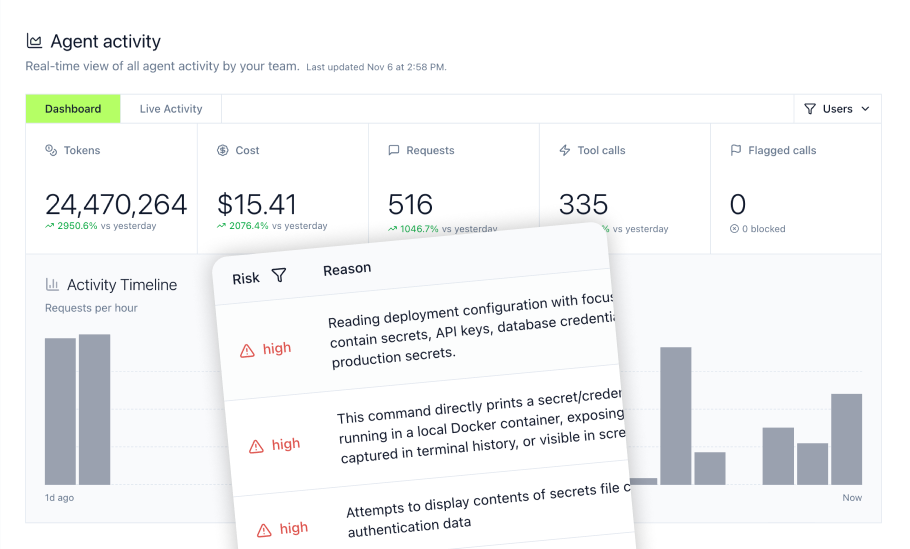
- Agent Monitor provides visibility into supported prompts, commands, file access, MCP tool calls, usage, and cost
- Operational controls help teams restrict or shut down access when incidents occur
With SSO, SCIM-driven access controls, per-agent credentials, audit trails, and SOC 2 Type II audited infrastructure, MintMCP extends prompt injection protection into a broader enterprise governance layer.
Visit MintMCP to learn how runtime guardrails fit into a governed AI-agent infrastructure.
Frequently asked questions
What is prompt injection and why does OWASP rank it first?
Prompt injection attacks manipulate AI systems by inserting malicious instructions into inputs, causing models to ignore original instructions, leak sensitive data, or perform unauthorized actions. OWASP ranks prompt injection as LLM01 because successful attacks can bypass access controls, exfiltrate data, and compromise system integrity. Attack success rates vary widely by attack technique, target model, application architecture, and defenses, making prompt injection an important production risk to test and mitigate.
How do runtime guardrails differ from pre-deployment scanning tools?
Pre-deployment scanners like Garak and PyRIT test applications before release, identifying vulnerabilities during development. Runtime guardrails like MintMCP's Mint Guard screen gateway tool calls, including supported arguments and connector results, and can block detected attacks in real time. Both approaches are complementary: scanners reduce attack surface before deployment, while runtime guardrails provide continuous protection against evolving threats and zero-day attacks in production.
Can prompt injection detection integrate with existing enterprise security infrastructure?
Enterprise-grade solutions integrate with identity providers, SIEM systems, and DLP tools. MintMCP supports SSO and SCIM integration with Okta, Entra ID, and Google, plus SIEM export via OTLP and Splunk HEC. Gateway Middleware enables integration with AWS Bedrock Guardrails, Google Cloud Model Armor, and external classifiers. Self-hosted tools provide integration flexibility but require custom implementation.
What detection approach works for air-gapped or offline environments?
Open-weight models like Meta Llama Prompt Guard 2 and Llama Guard 3 run entirely on customer infrastructure without external API calls, making them suitable for air-gapped deployments. Self-hosted open-source tools also support offline operation, though they require infrastructure management and may lack the continuous model updates that managed services provide.
How does agent identity affect prompt injection security posture?
Per-agent identity strengthens security by attributing every action to a specific non-human principal. When agents share human credentials or generic API keys, prompt injection attacks can escalate privileges and obscure attribution. Agent identities with scoped permissions, independent credentials, and dedicated audit trails contain blast radius and enable rapid incident response.