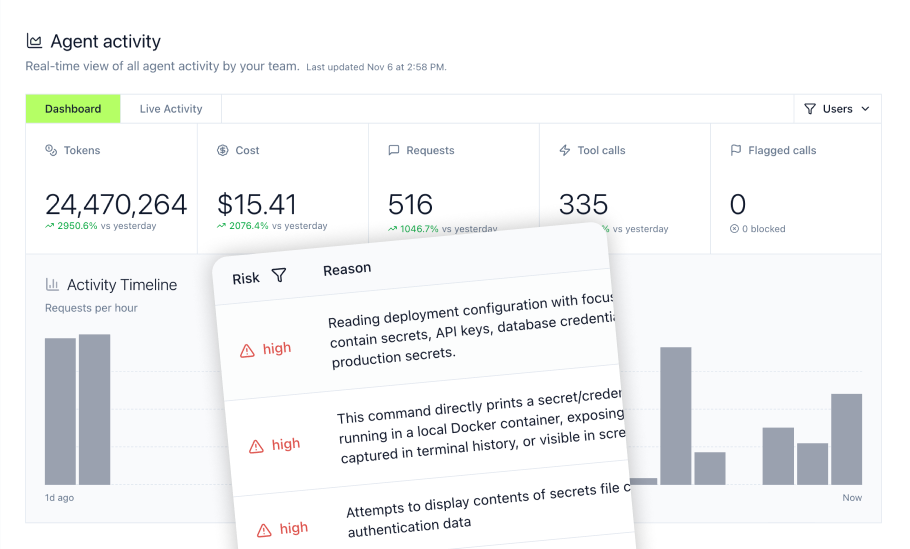
Data Loss Prevention for AI agents operates differently from traditional DLP. Instead of monitoring files and emails, AI DLP inspects prompts, tool calls, agent responses, and MCP (Model Context Protocol) connections in real time before sensitive data reaches external AI models or returns to users. As organizations deploy Claude, Cursor, ChatGPT, and custom agents across their enterprises, the need for specialized AI workflow DLP becomes critical.
The core challenge: AI introduces sensitive-data exposure paths across prompts, file uploads, model responses, API calls, and agent tool interactions. Traditional DLP products may cover some of these channels, but coverage varies significantly by deployment architecture. Modern AI DLP solutions should inspect sensitive data such as PII, PHI, PCI data, secrets, and intellectual property at the relevant interaction and enforcement points. Recent privacy research evaluates a privacy-preserving middleware architecture that screens prompts for prompt injection and sensitive-data exposure before routing eligible content to external LLM services.
Key takeaways
- MintMCP Guardrails provides enterprise AI DLP through three integrated layers: Mint Guard for managed detection policies, Rules for declarative pattern matching, and Gateway Middleware for custom DLP integrations
- MCP-native DLP addresses tool calls that conventional browser and network controls may not fully observe
- LLM-based classification can improve contextual detection compared with pattern matching alone, but accuracy and false-positive rates vary by classifier, policy, and data type
- Account control helps close a common bypass path where users access personal AI accounts outside organization-managed policies
- Browser-only solutions can leave coverage gaps when AI activity occurs through desktop applications, APIs, coding agents, or MCP tool calls
1. MintMCP Guardrails: Enterprise AI DLP with runtime controls
MintMCP's Guardrails provide runtime policy and security controls that screen every tool call flowing through the MCP Gateway. The architecture inspects both the arguments agents send and the results connectors return, stopping sensitive data exposure before it happens. Unlike point solutions focused only on browser traffic, MintMCP can apply governance to MCP traffic routed between AI agents and enterprise systems through its gateway.
What makes MintMCP Guardrails different
MintMCP addresses the fundamental gap in AI data protection: the MCP tool call layer. When an AI agent pulls data from Slack, Salesforce, GitHub, or your data warehouse via MCP servers, that data flows through the gateway where Guardrails can inspect, filter, and control it. This architecture provides DLP coverage that browser extensions and cloud proxies cannot reach.
The three-layer guardrail system allows organizations to start with managed detection and extend to fully custom policy enforcement:
Mint Guard: Managed detection policies
Mint Guard provides out-of-the-box, centrally maintained detection for categories that matter most to enterprise security:
- Prompt injection detection blocks at high confidence, preventing attackers from manipulating agent behavior through malicious inputs
- Credentials and secrets detection identifies API keys, tokens, and passwords before they reach AI models
- PII detection catches personally identifiable information in prompts and tool responses
- Harmful content detection screens for content that violates organizational policies
Mint Guard operates in three modes: Off, Monitoring, and Enforcing. Start in Monitoring mode to understand data flows, then enable Enforcing when policies are tuned. No custom rules to author, just toggle on.
Rules: Declarative pattern matching
MintMCP Rules provide declarative matching and enforcement:
- Match tool names to control which tools can be called
- Pattern match on arguments with regex-based conditions
- Content inspection for specific data patterns
- Supported actions include flag, block, ask-user, mask, or notify via Slack
Rules complement Mint Guard by enabling organization-specific policies beyond the managed detection categories.
Gateway Middleware: Custom DLP integration
Gateway Middleware runs customer-authored JavaScript in a sandboxed environment on every matching call. This enables:
- Integration with external DLP classifiers
- Custom transformation and redaction logic
- Resource allowlists that restrict which data sources agents can access
- Fail-closed behavior for policy-critical checks
MintMCP ships DLP/PII templates for major platforms, keeping policy enforcement in the security tools organizations already run.
Enterprise security architecture
MintMCP implements defense-in-depth security:
- SSO and SCIM with Okta, Entra ID, and Google
- RBAC and tool curation at the Virtual MCP level driven by directory groups
- Complete audit trails with tamper-evident logging
- SIEM export via OTLP or Splunk HEC
Agent Monitor integration
Beyond gateway traffic, Agent Monitor provides visibility into coding agent activity including prompts, file access, commands, and MCP tool calls. This creates two-layer governance: the gateway covers MCP traffic while Agent Monitor covers local non-MCP agent activity from Claude Code, Cursor, and Copilot.
Compliance
- SOC 2 Type II attestation
- Supports HIPAA standards (BAA available)
- Penetration tested
- Data encrypted in transit and at rest
Pricing
Contact for enterprise demonstration and pricing
Getting started
Visit mintmcp.com/for-security for security team resources
2. Strac AI DLP
Strac provides AI DLP coverage across browser, endpoint, and MCP layers, focusing on protecting SaaS applications and AI tools through real-time scanning and remediation.
Strac's primary focus
Strac positions itself around coverage across multiple inspection points. The platform supports browser extensions for ChatGPT and Claude web interfaces, endpoint agents for desktop AI applications, and MCP server wrappers for tool call inspection.
Core capabilities
- Pre-built and custom classification for sensitive data types
- Browser and endpoint inspection combined with MCP coverage
- Real-time redaction and blocking before data transmission
- Audit logging for compliance requirements
Where Strac fits
Organizations seeking a platform that spans browser, endpoint, and MCP inspection points from a single vendor. Strac separately markets AI-assisted triage for existing DLP environments.
Deployment model
Enterprise SaaS with browser extension, endpoint agent, and MCP gateway components
3. dope.security
dope.security takes an on-device approach to AI DLP, running inspection directly on endpoints rather than routing traffic through cloud proxies.
dope.security's primary focus
The platform emphasizes endpoint-native inspection and enforcement with LLM-based classification. Its architecture avoids routing the user's full web session through a cloud proxy, while supported classification workflows can use zero-retention cloud processing to evaluate extracted content. This approach is designed to reduce the tuning burden associated with pattern matching alone.
Core capabilities
- Endpoint agent deployment via MDM
- LLM-based classification designed to evaluate sensitive content in context
- Cloud Application Control to manage personal AI accounts while allowing enterprise tenants
- Inspection without cloud proxy overhead
Where dope.security fits
Organizations that want inspection without traffic backhaul delays, particularly for latency-sensitive AI workflows. The on-device approach suits teams prioritizing endpoint-level enforcement.
Deployment model
Endpoint agent deployment; pricing varies by plan and volume
4. Microsoft Purview
Microsoft Purview extends Microsoft's data governance capabilities to AI workloads, with native integration for Microsoft 365 Copilot users.
Microsoft Purview's primary focus
Native integration with the Microsoft ecosystem makes Purview particularly relevant for organizations that rely heavily on Microsoft 365 Copilot and existing Microsoft information-protection controls. The platform leverages existing sensitive information types and ML classifiers from the broader Microsoft security stack.
Core capabilities
- Native Copilot for Microsoft 365 integration
- Sensitive information types with ML-based classification
- Extension to endpoint protection through existing Microsoft security infrastructure
- Compliance tools integrated with Microsoft's governance framework
Where Microsoft Purview fits
Organizations invested in the Microsoft ecosystem seeking to extend existing data governance policies to AI workloads. Implementation is straightforward for teams already managing data classification through Microsoft tools.
Deployment model
Licensing depends on the Microsoft 365, Copilot, and Purview capabilities used; implementation time varies by the organization's existing Microsoft configuration and policy requirements
5. Netskope AI Gateway
Netskope adds AI controls to its existing Security Service Edge (SSE) platform, providing DLP for organizations already routing traffic through Netskope infrastructure.
Netskope's primary focus
The platform extends existing SSE investments with AI-specific controls. Organizations already using Netskope can reuse existing DLP and security-policy capabilities across its AI security portfolio. Netskope One AI Gateway itself is a deployable software layer for app-to-LLM traffic, while Netskope provides separate MCP-focused controls for agentic workflows.
Core capabilities
- AI controls added to existing SSE traffic routing
- ML-based classifiers for sensitive data
- Application policies to manage approved vs unauthorized AI tools
- Shadow AI discovery through traffic analysis
Where Netskope fits
Organizations with existing Netskope SSE deployments looking to add AI governance. The approach leverages existing traffic routing and policy frameworks.
Deployment model
Deployment varies by Netskope product and architecture; AI Gateway can be deployed within private infrastructure, while other AI controls integrate with the broader Netskope One platform
6. Prompt Security
Prompt Security focuses on agentic AI security across MCP usage and homegrown AI applications, with MCP visibility and enforcement alongside endpoint and gateway controls.
Prompt Security's primary focus
The platform provides dynamic risk scoring and policy enforcement at the MCP layer. This approach serves organizations running mixed AI environments with multiple model providers and deployment patterns.
Core capabilities
- MCP gateway with dynamic risk scoring
- Support for heterogeneous LLM environments
- Policy enforcement across various model providers
- Integration with existing security infrastructure
Where Prompt Security fits
Organizations with complex AI architectures spanning multiple model providers, both cloud and self-hosted deployments. The platform addresses unified policy enforcement across diverse environments.
Deployment model
Deployment can involve MCP Gateway, endpoint, or reverse-proxy controls depending on the use case; contact the vendor for current pricing
7. Symantec Data Loss Prevention
Symantec Data Loss Prevention extends established enterprise DLP controls into generative AI usage through endpoint, browser, web, and cloud inspection capabilities.
Symantec DLP's primary focus
Broadcom positions Symantec DLP around protecting sensitive data across endpoints, web traffic, cloud applications, email, and generative AI applications. Current releases include expanded visibility into interactions with tools such as ChatGPT and Microsoft Copilot.
Core capabilities
- Existing enterprise DLP policies and detection methods
- Exact Data Matching, structured-data detection, document matching, and machine-learning-based classification
- Endpoint and browser monitoring for generative AI usage
- Cloud and web controls for detecting and preventing sensitive-data transfer
Where Symantec DLP fits
Organizations with established Symantec DLP deployments that want to extend existing policies and detection methods to employee use of generative AI applications. Current Broadcom materials do not establish native MCP tool-call inspection as a core Symantec DLP capability.
Deployment model
Deployment varies across endpoint, cloud, and self-managed DLP components
Choosing the right AI DLP approach
Classification method matters
Classification accuracy is an important operational factor because false positives can create analyst workload and unnecessary blocking. LLM-based and semantic classifiers can improve contextual detection compared with pattern matching alone, but false-positive rates vary significantly by data type, model, threshold, and deployment.
Cover all surfaces
Browser-only DLP can leave coverage gaps when AI activity occurs through desktop applications, APIs, coding agents, or MCP tool calls. Organizations should evaluate whether their chosen solution covers:
- Web-based AI interfaces (ChatGPT, Claude web)
- Desktop AI applications (Claude Desktop, Cursor, Windsurf)
- MCP tool calls from agents accessing enterprise systems
- API-level access from custom agent implementations
Account control closes an important loophole
Controlling personal AI accounts while allowing approved enterprise tenants can reduce a common DLP bypass path. Without tenant-aware controls, users may access personal AI accounts outside organization-managed policies. Account-control features can distinguish approved and unapproved tenant usage while preserving access to sanctioned services.
MCP coverage is the 2026 differentiator
As organizations deploy MCP servers to connect AI agents to enterprise data, the tool call layer becomes an important data exposure and policy-enforcement surface. The OWASP MCP Security Cheat Sheet outlines input/output validation, authentication, authorization, and data-handling controls organizations should implement at the MCP layer. Solutions that only inspect browser traffic miss MCP tool calls entirely. Organizations building agent workflows should prioritize DLP solutions with MCP coverage.
Secure your AI deployments with MintMCP
Organizations deploying AI agents need governance that supports security and compliance requirements from day one. MintMCP combines runtime controls, monitoring, identity, and audit capabilities across AI workflows.
Its three-layer Guardrails architecture includes:
- Mint Guard: Managed detection for prompt injection, secrets, PII, and harmful content, with Monitoring and Enforcing modes.
- Rules: Declarative policies for tool access, arguments, and content, with actions including flag, block, ask-user, mask, and Slack notifications.
- Gateway Middleware: Sandboxed JavaScript for custom transformations, redaction, external DLP integrations, and fail-closed policy checks.
MintMCP extends these controls with:
- Agent Monitor for visibility into supported coding-agent activity
- SIEM export for integration with existing security operations workflows
- Enterprise identity for SSO, SCIM, and directory-driven access controls
- Audit and observability for centralized activity and security records
Together, these capabilities help organizations govern sensitive data and agent activity across AI workflows without replacing their existing security stack.
Visit mintmcp.com to learn how enterprise teams govern AI agent access and sensitive data.
Frequently asked questions
What is the primary difference between traditional DLP and DLP for AI agents?
Traditional DLP monitors files, emails, and network traffic for sensitive data leaving the organization. AI DLP operates at the prompt and tool call level, inspecting the data flowing between users, AI models, and enterprise systems in real time. This includes prompts sent to LLMs, responses returned to users, and data pulled through MCP tool calls. The inspection point shifts from storage and transmission to the interaction layer where AI agents operate.
How can DLP solutions prevent AI agents from accessing unauthorized sensitive data?
Effective AI DLP implements controls at multiple layers. At the gateway level, policy enforcement can block or redact sensitive data before it reaches AI models. Tool governance restricts which MCP servers and tools agents can access based on role and use case. Runtime rules can match patterns in tool arguments and block calls that would expose unauthorized data. The combination of access control, content inspection, and policy enforcement creates defense in depth.
What role does agent identity play in effective DLP for autonomous AI?
Agent identity enables per-agent policy enforcement and attribution. When autonomous agents have their own identities, security teams can apply different DLP policies based on the agent's purpose and trust level. A customer service agent might have different data access than an internal analytics agent. Identity also enables audit trails that show which agent accessed what data, critical for compliance and incident response.
Can DLP solutions for AI help with compliance requirements like HIPAA or SOC 2?
AI DLP can support controls relevant to frameworks such as HIPAA and SOC 2, but deploying a DLP platform does not by itself make an organization compliant. Capabilities such as PHI protection, access controls, audit logging, RBAC, tool governance, and SIEM integration can contribute to an organization's broader compliance program. The key is choosing a platform with compliance-grade audit capabilities and configuring those controls to match applicable requirements.
How does MintMCP differentiate its approach to DLP for AI agents and LLMs?
MintMCP provides three integrated layers: Mint Guard for managed detection policies, Rules for declarative pattern matching, and Gateway Middleware for custom integrations. The platform's MCP Gateway architecture means DLP applies to tool calls flowing between agents and enterprise systems, not just browser traffic. Combined with Agent Monitor for endpoint visibility and enterprise identity integration, MintMCP delivers comprehensive AI data protection without requiring multiple point solutions.