Selecting the right AI agent gateway requires evaluating deployment flexibility, governance capabilities, security features, and integration depth. As enterprises deploy AI agents like Claude, Cursor, ChatGPT, Gemini, and Copilot at scale, the choice between self-hosted and cloud-native gateways determines how much control organizations retain over their AI infrastructure. MintMCP Gateway provides MCP governance with managed SaaS deployment and VPC/self-hosted deployment available on request, while Google Cloud Agent Gateway operates within Google Cloud projects and runtimes. This comparison examines both platforms to help determine which approach aligns with your enterprise AI governance priorities.
Key Takeaways
- MintMCP is managed SaaS-first, with VPC/self-hosted deployment available on request, while Google Cloud Agent Gateway is designed around Google Cloud Agent Runtime and Gemini Enterprise environments
- MintMCP provides hundreds of prebuilt connectors with hosted deployment, while Google Cloud Agent Gateway uses Agent Registry to register agents, tools, servers, and endpoints within Google Cloud projects
- MintMCP's Virtual MCP Bundles enable role-based tool curation per team or use case, a capability not documented in Google Cloud Agent Gateway
- MintMCP supports per-agent identity with Agent Bundles, giving each AI agent its own rotatable credentials and permission scope independent of human users
- MintMCP works across Claude, Cursor, ChatGPT, Gemini, and Copilot with Cursor Hooks partner support, while Google Agent Gateway supports Agent Runtime and Gemini Enterprise environments
- Google Cloud Agent Gateway is currently documented as Preview/Pre-GA, so enterprises should evaluate launch-stage limitations, support terms, and access requirements before production use
- MintMCP's Agent Monitor detects shadow AI activity in developer tools like Cursor and Claude Code, providing visibility beyond gateway-only monitoring
Understanding AI Agent Gateways: The Core of Enterprise AI Infrastructure
AI agent infrastructure has accelerated as more teams connect assistants and agents to internal tools, business applications, and production systems. As MCP support expands across major AI clients and developer tools, AI agent gateways have emerged as the critical infrastructure layer for enterprises connecting AI systems to internal data sources, business applications, and production systems.
What is an AI Agent Gateway?
An AI agent gateway serves as the control plane between AI agents and enterprise resources. It manages:
- Authentication and identity for both human users and AI agents
- Access control determining which tools and data sources agents can reach
- Audit logging capturing every tool call, prompt, and response for compliance
- Policy enforcement applying security rules before data flows to or from agents
- Credential management handling API keys, tokens, and OAuth flows without exposing secrets to agents
The Model Context Protocol (MCP) has become the connective tissue for enterprise AI, standardizing how agents interact with tools and data sources. An MCP gateway governs this traffic, ensuring agents operate within defined boundaries.
Why Enterprises Need AI Agent Gateways
Without centralized governance, enterprises face several challenges. The NIST AI Risk Management Framework emphasizes operational risk management for AI systems, while the OWASP Top 10 for Agentic Applications highlights security risks specific to autonomous and tool-using agents:
- Credential sprawl as each agent deployment requires separate API keys and tokens
- Audit gaps when agent activity happens outside monitored channels
- Shadow AI as developers connect agents to production systems without IT visibility
- Compliance risk when sensitive data flows through ungoverned agent connections
- Configuration drift as MCP server settings diverge across teams
MintMCP addresses these challenges through its MCP Gateway for governed data and tool connections, combined with Agent Monitor for visibility into agent activity across the organization. This two-layer architecture covers both MCP traffic through the gateway and local agent activity in developer tools.
Self-Hosted Agent Gateway: Control, Customization, and Compliance
For enterprises with strict infrastructure requirements, existing investments, or multi-cloud strategies, self-hosted deployment provides control over AI agent governance.
Advantages of Self-Hosting for AI Agents
Self-hosted agent gateways offer several benefits for enterprises:
- Infrastructure control keeping gateway deployment and operational boundaries within your approved environment
- Multi-cloud flexibility operating across AWS, Azure, GCP, and on-premises environments
- Regulatory alignment meeting industry-specific requirements for data handling
- Infrastructure reuse leveraging existing Kubernetes clusters, security tooling, and operations teams
- Cost optimization at scale when compute costs favor owned infrastructure over usage-based pricing
MintMCP provides VPC/self-hosted deployment on request for organizations that need private infrastructure deployment alongside its managed SaaS option. This means organizations can run the MintMCP platform within their own infrastructure when required.
Compliance and Security Benefits of On-Premise Gateways
Regulated industries often require on-premise or private cloud deployments for AI infrastructure. MintMCP supports these requirements with:
- SOC 2 Type II audited with continuous compliance monitoring via Drata
- Compliant with HIPAA standards, with HIPAA documentation available for customers handling protected health information and BAAs available
- Penetration-tested infrastructure with data encryption in transit and at rest
- Deployment options for organizations with private infrastructure requirements
- Private network tunnel for secure connections to internal systems
The self-hosted model also enables integration with existing security governance tooling, SIEM platforms, and identity providers already deployed in the enterprise environment.
Cloud-Native Agent Gateways: Scalability, Managed Services, and Google Cloud Integration
Cloud-native agent gateways offer reduced operational overhead by delegating infrastructure management to the cloud provider. Google Cloud Agent Gateway represents this approach as part of the broader Gemini Enterprise Agent Platform.
The Promise of Cloud-Native AI Gateways
Cloud-native deployments provide certain advantages:
- Reduced operations burden with provider-managed infrastructure
- Elastic scaling handled automatically by the cloud platform
- Native cloud service integration with IAM, logging, and monitoring
- Usage-based pricing aligned with actual consumption
Google Cloud Agent Gateway integrates with Google's identity management, Cloud Logging, and Cloud Trace services. For organizations already committed to Google Cloud Agent Runtime or Gemini Enterprise, this native integration can simplify setup within Google Cloud's governance, logging, tracing, and identity stack.
Considerations for Google Cloud Agent Gateway
However, several factors warrant evaluation:
- Preview/Pre-GA status means the product has not reached general availability, and Google's Pre-GA terms may include limited support and launch-stage changes
- Google Cloud-centered governance means the gateway is deployed and managed within Google Cloud projects, even though Agent-to-Anywhere egress can connect to tools, APIs, agents, or servers outside Google Cloud
- No self-hosted option for organizations needing on-premise or private cloud deployment
- Runtime-specific mode limitations because Agent Runtime supports both Client-to-Agent ingress and Agent-to-Anywhere egress, while Gemini Enterprise supports only Agent-to-Anywhere egress
For enterprises requiring deployment flexibility or operating in multi-cloud environments, these constraints may limit Google Cloud Agent Gateway's applicability.
Security and Governance at Scale: Bundles, Identities, and Audit Trails
Enterprise AI governance requires granular control over who and what can access tools and data. The architectural approach to access control determines how easily organizations can scale AI adoption while maintaining security.
Beyond Basic Access Control: Granular Policy Enforcement
MintMCP's Bundle architecture packages tool access, policy enforcement, and audit logging into single governance units. Each Bundle represents a curated set of MCP tools scoped to a specific team, role, or use case.
Key capabilities of MintMCP Bundles include:
- SCIM-driven membership syncing automatically with Okta, Azure AD, or Google Workspace group changes
- Tool-level allowlisting enabling specific capabilities while blocking others (e.g., database reads but not writes)
- Cascading policies from organization to team level for consistent governance
- Isolated audit trails per Bundle for compliance investigations
- Admin approval workflows for adding new tools to curated Bundles
This approach prevents unrestricted tool access that occurs when agents can reach all available capabilities. Instead, each team or role receives an endpoint with precisely the tools they need.
The Importance of Per-Agent Identity and SCIM
MintMCP's Agent Bundles extend the Bundle model to non-human principals. Each deployed AI agent receives:
- Its own credential set scoped to the tools it needs
- Independent rotation and revocation without affecting human users or other agents
- M2M authentication via bearer API keys plus OAuth 2.0 client-credentials
- "Act as agent" admin flow for connectors requiring per-agent OAuth
- Audit attribution tracing every action to the specific agent identity
This per-agent identity model addresses a critical enterprise security requirement. When agents share credentials, a single compromise affects all connected systems. With Agent Bundles, each agent operates with its own rotatable credentials, limiting blast radius and enabling precise audit attribution.
Google Cloud Agent Gateway provides agent identity with mTLS and DPoP authentication, leveraging Google Cloud IAM. However, MintMCP's Agent Bundles offer a specialized approach designed specifically for the unique requirements of AI agent governance.
Detecting Shadow AI and Ensuring Compliance with Agent Monitoring
Gateway-only monitoring misses a significant category of agent risk: activity happening outside the gateway in local developer tools. MintMCP addresses this gap with its Agent Monitor platform.
The Hidden Risks of Unmonitored Agent Activity
Developers using AI coding assistants like Cursor and Claude Code often connect directly to production systems without IT visibility. This shadow AI activity creates several risks:
- PII exposure when agents access customer data without appropriate controls
- Credential leakage if API keys or tokens appear in agent outputs
- Risky bash commands executed through agent code generation
- Prompt injection attempts that manipulate agent behavior
- Compliance violations when agent activity bypasses audit requirements
Without visibility into local agent activity, security teams cannot assess or mitigate these risks.
Proactive Policy Enforcement and Incident Response for AI
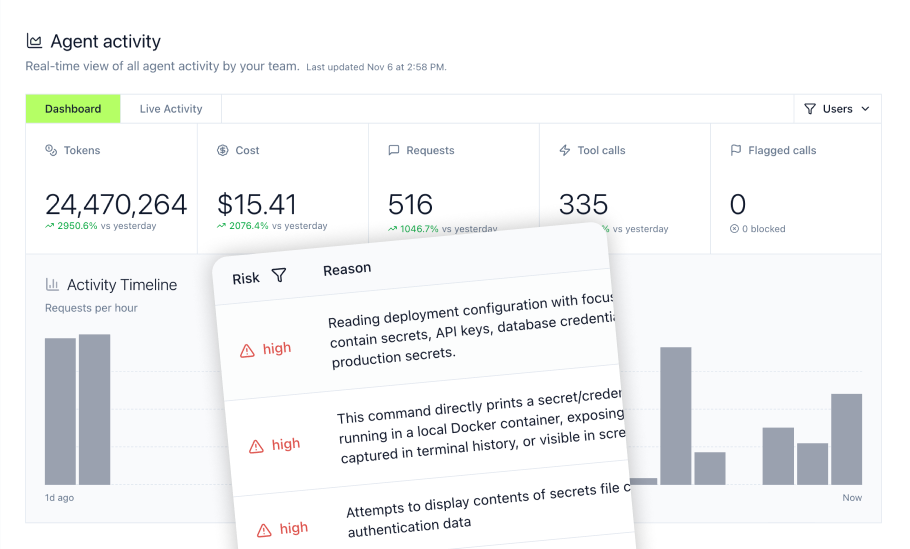
MintMCP Agent Monitor tracks agent activity in real-time across the organization, including MCP calls made outside the gateway through hooks in Cursor and Claude Code. Capabilities include:
- Shadow AI detection identifying off-gateway MCP usage in developer tools
- PII and credential detection flagging sensitive data in agent interactions
- Custom guardrail policies with block, flag, or alert actions
- MDM-pushed enforcement for consistent policy application across developer machines
- Org-level analytics on MCP adoption, usage patterns by team and tool, latency monitoring, and error tracking
This two-layer architecture combines gateway governance with local agent monitoring, covering both MCP traffic through the gateway and local agent activity in supported developer tools.
Integration and Ecosystem: Connecting AI Agents to Enterprise Workflows
The value of an agent gateway depends on how easily it connects to existing enterprise systems. Both platforms approach integrations differently.
Bridging AI Agents with Existing Business Applications
MintMCP provides hundreds of prebuilt MCP connectors with hosted deployment, covering:
- Collaboration tools: Slack, Notion, Asana, Linear
- Developer platforms: GitHub, GitLab, Jira, Buildkite
- Data sources: Snowflake, BigQuery, PostgreSQL, MongoDB
- CRM and sales: Salesforce, HubSpot, Gong
- Observability: Datadog, Grafana, Sentry
MintMCP hosts and operates these connectors with auto-scaling and isolated execution per connector. Customers do not need to manage Kubernetes pods, runtimes, or scaling for the connector layer.
For custom integrations, MintMCP supports:
- STDIO server hosting automatically converting locally-run MCP servers to hosted, production-ready services
- OAuth wrapping working around hosted-container redirect-URI limitations
- Protocol bridging for REST, SOAP, databases, and functions to MCP
- Custom MCP connectors deployable via CLI or Admin MCP
Developing a Future-Proof Agent Gateway Ecosystem
MintMCP's ecosystem extends across all major AI clients:
- Cursor Hooks partner support
- Claude integration including Claude Desktop, Claude Code, and Cowork
- ChatGPT setup including Custom GPTs
- Gemini CLI and Gemini Enterprise support
- GitHub Copilot, Windsurf, Replit, and other MCP clients
Google Cloud Agent Gateway supports Agent Runtime and Gemini Enterprise, with different supported modes for each runtime. It supports MCP, A2A, REST, and gRPC, and its governance model is centered on Google Cloud projects, Agent Registry, Cloud Logging, Cloud Trace, and related Google Cloud services.
Operational Efficiency: Performance, Cost, and Engineering Overhead
The operational model of an agent gateway affects both direct costs and engineering productivity.
Maximizing ROI from AI Agent Deployments
MintMCP customers report time savings on routine tasks post-deployment. Several factors contribute to this efficiency:
- One-click MCP server deployment eliminates connector development time
- Virtual MCP Bundles reduce configuration complexity for team onboarding
- Centralized credential management removes per-integration key handling
- Built-in monitoring provides latency and error tracking without additional tooling
- Enterprise SSO streamlines user authentication
MintMCP's Virtual MCP abstraction reduces configuration complexity for non-technical users, enabling broader AI adoption across teams.
Reducing Engineering Burden with Abstraction Layers
The choice between self-hosted and managed deployment affects ongoing operational costs:
MintMCP Managed:
- MintMCP hosts and scales connector instances
- Automatic updates and security patches
- SLA-backed availability
- Per-user pricing aligned with team size
MintMCP Self-Hosted:
- Full control over infrastructure
- Integration with existing Kubernetes operations
- Cost optimization at scale
- Deployment within approved infrastructure
Google Cloud Agent Gateway / Agent Platform:
- Agent Runtime and Sandbox usage are billed through Agent Compute and Agent Memory
- Gateway deployments may also depend on surrounding Google Cloud services, so teams should model total cost across runtime, networking, logging, tracing, and related infrastructure
- Pricing should be validated against current Google Cloud pricing before procurement
For organizations already operating Kubernetes clusters with dedicated platform teams, MintMCP's self-hosted option may provide long-term cost efficiency. For teams prioritizing speed to deployment without infrastructure management, MintMCP's managed option delivers the same capabilities without operational overhead.
Why Enterprises Evaluate MintMCP for AI Agent Governance
MintMCP positions itself as an MCP-specialized governance platform for enterprises deploying AI agents at scale. Several factors drive this adoption.
Real-World Impact: Case Studies and Client Successes
Public MintMCP case studies describe enterprise use cases around Virtual MCP Bundles, credential management, and reducing tool sprawl across teams. For this comparison, the more relevant distinction is architectural: MintMCP centers governance around scoped MCP access, per-agent identity, auditability, and monitoring.
MintMCP's Differentiated Approach to AI Security
MintMCP's architecture reflects a data-permissions-first philosophy. Rather than starting from the agent and retrofitting governance, MintMCP starts from data permissions (SSO, SCIM, IdP groups, Virtual MCP Bundles, tool-level policy, audit) and then enables agents on top. This means an agent's access is always a subset of an already-governed permission model.
The security whitepaper "Securing the Model Context Protocol: Risks, Controls, and Governance" was co-authored with security leaders from Vanta and Darktrace, establishing MintMCP as a thought leader in the MCP security domain.
MintMCP also provides customer-authored custom gateway middleware in a JS sandbox with:
- Allowed-domains fetch and secret injection
- Built-in templates for OpenAI moderation and jailbreak detection
- AWS Bedrock Guardrails integration (block and mask)
- DLP integrations with Google Cloud Sensitive Data Protection / Cloud DLP, Microsoft Purview, Nightfall, and Skyflow
MintMCP for Enterprise AI Agent Governance
For enterprises ready to deploy AI agents at scale, MintMCP provides the governance foundation that enables innovation without sacrificing security. Organizations evaluating AI agent gateways should consider how deployment flexibility, governance architecture, and monitoring capabilities align with their infrastructure requirements and compliance obligations.
MintMCP's managed SaaS-first approach delivers rapid deployment and reduced operational overhead, while VPC/self-hosted options address private infrastructure requirements. The platform's dual-layer architecture combines MCP Gateway for governed tool connections with Agent Monitor for shadow AI detection, providing visibility across both gateway-routed and local agent activity in developer tools like Cursor and Claude Code.
The Bundle and Agent Bundle model addresses a critical gap in enterprise AI governance: how to grant precise, auditable, rotatable access to both human teams and autonomous agents. With hundreds of prebuilt MCP connectors, Virtual MCP Bundles for role-based access, per-agent identity management, and comprehensive monitoring, MintMCP addresses core enterprise AI governance needs across Claude, Cursor, ChatGPT, Gemini, and Copilot deployments.
Organizations can start a free trial with no sales call required, or explore the product tour to see how MintMCP can govern AI agent infrastructure.
Frequently Asked Questions
What is the primary difference between a self-hosted AI agent gateway and a cloud-native one?
A self-hosted AI agent gateway runs on your own infrastructure, whether on-premises or in your cloud VPC, giving you control over infrastructure deployment, security configuration, and integration with existing systems. A cloud-native gateway runs on the provider's infrastructure with the provider managing operations. MintMCP is managed SaaS-first, with VPC/self-hosted deployment available on request, while Google Cloud Agent Gateway is deployed and managed within Google Cloud projects without a self-hosted option.
How does MintMCP address the "last mile problem" in enterprise AI?
MintMCP solves the last mile problem by providing centralized authentication, access control, and observability for AI agents connecting to internal systems. Rather than requiring extensive engineering work for each integration, MintMCP offers hundreds of prebuilt MCP connectors with hosted deployment, OAuth brokering for credential management, and Virtual MCP Bundles that package tools by role or use case.
What security and compliance standards does MintMCP support for enterprise use?
MintMCP is SOC 2 Type II audited, with continuous compliance monitoring via Drata. Customers handling protected health information can request HIPAA documentation, and MintMCP signs BAAs. Infrastructure is penetration tested, with data encryption in transit and at rest, deployment options for private infrastructure requirements, and uptime SLA. Visit the Trust Center or contact security@mintmcp.com for compliance documentation.
Can MintMCP detect and prevent shadow AI activity in developer tools like Cursor and Claude Code?
Yes. MintMCP's Agent Monitor detects off-gateway MCP usage in developer tools through hooks in Cursor and Claude Code. It identifies PII exposure, credential leakage, risky bash commands, and prompt injection attempts. Custom guardrail policies can block, flag, or alert on detected issues, and MDM integration enables policy enforcement across developer machines.
What is the Bundle architecture in MintMCP, and how does it simplify AI agent governance?
MintMCP's Bundle architecture packages tool access, policy enforcement, and audit logging into single governance units. Each Bundle represents a curated set of MCP tools for a specific team, role, or use case, with SCIM-driven membership that syncs with identity providers. Agent Bundles extend this model to AI agents, giving each agent its own credential set with independent rotation, M2M authentication, and scoped tool access.
How does MintMCP ensure auditability and credential hygiene for individual AI agents?
MintMCP's Agent Bundles provide per-agent identity with bearer API keys plus OAuth 2.0 client-credentials. Each agent receives its own rotatable credentials scoped to specific tools, independent of human user credentials. All agent actions are logged with full context: who initiated, which tools were called, what data flowed through, and when. Credentials can be rotated or revoked per agent without affecting other agents or users.