Selecting the right AI agent governance platform requires evaluating security architecture, deployment flexibility, policy enforcement capabilities, and how well each solution aligns with your specific enterprise needs. Both MintMCP and TrueFoundry serve the growing market for AI agent infrastructure, but they approach the challenge from fundamentally different angles. MintMCP's MCP Gateway provides governed data and tool connections for Claude, Cursor, ChatGPT, Gemini, and Copilot, while its Agent Gateway builds on that foundation with agent identities, permissions, memory, and monitoring for agents that work alongside users. TrueFoundry operates as a broader AI platform combining AI Gateway, MCP Gateway, Agent Gateway, and deployment infrastructure. This comparison examines both platforms to help determine which approach aligns with your enterprise's AI governance priorities.
Key Takeaways
- MintMCP provides purpose-built MCP governance with a specialized focus on securing AI coding assistants and enterprise agents
- MintMCP's Bundle architecture packages tool access, policy enforcement, and audit logging into single governance units, compared to multi-object configuration models used by alternatives
- MintMCP provides a managed connector runtime with hundreds of prebuilt connectors, while the broader MCP ecosystem has grown to more than 10,000 active servers
- MintMCP's Agent Monitor tracks activity beyond the gateway, detecting local agent activity in developer tools like Cursor and Claude Code
- MintMCP is listed in Cursor's Hooks Partners Program, supporting workflows for enterprises deploying AI coding assistants at scale
- MintMCP supports per-agent identity with scoped credentials, enabling rotation and revocation per agent without affecting users or other agents
Understanding Enterprise AI Agent Gateways: The Foundation of Governed AI
The enterprise AI landscape in 2026 presents a fundamental challenge: organizations are moving from AI experimentation to production agent deployments faster than their governance systems can adapt. As agents gain access to internal tools, SaaS systems, databases, and developer environments, visibility becomes the central operational gap.
This visibility gap creates real risk. Without centralized controls, teams can end up with unmanaged tool access, scattered credentials, incomplete audit trails, and no reliable way to investigate what an agent did. Enterprise AI agent gateways address this challenge by providing centralized control over how AI systems access internal data and tools.
What is an AI Agent Gateway and Why is it Essential for Enterprises?
An AI agent gateway serves as the governance layer between your AI systems and your enterprise data. It handles:
- Authentication: Ensuring every agent and user request is verified before accessing tools
- Authorization: Controlling which tools and data each agent or user can access based on role
- Audit logging: Capturing every tool call, prompt, and response with full attribution
- Policy enforcement: Applying security rules in real-time to block risky actions
Without this governance layer, enterprises face credential sprawl, audit gaps, and no clear way to answer "what did that agent just access?"
The Role of MCP in Enterprise AI Strategy
The Model Context Protocol (MCP) has emerged as the connective tissue for enterprise AI. MCP standardizes how AI agents connect to databases, SaaS tools, internal APIs, and other data sources. MCP has gained first-class client support across major AI platforms including ChatGPT, Claude, Cursor, Gemini, Microsoft Copilot, and Visual Studio Code, and the ecosystem reached 97 million monthly SDK downloads before transitioning to the Linux Foundation's governance in December 2025.
For enterprises, MCP adoption creates both opportunity and governance challenge. The protocol enables agents to access production systems directly, meaning uncontrolled MCP usage poses the same risks as uncontrolled API access, with the added complexity of AI decision-making in the loop.
Key Governance Principles for AI Deployments
Effective AI governance requires:
- Centralized visibility: One place to see all agent activity across tools and teams
- Granular access control: Tool-level permissions, not just server-level access
- Credential isolation: Per-agent credentials that can be rotated independently
- Policy enforcement at runtime: Rules that execute on every tool call, not just at deployment
- Audit trails for compliance: Immutable logs capturing who, what, when, and why
Both MintMCP and TrueFoundry address these principles, though with different architectures and priorities.
MintMCP's Governance Architecture: Bundles and Per-Agent Identity
MintMCP takes a data-permissions-first approach to AI governance. Rather than starting from the agent and retrofitting security, MintMCP starts from governance (SSO, SCIM, IdP groups, tool-level policy, audit) and enables agents on top. This architecture ensures an agent's access is always a subset of an already-governed permission model.
Simplify AI Governance with MintMCP's Bundle Model
The Bundle (Virtual MCP) is MintMCP's core abstraction. Each Bundle ties:
- SCIM group membership: Sync automatically with Okta, Azure AD, or Google Workspace
- Curated MCP server list: Select which tools each team or role can access
- Custom policy rules: Apply organization and team-level policies that cascade appropriately
- Isolated audit trail: Track activity per Bundle for clear compliance reporting
This packaging approach reduces configuration complexity. Instead of managing separate plugin, access rule, and credential objects, administrators work with one governance unit per team or role. The result: faster deployment and fewer configuration errors.
Bundles can require admin approval for new tool additions, addressing the silent capability expansion risk when upstream MCP servers add new tools. This tool-update policy gives security teams control over what new capabilities enter production.
Achieving Audit Attribution Through Per-Agent Credentials
MintMCP's Agent Identities feature provides each deployed AI agent with its own persistent identity and scoped credentials. This capability addresses a critical enterprise requirement: knowing exactly which agent performed which action.
Key capabilities include:
- Bearer API keys plus OAuth 2.0 client-credentials per agent
- Independent rotation and revocation without affecting human users or other agents
- "Act as agent" admin flow for connectors requiring per-agent OAuth
- Full audit attribution tying every action to a specific agent identity
When each agent has its own credentials and scope, security teams stop worrying about what could go wrong and start focusing on what they can build next. This per-agent isolation contrasts with shared token models where one compromised credential affects multiple systems.
Scalable Policy Management with SCIM Integration
MintMCP integrates with enterprise identity providers through SCIM, meaning Bundle membership updates automatically when Okta or Azure AD groups change. This integration eliminates manual access management and ensures governance scales with the organization.
The Bundle model extends to agent identities through Agent Bundles. Non-human principals receive the same governance treatment as human teams: explicit permissions, scoped tools, isolated audit trails.
Advanced Policy Enforcement and Data Security: MintMCP's Technical Edge
MintMCP's policy layer goes beyond declarative rules. Custom policy code execution on every tool call enables inline integration with existing enterprise security investments.
Runtime Policy Hooks: The Power of Custom Code Execution
MintMCP's Gateway Middleware runs customer-authored JavaScript in a sandboxed environment with:
- Allowed-domains fetch: Control which external APIs middleware can call
- Secret injection: Access credentials securely within policy code
- Built-in templates: Pre-configured rules for OpenAI moderation, jailbreak detection, and AWS Bedrock Guardrails
- awsSign() SigV4 helper: Simplified AWS service integration
- Pre- and post-phase hooks: Transform, mask, or block requests and responses
This programmable approach lets enterprises implement custom logic that declarative-only policy engines cannot express. Need to call an internal classification service before allowing data access? Write the integration once and apply it across all Bundles.
Integrating Enterprise DLP Solutions with AI Workflows
MintMCP provides documented integrations with enterprise DLP platforms:
- AWS Bedrock Guardrails: Block and mask modes for content filtering
- Google Cloud DLP: Scan for sensitive data patterns
- Microsoft Purview: Enterprise information protection
- Nightfall: Real-time PII detection
- Skyflow: Data privacy vault integration
These integrations enable MintMCP to act as the enforcement point for existing security investments. Rather than requiring a new DLP vendor, enterprises connect their current tools to the MCP governance layer.
Ensuring Data Security and Compliance
MintMCP is SOC 2 Type II audited, with continuous compliance monitoring via Drata. Additional security capabilities include:
- Compliant with HIPAA standards, with HIPAA documentation available and BAAs signed for customers handling protected health information
- Penetration tested infrastructure
- Data encryption in transit and at rest
- Data residency options for supported deployment needs
- Uptime SLA for production workloads
The platform operates on a zero-trust architecture with no default access assumptions. Every request requires authentication and authorization.
Shadow AI Detection and Monitoring: Beyond the Gateway with MintMCP Agent Monitor
One of the most significant governance gaps in enterprise AI is visibility into what happens outside the gateway. Developers using AI coding assistants locally can access MCP servers without passing through central governance. MintMCP's Agent Monitor addresses this challenge directly.
Uncovering Unsanctioned AI Use Cases: The Shadow AI Problem
Shadow AI refers to AI tool usage that bypasses enterprise governance. In the context of MCP, this means developers connecting AI assistants to MCP servers locally without central visibility. The result: no audit trail, no policy enforcement, and no way to detect risky behavior.
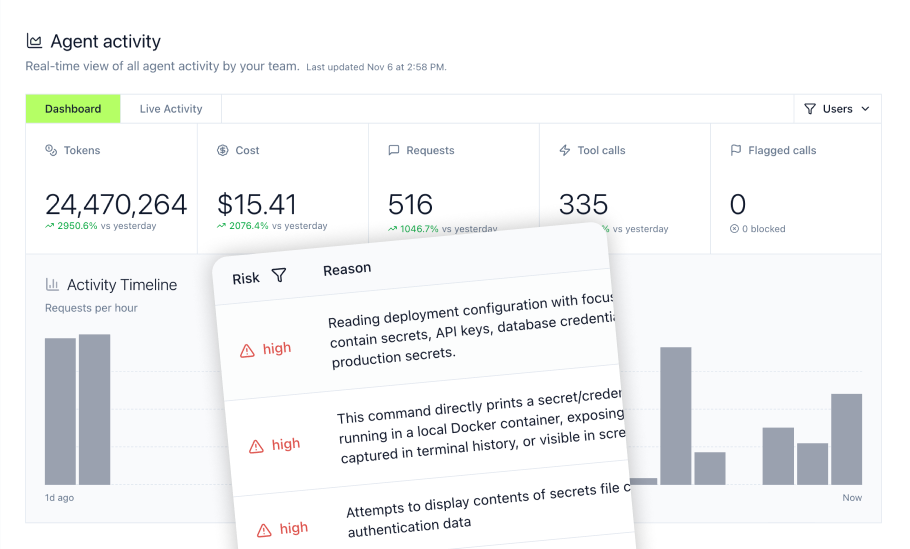
Agent Monitor solves this by hooking into developer tools where the AI activity actually happens. The platform tracks agent activity in real time across the organization, including local activity such as Bash commands, file reads and writes, and prompt submissions through hooks in Cursor and Claude Code.
Real-time Threat Detection for AI Agent Activity
Agent Monitor detects multiple risk categories:
- PII exposure: Sensitive data appearing in prompts or responses
- Credential leakage: API keys, tokens, or secrets in agent communications
- Risky bash commands: Dangerous system operations attempted by agents
- Prompt injection attempts: Attacks trying to manipulate agent behavior
Each detection can trigger block, flag, or alert actions based on configured guardrail policies. Security teams see what agents are doing without waiting for an incident report.
Enforcing Consistent Policies Across Developer Environments
Agent Monitor includes MDM integration for enterprise deployment. IT teams can push detect-only or enforce-mode configurations to developer machines through existing device management tools. This ensures consistent policy application whether developers connect through the gateway or use local MCP connections.
The two-layer governance model (Gateway + Agent Monitor) provides coverage that gateway-only solutions cannot match. MintMCP's security approach ensures every agent action is logged with full context: who initiated it, which tools were called, what data flowed through, and when.
TrueFoundry Agent Gateway: A Comparative Overview of Key Features
TrueFoundry positions itself as a broader AI platform combining AI Gateway, MCP Gateway, Agent Gateway, and deployment infrastructure. The platform serves teams that need unified control across models, tools, agents, training, and deployment.
TrueFoundry's Approach to AI Agent Access Management
TrueFoundry provides:
- MCP Registry for managing server connections
- RBAC integration with identity providers
- Authentication and authorization for gateway access and downstream MCP server connections
- Audit logging for compliance
The platform's broader scope means MCP governance is one module among many rather than the sole focus.
Policy Definition and Enforcement in TrueFoundry
TrueFoundry offers policy-based enforcement through declarative configuration. The platform provides real-time monitoring and can block tool calls based on defined rules. Budget controls allow per-team spending limits across models and tools.
Integration Ecosystem: A Look at Available Connectors
TrueFoundry's integration ecosystem includes:
- LLM providers: Routing across multiple model providers, including OpenAI, Anthropic, Gemini, Groq, and Mistral
- Observability: Monitoring and telemetry integrations for AI workloads
- Agent frameworks: LangGraph, CrewAI, AutoGen, and custom orchestration
- Deployment: Kubernetes, AWS, Azure, GCP, on-premises, and air-gapped options
The platform's breadth serves organizations seeking one vendor for multiple AI operations needs.
Key Differentiators: MintMCP vs. TrueFoundry in Enterprise AI Governance
The fundamental difference between these platforms comes down to specialization versus breadth. MintMCP focuses entirely on MCP governance and agent infrastructure. TrueFoundry spreads across the full AI platform stack.
Simplifying Configuration: MintMCP's Bundle vs. Competitor Models
MintMCP's Bundle model packages everything administrators need into one object. TrueFoundry and other alternatives typically require managing separate configuration elements:
MintMCP Bundle includes:
- Tool access permissions
- Policy enforcement rules
- Audit logging configuration
- SCIM group membership
- Agent identity scoping
This bundled approach means fewer configuration objects, faster deployment, and reduced chance of misconfiguration.
Granular Access Control: Per-Agent Identity vs. Shared Tokens
MintMCP provides per-agent OAuth credentials that rotate and revoke independently. When one agent needs credential rotation, other agents and users are unaffected. This granular control enables:
- Precise audit attribution: Every action tied to a specific agent
- Isolated blast radius: Compromised credential affects only one agent
- Independent lifecycle management: Rotate, revoke, or modify per agent
Alternative approaches using shared tokens across agents create audit ambiguity and broader exposure when credentials need rotation.
Extending Governance: Beyond the Gateway with Shadow AI Detection
MintMCP's Agent Monitor provides visibility into local agent activity that gateway-only solutions can miss. When developers use Cursor or Claude Code locally, Agent Monitor can track activity such as file reads, command execution, prompt submissions, and supported MCP tool calls.
This capability addresses the real-world challenge that not all AI usage flows through central infrastructure. Effective governance requires visibility at the endpoint, not just the gateway.
Deployment and Integration: Cloud, Hybrid, and Ecosystem Compatibility
Both platforms offer flexible deployment, though with different emphases.
Flexible Deployment: From Cloud to VPC
MintMCP operates as managed SaaS-first, with US and EU deployment options and VPC or self-hosted deployment available on request for enterprises requiring infrastructure control.
TrueFoundry offers managed SaaS plus self-hosted control plane deployment in customer Kubernetes environments. Air-gapped deployment uses forward proxy configuration.
Seamless Integration with Major LLMs and Developer Tools
MintMCP's integration ecosystem covers the AI tools enterprises actually deploy:
- AI assistants: Claude (Chat, Code, Cowork), ChatGPT, Gemini, Cursor, Windsurf, GitHub Copilot
- Platforms: Replit, Goose, LibreChat, Open WebUI
- Transports: STDIO for local subprocess-based servers, streamable HTTP for remote servers, and compatibility with legacy SSE-based MCP servers where needed
- Identity providers: Okta, Azure AD, Google Workspace via SSO and SCIM
- SIEM platforms: Microsoft Sentinel, Splunk, S3 export
MintMCP's connector catalog includes pre-configured connectors for Salesforce, GitHub, Slack, HubSpot, Notion, Linear, Gmail, Stripe, and other common enterprise tools. Hosted MCP connectors run with auto-scaling and sandboxed execution per connector, with no Kubernetes pods for customers to operate.
Programmatic Management for DevOps Workflows
MintMCP provides REST APIs and SDKs for infrastructure-as-code workflows. The Admin MCP capability enables operating the platform from any MCP client, managing rules, deploying custom connectors, pulling logs, and restarting connectors through conversational administration with full audit.
Enterprise Adoption and Market Traction in the AI Gateway Sector (2026)
The MCP gateway market has grown rapidly as enterprises recognize the governance challenge created by AI agent proliferation.
The Exploding MCP Ecosystem: A Protocol for Enterprise AI
MCP adoption accelerated dramatically in 2025, with first-class client support across major AI platforms including ChatGPT, Claude, Cursor, Gemini, Microsoft Copilot, and Visual Studio Code. The protocol's transition to Linux Foundation governance signaled enterprise readiness. MintMCP positioned as the infrastructure layer for this standardization wave, analogous to how API gateways emerged in the previous decade.
Real-World Impact: Client Successes with AI Agent Gateways
MintMCP's production use cases focus on reducing configuration complexity, centralizing credential management, and giving security teams clearer audit attribution across MCP servers and agent activity.
These outcomes reflect the data-permissions-first approach working in production enterprise environments.
Strategic Partnerships and Industry Recognition
MintMCP is listed in Cursor's Hooks Partners Program, supporting organizations that want governance for Cursor-based AI coding workflows.
MintMCP's differentiation in this comparison should stay focused on product architecture: MCP Gateway for governed data and tool connections, Agent Gateway for agent identities, permissions, memory, and monitoring, and Agent Monitor for visibility beyond gateway-only traffic.
Choosing the Right MCP Governance Solution
For organizations prioritizing governed MCP access for AI coding assistants and enterprise agents, MintMCP provides a purpose-built solution designed specifically for this challenge. The platform's specialized focus delivers several key advantages that matter when security and compliance are central requirements.
MintMCP's Bundle architecture reduces the operational burden of managing multiple configuration objects across teams, tools, and policies. Security teams configure once per role or team rather than managing dozens of individual permission mappings. This approach scales naturally as organizations grow their AI agent deployments from pilot to production.
Per-agent identity remains one of MintMCP's strongest differentiators. When every agent has isolated credentials that rotate independently, security teams gain precise audit attribution without the blast radius risk of shared tokens. Combined with Agent Monitor's visibility into off-gateway activity, this two-layer governance model addresses both centralized and distributed AI usage patterns.
The data-permissions-first architecture ensures governance is the foundation, not an afterthought. Agent access is always a subset of an already-governed permission model synced with your identity provider. Policy enforcement happens at runtime on every tool call, with programmable middleware that integrates existing DLP investments rather than requiring replacement.
For enterprises deploying Claude, Cursor, ChatGPT, Gemini, or Copilot with production data access requirements, MintMCP's specialized approach may be a better fit than broader platforms where MCP governance is one feature among many. The managed connector catalog and runtime eliminate the infrastructure overhead of building and maintaining MCP server deployments.
Explore MintMCP to deploy governed MCP access without building the control layer from scratch.
Frequently Asked Questions
What is the Model Context Protocol (MCP) and why is it important for enterprise AI?
MCP standardizes how AI agents connect to databases, SaaS tools, internal APIs, and other data sources. The protocol enables agents like Claude, Cursor, and ChatGPT to access production systems directly. For enterprises, MCP creates both opportunity (powerful agent capabilities) and risk (uncontrolled access to sensitive data). MCP gateways like MintMCP provide the governance layer that makes production MCP deployment safe.
How does MintMCP's 'Bundle' architecture simplify AI agent governance compared to traditional methods?
MintMCP's Bundle packages tool access, policy enforcement, audit logging, and SCIM group membership into a single governance unit. Administrators manage one object per team or role rather than separate plugin, access rule, and credential configurations. Bundles sync automatically with identity provider groups, cascade policies from organization to team level, and can require admin approval for new tool additions.
What is 'shadow AI' and how does MintMCP Agent Monitor address this challenge for enterprises?
Shadow AI refers to AI tool usage that bypasses enterprise governance, such as developers connecting AI assistants to MCP servers locally without central visibility. MintMCP's Agent Monitor hooks into Cursor and Claude Code to track off-gateway MCP usage, detecting PII exposure, credential leakage, risky commands, and prompt injection attempts. MDM integration enables consistent policy enforcement across developer machines.
How do MintMCP and TrueFoundry differ in their approach to agent identity and credential management?
MintMCP provides per-agent identity with dedicated credentials that rotate and revoke independently. Each agent gets its own API key and OAuth 2.0 client-credentials, with no shared keys to leak. TrueFoundry offers agent identity capabilities within its broader platform. The key difference is MintMCP's sole focus on this governance use case versus TrueFoundry's treatment of it as one module among many.
What security and compliance capabilities does MintMCP provide for enterprise adoption?
MintMCP is SOC 2 Type II audited, with continuous compliance monitoring via Drata. The platform is compliant with HIPAA standards, signs BAAs for customers handling protected health information, supports penetration-tested infrastructure, encrypts data in transit and at rest, offers data residency options for supported deployment needs, and provides an uptime SLA. Every agent action is logged with full context for compliance investigations.
Can MintMCP integrate with existing enterprise DLP solutions, and what is its capability for custom policy enforcement?
Yes. MintMCP's Gateway Middleware supports custom JavaScript code running in a sandboxed environment with pre- and post-phase hooks. Documented integrations include AWS Bedrock Guardrails (block and mask modes), Google Cloud DLP, Microsoft Purview, Nightfall, and Skyflow. This enables MintMCP to act as the enforcement point for existing security investments rather than requiring new DLP vendors.