Choosing an AI agent governance platform means evaluating how well each solution addresses your organization's security requirements, deployment speed, and protocol compatibility. Both MintMCP and Credal serve enterprise teams deploying AI agents, but they approach the problem from different architectural foundations. MintMCP's Agent Gateway is purpose-built for Model Context Protocol governance, providing centralized authentication, tool-level access control, and real-time monitoring for AI agents across Claude, Cursor, ChatGPT, Gemini, and Copilot. Credal operates as a broader enterprise agent registry and lifecycle platform, combining agent building, MCP server management, permission mirroring, and multi-agent workflow capabilities. This comparison examines both platforms to help determine which architecture aligns with your enterprise AI infrastructure needs.
Key Takeaways
- MintMCP provides MCP-native architecture purpose-built for Model Context Protocol governance, enabling centralized control over agent-to-tool communication
- MintMCP's registry includes 10,000+ MCP servers with one-click deployment for rapid enterprise adoption
- MintMCP offers one-click STDIO transformation that converts local MCP servers to enterprise-ready remote services in minutes
- MintMCP is listed in Cursor's Hooks partners program for MCP governance and visibility across AI coding assistant workflows
- MintMCP's Bundle architecture packages tool access, policy enforcement, and audit logging into single governance units per team or agent identity
- AI governance is becoming a practical enterprise requirement as agentic systems connect to tools, data, and applications, making governed access, monitoring, and auditability central to production rollout
Understanding the Enterprise Need for AI Governance Platforms
The enterprise AI landscape has shifted dramatically. AI agents now connect to production databases, customer records, and internal systems, creating a governance challenge that traditional security tools were never designed to address. Enterprise AI governance reflects this urgency as regulated industries adopt agentic systems that need controlled access, monitoring, and auditability before production rollout.
The Escalating Challenge of Unmanaged AI Agents
When developers deploy Claude Code, Cursor, or ChatGPT across an organization without centralized controls, several risks emerge:
- Credential sprawl: Each MCP server integration requires its own authentication, leading to unmanaged API keys and tokens scattered across developer machines
- Audit gaps: Without centralized logging, security teams cannot trace which agent accessed what data, when, or why
- Policy inconsistency: Different teams configure access controls differently, creating compliance blind spots
- Shadow AI activity: Agents running locally bypass network-level security entirely
Defining Enterprise AI Agent Governance
Effective AI agent governance aligns with broader AI risk management practices such as the NIST AI Risk Management Framework, then applies those controls at the agent, tool, identity, and audit layers:
- Centralized authentication: Single sign-on and identity provider integration for all agent access
- Tool-level access control: Granular permissions that specify which tools each team or agent can invoke
- Complete audit trails: Conversation-level logging that captures prompts, tool calls, responses, and context
- Policy enforcement: Rules that block or flag risky behaviors before they cause harm
MintMCP and Credal both address these requirements, though through different architectures.
Why Traditional Security Falls Short for AI Agents
API gateways and network security tools operate at the wrong layer for AI agent governance. They can see HTTP traffic, but they cannot interpret the semantic content of tool calls, detect prompt injection attempts, or enforce policies based on what an agent is trying to accomplish.
Model Context Protocol has become a standard for connecting AI models to tools, data, and applications, with more than 10,000 published MCP servers under the Linux Foundation's Agentic AI Foundation governance. But the protocol itself is not a complete enterprise governance layer. That gap is what MCP gateways and agent governance platforms fill.
MintMCP's Agent Governance: Security and Observability for MCP
MintMCP's architecture starts from a data-permissions-first foundation. Rather than building an agent platform and retrofitting security, MintMCP establishes SSO, SCIM, role-based access, and audit controls as the foundation, then enables agents on top of that governed layer.
The MintMCP Gateway: Orchestrating Secure Agent Access
MintMCP Gateway manages and hosts MCP servers with enterprise authentication and access controls. The platform provides:
- 50+ managed connectors including Salesforce, GitHub, Slack, HubSpot, Notion, Linear, Gmail, Stripe, Elasticsearch, and Snowflake
- 10,000+ MCP servers in the registry with one-click installation
- OAuth 2.0 and SAML authentication integrated with enterprise identity providers
- Automatic credential rotation eliminating manual key management
- Rate limiting per user/team preventing runaway agent behavior
- Tool-level access control enabling database reads while blocking writes, for example
The Gateway normalizes all upstream MCP transports (STDIO, HTTP-streamable, SSE) and authentication methods. Clients connect through one SSO-fronted remote MCP endpoint regardless of upstream variety.
Agent Monitor: Real-time Threat Detection and Usage Analytics
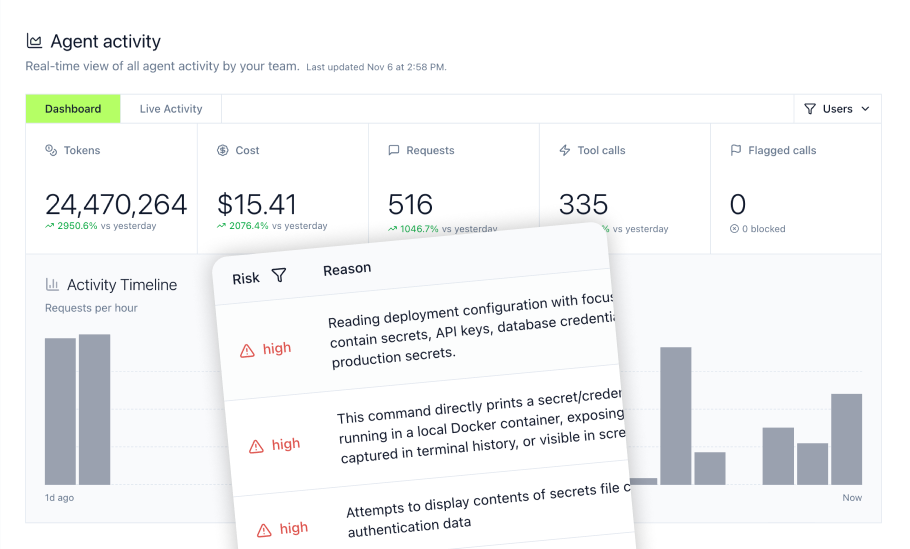
Agent Monitor extends visibility beyond the gateway to track agent activity across the organization, including MCP calls made outside the gateway through hooks in Cursor and Claude Code.
Key capabilities include:
- PII exposure detection with automatic alerts when agents attempt to access sensitive data
- Credential leakage scanning for API keys, tokens, and secrets in agent outputs
- Risky command detection for potentially destructive bash operations
- Prompt injection identification using built-in detection rules
- Custom guardrail policies with configurable block, flag, and alert actions
- Org-level analytics showing MCP adoption, usage patterns by team and tool, latency, and errors
Comprehensive Logging for Audit and Compliance
Every agent action through MintMCP is logged with full context: who initiated it, which tools were called, what data flowed through, and when. These audit trails support:
- Per-user attribution connecting every action to an authenticated identity
- Configurable retention matching your compliance requirements
- SIEM export to Microsoft Sentinel, Splunk, or S3
- Immutable audit records designed to support compliance investigations
Differentiating MintMCP: Bundles, Policies, and Credential Hygiene at Scale
MintMCP's Bundle architecture represents a fundamental departure from how other platforms approach governance. Rather than requiring separate configuration of plugins, access rules, and credential objects, MintMCP packages everything into a single governance unit.
The Power of Bundles: Streamlined Governance for Teams and Agents
A Bundle ties together:
- SCIM group membership synced automatically with Okta or Azure AD
- Curated MCP server list defining which tools the team can access
- Custom policy rules enforced on every tool call
- Isolated audit trail scoped to that Bundle's activity
This means onboarding a new team to governed MCP access involves creating one Bundle, not configuring multiple disconnected objects across different admin surfaces.
Virtual MCPs extend this model by creating role-based endpoints. Each Virtual MCP bundles multiple servers with tool access scoped to a specific use case.
Granular Control: Custom Policy Code and Inline DLP
MintMCP supports custom policy execution on every tool call through a JS sandbox with:
- Allowed-domains fetch for calling external services
- Secret injection for secure credential access in policy code
- Built-in templates for OpenAI moderation, jailbreak detection, and AWS Bedrock Guardrails
- Pre- and post-phase hooks that can transform, mask, or block tool calls
This programmable middleware layer integrates with existing DLP investments including AWS Bedrock Guardrails, Google Cloud DLP, Microsoft Purview, Nightfall, and Skyflow.
Securing Agent Identities with Independent Credential Rotation
Agent Bundles provide per-agent identity as a first-class primitive. Each AI agent receives:
- Bearer API keys specific to that agent
- OAuth 2.0 credentials for M2M authentication
- Independent rotation without affecting human users or other agents
- Per-agent OAuth flow for connectors requiring individual agent authorization
This eliminates shared service account keys and ensures credential hygiene at scale.
Ensuring Compliance in AI: SOC 2, HIPAA, and Data Residency
Enterprise AI deployment requires demonstrable compliance. Both MintMCP and Credal address compliance requirements.
Meeting Regulatory Demands: MintMCP's Compliance Posture
MintMCP maintains:
- SOC 2 Type II audited with continuous compliance monitoring via Drata
- Compliant with HIPAA standards with HIPAA documentation available for customers handling protected health information. MintMCP signs BAAs
- Penetration tested infrastructure with documented security practices
- Data encryption in transit and at rest
- Data residency options
- Uptime SLA for production workloads
Visit the Trust Center or contact security@mintmcp.com for compliance documentation.
Protecting Sensitive Data: Encryption and Data Residency
For organizations operating under GDPR, CCPA, or industry-specific regulations, deployment architecture matters. MintMCP lists data residency options, with VPC and self-hosted deployment options available on request for organizations requiring more infrastructure control. Teams with multi-region data residency requirements should confirm the exact deployment scope with MintMCP.
Mitigating Shadow AI Risks with Advanced Detection Capabilities
Shadow AI presents a growing concern for security teams. When developers run AI agents locally without going through governed channels, the organization loses visibility into what data those agents access and what actions they take.
Uncovering Unsanctioned Agent Activity
MintMCP's Agent Monitor addresses shadow AI through hooks that detect agent activity in Cursor and Claude Code, even when that activity does not flow through the MintMCP Gateway.
This detection covers:
- Local MCP calls made directly from developer machines
- File system access by AI coding assistants
- Bash command execution including potentially destructive operations
- Prompt submissions to LLM providers
Proactive Threat Intelligence for AI Agent Usage
Beyond detection, Agent Monitor enables proactive threat intelligence by:
- Identifying patterns in risky agent behavior across the organization
- Correlating activity across multiple agents and users
- Surfacing anomalies that may indicate compromised credentials or malicious prompts
- Tracking adoption to understand which teams and tools drive agent usage
Enforcing Policies Across Developer Workflows
MDM integration enables push of detect-only or enforce-mode configurations to developer machines. This allows security teams to start with visibility in detect mode, escalate to enforcement once policies are validated, and apply consistent controls across the entire developer population.
Use Cases for Enterprise AI Agent Deployment
MintMCP's architecture supports diverse enterprise use cases where AI agents need governed access to internal systems.
Accelerating Data Insights with Governed AI Agents
Data analysis agents connecting to Snowflake, Elasticsearch, or BigQuery can generate reports and answer questions about business metrics. With MintMCP governance, read-only access prevents accidental data modification, query logging creates audit trails for data access, and team-scoped permissions ensure analysts only access relevant datasets.
Transforming Customer Support and Development Workflows
Customer support agents connecting to CRM and ticket systems (Salesforce, Zendesk, HubSpot) can resolve issues faster. Development workflow agents connecting to GitHub, Jira, and CI/CD pipelines can automate routine tasks.
For development teams using Cursor or Claude Code, MintMCP provides governed repository access through GitHub MCP connectors, issue tracking integration via Linear or Jira connectors, and database query capabilities with read-only or read-write controls.
MintMCP customer materials highlight reduced configuration complexity through Virtual MCP abstraction, especially for teams that need governed access without asking every user to manage MCP setup manually.
MintMCP in the Ecosystem: Partnerships and Integrations
MintMCP's position in the AI ecosystem is supported by Cursor Hooks partner listing and broad integration coverage.
Seamless Integration with Leading LLM and Agent Platforms
MintMCP provides governed access for agents built on:
- Claude (Chat, Code, Cowork)
- ChatGPT and ChatGPT Workspace Agents
- Gemini
- Cursor (Cursor Hooks partner)
- Windsurf
- GitHub Copilot
- Replit
- Goose
- LibreChat
- Open WebUI
This breadth ensures organizations can govern agents regardless of which LLM provider or client interface they choose.
Extending Security with Identity and SIEM Providers
Enterprise identity integration includes Okta for SSO and SCIM provisioning, Azure AD for Microsoft-centric environments, and Google Workspace for Google-first organizations.
SIEM integration supports export to Microsoft Sentinel, Splunk, and S3 for custom analytics pipelines.
Competitive Landscape: MintMCP's Differentiators Against Alternatives
When evaluating MCP gateway and agent governance platforms, understanding architectural differences helps clarify which approach fits specific requirements.
Beyond Basic Gateways: Architectural Approach
MintMCP's MCP-native architecture provides advantages over platforms that treat MCP as one protocol among many:
- Purpose-built for MCP rather than retrofitted from API gateway architecture
- Protocol-level MCP handling that supports tool-level policy enforcement and auditability
- STDIO transformation that converts local servers to enterprise-ready remote services in minutes
- Broad MCP ecosystem coverage supporting rapid deployment
From Shared Tokens to Per-Agent Identity
Traditional approaches to agent authentication rely on shared service accounts or user-delegated tokens. MintMCP's Agent Bundles solve this by giving each agent its own identity with independent credential lifecycle, eliminating credential sprawl when multiple agents share the same keys, audit ambiguity when actions cannot be attributed to specific agents, and rotation complexity when revoking one agent's access requires regenerating keys for all.
Runtime Policy Enforcement: A Key Advantage
MintMCP's programmable middleware layer executes custom policy code on every tool call. This enables inline DLP integration with existing security investments, custom business logic beyond what declarative policies can express, and pre- and post-processing of tool call inputs and outputs.
Conclusion
MintMCP provides the MCP-native governance layer enterprises need as AI agents become core infrastructure. The MintMCP Gateway centralizes authentication, access control, and credential management for AI agents across Claude, Cursor, ChatGPT, Gemini, and Copilot. Agent Monitor extends visibility to detect shadow AI activity on developer machines. The Bundle architecture packages tool access, policy enforcement, and audit logging into single governance units that sync with enterprise identity providers.
For organizations standardizing on Model Context Protocol and deploying AI coding assistants at scale, MintMCP's purpose-built architecture provides an MCP-focused operating model for teams that want governance centered on agent-to-tool access, identity, monitoring, and auditability rather than a broader agent lifecycle platform.
With MCP moving under the Linux Foundation's Agentic AI Foundation in December 2025 and more than 10,000 published MCP servers across the ecosystem, MCP has become a major standard for connecting AI models to tools, data, and applications. MintMCP provides an infrastructure layer for enterprises adopting MCP at scale, adding the governance controls that production deployments require.
Get started with MintMCP's free trial at mintmcp.com. No sales call required.
Frequently Asked Questions
What is the Model Context Protocol (MCP) and why is governance critical for it?
Model Context Protocol is a widely adopted standard for AI agent-to-tool communication, enabling agents to connect to databases, APIs, and internal systems. Governance is critical because MCP connections give agents access to production data and systems. Without centralized authentication, access control, and audit logging, organizations face credential sprawl, compliance gaps, and shadow AI risks. MintMCP provides the governance layer that the base MCP protocol does not include.
How does MintMCP's Bundle architecture simplify AI agent deployment and security compared to other platforms?
MintMCP's Bundle architecture packages tool access, policy enforcement, and audit logging into a single governance unit per team or agent. Each Bundle ties SCIM group membership to a curated MCP server list with custom policy rules and isolated audit trails. This eliminates the need to separately configure plugins, access rules, and credential objects across disconnected admin surfaces. Onboarding a new team involves creating one Bundle rather than multiple configuration steps.
Can MintMCP detect and prevent shadow AI usage in my organization?
Yes. MintMCP's Agent Monitor detects AI agent activity beyond what flows through the gateway by using hooks in Cursor and Claude Code. This includes local MCP calls, file system access, bash command execution, and prompt submissions. MDM integration enables push of detect-only or enforce-mode configurations to developer machines for consistent policy application across the organization.
What compliance standards does MintMCP support for sensitive data handling?
MintMCP is SOC 2 Type II audited with continuous compliance monitoring via Drata. Organizations handling protected health information can request HIPAA documentation, and MintMCP signs BAAs. The platform provides data encryption in transit and at rest, data residency options, penetration tested infrastructure, and uptime SLA. Teams with multi-region data residency requirements should confirm the exact deployment scope with MintMCP. Visit the Trust Center for complete compliance documentation.
How does MintMCP ensure granular access control for AI agents interacting with internal systems?
MintMCP provides tool-level access control within each Bundle. Administrators can enable specific tools while blocking others (for example, allowing database reads while preventing writes). Custom policy code executes on every tool call through a JS sandbox, enabling inline DLP integration and business-specific rules. Agent Bundles extend this to non-human principals, giving each deployed agent its own rotatable credentials and permission scope independent of any user's access level.