ChatGPT Workspace Agents represent a fundamental shift from conversational AI to autonomous workers that execute multi-step tasks across your enterprise systems. Unlike traditional chatbots, these agents run in the cloud, accessing connected data sources through MCP servers to prepare reports, route feedback, qualify leads, and coordinate workflows even when users are offline. The challenge for enterprise teams? Deploying these agents without proper governance exposes sensitive data, creates compliance gaps, and leaves security teams blind to what AI systems are accessing. An MCP gateway provides the centralized control layer that bridges this gap, giving every ChatGPT agent secure, governed access to internal systems without requiring months of custom integration work.
Key Takeaways
- ChatGPT Workspace Agents run autonomously in the background, continuing work when users are offline
- The Model Context Protocol (MCP) standardizes how agents connect to databases, APIs, SaaS apps, and internal systems
- Security teams need visibility into what agents access, what tools they invoke, and what data flows through connected systems
- Enterprise teams can reduce manual coordination across recurring workflows through governed agents
- OAuth scope creep and shadow agent proliferation are common security risks when agents connect to enterprise systems without centralized governance
Understanding ChatGPT Workspace Agents in the Enterprise Landscape
ChatGPT Workspace Agents mark OpenAI's evolution beyond conversational AI into operational infrastructure. These agents access company data sources including Google Drive and SharePoint, execute multi-step workflows, write code, and perform actions continuously.
What Are ChatGPT Workspace Agents?
Workspace agents differ from standard ChatGPT in several critical ways:
- Autonomous execution: Agents run on schedules or triggers, not just in response to prompts
- Shared workflow context: Agents can use configured instructions, connected tools, and organizational context to support recurring workflows
- Multi-tool orchestration: A single agent can coordinate across Slack, GitHub, CRM, Google Drive, and custom connectors
- Background operation: Work continues even when the user who created the agent is offline
Why Enterprise Adoption Demands Robust Infrastructure
The productivity gains can be significant when agents are governed correctly. OpenAI's Workspace Agents examples include sales follow-up, product feedback routing, and finance workflows, showing how teams can move recurring operational work into shared agents.
But these gains come with risk. When agents have persistent access to production systems, the security model changes fundamentally. Traditional chatbot governance, designed for stateless conversations, fails to address:
- Agents with write access to production databases
- OAuth tokens or refresh tokens that can persist beyond a single task
- Agent-to-agent communication chains
- Background operations invisible to standard monitoring
The Need for Enterprise-Grade Governance: Bridging ChatGPT and MCP
The Model Context Protocol (MCP) emerged as the standardized layer connecting AI agents to enterprise data sources. Understanding MCP is essential because major AI platforms increasingly support MCP or connector-based workflows, making governance at the integration layer more important.
What Is the Model Context Protocol?
MCP provides a universal standard for AI-to-data integration using JSON-RPC 2.0 message encoding over UTF-8. Instead of building custom integrations for each AI tool and data source, organizations deploy MCP servers that compliant agents can connect to.
Key MCP components include:
- MCP servers: Connectors that expose specific data sources such as Salesforce, GitHub, databases, and internal APIs
- MCP clients: AI tools that consume MCP connections, including ChatGPT, Claude, Cursor, and other supported clients
- Transport layers: Communication methods between servers and clients, including STDIO, streamable HTTP, and SSE where supported
Why Standard Authentication Is Critical for Enterprise AI
The core security challenge with ChatGPT Workspace Agents lies in OAuth permissions. When users connect agents to data sources, they often grant broad access without understanding the implications. A single "Connect to Google Drive" action can expose sensitive documents, tickets, customer records, or internal workflows to an autonomous agent.
Standard authentication gaps include:
- No per-agent credential scoping: Agents inherit user permissions rather than receiving their own scoped credentials
- Limited credential lifecycle control: Tokens and connector credentials may persist beyond the immediate task unless governed centrally
- No tool-level access control: Agents get all-or-nothing access rather than granular permissions
- No audit attribution: Actions blur between human users and their agents
For a deeper understanding of these risks, the MCP data risk framework provides a comprehensive assessment methodology.
MintMCP Gateway: Your Hub for ChatGPT Workspace Agent Management
An MCP gateway centralizes the control layer between ChatGPT agents and your data sources. Rather than configuring security, authentication, and logging separately for each connector, a gateway provides unified governance across all MCP traffic.
Activating ChatGPT Agents with Pre-configured Connectors
MintMCP Gateway supports 10,000+ MCP servers in its catalog with managed runtime. For common enterprise tools, deployment works through one-click activation:
- Productivity: Google Drive, Slack, Notion, Confluence, Microsoft 365
- Development: GitHub, GitLab, Jira, Linear, Sentry
- CRM: Salesforce, HubSpot, Zendesk
- Data: Snowflake, BigQuery, PostgreSQL, MongoDB
Pre-configured connectors can be governed through OAuth 2.0 authentication, centralized credential management, and rate limiting.
Customizing Access for ChatGPT: STDIO Servers and VMCPs
For proprietary systems without pre-built connectors, organizations can deploy custom MCP servers and route them through MintMCP for authentication, policy enforcement, logging, and managed access.
Virtual MCPs (VMCPs) bundle multiple servers with role-based tool access. A "Sales Operations" VMCP might include Salesforce read access, Slack channel posting, and calendar management, while excluding database write permissions entirely.
For ChatGPT setup instructions, the documentation walks through connecting ChatGPT to Virtual MCP servers, copying MCP URLs, configuring the connector, and authenticating through MintMCP.
Ensuring Secure Authentication for Every Agent
Gateway-level authentication normalizes the security model across heterogeneous systems:
- SAML/OAuth SSO integration with Okta, Azure AD, and Google Workspace
- Credential rotation and revocation independent of user sessions where supported
- Bearer token management with configurable expiration
- Header injection for systems requiring custom authentication
Implementing Granular Security with Agent Bundles for ChatGPT
The Bundle architecture addresses a fundamental limitation in standard MCP deployments: the absence of per-agent identity. Without Bundles, agents operated by a single user may share credentials, making it difficult to rotate one agent's access without disrupting others.
Defining Access with the Bundle Model for ChatGPT Agents
A Bundle ties together:
- SCIM group membership: Who can access the Bundle
- Curated MCP server list: Which tools the Bundle exposes
- Custom policy rules: What operations are permitted
- Isolated audit trail: What happened within the Bundle
This model ensures that a marketing team's ChatGPT agent cannot access the finance team's database connectors, even if both teams use the same ChatGPT Enterprise workspace.
Automating Credentials and Policies for Agent Identity
Agent Bundles extend the model to non-human principals. Each deployed agent receives:
- Its own credential set scoped to the tools it needs
- Independent rotation schedule unaffected by user password changes
- Revocation capability that does not impact other agents or users
- M2M authentication using OAuth 2.0 client credentials
Per-agent credentials and scoped access reduce shared-credential risk by making each agent independently attributable, rotatable, and revocable.
For organizations building AI agent security into their deployment strategy, per-agent identity eliminates the shared-credential antipattern that creates lateral movement risk.
Real-time Visibility and Shadow AI Detection for ChatGPT Agents
Gateway-only visibility leaves a significant blind spot: agents operating outside the gateway. Developers using Cursor, Claude Code, or local MCP clients can bypass centralized controls entirely, creating shadow AI infrastructure invisible to security teams.
Monitoring ChatGPT Agent Activity Across Your Organization
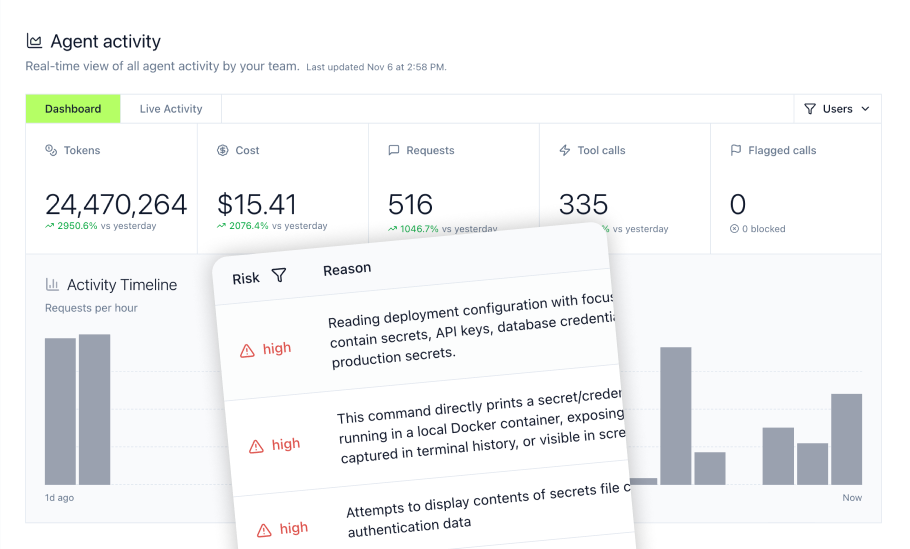
Agent Monitor tracks agent activity in real time across the organization, including MCP calls made outside the gateway. Coverage extends to:
- Tool calls: Which MCP servers agents accessed, with request, response, and audit visibility
- File operations: Local file reads and writes during agent execution
- Command execution: Bash commands, script invocations, and system calls
- Prompt submissions: What users asked agents to do
Detecting and Preventing Risky Behaviors
Built-in detection rules flag:
- PII exposure: Social Security numbers, credit card data, health information in agent outputs
- Credential leakage: API keys, tokens, and secrets appearing in logs or responses
- Risky commands: Destructive bash operations, network exfiltration attempts
- Prompt injection: Attempts to manipulate agent behavior through malicious data sources
MCP can expand the attack surface compared to traditional SaaS integrations when autonomous agents receive persistent access to tools, files, commands, and connected systems. The combination creates risks around data exfiltration, privilege escalation, and supply chain attacks through compromised MCP servers.
Enforcing Policy with MDM for Consistent Agent Supervision
For organizations using mobile device management (MDM), Agent Monitor supports push deployment of detect-only or enforce-mode configurations to developer machines. This ensures consistent policy application without requiring developers to manually configure local agents.
Integrating ChatGPT Workspace Agents with Enterprise DLP and SIEM
Enterprises with existing security tool investments need MCP governance that integrates with their stack, not replaces it.
Embedding Data Loss Prevention into Agent Workflows
MintMCP Gateway supports inline DLP integration with:
- AWS Bedrock Guardrails: Block or mask sensitive data in real time
- Google Cloud DLP: Classify and redact based on configured policies
- Microsoft Purview: Apply information protection labels to agent outputs
- Nightfall and Skyflow: Token-based data protection for PII
Custom policy code runs in a JS sandbox and can execute on tool calls, enabling organizations to enforce their existing data classification schemes within MCP traffic.
Logging and Exporting ChatGPT Agent Activity to SIEM
Full conversation-level logging captures:
- Prompts: What users asked agents to do
- Tool calls: Which MCP servers were invoked
- Responses: What data flowed back
- Context: Session metadata, user identity, timestamp, duration
Logs export to Microsoft Sentinel, Splunk, and S3 for integration with existing SIEM workflows. Configurable retention policies support compliance requirements from 30 days to multi-year archival.
The MCP security whitepaper covers audit logging architecture in detail, including immutable record guarantees and chain-of-custody considerations for compliance investigations.
Simplifying Deployment for ChatGPT Workspace Agents: STDIO and Hosted Options
The deployment model determines how much infrastructure your team must operate. Three primary options exist, each with different operational overhead.
Converting Local ChatGPT Agents to Hosted Services
STDIO server support helps convert locally run MCP servers into hosted, production-ready services. This addresses a common deployment challenge: MCP servers developed locally using subprocess-based communication require infrastructure changes for production hosting.
With automatic conversion:
- No code changes required: Upload your STDIO server and receive a hosted endpoint
- OAuth wrapping included: SSO-protected access without modifying server code
- Containerized sandbox execution: Untrusted code runs in isolated environments
- Input and output inspection: Security controls apply regardless of server implementation
One-Click Activation vs. Custom Deployment
For most enterprise use cases, pre-built connectors offer the fastest path to production. Pre-built connectors activate in minutes with managed infrastructure, while custom server timelines depend on the number of systems, policies, and approval workflows involved.
The Power of VMCPs for Non-Technical Users
VMCP abstraction helps non-technical teams use approved bundles without needing to understand each underlying connector or transport detail. This reduces configuration complexity for teams without deep MCP expertise.
Achieving Compliance and Trust for ChatGPT Enterprise Deployments
Regulated industries require documented security controls, audit trails, and attestation reports before deploying AI agents with data access.
Meeting Regulatory Requirements
ChatGPT Enterprise includes platform-level enterprise security and compliance controls. However, those controls do not automatically cover the MCP connectors, custom integrations, and workflows organizations build on top.
MCP governance platforms extend security, audit, and policy controls to the integration layer:
- Audit trails: Every tool call logged with user attribution
- Access controls: Role-based permissions enforced at the protocol level
- Data residency options: Deployment and processing-location options where available
- Retention policies: Configurable log retention for regulatory requirements
Ensuring Data Security and Privacy for ChatGPT Agents
Key security controls for enterprise ChatGPT deployments include:
- Encryption: Encryption in transit and at rest, based on the platform and deployment model
- Access controls: SSO integration, MFA support, least-privilege permissions
- Data location: Regional options where supported by the platform and deployment model
- Training exclusion: Enterprise data handling governed by the platform's enterprise terms and admin controls
For security teams evaluating MCP governance, the critical question is whether controls apply only to the gateway or extend to off-gateway agent activity.
Optimizing Workflows and Productivity with ChatGPT Powered by MCP
With governance in place, organizations can deploy ChatGPT agents across high-value use cases with confidence.
Real-world Use Cases for Governed ChatGPT Agents
Sales lead qualification: Agents pull from call notes, CRM data, and email history to score leads, draft personalized follow-ups, and update Salesforce records. Rippling reduced sales admin time from 5 to 6 hours weekly to background automation.
Month-end financial close: Agents access financial systems, generate workpapers with control totals, follow internal policies, and require CFO approval for final submission. OpenAI's accounting team reduced close time from days to minutes.
Customer feedback routing: Agents monitor Slack channels, support tickets, and customer calls continuously, categorizing feedback by priority and creating Jira tickets automatically.
Measuring Impact: Time Savings and Efficiency Gains
Organizations tracking ChatGPT agent ROI should measure:
- Hours saved on recurring manual workflows
- Reduction in handoffs across teams
- Faster routing of customer feedback, support issues, or sales follow-up
- Lower integration and maintenance burden compared with custom point-to-point connectors
The business case depends on workflow volume, governance requirements, and the amount of manual integration work the gateway replaces.
Why MintMCP Helps Enterprise Teams Govern ChatGPT Agents Securely
MintMCP addresses the governance gap that opens when ChatGPT Workspace Agents move from conversational tools to autonomous workers with persistent data access. MintMCP combines gateway controls, per-agent identity, monitoring, and audit workflows so teams can govern agent access across both managed MCP traffic and off-gateway activity.
The platform delivers unified control through three integrated capabilities:
Centralized Gateway Architecture: MintMCP Gateway provides a single policy enforcement point for MCP traffic across supported AI tools, whether agents connect through ChatGPT, Claude, Cursor, Gemini, or Copilot. One audit stream, one policy layer, and one credential management system reduce the fragmentation that creates security gaps. With 10,000+ hosted servers in the catalog, teams activate pre-built connectors in minutes while maintaining centralized authentication, policy, and audit controls.
Per-Agent Identity Through Bundle Architecture: Agent Bundles solve the shared-credential problem by giving each deployed ChatGPT agent its own rotatable credentials, independent of user sessions. This architecture packages tool access, policy enforcement, and audit logging into single governance units per team or agent, enabling fine-grained access control without operational overhead. Security teams can revoke a single agent's access without disrupting other agents or their creating users.
Shadow AI Detection Beyond the Gateway: Agent Monitor extends visibility to MCP calls made outside the gateway through hooks in Cursor and Claude Code, catching off-gateway usage that bypasses centralized controls. This addresses the blind spot in gateway-only setups, where developers can deploy local agents or use alternative MCP clients invisibly. MDM integration enables consistent policy enforcement across developer machines.
MintMCP integrates with existing enterprise security infrastructure rather than replacing it. Inline DLP integration with AWS Bedrock Guardrails, Microsoft Purview, Nightfall, and Skyflow enables real-time data classification and masking. SIEM export to Microsoft Sentinel, Splunk, and S3 maintains existing compliance workflows. For engineering teams deploying AI agents, MintMCP eliminates the infrastructure burden of hosting, scaling, and securing MCP servers.
MintMCP is SOC 2 Type II audited, with continuous compliance monitoring. Customers handling protected health information can access documentation demonstrating compliance with HIPAA standards and request Business Associate Agreements. The Trust Center provides full security documentation.
Start a free trial with no sales call required, or request a demo to see how MintMCP governs ChatGPT Workspace Agents at scale.
Frequently Asked Questions
What is the Model Context Protocol (MCP) and why is it important for ChatGPT Workspace agents in enterprises?
MCP is a standardized protocol that connects AI agents to enterprise data sources using JSON-RPC 2.0 messaging. It matters for ChatGPT Workspace Agents because major AI platforms increasingly support MCP or connector-based workflows, making it an emerging standard for AI-to-data integration. Without MCP governance, enterprises face fragmented security controls, inconsistent audit trails, and OAuth permission sprawl as agents connect to more data sources.
How does MintMCP ensure secure access and authentication for my ChatGPT Workspace agents?
MintMCP centralizes authentication through SAML/OAuth SSO integration with identity providers like Okta and Azure AD. Each agent receives its own credential set through Agent Bundles, enabling independent rotation and revocation without impacting other agents or users. The gateway applies tool-level access controls, so agents only access the specific MCP servers their Bundle permits, not every connector available to their creating user.
Can MintMCP detect and prevent shadow AI usage of ChatGPT Workspace agents within my organization?
Yes. Agent Monitor tracks agent activity beyond the gateway through hooks in Cursor and Claude Code, detecting MCP calls made outside centralized controls. This addresses the shadow AI visibility gap that concerns security teams when developers deploy local agents or bypass gateway infrastructure. MDM integration enables push deployment of monitoring policies to developer machines.
What are Agent Bundles and how do they simplify governance for multiple ChatGPT agents?
Agent Bundles extend the Bundle model to non-human principals, giving each deployed agent its own identity with scoped credentials, curated tool access, and isolated audit trails. This eliminates the shared-credential antipattern where all agents operated by a single user inherit the same permissions. You can rotate one agent's credentials without affecting others, and revoke access to a single agent without disrupting the user or their other agents.
How quickly can we deploy and connect our ChatGPT Workspace agents using MintMCP?
Pre-built connectors activate in minutes through one-click deployment, with OAuth, credential management, and rate limiting configured through the gateway. Custom MCP servers can be deployed using STDIO conversion, which wraps local servers with hosted infrastructure and OAuth protection. Deployment timelines depend on the number of data sources, custom integrations, and organizational approval workflows.