Your developers are already using MCP servers in Claude Code and Cursor. The question is not whether to govern them but whether to build or buy that governance layer. As MCP adoption grows across AI-assisted development and enterprise workflows, organizations face a critical infrastructure decision: deploy a self-hosted MCP registry on internal infrastructure or use a managed MCP gateway that handles authentication, governance, observability, and operations.
This article provides a decision framework for enterprise MCP registry deployment, covering total cost of ownership, compliance requirements, implementation timelines, and the specific scenarios where each approach delivers maximum value.
Key Takeaways
- Managed platforms can deploy in minutes with one-click setup, while self-hosted registries require additional infrastructure, security, and maintenance work
- Self-hosted can become more attractive at higher user counts where per-seat pricing creates budget pressure
- MintMCP's registry provides access to 10,000+ MCP servers, while its one-click deployment workflow helps reduce the "build every connector yourself" burden of self-hosted deployments
- First-year TCO for 50 users: MintMCP Teams pricing starts at $1,250/month for 50 included seats, while Enterprise pricing is custom for larger deployments
- Data residency requirements often dictate deployment model regardless of cost or convenience preferences
- Hybrid approaches using managed platforms for SaaS connectors and self-hosted infrastructure for sensitive internal APIs can combine the strengths of both models
- The right choice depends on engineering capacity, compliance requirements, time-to-production, and ongoing maintenance burden
Understanding the Enterprise MCP Registry Landscape
What Is an MCP Registry?
An enterprise MCP registry serves as the central catalog and governance layer for managing how AI agents discover and access enterprise tools, databases, and APIs. Unlike public directories that simply list available MCP servers, enterprise registries add authentication, role-based access control, audit logging, and compliance features required for production AI deployments.
The registry acts as the governed access layer for AI tools, providing a catalog where AI agents like Claude, ChatGPT, Cursor, Gemini, and Copilot can discover approved MCP servers that connect to enterprise systems.
MintMCP's MCP Directory shows a sampling of the 10,000+ servers available on MintMCP, including connectors for productivity tools, communication platforms, data and analytics systems, developer tools, customer support platforms, and enterprise knowledge systems.
The Rise of AI Agents in the Enterprise
MCP adoption has accelerated as enterprises use AI assistants to connect with Salesforce, databases, Slack, GitHub, documentation platforms, analytics tools, and internal APIs. This growth creates governance challenges that most organizations cannot address with local developer configurations alone.
When teams run MCP servers locally through Claude Desktop, Cursor, or other clients, credentials can spread across individual machines, tool access becomes difficult to audit, and IT has limited visibility into which AI tools can access which business systems.
This gap between AI adoption and AI governance creates operational, security, and compliance risk.
Key Considerations for Enterprise Deployment
The self-hosted versus managed decision depends on several organizational factors:
- Compliance requirements: HIPAA, GDPR, ITAR, FedRAMP, or internal audit expectations may influence deployment models
- Team capacity: DevOps expertise and platform engineering resources determine whether self-hosting is realistic
- User count: Per-seat pricing economics shift as adoption scales
- Time to production: Some teams need governed MCP access in days, while others can invest months in platform buildout
- Data residency: Legal or contractual requirements may affect where data can be processed and stored
- Connector coverage: Organizations need to evaluate whether they want to build and maintain integrations or use a managed catalog
The Allure of Self-Hosted MCP Registries: Control and Customization
Benefits of Self-Hosting
Self-hosted registries provide control over infrastructure, data location, and customization. Organizations can deploy on existing Kubernetes clusters, within specific VPCs, or in environments designed around strict regulatory requirements.
Key advantages include:
- Full infrastructure control: Teams decide where the registry runs, how it scales, and how it integrates with internal systems
- Data sovereignty: Data can remain inside internal infrastructure when required by legal or compliance teams
- Deep customization: Platform teams can modify components to match organizational requirements
- No vendor dependency: Teams avoid relying on a managed provider's roadmap, pricing model, or service availability
- Infrastructure reuse: Organizations can leverage existing Kubernetes, cloud, monitoring, and security investments
Challenges of Self-Hosting
The operational burden of self-hosted deployments is substantial. A self-hosted MCP registry is not just a catalog. It needs authentication, authorization, audit logging, credential handling, uptime monitoring, version management, and secure deployment workflows.
Additional challenges include:
- Session state management: MCP connections can be stateful, requiring careful design for scaling and reliability
- Compliance readiness: Your deployment must support SOC 2 Type II audit evidence, ISO 27001 requirements, HIPAA standards review, or other compliance needs
- Connector development: Without a managed catalog, each new integration may require custom engineering work
- Security hardening: OAuth flows, token handling, access control, and audit logging must be designed correctly from the start
- 24/7 on-call: No vendor SLA means your team handles incident response, upgrades, and outages
- Long-term maintenance: MCP specs, client behavior, server schemas, and enterprise requirements will continue to evolve
When Self-Hosting Is the Right Choice
Self-hosted registries make sense when:
- Data residency legally requires on-premises or specific VPC deployment
- User counts are sufficiently high that subscription costs become a major constraint
- Platform teams already have Kubernetes, identity, observability, and security expertise
- Budget models favor internal infrastructure investment over SaaS subscriptions
- Deep customization or integration with proprietary systems is required
- The organization has enough engineering capacity to maintain the platform long term
Embracing Managed Enterprise MCP Registries: Ease, Efficiency, and Expert Support
The Value Proposition of Managed Services
Managed MCP registries shift operational complexity from customer teams to specialized vendors. Instead of building authentication, credential management, connector hosting, audit logging, and governance infrastructure internally, teams can start from a managed control plane.
The primary value proposition centers on time-to-governance. Organizations can begin enforcing access controls, generating audit logs, and managing MCP permissions faster than building the same infrastructure from scratch.
Reduced Operational Overhead
Managed platforms reduce several operational burdens:
- Infrastructure management: No Kubernetes clusters, load balancers, or SSL certificates to maintain for the registry layer
- Security patching: Vendor-managed services handle vulnerability remediation and platform updates
- Scaling: Capacity management is handled by the provider based on usage patterns
- Monitoring: Pre-built dashboards help teams understand server health, usage patterns, and access activity
- Connector lifecycle: The provider helps maintain the connector layer as tools and schemas evolve
Focus on Core Business Activities
Engineering teams can focus on business logic rather than infrastructure plumbing. For organizations without dedicated platform engineering teams, managed services provide enterprise capabilities without requiring specialized hiring or extensive internal training.
Managed platforms are especially useful when the goal is not to build an MCP platform as a product, but to safely enable employees and internal agents to use approved AI tools with business systems.
MintMCP's Managed Enterprise MCP Registry: Secure, Compliant, and Scalable
Enterprise-Grade Security and Compliance
MintMCP's MCP Gateway provides the security infrastructure enterprises require. The platform is SOC 2 Type II audited, compliant with HIPAA standards, and provides complete audit trails that support security and compliance review. Data residency options are available, with VPC or self-hosted deployment available on request.
Security features include:
- OAuth 2.0 and SAML integration with enterprise identity providers such as Okta, Azure AD, and Google Workspace
- Granular tool access control configurable by role, enabling read-only operations while excluding write tools
- Complete audit logging of MCP interactions, access requests, and configuration changes
- Centralized credential management with protected token handling and revocation
- SSO enforcement so employees and agents access tools through governed identity flows
- Role-based MCP bundles that group tools by team, role, or use case
For teams managing AI agent data exposure, MintMCP's security documentation details the authentication, identity, and tool governance layers available.
Seamless Deployment and Management
The MintMCP server registry provides access to over 10,000 MCP servers, including hosted and remote connectors that can connect to Claude, ChatGPT, Cursor, and more. The directory includes a sampling of available servers across categories such as productivity, communication, data and analytics, developer tools, sales and CRM, project management, DevOps, AI and ML, finance, and customer support.
Deployment workflow:
- SSO Configuration: Integrate with an existing identity provider via SAML or OAuth
- Server Selection: Browse the catalog and enable approved servers for the organization
- Virtual MCP Bundle Creation: Group tools by team or use case with role-based access
- Client Connection: Connect Claude Code, Cursor, ChatGPT, Gemini, Copilot, or other compatible clients to the MintMCP gateway endpoint
This workflow helps teams move from local MCP experimentation to governed production access without requiring every team to run servers on individual machines.
Unlocking Enterprise AI Potential
MintMCP addresses the specific challenges of enterprise MCP deployment:
- Shadow AI prevention: Approval workflows and server allowlisting help prevent unapproved tool connections
- Centralized governance: A single control plane supports Claude, Cursor, ChatGPT, Gemini, and Copilot
- STDIO server hosting: Local STDIO-based servers can be hosted and exposed as governed services with authentication
- Real-time monitoring: Dashboards help track server health, usage patterns, and policy compliance
- Tool-level access control: Admins can enable safe operations while excluding sensitive write actions
- Agent and user identities: Teams can separate human access from agent access for better governance
For organizations evaluating how MCP gateways fit into broader AI infrastructure, this MCP gateways overview provides architectural context.
Bridging the Gap: From Local MCP to Enterprise Deployment
From Developer Utility to Production-Grade Infrastructure
Individual developers often run MCP servers locally through Claude Desktop or Cursor configurations. While functional for personal use, this approach creates security and compliance gaps at organizational scale.
Common problems include:
- Credentials stored on individual machines
- No central audit trail
- Limited visibility into which tools are installed
- Inconsistent access policies across teams
- Difficulty revoking access when employees change roles
- Unclear ownership for server updates and security patches
MintMCP's gateway transforms this developer-centric pattern into governed infrastructure. Local STDIO servers can be hosted on MintMCP instead of running on individual machines, becoming accessible to clients without local installations while adding authentication, logging, and access control.
Addressing Shadow AI with Governance
Shadow MCP sprawl represents a significant risk. Without governance, developers can install servers from public registries, connect to production systems, and create data exposure without IT awareness.
Managed registries support a more controlled model where unapproved servers can be blocked or withheld by default. Combined with SSO enforcement, RBAC, and audit logging, this approach turns shadow AI into sanctioned AI without blocking developer productivity.
Enabling AI Tools Safely and Rapidly
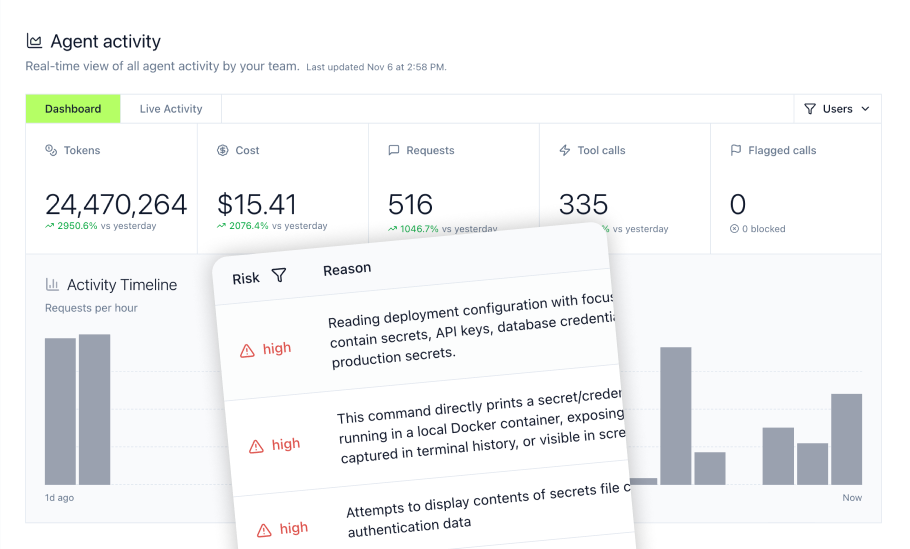
The LLM Proxy extends governance beyond MCP to cover coding agent activity. Teams can monitor tool invocations, bash commands, and file operations from Claude Code and Cursor, protect sensitive files like .env and SSH keys, and maintain audit trails for security review.
This two-layer approach, gateway for MCP traffic and proxy for agent activity, helps provide broader coverage of AI tool usage across the organization.
Cost-Benefit Analysis: Evaluating Managed vs. Self-Hosted
Understanding the True Cost of Ownership
Direct cost comparisons between managed and self-hosted often underestimate hidden expenses. A complete first-year analysis for a 50-user organization should compare subscription costs against infrastructure, engineering, maintenance, security, and compliance costs.
Managed, using MintMCP Teams:
- Subscription: $1,250/month for 50 included seats
- Additional seats: $25 per seat per month
- Setup and onboarding: Self-serve onboarding included on Teams
- Included capabilities: Role-based MCP bundles, user and agent identities, custom hosted connectors, 1000+ pre-built connectors, agent observability, basic audit logs, SSO/SAML, SCIM directory sync, and OTEL export
- Estimated Year 1 subscription cost for 50 seats: $15,000 before additional seats or Enterprise requirements
Enterprise, for larger deployments:
- Pricing: Custom
- Seat range: 100+ seats
- Added capabilities: Configurable audit logs, dedicated CSM, white-glove deployment, SLAs, and enterprise support for large or regulated deployments
Self-hosted:
- Cloud infrastructure: Variable based on hosting model
- Load balancer and SSL: Variable based on cloud provider and architecture
- Monitoring and logging: Variable based on tooling
- Initial engineering setup: Variable based on complexity
- Ongoing maintenance: Variable based on team costs
- Compliance evidence and audit preparation: Variable based on regulatory needs
- Total Year 1: Variable based on infrastructure, engineering, and compliance requirements
Predictable vs. Variable Expenses
Managed platforms provide more predictable monthly costs, simplifying budgeting and financial planning. Self-hosted deployments face variable expenses from infrastructure scaling, incident response, engineering maintenance, compliance work, and unplanned upgrades.
However, managed per-seat pricing can create budget pressure at scale. At higher user counts, managed pricing should be evaluated through current vendor pricing, while self-hosted infrastructure costs may scale differently depending on usage, support, and internal engineering overhead.
Strategic Resource Allocation
The break-even analysis depends on engineering costs and organizational priorities. Organizations with dedicated DevOps teams and sufficient user scale should evaluate both models carefully, considering not just direct costs but also time-to-production, ongoing maintenance burden, compliance evidence requirements, and opportunity costs of engineering time.
Key Features of an Enterprise-Grade MCP Registry
Security and Access Management
Enterprise registries require robust security primitives:
- Role-based access control: Define which teams access which tools at granular levels
- Enterprise SSO: SAML and OIDC integration with existing identity providers
- Centralized credentials: Manage AI tool API keys and tokens in one place
- Policy enforcement: Enforce data access and usage policies consistently
- Tool-level allowlisting: Enable approved tools while excluding risky or unnecessary actions
- User and agent identities: Separate human permissions from machine or agent permissions
Monitoring and Analytics
Visibility into AI tool usage supports both operations and compliance:
- Real-time usage tracking: Monitor AI tool interactions across supported clients
- Usage analytics: Understand adoption by team, project, server, or tool
- Performance metrics: Measure response times, errors, and usage patterns
- Data access logs: See what each AI tool accesses and when
- Audit exports: Preserve records for internal review, compliance evidence, and incident response
Deployment and Integration Capabilities
Production-grade registries support the full enterprise integration landscape. MintMCP's database connectors enable AI agents to query PostgreSQL, MySQL, MongoDB, Snowflake, and other data sources with authentication and access controls. The Elasticsearch integration supports AI-powered knowledge base search across enterprise documentation.
The MintMCP server directory also includes connectors for Notion, Linear, Slack, Gmail, Google Calendar, Outlook, Google Drive, SharePoint, Salesforce, Gong, Zendesk, QuickBooks, GitHub, Supabase, Grafana, HubSpot, Figma, BigQuery, Datadog, and many other systems.
Compliance and Governance: A Deciding Factor
Navigating the Regulatory Landscape
Compliance requirements often dictate deployment models more than cost or convenience, especially as AI governance frameworks, privacy expectations, and regulatory requirements continue to evolve.
Enterprise MCP registries must support:
- SOC 2 Type II: Audit trails with user identity, timestamp, tool name, parameters, and results
- HIPAA: Protected health information handling with appropriate access controls and BAA support
- GDPR: Data processing documentation, data residency options, and right-to-erasure capabilities
- Internal security review: Evidence of access controls, logging, retention, credential handling, and incident response workflows
Automating Compliance with Managed Services
Managed platforms provide pre-built compliance infrastructure. MintMCP's SOC 2 Type II audited posture, HIPAA standards alignment, and audit trail capabilities give customers a faster path to security review than building those controls from scratch.
The tool governance documentation details how access controls, audit logging, and policy enforcement map to enterprise governance requirements.
Self-Hosted Compliance Challenges
Self-hosted deployments place compliance evidence burden entirely on the organization. Audit-ready structured logging, OAuth 2.1 with proper scope validation, immutable audit trails, credential rotation, data retention, and access review workflows are architectural decisions that cannot be added retroactively without rework.
For regulated teams, this means self-hosting is not just an infrastructure project. It is also a security, compliance, and audit-readiness project.
Future-Proofing Your AI Infrastructure
Staying Ahead of the Curve
The MCP ecosystem continues to expand. Planning for future needs means selecting infrastructure that can adapt to evolving agent capabilities, new compliance requirements, and expanding tool catalogs.
Managed platforms benefit from vendor investment in new features, integrations, and compliance programs. Self-hosted deployments require internal teams to track ecosystem changes and implement updates themselves.
Optimizing for AI Client Compatibility
MintMCP supports a broad range of enterprise AI clients and agent workflows, including:
- Claude
- ChatGPT
- Microsoft Copilot
- Cursor
- Gemini
- Windsurf
- Custom MCP-compatible agents
This broad compatibility helps organizations govern AI usage regardless of which tools teams adopt, avoiding fragmented governance approaches as AI client preferences evolve.
For practical guidance on maximizing AI assistant effectiveness within governed environments, the Claude skills guide provides actionable recommendations.
Making the Right Choice for Your Organization
The decision between self-hosted and managed MCP registries ultimately depends on your organization's specific requirements, constraints, and priorities. Both approaches can deliver enterprise-grade governance when implemented correctly, but they serve different organizational profiles and use cases.
MintMCP's Managed Platform Excels for Organizations That:
- Need rapid deployment to address immediate governance gaps or support pilot programs
- Lack dedicated platform engineering resources or Kubernetes expertise
- Prioritize predictable operational costs and minimal ongoing maintenance burden
- Require broad connector coverage without custom development for each integration
- Want to leverage vendor expertise in security, compliance, and MCP ecosystem evolution
- Need a central governance layer for Claude, Cursor, ChatGPT, Gemini, and Copilot
- Want hosted MCP connectors instead of local servers running on individual machines
The platform's 10,000+ server catalog, one-click deployment workflow, SSO, RBAC, audit trails, and monitoring capabilities help teams move toward production-ready AI governance faster than building the same layer internally.
Organizations gain access to SOC 2 Type II audited infrastructure, controls that are compliant with HIPAA standards, and complete audit trails without building these capabilities internally.
For teams managing AI adoption at scale, MintMCP provides the governance foundation needed to enable developer productivity while maintaining visibility, control, and compliance. The combination of centralized authentication, granular access controls, and real-time monitoring addresses the shadow AI challenge that affects enterprises deploying agentic systems.
By choosing a managed approach through MintMCP, organizations can focus engineering resources on building differentiated capabilities rather than maintaining governance infrastructure, while ensuring AI tools operate within appropriate security and compliance boundaries from day one.
Frequently Asked Questions
Can I start with managed and migrate to self-hosted later?
Yes, migration paths can exist in both directions depending on architecture and provider support. Organizations commonly start with managed platforms to achieve rapid time-to-value, then evaluate self-hosted options as scale increases and platform engineering capacity develops.
The key consideration is ensuring your MCP server configurations, RBAC policies, and audit log formats can transfer between platforms. Document your governance policies in platform-agnostic formats to simplify potential future migrations.
How do hybrid deployments work in practice?
Sophisticated teams may use managed platforms for standard SaaS connectors such as Salesforce, Slack, Gmail, and GitHub while running self-hosted infrastructure for internal proprietary APIs and sensitive data sources.
This approach minimizes operational burden for standard integrations while maintaining strict control where legally or operationally required. The two environments can operate independently, with AI clients configured to route requests to the appropriate gateway based on the target system.
What happens if my managed provider experiences downtime?
Enterprise-grade managed platforms may provide uptime SLA commitments. MintMCP includes SLAs for Enterprise deployments. However, organizations with zero-downtime requirements should evaluate provider SLA terms carefully and consider maintaining fallback configurations.
Review the provider's historical uptime data, support process, incident response procedures, and enterprise terms before committing to production deployment.
How do I prevent developers from bypassing the registry entirely?
Effective governance requires both technical controls and organizational policy. On the technical side, teams can use network policies to block direct MCP server connections where appropriate, MDM configurations to restrict unmanaged local tooling, monitoring to detect unapproved STDIO processes, identity enforcement through SSO, and approval workflows for new MCP servers. On the organizational side, clear acceptable use policies, developer training on approved workflows, regular audits of client configurations, and a fast approval process help ensure teams are not incentivized to bypass controls. The combination of accessible approved tools and clear governance expectations drives adoption.
What compliance documentation should I request from managed providers?
Request SOC 2 Type II reports, penetration test summaries, data processing agreements for GDPR, Business Associate Agreements for HIPAA, and detailed descriptions of data residency options. Verify that audit log formats meet your compliance team's requirements for evidence collection. For regulated industries, confirm the provider's experience with your specific regulatory framework and request reference customers in similar compliance environments.