AI coding assistants have transformed software development workflows, but their deep system access—reading files, executing commands, and connecting to production databases—introduces security risks that enterprises cannot ignore. Claude Code, Cursor, and GitHub Copilot each bring distinct capabilities to the development environment, yet all three have accumulated documented vulnerabilities throughout 2025-2026. For organizations deploying these tools at scale, the MCP Gateway provides the security infrastructure layer that transforms individual coding assistants into enterprise-ready, governed solutions.
This comparison examines the security postures of leading AI code editors, their compliance readiness, and how MintMCP enables organizations to adopt powerful AI development tools without compromising on governance or audit requirements.
Key Takeaways
- Cursor's case-sensitivity bypass vulnerability (CVE-2025-59944) enabled persistent remote code execution across IDE restarts through MCP configuration poisoning
- GitHub Copilot's CamoLeak vulnerability scored CVSS 9.6, enabling silent exfiltration of private repository code through invisible prompt injection
- MintMCP Gateway holds SOC 2 Type II attestation and provides real-time blocking capabilities—preventing risky actions before execution rather than alerting after damage occurs
- When security documentation is incomplete, enterprise procurement and security reviews can slow AI tool deployment significantly
- Secret leakage rates run 40% higher in repositories using Copilot (6.4% versus 4.6% baseline), underscoring the need for centralized governance
Understanding the Security Landscape of AI Code Editors in 2026
The AI coding assistant market has expanded dramatically, with GitHub reporting that Copilot now serves over 26 million users and 90% of the Fortune 100. Cursor achieved a $9.9 billion valuation in 2025, while Anthropic reported that Claude Code reached $1 billion in run-rate revenue within six months of launch. This rapid adoption has outpaced security infrastructure development, creating governance gaps that attackers actively exploit.
The Evolution of AI Code Editor Threats
Coding agents operate with extensive system access that traditional development tools never required. Unlike static code analysis or simple autocomplete, modern AI assistants can:
- Execute arbitrary bash commands with user-level permissions
- Read and modify files across the entire project structure
- Access production systems through MCP tool integrations
- Exfiltrate data through seemingly legitimate API calls
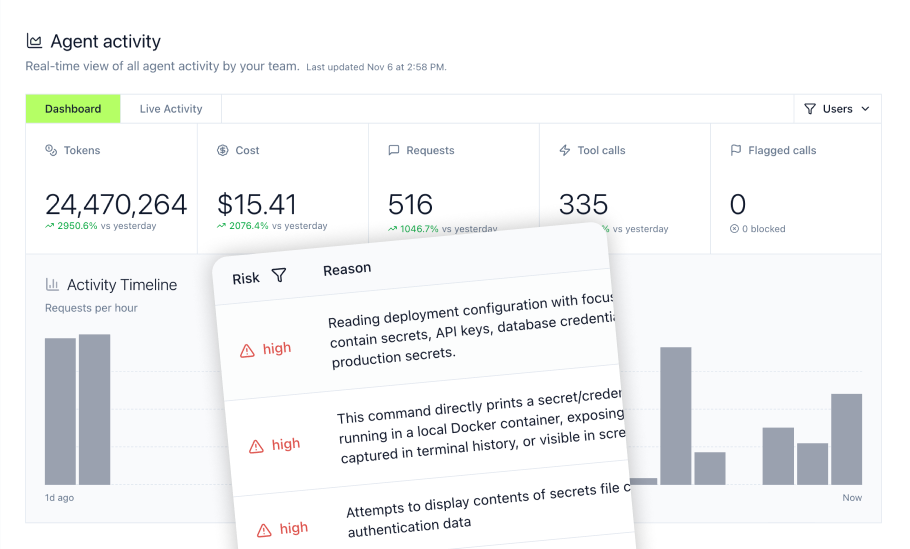
Without proper monitoring, organizations cannot observe what agents access or control their actions. The MintMCP LLM Proxy addresses this visibility gap by sitting between LLM clients and the models themselves, forwarding and monitoring every request to provide observability into how employees use AI coding tools.
Compliance Mandates Driving Security Innovations
Enterprise security teams face mounting pressure to demonstrate control over AI tool usage. The challenge extends beyond individual vulnerabilities to proving systematic governance for SOC 2 audits and data protection requirements. When security documentation is incomplete or difficult to verify, enterprise procurement and security reviews can slow AI tool deployment significantly—delays that MintMCP helps reduce through pre-built audit logging, access controls, and policy enforcement.
Claude Code Security Features and Enterprise Integration
Anthropic's Claude Code is one of the strongest coding assistants in the market, with benchmark-leading results on several software engineering evaluations including strong results on SWE-bench Verified and other software engineering evaluations and strong support for complex multi-file workflows. For enterprise teams, the more important question is not just model quality, but how those capabilities are governed in production.
Data Handling and Privacy Protocols
Claude Code operates through Anthropic's API infrastructure, inheriting the parent company's privacy policies. By default, Claude Code does not use customer code for training purposes, though explicit data retention policies for the standalone tool remain undisclosed in public documentation.
The tool's autonomous task execution capability—while powerful for complex refactoring—creates larger blast radius concerns when compromised. Check Point Research documented how malicious .claude/settings.json files could trigger remote code execution and API key theft, demonstrating how Claude Code's power becomes a liability without proper guardrails.
Documented Vulnerabilities
The following vulnerabilities have been identified and addressed in Claude Code:
- CVE-2025-59536 (CVSS 8.7): Remote code execution via malicious project configuration files, patched in version 1.0.111
- CVE-2026-21852 (CVSS 5.3): API key exfiltration through environment variable manipulation, patched in version 2.0.65
- CVE-2026-25725: Sandbox bypass enabling unauthorized file system access, patched in version 2.1.2
Attack vectors include hook injection, MCP server poisoning, and environment variable manipulation—all scenarios where MintMCP's tool governance would detect and block malicious configurations before execution.
Enterprise Authentication and Access Controls
Claude Code inherits authentication capabilities from Anthropic's API layer, supporting account-level multi-factor authentication and API key management. However, enterprise-grade SSO/SAML integration requires implementation at the API level rather than the tool level, creating gaps for organizations with strict identity provider requirements.
MintMCP Gateway bridges this gap by providing OAuth 2.0 and SAML authentication wrapping for any MCP server connection. Administrators configure enterprise SSO once, and all Claude Code interactions flow through centralized authentication—eliminating scattered API key management.
Cursor's Security Architecture and Local-First Advantages
Cursor is widely used by teams that want an AI-native IDE experience with strong multi-file editing workflows. In enterprise settings, that usability advantage still needs to be paired with consistent monitoring, policy enforcement, and access controls.
Privacy Mode and Data Handling
Cursor offers a Privacy Mode focused on zero-retention handling, with code not stored by model providers or used for training. That improves data-handling posture, but it is not the same as fully local-only processing, and organizations still need visibility into what external services or MCP connections are in use.
However, Cursor's MCP integration capabilities introduce complexity. When developers configure MCP servers for database access or API integrations, those connections create separate data-access paths that still require centralized visibility and policy controls. Without centralized visibility, IT teams cannot determine which data sources developers have connected to their Cursor instances.
Documented Vulnerabilities
Cursor accumulated multiple vulnerabilities during 2025, primarily related to its MCP integration features:
- CVE-2025-59944 (Critical): Case-sensitivity bypass enabling persistent RCE through
.CURSOR/mcp.jsonvariant files, patched in version 1.7 - CVE-2025-54136: MCP trust boundary bypass allowing untrusted server execution, patched in version 1.3
- CVE-2025-54135 (CVSS 8.6): Untrusted MCP remote code execution, patched in version 1.3
The Lakera AI research team demonstrated how attackers could exploit case-insensitive filesystem handling to inject malicious MCP configurations that survived IDE restarts. This attack pattern—leveraging legitimate features for malicious purposes—exemplifies why MCP gateway infrastructure matters.
Security Policy Customization
Cursor's extension architecture provides flexibility but requires organizations to establish clear policies around:
- Which MCP servers developers may configure
- What file system paths agents can access
- Which bash commands are permitted during code generation
MintMCP's LLM Proxy rules engine enables granular policy enforcement without modifying Cursor itself. Security teams define blocklists for dangerous commands, restrict file access patterns, and receive real-time alerts when agents attempt unauthorized actions.
GitHub Copilot Enterprise: Advanced Security and Compliance Features
GitHub Copilot holds the largest market position among AI coding assistants, serving organizations at massive scale. Microsoft's backing gives GitHub Copilot substantial enterprise reach, documentation depth, and administrative controls. Even so, organizations still need a separate governance layer for tool access, monitoring, and policy enforcement across mixed AI environments.
Enterprise Compliance Features
GitHub Copilot Enterprise tier ($39/user/month) provides organization-level policy controls for Copilot, including exclusion controls and administrative governance features. Some adjacent capabilities often used in enterprise deployments—such as data residency and private networking—come from the broader GitHub Enterprise platform rather than Copilot alone. These features address compliance requirements that individual and team tiers cannot match. However, Copilot's compliance applies to the Copilot service itself—not to downstream MCP integrations or custom tooling that developers may configure alongside it.
Data Protection and IP Indemnification
Microsoft provides IP indemnification for Copilot Enterprise customers, assuming liability for copyright claims arising from generated code. Data retention policies specify:
- IDE code completions: Prompts and suggestions not retained; engagement data kept for 2 years
- Other Copilot access and use outside IDE chat/code completions: Prompts and suggestions retained for 28 days; engagement data for 2 years
- Business/Enterprise: Custom retention options available
For organizations concerned about training data usage, Copilot Business and Enterprise tiers explicitly exclude customer code from model training processes.
Documented Vulnerabilities
Despite Microsoft's security resources, GitHub Copilot has experienced significant vulnerabilities:
- CVE-2025-62449 (CVSS 6.8): Path traversal enabling unauthorized file access, patched November 2025
- CVE-2025-62453 (CVSS 5.0): Improper AI output validation allowing code injection, patched November 2025
- CVE-2025-59286: Spoofing vulnerability, patched 2025
- CamoLeak (CVSS 9.6): Critical prompt injection enabling silent code exfiltration through invisible Unicode characters in GitHub Issues, patched June 2025
The CamoLeak vulnerability demonstrated how attackers could embed invisible prompts that caused Copilot to exfiltrate private repository contents without user awareness. This silent data loss scenario—with zero detection capabilities—underscores why organizations need monitoring infrastructure independent of the tools themselves.
Code Quality and Security Concerns
Beyond vulnerabilities in Copilot itself, research indicates concerns about generated code quality. Academic research has found a meaningful rate of security weaknesses in Copilot-generated code snippets, including Python examples with issues such as SQL injection and cross-site scripting, underscoring the need for human review and policy controls. Additionally, secret leakage rates run 40% higher in repositories using Copilot (6.4% versus 4.6% baseline).
These statistics highlight that securing AI coding tools requires monitoring both the tools' behavior and the code they produce.
Monitoring and Auditing AI Coding Tools for Compliance
Enterprise compliance frameworks—SOC 2 Type II and data protection regulations—require demonstrable controls over data access and processing. AI coding assistants create unique audit challenges: they access vast amounts of code, make API calls to external services, and execute commands that traditional application monitoring was never designed to track.
Generating Comprehensive Audit Trails
Effective compliance requires capturing every AI agent interaction in formats auditors can review. The audit trail must include:
- Tool call logging: Which MCP tools each agent invoked, with parameters and responses
- Bash command tracking: Complete history of executed commands, including failed attempts
- File access monitoring: What files agents read, modified, or attempted to access
- Prompt/response capture: Full context of AI interactions for security review
- Timestamp correlation: Linking all events to enable forensic reconstruction
Individual AI coding tools provide varying levels of this visibility. GitHub Copilot Enterprise includes engagement metrics and retention policies. Cursor and Claude Code offer more limited native logging capabilities that may not satisfy compliance requirements.
MintMCP's audit observability captures complete activity trails across all connected tools—Claude Code, Cursor, Copilot, and custom MCP servers—through a single governance layer. Audit exports support internal control reviews and regulated deployment workflows without custom development.
Real-time Alerts for Security Incidents
Detection speed determines incident severity. Organizations need alerts when:
- Agents attempt to access sensitive file patterns (
.env, SSH keys, credentials) - Unusual outbound data transfers occur during AI sessions
- Prompt injection attempts contain suspicious Unicode sequences
- Tool calls exceed normal usage patterns for a given user or role
MintMCP Gateway provides configurable alerting that integrates with existing SIEM and SOAR platforms. Security teams define thresholds and patterns; the gateway enforces them in real-time across all monitored AI tools.
Protecting Sensitive Data: File Access and Command Execution Controls
AI coding agents require broad file system access to function effectively—they need to read code, understand project structure, and execute build commands. This legitimate access creates attack surfaces that traditional endpoint protection may not address.
Implementing Granular Access Policies
The principle of least privilege applies to AI agents just as it does to human users. Effective controls include:
- File path restrictions: Blocking access to directories containing credentials, keys, or sensitive configuration
- Command blocklists: Preventing execution of dangerous commands like
rm -rf, credential dumping, or network reconnaissance - Output filtering: Scanning agent responses for accidentally exposed secrets before they reach developer screens
- Rate limiting: Detecting and throttling unusual activity patterns that may indicate compromise
MintMCP's sensitive file protection prevents access to .env files, SSH keys, and credential stores. Pattern matching identifies secrets in transit, blocking exfiltration attempts before data leaves the organization.
Preventing Unauthorized Access to Production Systems
MCP integrations connect AI assistants to databases, APIs, and internal services. Without controls, a compromised coding agent could:
- Query production databases and exfiltrate customer data
- Modify infrastructure configurations through connected admin APIs
- Access internal documentation containing trade secrets
- Pivot through connected services to expand breach scope
MintMCP's Virtual MCP concepts enable administrators to expose only minimum required tools—not entire MCP servers. A developer might receive read access to a staging database without any ability to query production systems, enforced at the gateway level regardless of what the underlying AI tool requests.
Centralized Governance for AI Code Generation Pipelines
Shadow AI—unauthorized tool usage outside IT visibility—presents growing governance challenges. Development teams adopt AI assistants faster than security teams can evaluate them, creating unmonitored access paths to sensitive code and data.
From Shadow AI to Sanctioned AI
MintMCP launched specifically to address the gap between AI tool adoption and enterprise governance requirements. The platform enables organizations to:
- Gain visibility: See which AI tools teams are using, track usage patterns, understand data access across the organization
- Enforce policies: Automatically apply data access and usage policies without manual configuration per tool
- Meet compliance: Generate audit trails and compliance reports for internal security reviews
- Enable safely: Deploy AI tools with pre-configured policies without slowing developers
This approach transforms scattered, ungoverned AI usage into centralized, observable, controllable infrastructure.
Managing AI Tool Access and Permissions at Scale
Enterprise AI governance requires capabilities beyond what individual tools provide:
- Centralized credential management: Single location for all AI tool API keys and tokens, eliminating developer-managed sprawl
- Role-based endpoint provisioning: Automatic MCP endpoint configuration based on user role and team membership
- Cross-tool usage analytics: Unified dashboard showing activity across Claude Code, Cursor, Copilot, and custom integrations
- Cost allocation: Track AI spending per team, project, and tool for budgeting and chargeback
MintMCP's user management centralizes provisioning with team-based access controls. Administrators define which roles access which tools; the platform enforces those decisions across all connected AI assistants.
The Role of MCP Gateways in Secure AI Development Workflows
The Model Context Protocol has emerged as a widely adopted standard for connecting AI clients to external tools and data sources. Supported by Anthropic, OpenAI, Google, and Microsoft, MCP enables AI assistants to access databases, APIs, and enterprise systems. However, MCP adoption introduces deployment, security, and governance challenges that individual tools cannot address alone.
Bridging LLMs and Internal Data Securely
MCP gateways solve three specific problems for enterprise deployments:
- Tool Organization: Centralizing scattered MCP server configurations into managed infrastructure
- Protocol Translation: Handling authentication, connection management, and transport security
- Security Control: Enforcing policies, logging activity, and blocking unauthorized actions
Without gateway infrastructure, each developer maintains their own MCP configurations with inconsistent security postures. The MintMCP Gateway architecture provides centralized control while maintaining developer self-service for authorized tools.
One-Click Deployment and Enterprise Hardening
Most MCP servers use STDIO-based protocols designed for local execution—they assume trusted environments with direct file system access. Deploying these servers for team use traditionally required:
- Custom hosting infrastructure
- Manual OAuth/SSO integration
- Bespoke audit logging development
- Individual security assessments per server
MintMCP's one-click deployment transforms local servers into production services automatically. The platform adds OAuth protection, enterprise monitoring, and compliance logging without requiring code changes to the underlying MCP server. Organizations move from local prototype to governed production in minutes rather than months.
Choosing the Right Security Approach for Your Organization
Each AI coding assistant brings distinct strengths to development workflows. The security infrastructure layer determines whether those capabilities can be deployed safely at enterprise scale.
When to Deploy MintMCP Gateway
Organizations benefit from MCP gateway infrastructure when they:
- Require documented security controls: Internal reviews for SOC 2, privacy, or regulated data use need demonstrable logging and access governance
- Support multiple AI tools: Teams use different assistants for different tasks (Cursor for IDE, Claude for reasoning, Copilot for GitHub integration)
- Need real-time protection: Blocking risky actions before execution rather than detecting afterward
- Value unified visibility: Single dashboard across all AI agent activity
- Want fast deployment: Production-ready governance in days rather than months
MintMCP provides the security layer that makes enterprise AI adoption practical—not by replacing coding assistants but by making them enterprise-ready.
Matching Tools to Use Cases
For organizations adopting AI coding assistants under MintMCP governance, different tools can fit different workflows—whether that means deeper reasoning for complex refactors, a familiar enterprise platform for day-to-day development, or an AI-native IDE experience. The advantage of MintMCP is that governance stays consistent even when teams standardize on different assistants.
Conclusion
Enterprise AI adoption demands more than powerful coding assistants—it requires secure, observable, governable infrastructure. Claude Code, Cursor, and GitHub Copilot have each demonstrated substantial capabilities while also accumulating documented vulnerabilities throughout 2025-2026, from CVSS 8.6 MCP bypass attacks to CVSS 9.6 silent exfiltration.
The MintMCP Gateway provides the security and governance foundation that enables organizations to deploy AI coding tools confidently across teams. Rather than forcing a choice between developer productivity and enterprise control, MintMCP delivers both through SOC 2 Type II-attested infrastructure that works with all major coding assistants.
Key capabilities include real-time policy enforcement that blocks dangerous actions before execution, comprehensive audit trails capturing every tool invocation and command, centralized credential management eliminating scattered API keys, and role-based access controls enforcing least-privilege principles across all connected tools. The platform transforms shadow AI into sanctioned AI—giving security teams the visibility and control they need while enabling developers to use the tools that make them most productive.
Organizations gain production-ready governance without custom development. The one-click deployment model means moving from local prototype to enterprise deployment in minutes, not months. Whether teams prefer Claude Code for complex reasoning tasks, Cursor for AI-native IDE workflows, or Copilot for GitHub integration, MintMCP ensures consistent security posture and compliance-ready audit trails across all tools.
Deploy secure AI development infrastructure in minutes. Book a demo to see how MintMCP secures AI coding tools at enterprise scale.
Frequently Asked Questions
What are the primary security risks when using AI code editors in an enterprise?
AI coding assistants operate with extensive system access—reading files, executing commands, and connecting to external services through MCP integrations. Documented risks include remote code execution through malicious project configurations, prompt injection attacks that silently exfiltrate code, and credential theft through environment variable manipulation. Without monitoring infrastructure, organizations cannot observe agent behavior or prevent unauthorized actions.
How does MintMCP's LLM Proxy enhance security for Cursor?
The MintMCP LLM Proxy sits between LLM clients (including Cursor) and the models themselves, monitoring every request. The proxy provides complete visibility into tool invocations, bash commands, and file operations. Security teams configure blocklists for dangerous commands, restrict file access patterns, and receive real-time alerts when agents attempt unauthorized actions—all without modifying Cursor itself.
Can MintMCP help with compliance requirements for AI development?
MintMCP Gateway is positioned around SOC 2 Type II-attested infrastructure and provides detailed audit trails for security and compliance review. The platform captures tool activity, commands, and related logs across connected AI tools, which can support internal control reviews and regulated deployment workflows. Organizations often face deployment delays when adopting tools without established security documentation; MintMCP helps reduce that friction with pre-built audit logging, access controls, and policy enforcement.
What is shadow AI and how does MintMCP address it?
Shadow AI refers to unauthorized AI tool usage outside IT visibility—developers adopting assistants faster than security teams can evaluate them. MintMCP addresses this through centralized governance that provides visibility into which tools teams use, enforces access policies automatically, and generates compliance documentation. Organizations transform scattered, ungoverned AI usage into controlled infrastructure without blocking developer productivity.
How do Claude Code, Cursor, and Copilot handle sensitive data?
Data handling varies by tool and tier. GitHub Copilot Business/Enterprise explicitly excludes customer code from training and provides IP indemnification. Claude Code inherits Anthropic's privacy policies, which do not use customer code for training by default. Cursor offers Privacy Mode for zero-retention handling. However, all tools can access and transmit sensitive data through their normal operation—MintMCP provides the monitoring and blocking layer that prevents unauthorized data exfiltration regardless of each tool's native policies.
What are the benefits of using an MCP Gateway for enterprise deployment?
MCP gateways centralize what would otherwise be scattered, inconsistent security configurations. Benefits include: unified authentication (OAuth/SSO) across all MCP connections, complete audit logging for compliance, real-time blocking of risky actions, role-based access control at the tool level, and one-click deployment of STDIO-based servers with enterprise hardening. Organizations achieve production deployment in days rather than months while maintaining visibility across all AI coding tools.