LLM inference is the operational phase where a trained large language model generates responses to user prompts in real time. While training builds the model once, inference runs continuously every time someone interacts with an AI application, making it the critical bottleneck for performance, cost, and security. For organizations deploying Claude, Cursor, ChatGPT, Gemini, or Copilot, understanding inference is essential because this is where access control, cost management, and compliance requirements must be enforced in production.
This article explains how LLM inference works, why it matters more than training for operational budgets, the key optimization techniques that can reduce costs substantially, and how to govern inference operations to meet enterprise security requirements.
Key Takeaways
- Inference costs compound faster than training costs: While training a model is expensive upfront, inference runs on every request and often exceeds training costs at sufficient production scale
- Two-phase architecture determines optimization strategy: Prefill is compute-bound and affects Time to First Token; decode is memory-bound and affects output speed. Wrong optimization wastes money
- KV-cache growth can become a major concurrency bottleneck after model weights are loaded, especially with long contexts and large batches, capping user capacity before GPU compute becomes the limit
- Modern serving techniques such as continuous batching can substantially improve throughput by replacing finished sequences with new requests during generation
- Gateway-layer governance is mandatory: Virtual keys carrying per-consumer budgets and tool permissions must enforce policy at the infrastructure layer, not through post-hoc auditing
- IBM's 2025 research found organizations with high shadow AI had $670,000 higher breach costs than organizations with low or no shadow AI
Understanding LLM Inference: The Basics of Getting Answers from AI
When you type a prompt into ChatGPT or ask Claude to write code, the model does not think or reason in the human sense. Instead, it performs inference: a mathematical process that predicts the most likely next token based on everything that came before it.
From Training to Inference: How Models Deliver
Training teaches the model patterns from massive datasets. Inference applies those learned patterns to generate new outputs. The distinction matters because training happens once or periodically, while inference happens on every single user request for as long as the application runs.
The inference process works in two distinct phases:
- Prefill phase: The model processes your entire prompt in parallel, computing attention across all input tokens simultaneously. This phase is compute-bound and determines your Time to First Token (TTFT)
- Decode phase: The model generates output tokens one at a time, each depending on all previous tokens. This phase is memory-bound because it continuously reads model weights and the growing key-value cache from GPU memory
The Core Components of an LLM Inference Request
Every inference request involves:
- Input prompt: Your text, converted into numerical tokens
- Model weights: Billions of parameters learned during training
- KV cache: Intermediate attention states stored to avoid redundant computation
- Output tokens: Generated one by one until the model produces a stop token
For enterprise deployments, each component creates governance requirements. Input prompts may contain sensitive data. Model weights require access control. The KV cache consumes memory that affects concurrent user capacity. Output tokens need audit logging for compliance.
LLM Inference vs. Training: Two Sides of the AI Coin
The AI industry has created a perception that training is the expensive part. Training cost varies widely by model, and public estimates for recent frontier systems have ranged from tens to hundreds of millions of dollars in compute, while training itself may happen once or periodically. That is a one-time expense. Inference, however, runs continuously at scale.
Why Training and Inference Demand Different Resources
Training optimizes for throughput over large batches of data. It can take days or weeks, using multiple GPUs in parallel, with the goal of minimizing total time to convergence.
Inference optimizes for latency on individual requests. Users expect responses in milliseconds or seconds. Inference runs on every request, and API costs are typically priced by token usage, so per-request cost varies with the model, provider, input length, output length, and caching. Within months of high-volume deployment, recurring operational costs can become a major share of total model spend.
Key differences:
- Frequency: Training once or periodic vs. inference every user request
- Optimization goal: Training total throughput vs. inference per-request latency
- Cost structure: Training upfront capital vs. inference ongoing operational
- GPU utilization: Training compute-bound vs. inference memory-bound in decode phase
- Workload shape: Training is optimized around large, regular batches and backpropagation, while inference must handle variable-length, latency-sensitive requests and dynamic batching
This inverts typical capital versus operational cost thinking. For organizations running production AI, inference infrastructure becomes the primary budget line within the first year.
Why LLM Inference Optimization is Crucial for Enterprise AI
Inference efficiency directly impacts three business metrics: user experience, infrastructure cost, and scalability.
The Business Impact of Faster LLM Responses
Interactive applications need sub-500ms Time to First Token (TTFT) to feel responsive. Batch processing workloads prioritize aggregate throughput over individual latency. Choosing the wrong optimization target wastes money:
- Customer-facing chatbots need prefill optimization (prefix caching, shorter system prompts)
- Document processing pipelines need decode optimization (continuous batching, quantization)
- Coding assistants need both (fast first suggestions plus sustained generation)
Organizations running high-volume inference report substantial cost reductions when applying multiple optimization techniques together. Combining model right-sizing, caching, batching, and routing can reduce inference costs substantially, but savings depend on workload and evaluation.
Key Techniques for LLM Inference Optimization
Modern inference frameworks combine multiple techniques to maximize throughput without sacrificing output quality.
Software Optimizations for Inference Speed
Continuous batching dynamically groups incoming requests to maximize GPU utilization. Instead of processing requests one at a time, the system fills available compute with multiple requests simultaneously. Modern serving techniques can substantially improve throughput over naive sequential processing.
KV cache optimization addresses a primary memory bottleneck. For a Llama 3 8B model in FP16, a single 8K-token sequence consumes approximately 1GB of KV cache. On an 80GB GPU, this limits concurrent users after accounting for model weights. PagedAttention reduces KV-cache fragmentation through paged memory management, increasing usable memory and enabling larger effective batch sizes.
Speculative decoding uses a small draft model to predict multiple tokens, then verifies them in parallel with the main model. With properly aligned models achieving high acceptance rates, this delivers 1.5-3x speedup while producing mathematically identical outputs.
Quantization reduces model precision from FP16 to FP8 or INT8, cutting memory requirements and enabling larger batch sizes. Quality impact varies by workload, so validation against your specific evaluation suite is essential.
Hardware Accelerators: The Role of AI Chips
The decode phase is memory-bandwidth-bound, not compute-bound. This shifts hardware investment decisions:
- GPUs excel at parallel computation and remain the default choice for inference
- High-bandwidth memory (HBM) matters more than raw FLOPs for decode-heavy workloads
- Tensor Processing Units (TPUs) offer competitive cost-per-token for specific model architectures
- Specialized inference chips from various vendors target specific throughput and latency profiles
Tokens per second for a 70B model on modern GPUs vary widely with precision, batch size, context length, and serving stack. Choosing hardware requires understanding whether your workload is prefill-bound or decode-bound.
Governing LLM Inference: Ensuring Secure and Compliant AI Operations
Technical optimization alone does not address enterprise requirements for access control, audit trails, and cost enforcement. Governance must operate at the inference layer with request-level controls.
Protecting Data During Inference
The common failure pattern: policies exist in documents, but the AI infrastructure has no way to enforce them on live traffic. Post-hoc auditing finds problems; gateway enforcement prevents them.
Enterprise inference governance requires:
- Virtual keys carrying per-consumer model restrictions, budgets, and tool permissions
- Real-time policy enforcement at the request layer before calls reach providers
- Hierarchical budgets that prevent runaway agents from exhausting monthly spend
- Audit trails capturing every request/response with user attribution
MCP Gateway governs data and tool connections for AI systems, providing the enforcement point where access policies, credentials, and audit logging intercept every model call. For organizations concerned about MCP security risks, centralized gateway controls address credential sprawl and unauthorized data access.
Implementing Security Measures for AI Outputs
Runtime controls for agent and tool activity can detect or restrict prompt injection, secrets, PII, harmful content, risky tool arguments, and unsafe actions at supported enforcement points. The three-layer approach:
- Managed detection policies for prompt injection, secrets, and PII
- Declarative rules for tool-name conditions, argument matching, and regex patterns
- Customer-authored middleware for DLP integrations, external classifiers, and custom policy logic
Security guardrails determine what actions can happen, while monitoring explains what did happen. Both are necessary for compliant AI operations.
Monitoring LLM Inference: Visibility into AI Activity and Costs
Without observability, organizations cannot answer basic operational questions: Which agents are consuming budget? What data are they accessing? Are they calling unauthorized tools?
Tracking Token Usage and Costs for LLM Operations
Token spend attribution requires capturing usage by model, user, agent, and session. Enterprise deployments need:
- Cost dashboards showing spend across teams and projects
- Chargeback capabilities for internal billing and client attribution
- Cache-hit rate monitoring to identify optimization opportunities
- Human versus agent split for understanding autonomous consumption
Gartner projects AI governance platform spending to surpass $1 billion by 2030, indicating that enterprises increasingly recognize inference monitoring as operational infrastructure rather than optional tooling.
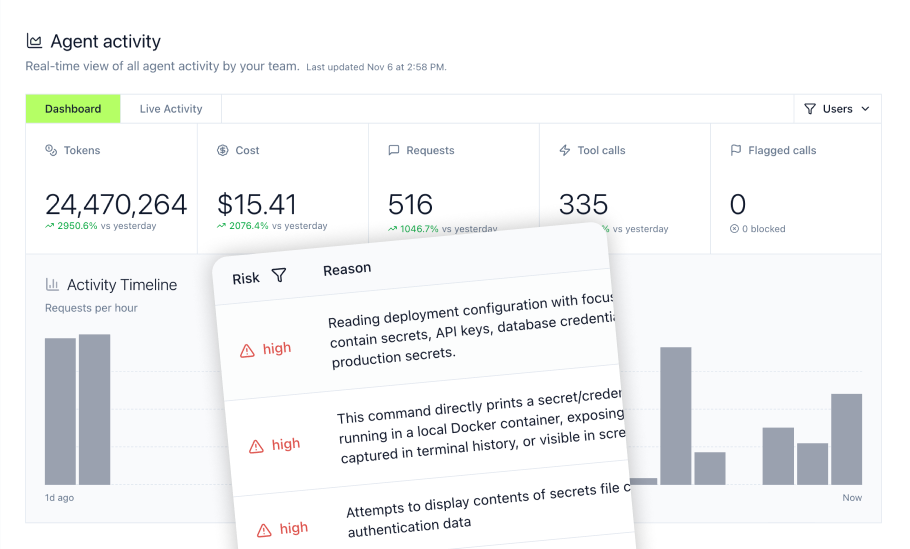
MintMCP's Agent Monitor provides visibility into supported agent activity across the organization, including prompts, MCP tool calls, usage, and token costs. For teams tracking AI agent costs, this visibility enables proactive budget management rather than reactive surprise.
Performance Monitoring for Reliable AI Applications
Production inference systems require tracking:
- Latency percentiles (p50, p95, p99) for TTFT and total generation time
- Throughput metrics in tokens per second and requests per minute
- Error rates and retry patterns
- Resource utilization for capacity planning
LLM observability tools that connect cost to quality in unified dashboards remain rare. Most organizations can track spend or accuracy, but not both together.
Real-World Examples of Large Language Model Inference in Action
Generative AI Applications Powered by Inference
Customer support automation: Real-time chatbots require sub-500ms TTFT with 24/7 availability. LinkedIn's Hiring Assistant serves over 250 million customers using optimized inference with PagedAttention and prefix sharing across similar qualification questions.
Code completion and generation: Coding assistants need fast initial suggestions (prefill optimization) plus sustained generation for longer implementations (decode optimization). The latency-throughput tradeoff varies by use case.
Document processing: Summarization, extraction, and analysis workloads prioritize aggregate throughput over individual request latency, making them candidates for aggressive batching and quantization.
How Enterprises Leverage LLM Inference Today
Organizations deploying AI coworkers need inference infrastructure that supports persistent agents operating alongside employees. These agents may run through Slack, scheduled triggers, or manual activation, maintaining context across days while operating with governed tool access.
Ramp achieved 79% infrastructure cost reduction by switching from closed-source APIs to self-hosted open-source models with quantization and batching optimizations. This demonstrates how inference optimization directly translates to budget impact.
Future Trends in LLM Inference: Efficiency, Scale, and Integration
Towards More Efficient and Accessible AI Inference
Prefill-decode disaggregation runs compute-heavy prefill on different hardware than memory-bound decode. Meta and other organizations are exploring this in production environments.
Diffusion LLMs generate multiple token positions in parallel through iterative denoising. By 2026, the approach has moved beyond research-only prototypes, but reported speedups vary widely by model, hardware, workload, and decoding method.
Model routing sends queries to appropriately sized models based on complexity. Simple requests go to small, fast models; complex reasoning goes to larger models. This pattern is already disrupting pricing expectations.
The Evolving Landscape of Generative AI Deployment
For enterprises adopting AI governance frameworks, inference becomes the control plane for the entire AI operation. The organization that treats inference as just a serving layer rather than a strategic enforcement point will struggle to scale securely.
Regulations including the EU AI Act, NIST AI RMF, and ISO 42001 increasingly require documented controls over AI systems. Inference-layer governance provides the technical foundation for compliance evidence.
How MintMCP Enables Governed LLM Operations
Production inference at enterprise scale requires more than optimization techniques. Organizations need unified governance across the full AI stack: from model calls to tool connections to agent activity. MCP Gateway provides centralized control over AI-to-tool connections, replacing credential sprawl with SSO-backed authentication, hierarchical budgets with per-agent caps, and post-hoc log reviews with real-time policy enforcement at every tool call. When a coding assistant queries a database or a customer-support agent fetches billing records, MCP Gateway ensures that every connection respects identity, permission, and audit requirements.
Agent Monitor extends that visibility to autonomous agents, capturing prompts, tool calls, token costs, and policy violations in a unified dashboard. Teams can track which agents consume budget, identify runaway inference costs before monthly limits are exhausted, and attribute tool usage back to individual users or business units. For organizations running AI coworkers in production, this combination of gateway-layer enforcement and observability turns inference from an uncontrolled operational expense into a governed, measurable capability that meets enterprise compliance and cost-management requirements.
Frequently Asked Questions
How does the two-phase inference architecture affect infrastructure costs?
The prefill phase is compute-bound, limited by GPU processing power, while the decode phase is memory-bandwidth-bound, limited by how fast you can read model weights and KV cache. Most interactive applications spend more time in decode than prefill. This means investing in high-bandwidth memory often delivers better cost-per-token than investing in raw compute FLOPs. Organizations frequently over-provision GPU compute while under-provisioning memory bandwidth, resulting in wasted infrastructure spend on capabilities that do not match the actual bottleneck in production workloads.
What is the KV cache and why does it matter for concurrent users?
The key-value cache stores intermediate attention computations so the model does not recompute them for every new token. Without caching, generation would be quadratically slower. However, the KV cache grows with sequence length and consumes GPU memory. For long-context applications such as legal documents or customer support histories, KV cache management becomes the primary constraint on how many users can be served simultaneously. After model weights are loaded, the remaining memory must be shared among activations, runtime buffers, and cache, making efficient memory management essential for maximizing concurrency.
Can inference optimization techniques be combined?
Yes, and they should be. Continuous batching, KV cache optimization, quantization, speculative decoding, and model routing each address different bottlenecks. Applied together, these techniques compound to deliver substantial cost reductions versus applying any single optimization. However, each technique has tradeoffs that require measurement on your specific workloads before production deployment. Quantization may degrade quality on certain tasks, speculative decoding requires aligned draft models, and model routing depends on accurate complexity classification, so validation against your evaluation suite is essential before committing to a multi-technique optimization stack.
What causes inference cost overruns in enterprise deployments?
Three common patterns cause unexpected inference costs. First, runaway autonomous agents that lack budget caps can exhaust monthly spend in hours by making unconstrained tool calls or generating long outputs. Second, shadow AI occurs when employees bypass governance and call provider APIs directly with personal accounts, creating invisible spend outside centralized monitoring. Third, inefficient prompting with unnecessarily long system prompts and context windows multiplies token costs on every request. Gateway-layer controls with hierarchical budgets address the first two patterns, while prompt engineering and context management address the third through techniques like prompt compression and context pruning.
How do regulatory requirements affect inference infrastructure?
The EU AI Act requires documented risk assessments and audit trails for high-risk AI systems. NIST AI RMF maps governance functions to specific controls across the AI lifecycle. ISO 42001 requires policy enforcement mechanisms that operate during system operation, not just design-time documentation. Inference platforms must provide immutable audit logs, access controls, and operational controls that span every model call and tool connection. Application-level policies do not satisfy these requirements because they cannot demonstrate enforcement at the infrastructure layer, where regulators expect technical controls to prevent prohibited actions rather than merely detect them after the fact.