AI systems can fail while your infrastructure dashboards remain green. A service returns 200 OK responses, latency stays normal, and uptime metrics look perfect, yet the underlying model delivers hallucinated content, exposes sensitive data, or makes biased decisions. Traditional application performance monitoring tools miss these failures entirely because they track system health, not output quality. This visibility gap created the AI observability category, which has become essential infrastructure for enterprises deploying large language models, autonomous agents, and RAG pipelines at scale. Platforms like MintMCP's Agent Monitor address this gap by providing visibility into what AI systems actually do, not just whether they respond.
This article explains what AI observability is, why it differs fundamentally from traditional monitoring, and how enterprises can implement effective observability across their AI infrastructure to maintain governance, security, and compliance.
Key Takeaways
- AI observability monitors what models said, not just whether services responded, addressing the semantic failure gap where infrastructure stays healthy while outputs cause business damage
- AI observability helps teams connect model and agent behavior to reliability, security, cost, and governance signals that infrastructure monitoring alone cannot capture
- In the 2024 DORA survey, 81% of respondents said their organizations had shifted priorities to increase AI incorporation into applications and services
- Effective AI observability operates across four interdependent layers: application, orchestration, agentic, and model/LLM
- The eval-to-guardrail lifecycle closes the loop from offline testing to production enforcement, turning passive monitoring into active reliability engineering
- The EU AI Act generally applies from August 2, 2026, with earlier and later exceptions; high-risk systems are subject to logging and post-market monitoring requirements
What is AI Observability?
AI observability is the practice of continuously monitoring, tracing, and analyzing AI systems in production to understand their behaviors, execution context, and outputs. Unlike traditional monitoring that tracks deterministic software metrics like uptime, latency, and error rates, AI observability addresses the probabilistic nature of AI systems by measuring quality, safety, costs, and semantic correctness of outputs.
The fundamental shift is that AI systems fail semantically while infrastructure stays green. A chatbot can return responses with normal latency while simultaneously fabricating information. A coding agent can execute commands successfully while exposing credentials. Traditional APM tools were architected for deterministic systems where identical inputs produce identical outputs. AI systems break this assumption: the same prompt can yield different completions based on temperature settings, context windows, and model updates.
Why traditional monitoring falls short:
- Infrastructure metrics (CPU, memory, latency) cannot detect hallucinations or policy violations
- Error codes reveal nothing about output quality or safety
- Log aggregation captures requests but not semantic correctness
- Threshold-based alerting fails when there is no single "correct" output to compare against
AI observability extends the three pillars of traditional observability (logs, metrics, traces) with AI-specific telemetry that tracks what models said, the observable context and execution path around the output, and whether the response was safe, accurate, and policy-compliant.
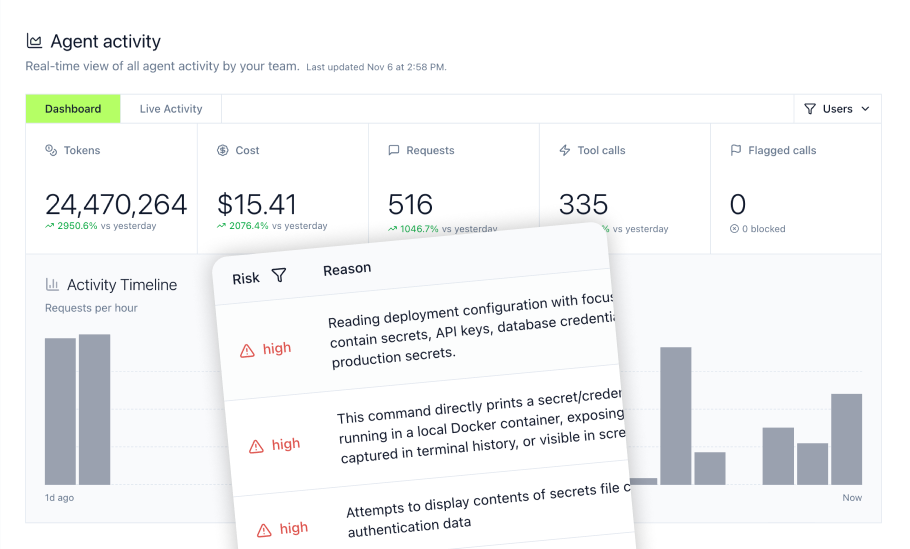
MintMCP's Agent Monitor provides visibility into supported AI agent activity including prompts, file access, commands, MCP tool calls, usage, and token costs, addressing the semantic failure gap that infrastructure monitoring misses.
Key Components of an AI Observability Platform
Effective AI observability operates across four interdependent layers. Missing any layer creates blind spots where failures hide.
Monitoring AI Agent Activity
The agentic layer monitors observable execution traces, tool calls, and memory interactions for autonomous agents. As organizations deploy agents that take real actions (booking refunds, querying databases, spawning sub-agents), observability of decision traces becomes essential. This layer captures:
- Tool calls and their arguments
- Memory reads and writes
- Sub-agent spawning and coordination
- Decision attribution and lineage
For organizations running Claude Code, Cursor, ChatGPT, or custom agents, this visibility answers the critical question: what did the agent actually do?
Enforcing Runtime Guardrails
Visibility alone is insufficient. The 2026 architectural pattern consolidates offline evaluation with runtime protection. When evaluation scores cross thresholds, runtime systems intervene by blocking, rewriting, or escalating outputs. This turns observability from passive monitoring into active reliability engineering.
MintMCP's Guardrails provide three complementary layers:
- Mint Guard: Managed detection policies for prompt injection, secrets, PII, and harmful content
- Rules: Declarative matching and enforcement on tools, arguments, or content
- Gateway Middleware: Customer-authored security and transformation logic for DLP integrations and custom policies
Ensuring Data and Tool Governance
The orchestration layer captures prompt/response pairs and tool execution timing. For enterprises using MCP (Model Context Protocol) to connect AI systems to enterprise tools, this layer governs what systems agents can access, which credentials they use, and how every interaction is logged.
MintMCP's MCP Gateway provides governed data and tool connections for AI clients including Claude, Cursor, ChatGPT, Gemini, and Copilot, centralizing authentication, access control, credential handling, and audit.
Why AI Observability is Critical for Enterprise AI Governance
AI observability connects model and agent behavior to reliability, security, cost, and governance signals. Teams implementing AI-specific monitoring report faster incident resolution, reduced alert noise, and higher deployment velocity compared to teams relying only on infrastructure observability.
Addressing Shadow AI and Compliance Risks
In the 2024 DORA survey, 81% of respondents said their organizations had shifted priorities to increase AI incorporation into applications and services. As AI usage expands, security and platform teams need visibility into which systems agents access, whose credentials they use, and what actions they take.
Shadow AI represents a significant risk: employees and developers using Claude Code, Cursor, or other AI tools without IT oversight. MintMCP's Agent Monitor can detect MCP use even when the MCP is not connected through MintMCP's gateway, providing visibility into both sanctioned and unsanctioned AI activity.
Preventing Dangerous Agent Actions
Agents can execute flawlessly from an infrastructure perspective while simultaneously:
- Delivering fabricated information to customers
- Exposing PII or credentials in tool call arguments
- Making unauthorized data access or modifications
- Running shell commands that install malicious packages
The unit of failure shifts from "did the service crash" to "did the agent make a safe, correct, policy-compliant decision." Agents take real actions, not just predictions, making observability of decision traces essential.
Ensuring Auditability and Attribution
Compliance teams increasingly need audit trails proving AI decisions for SOC 2, HIPAA, and internal risk reporting. Without AI observability, organizations cannot answer basic governance questions:
- Which agent performed this action?
- What data did it access?
- Which credentials did it use?
- Who approved its permissions?
MintMCP's Security & Enterprise features provide SIEM export and logging across tool calls, credential lifecycle events, and access policy changes, with tamper-evident access-grant history where supported.
Monitoring Large Language Models (LLMs) with Observability Tools
LLM observability addresses the specific challenges of monitoring language model behavior at scale.
Tracking LLM Prompts and Usage
The model/LLM layer measures token consumption, latency, and quality metrics. Effective LLM monitoring captures:
- Prompt submissions and completions
- Token usage by model, user, and session
- Response latency distributions
- Quality scores via evaluation frameworks
Model behavior drifts gradually rather than failing catastrophically. Accuracy can quietly drop from 95% to 70% while all infrastructure metrics remain normal. Automated anomaly detection using ML-trained baselines identifies meaningful deviations that threshold-based alerting would miss.
Analyzing Model and Token Costs
Token costs compound quickly across distributed AI workloads. Observability platforms provide:
- Cost attribution by team, project, and agent
- Human versus agent usage split
- Cache-hit rate analysis
- Chargeback-grade visibility for financial accountability
MintMCP's Agent Monitor includes usage and cost tracking with token spend by model, user, agent, and session, enabling organizations to attribute AI costs accurately across teams and projects.
Ensuring Consistent Access Across LLMs
Enterprises deploy mixed AI environments where employees use Claude, ChatGPT, Gemini, Copilot, and custom agents. Each tool has separate permission models, logs, and security controls. AI observability creates a unified governance layer that maintains consistent visibility regardless of which LLM or AI client employees use.
Implementing Effective AI Observability for Autonomous Agents
As organizations scale from 10 to 100+ autonomous agents, "who did what" becomes the central governance question.
Assigning First-Class Identities to Agents
Autonomous agents should not operate through human credentials or generic service accounts. Each agent needs its own identity with:
- Named, org-scoped non-human principal status
- Independent credential rotation and revocation
- Scoped tool access separate from human permissions
- Attributable audit trail for every action
MintMCP's Agent Gateway treats autonomous agents as first-class non-human principals. Authentication can include bearer credentials, OAuth client-credentials/M2M tokens, and workload identity federation.
Managing Agent Credentials and Permissions
Credentials scattered across laptops represent a significant security risk. A single leak can expose keys to multiple enterprise systems. Centralized credential management provides:
- Credential injection per call (no long-lived secrets in agent code)
- Per-user OAuth where applicable
- Independent expiration and rotation per agent
- Encrypted storage with rotated AES keys
Tracking Agent Activity and Attribution
Agent Monitor capabilities should capture activity before it happens via lightweight local hooks, with rules to block risky behavior in real time. Relevant activity includes:
- File reads (including .env files and SSH keys)
- Commands (bash, package installs, git operations)
- MCP tool calls and their arguments
- Prompt submissions
The MintMCP data risk guide provides additional context on assessing and managing risk across MCP connections.
Leveraging Virtual MCPs for Granular AI Observability
The Virtual MCP (VMCP) provides a key abstraction for achieving granular observability. A VMCP bundles approved connectors and a curated tool surface behind one governed endpoint for a particular team, role, use case, or agent.
Defining Access and Tools with Virtual MCPs
A Virtual MCP serves as the unit of:
- Deployment: One endpoint per role or use case
- Access control: SCIM-driven group membership
- Tool curation: Curated tool lists per audience
- Audit: Complete logging per VMCP
- Administration: Centralized management
Read-only versus read-write access is simply two VMCPs over the same connector with different tool curation. This approach eliminates the config sprawl where every developer configures every MCP server locally, creating N installs, N auth flows, and N points of failure.
Streamlining Administration and Audit
VMCPs centralize what previously required per-machine configuration:
- Users connect once instead of configuring each server individually
- Pre-configured credentials mean servers work immediately after SSO
- Directory groups drive membership through SCIM
- Tool-update policies control whether new upstream tools require approval
Integrating with Existing Identity Systems
Enterprise SSO through Okta, Entra ID, or Google drives both admin roles and tool access. When you suspend a user in the IdP, it propagates to MCP access. This integration supports:
- SSO authentication for supported human AI-client connections
- SCIM-driven access policies based on directory groups
- IdP-governed token exchange with Okta currently
- Dual attribution (human + agent) for comprehensive audit
Runtime Controls and Guardrails for Observable AI Operations
Observability explains what happened. Guardrails determine what can happen.
Detecting and Preventing AI Risks with Mint Guard
Prompt injection represents a significant threat vector where malicious tool descriptions inject instructions into the agent's prompt. Mint Guard provides managed detection policies for:
- Prompt injection: Blocks at high confidence
- Credentials and secrets: Detects exposed API keys and tokens
- PII: Identifies personally identifiable information in tool calls
- Harmful content: Screens for unsafe outputs
Mint Guard operates in monitoring or enforcing modes where supported, screening supported gateway tool calls without requiring custom policy authoring.
Implementing Custom Policies with Rules and Middleware
Rules provide declarative pattern matching that can evaluate tool names, argument patterns, and content via regex. Supported actions include flag, block, ask-user, mask, and Slack-notify.
Gateway Middleware enables customer-authored JavaScript logic for:
- DLP integrations with external classifiers
- Transformations and redaction
- Resource allowlists
- Custom policy enforcement
The middleware ships with templates for AWS Bedrock Guardrails, Google Cloud Model Armor, OpenAI moderation, and other enterprise security tools.
Ensuring Secure and Compliant AI Interactions
The combination of observability and enforcement creates a closed loop:
- Agent Monitor captures supported tool-call activity and arguments where coverage is available
- Evaluation scores outputs against quality and safety rubrics
- When scores cross thresholds, enforcement intervenes
- Blocked or modified actions are logged for audit
This eval-to-guardrail lifecycle turns AI observability from passive watching into active reliability engineering.
Integrating AI Observability into Enterprise Security Operations
AI observability must integrate with existing enterprise security infrastructure to deliver compliance value.
Centralizing AI Access and Identity Management
Enterprise controls should include:
- SSO and SCIM: Directory groups drive both admin roles and tool access
- RBAC: Org-level roles for admin reach; VMCP access policies for tool reach
- Operational controls: Kill switch, per-VMCP disable, credential rotation
- Configuration as code: Declarative management of gateway config and rules
Exporting AI Activity for SIEM Analysis
SIEM export capabilities support OTLP or Splunk HEC, exporting:
- Tool calls and their results
- Prompt submissions
- Gateway requests
- Access policy changes
- Credential lifecycle events
This integration enables security teams to correlate AI activity with other enterprise security data.
Establishing Robust Credential Lifecycles
Credential controls should address:
- Encrypted storage with rotated encryption keys
- Per-call credential injection (no long-lived secrets in agent code)
- Independent rotation and revocation per agent identity
- Audit logging of all credential access
The EU AI Act generally applies from August 2, 2026, with earlier and later exceptions. High-risk AI systems are subject to record-keeping and post-market monitoring requirements based on the provisions and dates that apply to them. AI observability can support this evidence and monitoring infrastructure.
How MintMCP Delivers Enterprise AI Observability
MintMCP combines AI observability, governance, and runtime enforcement for enterprises deploying autonomous agents and MCP-connected AI systems at scale.
Comprehensive visibility across the AI stack:
MintMCP's Agent Monitor provides visibility into supported AI-agent activity, including prompts, file access, shell commands, MCP tool calls, token usage, and costs. It can also provide supported visibility into local or off-gateway activity from coding-agent environments, helping security teams identify sanctioned and unsanctioned agent activity.
Governed access with centralized control:
The MCP Gateway provides governed data and tool connections for AI systems. Define Virtual MCPs that bundle approved connectors and curated tools behind governed endpoints. MintMCP's Agent Gateway builds on this foundation by giving autonomous agents first-class identities with independent credentials, scoped permissions, and attributable audit trails. Integrate with Okta, Entra ID, or Google for SSO, SCIM-driven access policies, and directory-based governance.
Active runtime protection:
Deploy Guardrails that enforce security and compliance policies before risky actions execute. Mint Guard provides managed detection for prompt injection, credential exposure, PII leakage, and harmful content. Rules enable declarative policy enforcement via pattern matching. Gateway Middleware supports custom JavaScript logic for DLP integrations and transformations. Use Agent Monitor for supported activity visibility and Guardrails for runtime policy enforcement.
MintMCP is SOC 2 Type II audited with SIEM export for enterprise security integration. The platform provides penetration-tested infrastructure with data encrypted in transit and at rest. For detailed compliance documentation, see the Trust Center.
Frequently Asked Questions
What is the difference between AI observability and traditional application monitoring?
Traditional application monitoring tracks deterministic software where identical inputs produce identical outputs, measuring uptime, latency, error rates, and resource utilization. AI observability addresses the probabilistic nature of AI systems by tracking output quality, semantic correctness, safety, and policy compliance. An AI system can return a 200 OK response with normal latency while delivering hallucinated content or exposing sensitive data. Traditional monitoring would show everything healthy while business impact accumulates. AI observability closes this semantic failure gap by capturing what the model said, not just whether it responded.
How does AI observability help prevent prompt injection attacks?
Prompt injection occurs when malicious content in tool descriptions, user inputs, or retrieved documents manipulates an AI agent into executing unintended actions. AI observability platforms detect prompt injection through multiple mechanisms: pattern matching on known attack signatures, anomaly detection when agent behavior deviates from baselines, and LLM-as-judge evaluation scoring outputs against safety rubrics. When detection occurs, runtime enforcement can block the request before execution, mask sensitive content, or escalate for human review. This eval-to-guardrail lifecycle transforms observability from passive monitoring into active protection.
Can AI observability tools track costs across different LLMs?
Yes. Modern AI observability platforms track token consumption, latency, and costs across multiple LLM providers including Claude, ChatGPT, Gemini, and open-source models. Cost tracking provides attribution by team, project, user, and agent session, enabling chargeback and budget management. Platforms distinguish between human and agent usage, measure cache-hit rates, and identify optimization opportunities. Comprehensive cost visibility across all AI workloads supports financial governance and optimization efforts.
What role does agent identity play in AI observability?
Agent identity is foundational for meaningful AI observability. When autonomous agents operate through human credentials or shared service accounts, the audit trail collapses and you cannot distinguish which agent performed an action, rotate credentials independently, or apply agent-specific policies. First-class agent identities give each autonomous agent its own named principal, independent credentials, scoped tool access, and attributable audit trail. This enables organizations to answer governance questions about who did what, enforce least-privilege access per agent, and rotate or revoke credentials without affecting other agents or human users.
How does AI observability support compliance requirements like SOC 2?
AI observability can support compliance by producing logs, access records, and operational evidence, but requirements vary by framework and system. SOC 2 does not prescribe a universal requirement to log every AI tool call, and HIPAA requires regulated entities to implement audit controls that record and examine activity in systems containing or using ePHI. The EU AI Act generally applies from August 2, 2026, with earlier and later exceptions; applicable high-risk systems have record-keeping and post-market monitoring duties. AI observability infrastructure provides the telemetry, audit trails, and SIEM integration that support these compliance frameworks.