As AI agents move from prototypes to production, monitoring and observability have become core requirements for enterprise LLM deployments. Yet many organizations still struggle to scale AI because they lack reliable tracing, evaluation, and governance tooling. For enterprise teams deploying AI coding assistants, automation agents, and customer-facing AI products, choosing the right observability platform has become mission-critical.
The challenge goes beyond basic logging. Modern LLM observability must handle non-deterministic agent behavior, multi-step workflows, security threats, and compliance requirements. With 23% of organizations reporting that they are scaling an agentic AI system somewhere in the enterprise, the gap between pilot projects and production-ready deployments often comes down to visibility and governance. Enterprise teams need platforms that provide real-time tracking, security controls, and audit trails without slowing down engineering velocity. For teams deploying Claude, Cursor, ChatGPT, Gemini, and Copilot at scale, solutions like MintMCP's Agent Monitor address these requirements with centralized governance and shadow AI detection.
Key Takeaways
- Evaluation-first platforms score production traces with research-backed metrics for content quality
- Open-source observability cores with self-hosting enable strict data residency requirements
- ML monitoring heritage platforms excel at RAG pipeline debugging and retrieval quality analysis
- Native framework integration provides near-zero-config setup for specific AI stacks
- Unified monitoring, evaluation, and experimentation platforms eliminate context switching
- LLM gateway and observability combinations enable unified tool access with cost attribution
- End-to-end GenAI lifecycle platforms cover tracing, evaluation, and prompt management
- Unified infrastructure and LLM observability reduces storage costs through columnar formats
- Agent testing frameworks validate multi-turn behavior as merge-blocking gates in CI/CD
- MintMCP Agent Monitor tracks agent activity across the organization with real-time PII detection, credential leakage alerts, and shadow AI discovery
1. MintMCP Agent Monitor: Enterprise governance with real-time agent visibility
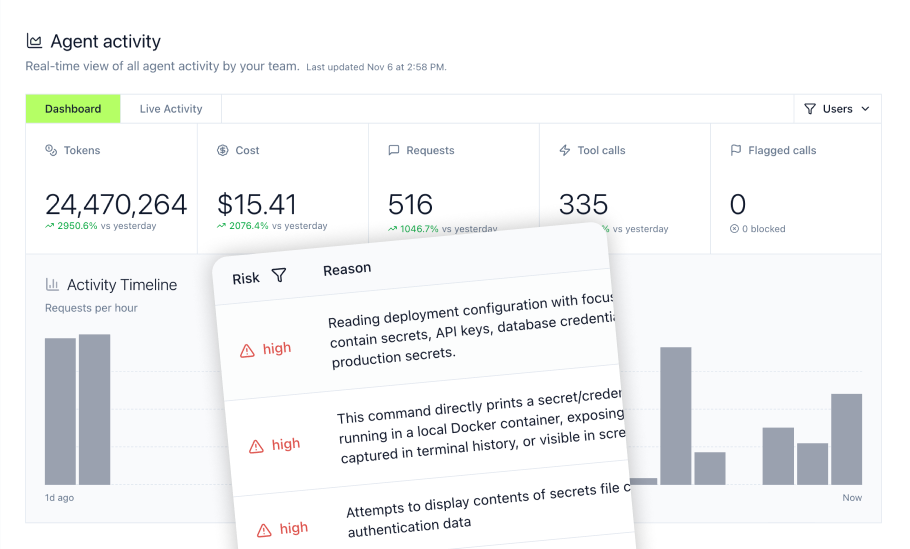
MintMCP Agent Monitor provides real-time visibility into agent actions across your organization, including off-gateway activity detection in tools like Cursor and Claude Code. The platform addresses the unique challenges of enterprise AI deployments where agents access production systems, databases, and sensitive data.
What makes MintMCP Agent Monitor different
MintMCP takes a data-permissions-first approach to AI observability. Rather than retrofitting governance onto an agent platform, MintMCP starts with SSO, SCIM-driven RBAC, IdP groups, Virtual MCP Bundles, tool-level policy, and audit logs, then enables agents on top. This architecture ensures an agent's access is always a subset of an already-governed permission model. MintMCP's Agent Gateway builds on the MCP Gateway foundation by adding agent identities, permissions, memory, and monitoring as a connected control layer.
Core capabilities
- Real-time activity tracking across MCP calls made both through the gateway and outside it through hooks in Cursor and Claude Code
- PII exposure detection with built-in rules that flag or block sensitive data before it leaves the organization
- Credential leakage monitoring that detects API keys, tokens, and secrets in agent outputs
- Risky bash command detection with configurable block/flag/alert actions
- Prompt injection attempt identification using built-in and custom guardrail policies
- Org-level analytics on MCP adoption, usage patterns by team/tool, latency monitoring, and error tracking
- MDM integration for push of detect-only or enforce-mode configurations to developer machines
Security and compliance
MintMCP is SOC 2 Type II audited, compliant with HIPAA standards, and penetration tested. Enterprise SSO, complete audit trails, PII detection, and role-based access control are built into every layer of the platform. Customers handling protected health information can request HIPAA documentation. MintMCP signs BAAs.
Enterprise integrations
The platform integrates with Claude, Cursor, ChatGPT, Gemini, and Copilot through centralized gateway and Agent Monitor coverage. SIEM export capabilities support Microsoft Sentinel, Splunk, and S3 for compliance investigations.
Fit for enterprise teams
MintMCP Agent Monitor is designed for engineering teams deploying AI coding assistants, security teams requiring audit trails and compliance controls, and platform engineering teams building internal AI tooling. The combination of MCP Gateway for governed tool access and Agent Monitor for comprehensive visibility addresses the two-layer governance requirement that enterprise AI deployments need.
2. Confident AI
Confident AI provides evaluation-first LLM observability, scoring every production trace with research-backed metrics rather than focusing primarily on infrastructure monitoring. The platform runs 50+ metrics from the DeepEval framework to measure content quality alongside standard performance indicators.
Primary focus
The platform emphasizes quality-aware alerting via Slack, PagerDuty, and Teams. Organizations can define thresholds based on content correctness, hallucination detection, and relevance scores rather than just latency and error rates.
Where Confident AI fits
- Organizations prioritizing AI content quality and correctness over pure infrastructure metrics
- Teams needing cross-functional workflows where PMs, QA, and domain experts participate without engineering
- Enterprises requiring SOC 2 documentation, with HIPAA support and custom data residency available on the Enterprise tier
Customers include Panasonic, Toshiba, Amdocs, BCG, CircleCI, and Finom. Finom reported cutting agent improvement cycles from 10 days to 3 hours using the platform.
Pricing
Free tier with 2 seats and 1 GB-month, Starter at $200/month with unlimited seats, Team at $2,000/month, and Enterprise with custom pricing.
3. Langfuse
Langfuse offers an MIT-licensed open-source core with self-hosting capability and a large developer community, while certain enterprise features require a commercial license. The platform is now part of ClickHouse.
Primary focus
The platform provides OpenTelemetry-native instrumentation with 60% of cloud traffic flowing via OTEL. Self-hosting via Docker Compose takes under 5 minutes, and the platform includes prompt management with version control.
Where Langfuse fits
- Teams with strict data residency requirements needing full infrastructure control
- Organizations comfortable building custom evaluation layers on top of trace data
- Engineering teams already working with LangChain, LlamaIndex, OpenAI SDK, LiteLLM, or Vercel AI SDK
Pricing
Free self-hosted open-source core, Cloud Core at $29/month with 100,000 units included, and Enterprise at $2,499/month with a yearly commitment.
4. Arize AI / Phoenix
Arize AI brings mature ML monitoring practices to LLM observability through Phoenix, its OpenTelemetry-compatible open-source component. The platform excels at RAG-specific observability including retrieval quality and embedding drift detection.
Primary focus
The platform provides production-scale dashboards with real-time monitoring and supports the OpenInference standard for vendor-agnostic interoperability. Strong government and enterprise adoption validates the platform's compliance posture.
Where Arize AI fits
- Organizations with existing ML observability practices extending to LLMs
- Teams building RAG pipelines needing retrieval quality debugging
- Enterprises standardizing on OpenTelemetry for AI instrumentation
Pricing
Phoenix is open-source under Elastic License 2.0, Arize AX Pro at $50/month, Enterprise tier with custom pricing.
5. LangSmith
LangSmith provides LLM engineering capabilities built by the LangChain team, offering deep integration with LangChain and LangGraph frameworks. Near-zero-config setup makes it straightforward for teams already using the LangChain ecosystem.
Primary focus
Time-travel debugging and Agent Studio breakpoints allow developers to replay and inspect agent workflows. The Prompt Hub provides centralized prompt management across teams.
Where LangSmith fits
- Teams with AI stacks built on LangChain or LangGraph
- Organizations needing automatic instrumentation without custom integration work
- Developers requiring detailed debugging for multi-step agent workflows
Pricing
Free Developer plan, Plus at $39/user/month, Enterprise tier with custom pricing.
6. Braintrust
Braintrust combines monitoring, evaluation, and experimentation into a unified platform. Customers include Notion, Vercel, Instacart, Zapier, Stripe, and Airtable.
Primary focus
The platform runs automated scorers continuously on production traffic with fast Brainstore trace search and AI-assisted analysis. Asynchronous logging maintains performance at high volume.
Where Braintrust fits
- Teams needing integrated monitoring, evaluation, and experimentation without context switching
- Organizations wanting self-hosted and hybrid deployment options on Enterprise tier
- Engineering teams focused on development velocity optimization
Notion reported going from fixing 3 issues per day to 30 after adopting the platform, a 10x improvement in development velocity.
Pricing
Free tier with 1GB processed data, Pro at $249/month, Enterprise tier with custom pricing.
7. Datadog Agent Observability
Datadog extends its established enterprise APM platform with agent-specific observability, correlating LLM traces with infrastructure, APM, logs, and security data. Datadog acquired Adaptive ML in June 2026 to expand its research and development work around agentic AI systems.
Primary focus
Single-pane consolidation with existing Datadog infrastructure eliminates new vendor procurement for organizations already standardized on the platform. Compliance and governance controls are typically pre-approved in enterprises using Datadog.
Where Datadog fits
- Enterprises heavily standardized on Datadog for infrastructure monitoring
- Organizations wanting unified observability across traditional applications and AI workloads
- Teams avoiding new vendor procurement processes
Pricing
Agent Observability starts at $160 per month for the first 100,000 LLM spans with annual billing, or $200 month-to-month, with additional spans and longer retention billed separately.
8. Galileo AI
Galileo AI focuses on agent reliability with proprietary Luna-2 SLMs that deliver a vendor-reported 152ms average evaluation latency and 97% lower cost than LLM-based evaluations. Cisco acquired Galileo in April 2026 to strengthen AI observability capabilities within its Splunk portfolio.
Primary focus
Runtime Protection blocks unsafe outputs before reaching users with pre-execution intervention under 250ms. The eval-to-guardrail lifecycle automatically converts evaluation criteria into production guardrails.
Where Galileo AI fits
- Enterprises needing runtime protection and governance with low-latency eval models
- Organizations requiring on-premise deployment within customer VPC or bare-metal
- Teams wanting proprietary agentic eval models rather than LLM-as-judge approaches
Pricing
Contact sales for pricing.
9. TrueFoundry
TrueFoundry provides end-to-end prompt and output tracing with OpenTelemetry spans combined with LLM gateway capabilities. The platform recently acquired Seldon AI for expanded AI capabilities.
Primary focus
Fine-grained metadata and cost attribution per run, team, and customer enables detailed chargeback. Published benchmarks report roughly 3 to 4ms of gateway overhead in some configurations and more than 350 requests per second on a single vCPU, although newer testing shows overhead can rise to approximately 12ms with full tracing near that throughput.
Where TrueFoundry fits
- Platform engineering teams needing unified AI gateway and observability
- Organizations requiring self-hosted deployment with RBAC, SSO, and compliance controls
- Teams focused on cost control and attribution across AI workloads
Pricing
Custom enterprise pricing for cloud and self-hosted deployments.
10. MLflow
MLflow provides Apache 2.0 licensed end-to-end GenAI lifecycle management under Linux Foundation governance. The platform covers tracing, evaluation, and prompt management in a unified open-source package.
Primary focus
Production-grade tracing with automated LLM-as-a-Judge evaluation and trace replay for reproducing non-deterministic failures. The combination of open-source licensing and enterprise backing provides both auditability and managed infrastructure options.
Where MLflow fits
- Teams wanting full auditability with open-source licensing
- Organizations with existing investments seeking integrated AI observability
- Engineering teams needing trace-level replay for debugging non-deterministic behavior
Pricing
Free open-source under Apache 2.0; managed enterprise options are available through Databricks, AWS, and other platforms.
11. OpenObserve
OpenObserve provides unified logs, metrics, traces, LLM traces, and RUM in a single platform. In a vendor-published storage-only comparison using S3-backed Parquet versus Elasticsearch on EBS, OpenObserve reported up to 140x lower storage costs, although actual results vary by workload and data compressibility. The AGPL-3.0 licensed platform deploys via single binary in under 2 minutes.
Primary focus
SQL-based queries correlate LLM traces with infrastructure metrics. Parquet columnar format enables storage cost reduction for organizations with long retention requirements.
Where OpenObserve fits
- Teams wanting single platform coverage for infrastructure and LLM observability
- Organizations with significant log volumes needing storage cost reduction
- Engineering teams preferring SQL-based query interfaces
Pricing
Free self-hosted, Cloud tier with usage-based pricing.
12. LangWatch
LangWatch combines observability with agent testing through its Scenario framework, which uses a User Simulator and Judge Agent to test multi-turn agent behavior. Customers include Deloitte, Backbase, and PagBank in banking and payments.
Primary focus
Batch Runs execute scenarios as merge-blocking gates in CI/CD pipelines. The platform provides self-hosted, hybrid, or cloud deployment, with ISO 27001 and GDPR documentation plus RBAC, SSO, and SCIM on the Enterprise tier.
Where LangWatch fits
- Regulated industries needing both observability and agent testing with compliance certifications
- Teams building CI/CD pipelines that require agent behavior validation before deployment
- Organizations in banking, payments, or financial services with strict audit requirements
LangWatch uses an open-core model: most of the repository is Apache 2.0 licensed, while enterprise modules use a separate commercial license.
Pricing
Free Developer tier with 50,000 events per month and 2 users; Growth at €29 per core seat per month with 200,000 events included and unlimited lite users; Enterprise with custom pricing.
Deploy AI agents with enterprise observability and governance
Enterprise teams deploying AI agents across Claude, Cursor, ChatGPT, Gemini, and Copilot need observability infrastructure that addresses both tool governance and agent behavior. MintMCP provides a two-layer approach:
- MCP Gateway for governed data and tool connections
- Agent Gateway for agent identities, permissions, memory, and monitoring
MCP Gateway establishes the foundation by transforming fragmented agent-to-tool connections into a centralized, governed hub. Every connection flows through a single authentication and authorization layer, enabling:
- Reduced credential sprawl
- Consistent policy enforcement
- Centralized authentication and authorization
- Complete audit logging for tool connections
Agent Monitor extends this foundation with real-time visibility into agent behavior, including shadow AI detection through hooks in Cursor and Claude Code.
This architecture distinguishes between two separate governance requirements:
- Tool access governance: MCP Gateway handles authentication, authorization, and audit logging for tool connections.
- Agent activity governance: Agent Gateway adds per-agent identities, scoped permissions, memory management, and behavioral monitoring.
Together, they provide the complete governance stack that enterprise AI deployments require.
MintMCP supports the teams responsible for moving AI agents into production:
- Engineering teams moving from AI prototypes to production systems
- Security teams enforcing compliance and access-control requirements
- Platform teams building and managing internal AI infrastructure
Every agent action is logged with full context, including:
- Who initiated the action
- Which tools were called
- What data flowed through the interaction
- When the action occurred
PII detection, credential leakage monitoring, and prompt injection identification operate in real time, with configurable enforcement policies that balance security with development velocity.
Frequently asked questions
What is LLM observability and why is it crucial for enterprises?
LLM observability encompasses monitoring, tracing, and evaluating large language model behavior in production environments. Unlike traditional application monitoring, LLM observability must handle non-deterministic outputs, multi-step agent workflows, and quality metrics beyond latency and error rates. Enterprises need LLM observability to maintain audit trails for compliance, detect security threats like prompt injection, and ensure AI outputs meet quality standards before reaching customers or internal systems.
How do LLM observability tools help in detecting and preventing shadow AI?
Shadow AI refers to AI tool usage outside sanctioned channels, creating security and compliance blind spots. Observability platforms detect shadow AI by monitoring agent activity across the organization, including off-gateway traffic. Solutions like MintMCP's Agent Monitor provide hooks into tools like Cursor and Claude Code to identify unsanctioned MCP usage, with MDM integration enabling enforcement of detect-only or block-mode policies across developer machines.
What role does the Model Context Protocol (MCP) play in enterprise LLM observability?
MCP provides the connection layer between AI agents and enterprise tools, databases, and APIs. Observability at the MCP layer captures which tools agents access, what data flows through those connections, and how agents use their available capabilities. MCP gateways serve as the central control point for authentication, authorization, and logging, transforming fragmented point-to-point connections into a governed, observable infrastructure.
Can LLM observability tools integrate with existing enterprise security and compliance frameworks?
Yes. Enterprise-grade observability platforms integrate with identity providers via SSO and SCIM, export audit logs to SIEM platforms like Microsoft Sentinel and Splunk, and support compliance frameworks including SOC 2, HIPAA, and GDPR. Many platforms offer data residency options, self-hosted deployment, and configurable retention policies to meet specific regulatory requirements.
How does per-agent credential scoping enhance security in LLM deployments?
Per-agent credential scoping gives each AI agent its own identity with rotatable credentials independent of human users. This approach means compromised credentials affect only one agent rather than all systems that share service account keys. Teams can revoke individual agent access without disrupting other agents or users, and audit trails clearly attribute actions to specific agents rather than shared accounts. Agent identity management becomes especially important as organizations scale from a handful of AI agents to dozens or hundreds operating across different teams and use cases.