AI agents have fundamentally changed how enterprises interact with data, execute tasks, and automate workflows. Unlike traditional chatbots, these autonomous systems feature persistent memory, tool integration, and multi-step reasoning—creating security challenges that legacy application security cannot address. With over 30 vulnerabilities resulting in 24 CVEs discovered in December 2025 across major AI platforms including GitHub Copilot, Cursor, and Windsurf, developers face an urgent need to understand and mitigate these risks before they become breach headlines.
This article provides a comprehensive guide to AI agent security risks, covering the evolving threat landscape, specific vulnerabilities, authentication strategies, data protection measures, and enterprise governance frameworks. For organizations seeking centralized control over AI agent deployments, MCP Gateway provides the security, governance, and ease-of-use that enterprises need to deploy MCP at scale.
Key takeaways
- The threat landscape has fundamentally shifted: Most organizations discover significantly more AI agents than initially estimated during security audits, creating massive blind spots in security coverage
- Traditional security tools fall short: AI agents require identity-first architectures with dynamic authorization—static RBAC and perimeter controls cannot inspect agent behavior or enforce context-aware policies
- Layered defense blocks most attacks: Organizations implementing input sanitization combined with behavioral monitoring achieve significant attack prevention at the input/output stage
- ROI is compelling: The average data breach costs over $4M, making security investments pay back within months when breach prevention is factored in
- Credential rotation is essential: Short-lived certificates with rotation materially reduce the blast radius of credential theft and limit persistence after compromise
Understanding the evolving threat landscape of AI agents
The rise of shadow AI: Unseen risks
Shadow AI represents one of the most significant security challenges facing enterprises today. Business units deploy AI agents to accelerate workflows, often bypassing IT controls entirely. These unsanctioned deployments create blind spots where security teams have no visibility into what data agents access, what actions they take, or what external systems they connect to.
The scale of this problem is substantial. Many organizations discover far more AI tooling and agent activity than expected once they audit OAuth grants, API keys, IDE extensions, and SaaS integrations. OAuth grants, API keys, and SaaS app installations often reveal hidden agents that have been operating for months without oversight.
Why traditional security falls short for AI agents
Legacy application security was designed for deterministic systems with predictable behavior. AI agents operate differently:
- Autonomous decision-making: Agents make choices without human intervention, potentially taking actions outside defined parameters
- Persistent memory: Unlike stateless APIs, agents retain context across sessions, creating data leakage risks
- Tool integration: Agents execute bash commands, access databases, and call external APIs—each interaction expanding the attack surface
- Multi-step reasoning: Complex task chains make it difficult to predict or trace agent behavior
Traditional perimeter controls, static role-based access, and signature-based detection cannot address these characteristics. As noted in the McKinsey security playbook, organizations need identity-first architectures with dynamic, context-aware authorization policies. The NIST AI Risk Management Framework provides additional guidance for managing these emerging risks.
Common attack vectors for AI agents
The OWASP Top 10 for Agentic Applications identifies critical attack vectors that developers must address:
- Prompt injection: Malicious instructions embedded in user inputs or retrieved data that manipulate agent behavior
- Privilege escalation: Agents acquiring permissions beyond their intended scope through chained tool calls
- Data exfiltration: Sensitive information extracted through seemingly benign queries or tool interactions
- Supply chain attacks: Compromised MCP servers, plugins, or model weights introducing vulnerabilities
Identifying key security risks in AI agent deployments
Data access and confidentiality risks
AI agents often require broad data access to perform their functions effectively. A customer support agent might need CRM data, support tickets, and customer history. A coding agent requires repository access, environment variables, and CI/CD system credentials. This creates substantial risk:
- Excessive permissions: A significant portion of security breaches occur when agents are granted more access than necessary for their functions
- Credential exposure: Agents accessing .env files, SSH keys, and API tokens without proper controls
- Cross-system data flow: Information moving between systems without audit trails or access logging
Integrity and availability attacks
Beyond data theft, attackers target agent integrity and availability:
- Model poisoning: Corrupted training data or fine-tuning that introduces backdoors
- Code injection: Studies show AI coding assistants can generate insecure patterns in realistic scenarios—treat suggestions as untrusted, require human review, and run automated security scanning before merge
- Denial of service: Resource exhaustion attacks that disable critical agent functions
Compliance and governance challenges
Regulatory frameworks increasingly scrutinize AI deployments. Organizations must demonstrate:
- Audit trails: Complete logs of every agent interaction for SOC2 and GDPR compliance
- Data minimization: Agents accessing only necessary data per GDPR Article 5(1)(c)
- Transparency: For high-risk AI systems, provide the instructions and operational transparency deployers need to interpret outputs and use the system appropriately (EU AI Act Article 13)
The CISA secure AI deployment guidelines provide federal standards for managing these compliance requirements.
Implementing robust access control and authentication for AI agents
Leveraging enterprise authentication standards
AI agents require the same authentication rigor as human users—often more. Best practices include:
- OAuth 2.0 and SAML integration: Connect agents to enterprise identity providers for centralized authentication
- Workload identity federation: Use cryptographic attestation rather than static API keys
- Short-lived credentials: Implement short-lived access tokens with automated rotation (configured to your IdP and risk level) to limit exposure from compromised credentials
- Multi-factor verification: Require additional authentication for high-risk operations
MCP Gateway provides enterprise authentication with OAuth 2.0, SAML, and SSO integration for all MCP servers, automatically wrapping local servers with enterprise-grade authentication.
Granular control over AI agent permissions
Static role-based access control (RBAC) is insufficient for AI agents. Organizations should implement:
- Attribute-based access control (ABAC): Policies that evaluate context including time, location, resource sensitivity, and user role
- Least privilege enforcement: Default deny policies with explicit grants for specific functions
- Dynamic authorization: Real-time policy evaluation that adapts based on behavioral risk scores
- Tool-level permissions: Configure access by operation type—enable read-only operations while excluding write tools
Securing credentials and API keys
Credential management for AI agents requires centralized control:
- Secret management: Store all API keys and tokens in enterprise vaults (HashiCorp Vault, AWS Secrets Manager)
- Automatic rotation: Eliminate manual credential updates with automated lifecycle management
- Scope limitation: Issue credentials with minimum necessary permissions for specific tasks
- Revocation capability: Immediate token invalidation when anomalies are detected
Ensuring data protection and privacy for AI agent interactions
Protecting sensitive data from AI access
LLM Proxy addresses a critical gap in AI agent security: visibility and control over what coding agents access and execute. Key protections include:
- Sensitive file blocking: Prevent access to .env files, SSH keys, credentials, and configuration files
- Command filtering: Block dangerous bash commands in real-time before execution
- Input sanitization: Implement spotlighting techniques to isolate untrusted content in prompts
- Output validation: Scan agent responses for data leakage and malicious code
Meeting regulatory requirements with data controls
Compliance mandates specific data handling practices:
- Encryption standards: TLS 1.3 for data in transit, AES-256 for data at rest
- Retention policies: Automated enforcement of retention requirements that match your regulatory scope (e.g., SEC/FINRA recordkeeping rules and internal legal holds)
- Access logging: Immutable records of every data access for audit purposes
Organizations operating under GDPR or SOC2 requirements can leverage MCP Gateway's security features including complete audit logs and encrypted communications.
Monitoring and auditing AI agent behavior for security anomalies
Gaining observability into AI agent actions
Without monitoring, organizations cannot see what agents access or control their actions. Effective observability requires:
- Tool call tracking: Monitor every MCP tool invocation, bash command, and file operation
- MCP inventory: Complete visibility into installed MCPs, their permissions, and usage patterns
- Behavioral baselines: Establish normal patterns for query volume, data access, and API calls
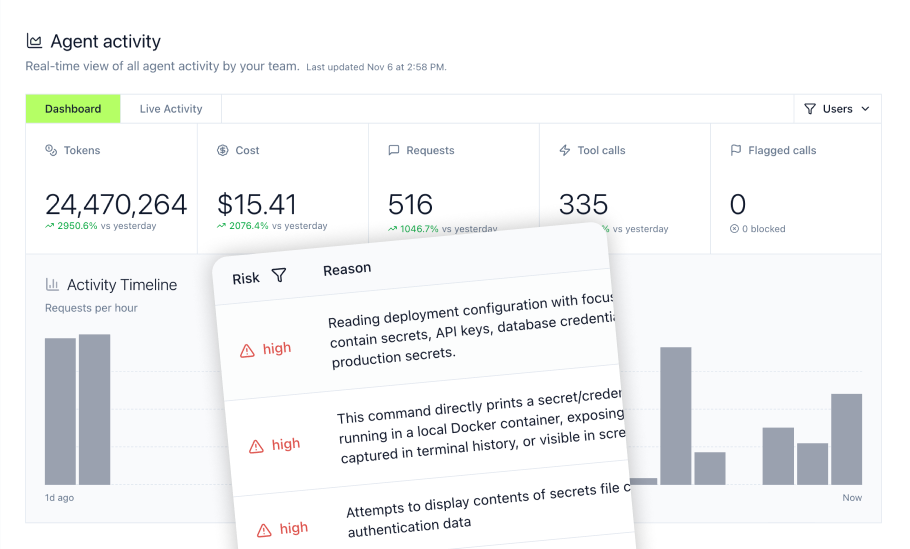
- Real-time dashboards: Live visibility into server health, usage patterns, and security alerts
The LLM Proxy sits between your LLM client (Cursor, Claude Code) and the model itself, providing essential visibility into how employees use LLM clients and what tools agents invoke.
Detecting malicious activity in Real-Time
Behavioral analytics enable rapid threat detection:
- Anomaly alerts: Automatic notification when access patterns deviate from baselines (>3x normal volume)
- Mean time to detect (MTTD): Enterprise platforms achieve detection within minutes for high-severity threats
- SIEM integration: Correlation with enterprise security tools for comprehensive threat analysis
- Automated response: Token revocation and agent isolation when policy violations occur
Leveraging audit logs for Post-Incident analysis
Complete audit trails serve multiple purposes:
- Forensic investigation: Trace the exact sequence of agent actions leading to an incident
- Compliance reporting: Generate documentation for SOC2 and GDPR audits
- Pattern identification: Analyze historical data to identify vulnerability trends
- Accountability: Establish who approved agent access and when
Implementing secure development practices for AI agents
Building security into AI agents from the start
Secure development practices reduce vulnerabilities before deployment:
- Input validation: Sanitize all user inputs and retrieved data before agent processing
- Output encoding: Prevent injection attacks by properly encoding agent outputs
- Dependency scanning: Audit MCP servers and plugins for known vulnerabilities
- Threat modeling: Apply MITRE ATLAS techniques to identify attack vectors during design
Automating security checks in CI/CD pipelines
Integration with development workflows ensures continuous security:
- Pre-deployment scanning: Automated vulnerability assessment before production release
- Code review requirements: Human verification of AI-generated code before merge
- Secret detection: Scan for exposed credentials in agent configurations
- Compliance validation: Verify policy compliance before deployment approval
Turning shadow AI into sanctioned AI with enterprise governance
Establishing clear AI agent policies
Organizations with formal AI governance strategies report significantly higher success rates versus those without structured approaches. Effective governance requires:
- Acceptable use policies: Define approved AI agent use cases and prohibited activities
- Data classification: Specify which data categories agents can access based on sensitivity
- Approval workflows: Establish processes for new agent deployments and permission grants
- Exception handling: Define procedures for temporary elevated access when needed
Managing AI tools and usage across teams
Centralized management enables consistent security:
- User provisioning: Team-based access controls with role-appropriate permissions
- Usage analytics: Track tool usage, performance, and cost allocation across teams
- Rate limiting: Control API consumption to prevent abuse and manage costs
- Policy enforcement: Automatically apply data access and usage policies
MCP Gateway provides centralized governance with authentication, audit logging, and rate control for all MCP connections—transforming shadow AI into sanctioned AI. Organizations can deploy STDIO servers on MintMCP's managed service or connect other deployable or remote servers for comprehensive coverage.
Leveraging Enterprise-Grade platforms for AI agent security
Evaluating AI gateway solutions
Enterprise AI security platforms should provide:
- One-click deployment: Transform local MCP servers into production services with built-in security
- OAuth protection: Add SSO and OAuth to any local MCP server automatically
- High availability: Enterprise SLAs with automatic failover and redundancy
- Cross-platform support: Work with Claude, ChatGPT, Cursor, and other MCP-compatible clients
Benefits of a centralized LLM proxy
A proxy architecture provides unique security advantages:
- Complete visibility: See every tool call without modifying agent code
- Real-time blocking: Prevent dangerous operations before they execute
- Audit completeness: Capture all interactions for compliance and forensics
- Minimal friction: No changes required to developer workflows
For organizations seeking to understand MCP infrastructure, enterprise platforms address critical challenges with cost control, compliance, and governance that point solutions cannot match.
Choosing the right infrastructure for secure AI agents
Implementation complexity varies based on organizational needs:
DIY approaches work when:
- Teams have fewer than 50 agents with low-risk use cases
- Strong existing security expertise (CISSP-certified staff)
- Simple deployments within single cloud environments
Enterprise platforms are needed when:
- 50-200+ agents operate across multiple platforms requiring unified governance
- Regulatory compliance (SOC2, GDPR) demands comprehensive audit trails
- Complex authorization policies require ABAC/PBAC implementation
- Recent security incidents require forensics and remediation capabilities
Automated behavioral analytics can meaningfully reduce incident response time by speeding detection, triage, and containment—especially when tied to real-time enforcement, with average break-even on security investments occurring within months when breach prevention is factored in.
Frequently asked questions
What is the difference between AI agent security and traditional application security?
Traditional application security focuses on deterministic systems with predictable inputs, outputs, and behavior patterns. AI agent security addresses autonomous systems that make independent decisions, maintain persistent memory across sessions, integrate with multiple tools and data sources, and exhibit emergent behaviors that cannot be fully predicted. This requires identity-first architectures, behavioral monitoring, and dynamic authorization policies that traditional security tools were not designed to provide.
How do I discover all AI agents operating in my organization?
Shadow AI discovery requires multiple approaches: scan OAuth grants across SaaS platforms to identify AI tool authorizations, audit API key usage and generation logs, review network traffic for AI service endpoints, check SaaS app inventories for AI-powered tools, and survey teams about AI tools they use for productivity. Most organizations discover 3-5x more agents than initially estimated through comprehensive audits.
What is the OWASP top 10 for agentic applications and why does IT matter?
Released in December 2025, the OWASP Top 10 for Agentic Applications represents the first industry-standard framework specifically addressing AI agent security. Developed with input from over 100 security researchers, industry practitioners, user organizations, and leading security and GenAI providers, it identifies the ten highest-impact risks including prompt injection, excessive agency, and insecure tool integration. The framework provides a common vocabulary for security discussions and prioritizes remediation efforts based on real-world attack patterns.
How should organizations handle ai-generated code security?
Research indicates that 15-25% of AI code contains security vulnerabilities. Organizations should require human code review before merging AI-generated changes, implement automated security scanning in CI/CD pipelines specifically targeting common AI coding mistakes (SQL injection, XSS, authentication bypasses), establish sandboxed testing environments for AI-suggested code execution, and maintain audit trails of which code was AI-generated for post-incident analysis.
What credentials rotation frequency is recommended for AI agents?
Industry best practice recommends 24-hour rotation for standard agents and more aggressive 1-hour rotation for agents with elevated privileges or access to sensitive data. Short-lived certificates with cryptographic attestation prevent credential theft from becoming persistent access. Automated rotation through secret management platforms eliminates manual processes that often lead to expired or forgotten credentials.