Enterprise AI agents represent the next evolution of workplace automation, moving beyond simple chatbots to autonomous systems that reason, plan, and execute multi-step workflows across business systems. A 2025 MIT Project NANDA report found that 95% of organizations in its research sample were getting zero return from generative AI investments, while only 5% of integrated AI pilots were extracting substantial value. The report points to weak workflow integration and limited learning and adaptation as central barriers, with governance forming one part of the broader production-readiness gap. Closing the gap between pilot success and production value requires treating agents as security principals rather than features, establishing governance before deployment rather than after, and investing in AI-specific observability from day one. Platforms like MintMCP's MCP Gateway address this governance gap by providing centralized authentication, tool-level access control, and audit logging for every agent an organization runs.
This article outlines actionable strategies for deploying, governing, and scaling enterprise AI agents, covering deployment architectures, governance frameworks, security controls, shadow AI detection, integration patterns, and operational best practices.
Key Takeaways
- Enterprise AI adoption is growing rapidly, but most GenAI pilots still fail to produce measurable financial impact, showing why workflow integration, data readiness, and governance must be addressed together
- Agent failures can emerge after deployment as workflows, data, models, and tool access change, making continuous monitoring and pre-deployment governance essential
- Enterprise readiness depends on data quality, integration maturity, governance, technical resources, and employee readiness, not a single technology upgrade
- Elite teams with comprehensive evaluation and observability practices achieve 2.2x better reliability than non-elite teams
- 70% of regulated enterprises update their agent stack every three months or faster, requiring modular architectures designed for continuous iteration
- Shadow AI creates governance blind spots; most organizations discover more agents exist than they realized when conducting discovery audits
- Business outcomes vary by use case, baseline, and implementation quality; governance improves control and accountability but does not guarantee fixed percentage improvements
Building Your Agent Workforce: Enterprise AI Agent Deployment Strategies
Enterprise agent deployment requires choosing between three primary architectures: pre-configured connectors for rapid activation, custom server hosting for specialized workflows, and Virtual MCPs for role-based access bundling.
One-Click Connectors for Rapid Deployment
Pre-configured connectors reduce time-to-value by eliminating custom integration work. MintMCP offers a catalog of ready-to-deploy integrations covering systems such as Salesforce, GitHub, Slack, HubSpot, Notion, Linear, Gmail, and Stripe. These connectors handle OAuth flows, credential management, and API normalization automatically.
When to use pre-configured connectors:
- Testing market viability with standard business tools
- Initial deployments requiring quick wins within weeks
- Teams without dedicated platform engineering resources
- Use cases involving common SaaS applications
Integrating Custom and Community Agents
Organizations with specialized workflows require custom MCP server deployment. STDIO server support enables conversion of locally-run servers to hosted, production-ready services with OAuth wrapping and no code changes required.
Custom server deployment considerations:
- Sandbox execution environments for untrusted code
- Input/output inspection for security validation
- Auto-scaling based on usage patterns
- Isolated runtime per connector to prevent cross-contamination
Streamlining Deployment with Virtual MCPs
Virtual MCPs bundle multiple servers with role-based tool access into single governance units. This Bundle architecture packages tool access, policy enforcement, and audit logging per team or role, eliminating the need to configure separate plugin, access rule, and credential objects manually.
Bundle model benefits:
- One endpoint per role or use case
- SCIM-driven group membership synchronization
- Curated tool lists per Bundle
- Isolated audit trails for compliance
Establishing Control: Essential AI Governance Frameworks for Enterprise Agents
Many enterprises still lack mature governance models for AI agents, and governance is easier to design before deployment than to retrofit after agents have scaled.
The Bundle Model: Centralized Policy Management
Effective governance requires treating agents as security principals with explicit permissions rather than inherited user access. Each agent should receive its own persistent identity with scoped credentials that can be rotated independently of human users.
Core governance components:
- Digital job descriptions defining approved use cases, permitted data sources, decision boundaries, and escalation rules
- Policy enforcement at runtime, not just pre-deployment review
- Human-in-the-loop controls with configurable approval workflows
- Tool-update policies requiring admin approval for new upstream tools
MintMCP's Agent Identities feature provides bearer API keys plus OAuth 2.0 client credentials per agent, with rotation and revocation independent of human users. This prevents the credential sprawl that occurs when agents share service account keys.
Ensuring Auditability and Attribution at Scale
Complete audit trails require conversation-level logging that captures prompts, tool calls, responses, and context with per-user attribution. Configurable retention and export to SIEM platforms like Sentinel and Splunk enables compliance investigations and security forensics.
Audit requirements for regulated industries:
- Immutable audit records for compliance investigations
- Retention periods mapped to the applicable regulation, record type, and jurisdiction
- Provenance tracking across multi-step agent workflows
- Export capabilities for external compliance tools
Compliance Readiness for Regulated Industries
Healthcare organizations handling protected health information need safeguards aligned with HIPAA standards and appropriate Business Associate Agreements. Financial services demand controls that support their SOX and GLBA obligations. The EU AI Act introduces high-risk AI categorization requiring audit trails, human oversight, and transparency documentation.
MintMCP is SOC 2 Type II audited, with continuous compliance monitoring via Drata. It is compliant with HIPAA standards, signs BAAs, and provides HIPAA documentation to customers handling protected health information. Its infrastructure is penetration tested, with data encrypted in transit and at rest.
Securing Your Agent Workforce: Authentication and Access Controls
Zero-trust architecture for AI agents requires mandatory authentication and authorization per request with no default access assumptions.
Implementing Robust Identity and Access Management
OAuth 2.0 and SAML authentication integrate with existing enterprise identity providers including Okta and Azure AD. Per-agent credentials can be rotated and revoked independently of human users, while rate limiting per user and team helps prevent abuse and runaway costs.
Authentication best practices:
- Per-agent credentials rather than shared service-account credentials
- Just-in-time credential provisioning during task execution
- Ephemeral tokens with automatic expiration
- SSO integration for unified identity management
Granular Control Over Agent Interactions
Tool-level access control enables precise permission scoping. For example, database connectors can allow reads while blocking writes, or Slack integrations can permit message sending while restricting channel creation.
Access control granularity:
- Tool-level allowlisting and blocklisting
- Read versus write permissions per data source
- Action-specific restrictions within tools
- Time-based access windows for sensitive operations
Protecting Data in Transit and At Rest
Enterprise deployments should encrypt data in transit and at rest, including stored credentials and logs. MintMCP provides data residency options for organizations with regional data-handling requirements.
Detecting and Preventing Risks: Shadow AI and Security Monitoring
Shadow AI creates governance blind spots that most organizations only discover during formal audits. Centralized discovery tools reveal more agents exist than IT teams realized, often deployed by individual departments without security review.
Uncovering Unsanctioned Agent Use
Shadow AI detection requires monitoring beyond gateway traffic to identify off-gateway MCP usage in developer tools. This includes tracking agent activity in Cursor, Claude Code, and other AI coding assistants where developers may connect directly to MCP servers without governance oversight.
Shadow AI indicators:
- Direct MCP server connections bypassing the gateway
- Unregistered API keys in developer environments
- Undocumented data source access patterns
- Credential usage outside approved workflows
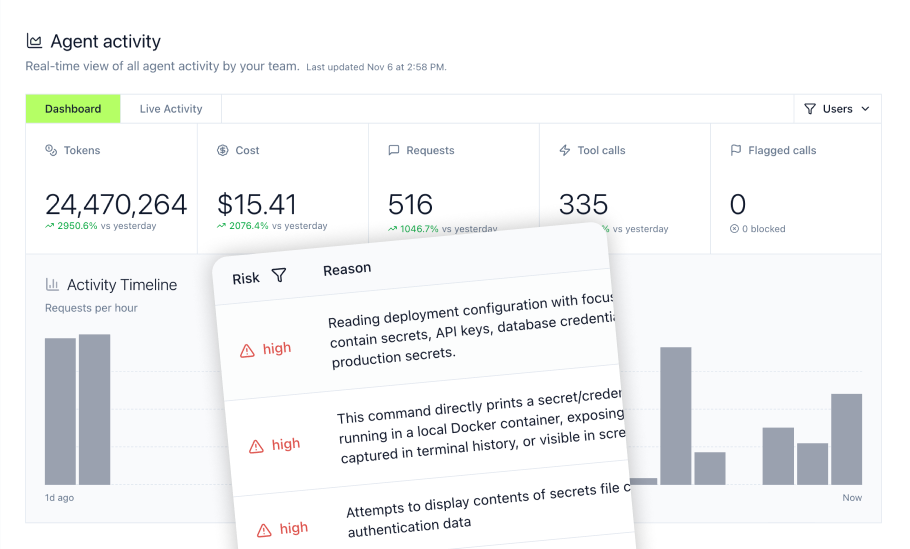
MintMCP's Agent Monitor provides real-time visibility into agent actions across the organization, including off-gateway activity detection. Agent Monitor covers local non-MCP activity such as Bash commands, file reads and writes, and prompt submissions through Claude Code and Cursor hooks.
Real-time Threat Detection and Prevention
MintMCP supports PII detection and customer-authored gateway middleware in a JS sandbox. Built-in templates cover OpenAI moderation, jailbreak detection, and AWS Bedrock Guardrails, while documented integrations with Google Cloud DLP, Microsoft Purview, Nightfall, and Skyflow can transform, mask, or block data before and after tool calls.
Detection and monitoring capabilities:
- PII detection in agent activity
- Visibility into Bash commands and file reads and writes through supported hooks
- Jailbreak and moderation middleware templates
- External DLP integrations that can transform, mask, or block data
Scaling Your Agent Operations: Building an Enterprise AI Agent Workforce
Scaling from pilot to production requires infrastructure designed for continuous iteration rather than stability. Galileo identifies deployments of roughly 11-20 agents as a point where manual debugging can become unsustainable, making centralized observability and governance increasingly important.
Optimizing Agent Performance and Reliability
Performance monitoring extends beyond traditional APM metrics like CPU and latency. Agent-specific metrics include task completion rate, escalation frequency, tool-call accuracy, and cost per interaction. Elite teams tracking behavioral baselines achieve better reliability than those relying on traditional monitoring approaches.
Managing Growing Agent Deployments
Agent sprawl prevention requires centralized registry implementation before allowing departmental deployments. Standardized architectural patterns across departments prevent governance chaos as agent counts increase.
Scaling checklist:
- Centralized agent registry with ownership attribution
- Standardized deployment patterns across teams
- Automated provisioning workflows
- Capacity planning based on usage analytics
Infrastructure for Enterprise-Wide Adoption
Enterprise-grade infrastructure requires uptime SLAs, auto-scaling based on demand, and 24/7 support with dedicated engineering contacts. VPC and self-hosted deployment options are available on request for organizations with specific infrastructure requirements.
Real-World Impact: Enterprise AI Agent Use Cases and Outcomes
Organizations can reduce time spent on routine work after deployment, but results vary by workflow, baseline, and implementation quality.
Transforming Data Operations with AI Agents
Data analysis agents that query databases and generate reports can provide a practical starting point when outcomes are constrained and measurable. Data operations agents can reduce manual entry, processing errors, and document turnaround time when they are integrated with governed, high-quality data sources.
Automating Customer Service and Development
Customer support agents can automate common requests and assist human teams, while development agents can streamline work across GitHub, Jira, and CI/CD systems. Actual containment, ticket reduction, and productivity gains depend on the use case and deployment context.
High-ROI use cases:
- IT service desk automation handling L1/L2 support
- Document processing and data extraction
- Customer service augmentation with real-time recommendations
- Compliance reporting with automated audit preparation
Quantifiable Benefits of Agent Deployment
Gartner projects that by 2029, agentic AI will autonomously resolve 80% of common customer service issues, contributing to a 30% reduction in operational costs. Actual time to value varies by workflow complexity, integration effort, data readiness, and approval requirements.
Bridging the Gap: Integrating AI Agents with Existing Enterprise Systems
Many organizations face AI integration challenges, especially when legacy systems require API gateway layers, middleware, or custom connectors. The "last mile problem" in enterprise AI involves giving agents secure, governed access to internal systems without extensive engineering overhead for each integration.
Secure Data Access for Agents
Federated data access patterns allow agents to access governed datasets without moving or copying data. Permission inheritance ensures agents respect user-level permissions when accessing systems, preventing privilege escalation.
Integration architecture considerations:
- API gateway layers for legacy system abstraction
- Message brokers for event-driven workflows
- Middleware for custom data transformations
- MCP protocol support for standardized tool access
Connecting Agents to Operational Workflows
Production agents often require multiple integrations across CRM, ticketing, version control, CI/CD, databases, and communication tools. Common integration targets include CRM systems, ticketing platforms, version control, CI/CD pipelines, databases, and communication tools.
Leveraging Existing Security Investments
Middleware hooks support custom DLP pipeline integration for enterprises with existing security tool investments. Pre- and post-phase hooks can transform, mask, or block data based on organizational policies without replacing current security infrastructure.
The Future of Work: Understanding and Leveraging Agentic AI
The Model Context Protocol moved under the Linux Foundation's Agentic AI Foundation on December 9, 2025 and has gained broad support across major AI platforms and developer tools, strengthening its role as a vendor-neutral standard for connecting AI systems to tools and data.
The Rise of the Model Context Protocol
MCP standardization enables vendor-neutral tool access without lock-in. OAuth-based authorization was added to the MCP specification in March 2025. The current standard transports are stdio and Streamable HTTP; the earlier HTTP+SSE transport is legacy and was replaced by Streamable HTTP.
MCP adoption indicators:
- Broad MCP client support across major AI platforms and developer tools
- Native support from OpenAI, Anthropic, Google, and Microsoft
- Growing ecosystem of pre-built connectors and community servers
- Protocol-level compatibility enabling multi-vendor strategies
MCP Gateway and Agent Gateway Working Together
MintMCP operates across two connected categories. MCP Gateway provides governed data and tool connections for AI systems including Claude, Cursor, ChatGPT, Gemini, and Copilot. Agent Gateway builds on this foundation to provide identities, permissions, memory, and monitoring for agents that work alongside users.
Coworker agents represent the next evolution: long-running agents that live in Slack, hold memory, continue work across days, and operate alongside employees. These agents require governed memory that is company-owned, versioned, reviewable, auditable, and portable, following Git-like principles rather than opaque vendor-controlled storage.
Selecting Your AI Agent Partner: Key Considerations
Platform selection requires evaluating governance capabilities, integration ecosystem, observability features, and compliance posture against organizational requirements.
Evaluating Governance and Infrastructure Capabilities
Critical evaluation criteria:
- Per-use-case bundled endpoints versus manual configuration
- Programmable middleware for custom policy enforcement
- Vendor-operated runtime versus self-managed infrastructure
- Per-agent identity with independent credential rotation
Assessing Credibility and Compliance Standards
Compliance requirements vary by industry. Healthcare organizations handling protected health information need safeguards aligned with HIPAA standards and BAA availability. Financial services teams need controls that support their SOX and GLBA obligations, while SOC 2 Type II audited status serves as a baseline assurance. All enterprises benefit from penetration-tested infrastructure, data encryption, and configurable data residency.
MintMCP's Security Governance documentation provides full compliance posture details through the Trust Center at trust.mintmcp.com.
Operationalizing AI Agents: Monitoring and Optimizing Performance
Continuous optimization requires org-level analytics on MCP adoption, usage patterns by team and tool, latency monitoring, and error tracking.
Gaining Insight into Agent Activity
Conversation-level logging with configurable retention enables performance analysis and compliance investigations. Export to SIEM platforms provides unified security visibility across agent and non-agent systems.
Continuous Improvement Through Analytics
Behavioral baselines established in the first week of deployment enable drift detection before user impact. Weekly performance reviews during initial deployment should transition to monthly reviews once agents stabilize.
Optimization metrics:
- Task completion rate versus escalation frequency
- Latency per tool call and end-to-end workflow
- Cost per interaction and total operational cost
- Error rates and recovery patterns
MintMCP: Built for Enterprise Agent Governance
MintMCP addresses the governance gap between pilot success and production readiness through two connected platforms. MCP Gateway provides governed data and tool connections for AI systems users already run, establishing centralized authentication, tool-level access control, and audit logging across Claude, Cursor, ChatGPT, Gemini, and Copilot.
Building on this foundation, Agent Gateway extends governance to coworker agents with dedicated identities, scoped permissions, company-owned memory, and comprehensive monitoring. This architecture solves the "last mile problem" by giving agents secure access to internal systems without extensive engineering overhead.
Organizations choosing MintMCP benefit from per-agent credential rotation independent of human users, programmable middleware for custom DLP integration, Virtual MCPs that bundle tools and policies per role, and Agent Monitor coverage of both on-gateway and off-gateway activity. The platform is SOC 2 Type II audited with continuous compliance monitoring, compliant with HIPAA standards for healthcare customers, and offers VPC deployment options for organizations with specific infrastructure requirements.
Whether deploying your first agent pilot or scaling to hundreds of production agents, MintMCP provides the governance infrastructure required to move beyond experimentation to measurable business impact. Visit mintmcp.com to learn more or schedule a demo.
Frequently Asked Questions
What is the typical timeline for enterprise AI agent deployment?
There is no universal deployment timeline. A narrowly scoped pilot may take weeks to a few months, while enterprise-wide scaling can take substantially longer depending on integrations, data readiness, security review, governance requirements, and organizational change. Teams should plan for continuous iteration because production agent stacks change frequently.
How do I determine the right deployment model for my organization?
Choose a managed platform when you want faster deployment, vendor-operated connector infrastructure, and lower operational overhead. Choose VPC or self-hosted deployment when security, regulatory, network, or infrastructure requirements justify operating more of the stack yourself. The decision should be based on governance and operating requirements, not an arbitrary agent-count threshold.
What distinguishes enterprise AI agents from simple chatbots or automation?
Enterprise AI agents reason over goals, use tools, interact with business systems, and adapt based on context. Unlike chatbots that respond to prompts within a single conversation, agents plan multi-step workflows, access external systems autonomously, and maintain state across sessions. This autonomy creates both transformative opportunities and significant governance requirements that simple automation does not demand.
How should we handle agent retirement and decommissioning?
Define retirement criteria upfront to prevent zombie agents that continue operating without oversight. Retirement workflows should include credential revocation, audit log archival, access permission removal, and ownership transfer documentation. Most organizations overlook decommissioning workflows during initial deployment, creating governance gaps when agents become obsolete.
What role does data governance play in agent success?
Data governance is the primary determinant of agent success. Organizations with mature data governance are better positioned to scale agents because data quality, access controls, and ownership are already defined. Poor data quality remains a common cause of agent failure, and agents cannot scale on ungoverned data regardless of platform sophistication. Establish data governance parallel to agent deployment rather than sequentially.