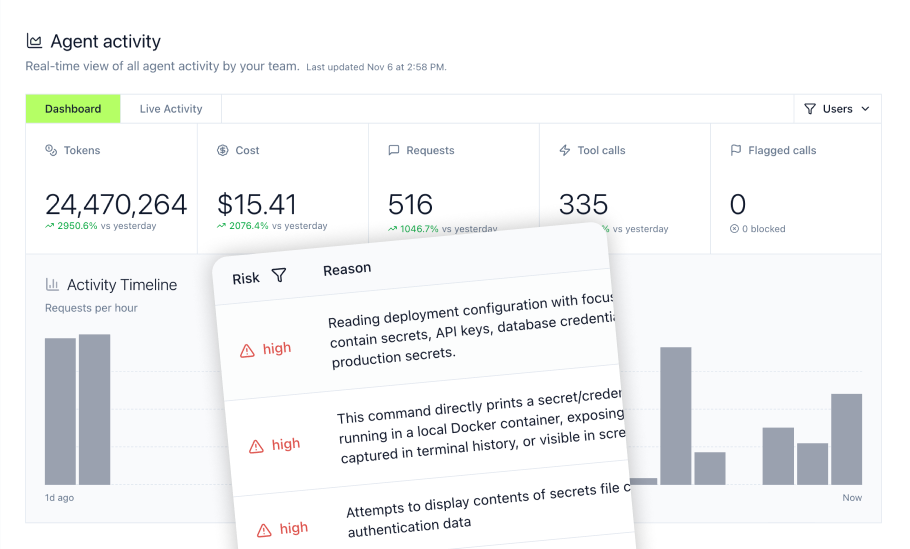
Non-human identities, including machine and agent credentials, are expanding across enterprise environments, yet only 46% of breached organizations in IBM's 2026 study reported securing NHIs in AI workflows. Among organizations in the same study that experienced an AI-related breach, 92% lacked proper access controls. Organizations need a structured approach to AI agent permissions and access control. MintMCP addresses this through two connected layers: its MCP Gateway governs data and tool connections, while its Agent Gateway adds identities, permissions, memory, and monitoring for agents that work alongside users.
This guide delivers a practical, phased implementation roadmap for establishing secure AI agent permissions, covering identity management, role-based access control, token-based authentication, audit logging, and real-time monitoring.
Key Takeaways
- Non-human identities and AI agents require distinct governance, ownership, permission, and lifecycle controls
- Implement a phased approach: assessment, identity and policy implementation, then ongoing monitoring and refinement
- Replace long-lived shared API keys with scoped, short-lived access tokens that support expiration, refresh, and revocation
- Require comprehensive audit trails before deploying agents that access sensitive or regulated systems
- Shadow AI discovery is critical because initial inventories often uncover agents, tools, and credentials that security teams have not reviewed
- Start with "monitor-only" mode to observe actual agent behavior before enforcing policies, avoiding production breakage
- Agent identities must be distinct from human users, with independent credential rotation and permission scoping
Understanding the AI Agent Security Gap
The fundamental challenge with AI agent security differs from traditional application security. Unlike applications that follow predictable code paths, AI agents make dynamic, context-driven decisions. A support chatbot may decide to query a customer database, pull transaction history, and summarize account status, all in response to a single user request. Without proper access controls, that same agent could access records belonging to other customers, expose sensitive payment data, or exfiltrate information to external systems.
The security gap becomes clearer when examining current breach research. IBM's 2026 study found that AI-related incidents were often rooted in compromised connected APIs, applications, and cloud misconfigurations, reinforcing the need to govern the systems surrounding the model rather than focusing on model choice alone.
Traditional Identity and Access Management (IAM) systems provide a necessary identity foundation, but agent deployments often require additional controls for delegated access, runtime context, tool use, and autonomous behavior:
- Session persistence: Human access is usually session-oriented; agents may authenticate and call tools continuously at machine speed
- Behavioral unpredictability: Agents can be manipulated via prompt injection to perform unintended actions
- Credential proliferation: Shared API keys across multiple agents eliminate audit attribution
- Privilege accumulation: Agents inherit permissions from deploying users rather than receiving task-specific scopes
Phase 1: Inventory and Assessment
Step 1: Discover All AI Agents
You cannot secure what you cannot see. The first step involves documenting every AI agent in your environment, including "shadow AI" deployed by business units without IT approval. This discovery process often reveals unapproved agents, tool connections, and shared credentials that security teams have not reviewed.
Discovery methods:
- Scan SaaS OAuth logs for connected applications
- Query identity providers for service accounts
- Survey teams about AI tools in active use
- Review API gateway logs for non-human traffic patterns
- Audit Slack, Microsoft Teams, and other collaboration tools for bot integrations
For each agent, document:
- Agent name and business function
- Owner (individual and team)
- Connected systems (databases, APIs, SaaS applications)
- Current permissions and OAuth scopes
- Authentication method (API key, OAuth token, certificate)
Step 2: Map Agent-to-System Connections
For each discovered agent, trace the complete data flow. Identify which APIs, databases, and SaaS applications it accesses. Capture the effective permissions, not just the configured ones. Many agents accumulate permissions over time as developers add capabilities without removing old access grants.
This mapping exercise often reveals over-privileged agents. A customer support chatbot that should only read ticket data may have write access to customer records, billing systems, and internal wikis. The principle of least privilege requires reducing these scopes to the minimum necessary for each agent's actual function.
Step 3: Classify Data and Define Policies
Tag data by sensitivity level (public, internal, confidential, restricted) and define which agent roles should access which data classes. This classification framework becomes the foundation for your access control policies.
Example policy structure:
- Support agents: Read-only access to customer tickets, no access to payment data
- Analytics agents: Aggregated data only, no individual customer records
- Development agents: Access to code repositories and CI/CD systems, no production database access
Phase 2: Identity and Policy Implementation
Step 4: Establish Unique Agent Identities
The most dangerous pattern in agent security involves agents inheriting permissions from the human who deployed them. When a DevOps engineer's agent has production database access, that agent becomes a vector for data exfiltration via prompt injection, even though the engineer themselves would never perform such actions.
Agent identities must be distinct from human users:
- Create unique service principals for each agent in your IAM system
- Issue cryptographic credentials (OAuth client ID and secret, or X.509 certificates)
- Store credentials in secure vaults (HashiCorp Vault, AWS Secrets Manager)
- Never share credentials across multiple agents
MintMCP's Agent Bundles address this requirement directly, providing per-agent identity with M2M authentication, independent credential rotation, and explicit permission scoping. Each agent receives its own rotatable credentials and permission scope, independent of its creator's access level.
Step 5: Configure RBAC and ABAC Policies
Role-Based Access Control (RBAC) defines what actions each agent role can perform. Attribute-Based Access Control (ABAC) adds context-aware decisions based on factors like time of day, data sensitivity, or request source.
RBAC implementation steps:
- Define roles based on agent function (customer-support-agent, data-query-agent, dev-automation-agent)
- Assign specific permissions to each role
- Map each agent identity to the appropriate role(s)
- Encode policies as code (YAML, JSON) in version control for auditability
ABAC enhancements:
- Time-based restrictions (analytics agents only run during business hours)
- Data sensitivity filtering (agents cannot access records marked "restricted" without additional approval)
- Request-source validation (agents can only be invoked from approved systems)
Policy-as-code approaches can keep authorization rules version-controlled, peer-reviewed, and deployed through standard CI/CD workflows.
Step 6: Implement Token-Based Authentication
Static API keys create long-lived exposure when they are reused across agents or systems. Short-lived, scoped access tokens reduce the exposure window, but they do not eliminate credential risk. Token lifetimes should reflect the workload's risk, identity-provider capabilities, and operational requirements.
Token implementation requirements:
- Acquire and cache tokens through a trusted backend, reusing them only until expiration or revocation
- Set token lifetimes according to risk and identity-provider guidance, avoiding long-lived bearer credentials
- Implement automated token refresh with retry logic
- Monitor authentication failure rates for anomaly detection
MintMCP authentication covers OAuth, API tokens, and per-user, service-account, and hybrid patterns. Agent identities can use bearer keys or M2M tokens.
Phase 3: Monitoring and Refinement
Step 7: Enable Comprehensive Audit Logging
Comprehensive audit trails are essential before deploying agents to production, particularly for systems handling sensitive or regulated data. Audit logs must capture every agent action: timestamp, agent ID, action performed, resource accessed, and outcome.
Audit log requirements:
- Immutable storage: Logs cannot be modified after creation
- Retention period: Define retention according to legal, regulatory, contractual, and incident-response requirements rather than applying one universal period
- Searchability: Filter by agent, action, resource, time range
- Export capability: SIEM integration (Splunk, Microsoft Sentinel, Datadog)
The NIST AI Risk Management Framework emphasizes documented governance, inventory, monitoring, and incident processes rather than prescribing a specific logging product. In MintMCP's two-layer model, MCP Gateway governs MCP traffic, while Agent Monitor extends visibility to local non-MCP activity through Claude Code and Cursor hooks.
Step 8: Deploy Real-Time Monitoring
Audit logs tell you what happened. Real-time monitoring tells you what is happening. Behavioral analytics establish baselines for normal agent activity and flag anomalies immediately.
Monitoring triggers to configure:
- Unusual data access volumes (agent querying 10x normal records)
- After-hours activity from agents with business-hours restrictions
- Privilege escalation attempts
- Cross-tenant data access (critical for B2B SaaS platforms)
- Failed authentication spikes
Shadow AI detection becomes possible through monitoring hooks in developer tools. Agent Monitor identifies off-gateway MCP usage in Cursor and Claude Code, detecting agents that bypass central governance.
Step 9: Conduct Quarterly Access Reviews
Permissions expand over time as developers add capabilities. Quarterly reviews ensure that agent access remains aligned with actual operational needs.
Review checklist:
- Compare assigned permissions to actual usage (revoke unused access)
- Verify agent owners still require the agents to be active
- Decommission agents tied to departed employees
- Re-certify business justification for elevated permissions
- Update policies based on observed behavior patterns
Best Practices for Ongoing Governance
Visibility First, Enforcement Second
The most common implementation failure involves trying to enforce policies before understanding actual agent behavior. Deploy monitoring in "observe-only" mode for 2 weeks before enabling enforcement. This approach reveals which permissions agents actually need, preventing production breakage from over-restrictive policies.
Treat Agents as First-Class Identities
Agents are not extensions of human users. They require independent identity lifecycle management: provisioning, permission assignment, credential rotation, and decommissioning. Orphaned agents tied to departed employees remain a lifecycle risk when ownership, permissions, and credentials are not reviewed or revoked.
Automate Lifecycle Management
Manual credential rotation, policy reviews, and agent decommissioning become harder as agent fleets grow. Policy-as-code, automated token rotation, and workflow-triggered access reviews reduce repetitive IAM work and improve consistency.
Integrate with Existing Security Infrastructure
AI agent governance should extend, not replace, existing security investments. Integration points include:
- Identity providers: Azure AD, Okta for SSO and SCIM group sync
- SIEM platforms: Splunk, Microsoft Sentinel for centralized alerting
- Guardrails and data protection: AWS Bedrock Guardrails for model input and output controls, and Microsoft Purview for data governance and protection
- Secret managers: HashiCorp Vault, AWS Secrets Manager for credential storage
MintMCP's security governance includes JS sandbox middleware with integrations for AWS Bedrock Guardrails, Google Cloud DLP, Microsoft Purview, Nightfall, and Skyflow.
ROI Indicators
Measure the operational impact of agent governance against your organization's existing baseline:
- Time required to produce audit evidence
- Mean time to investigate and contain agent-related incidents
- Percentage of agents with unique identities and scoped permissions
- Number of unused or excessive permissions revoked
- Manual hours spent on provisioning, credential rotation, and access reviews
Calculate payback using customer-specific labor, infrastructure, compliance, and incident-response data. Do not treat average breach costs as guaranteed savings.
Implementing Governance with MintMCP
MintMCP separates governed data access from agent lifecycle management through two connected layers:
- The MCP Gateway governs MCP-based data and tool connections routed through it. Tool calls can be authenticated, inspected, logged, and controlled through centralized policies.
- The Agent Gateway builds on that foundation with distinct agent identities, scoped permissions, memory, and monitoring.
- Agent identities use independently managed credentials and attributable audit records instead of relying on a deploying employee’s access.
- Agent Monitor extends visibility to supported local activity in Claude Code and Cursor, helping teams identify off-gateway and shadow AI usage.
This model gives security and platform teams a central place to manage:
- Agent and tool access policies
- OAuth, API tokens, and credential rotation
- Audit records for operational and compliance review
- Version-controlled security policies through Terraform
- Changes across simple automations and multi-agent workflows
Organizations can measure the impact through incident-response time, audit-preparation effort, and reductions in orphaned or over-privileged credentials. MintMCP’s security governance capabilities help teams apply these controls consistently as their agent deployments grow.
Frequently Asked Questions
How do I handle agents that need to act on behalf of users?
Delegation scenarios require careful architecture. The agent should authenticate with its own identity, then request user-specific access through a consent flow. OAuth 2.0 on-behalf-of flows enable this pattern, where the agent presents its own credentials plus a user assertion to receive a scoped token that grants only the permissions the user has authorized. Never allow agents to impersonate users directly or share user credentials.
What compliance frameworks apply to AI agent access control?
AI agent access control may be relevant to several frameworks, but none provides one universal agent checklist. The NIST AI Risk Management Framework is voluntary and emphasizes governance, documentation, inventory, monitoring, and accountability. SOC 2 Type II attestation is an examination of a service organization's described controls against selected Trust Services Criteria over a period; it does not prescribe agent-specific controls or mandatory quarterly reviews. The HIPAA Security Rule requires access control and audit controls for systems containing ePHI, while the Privacy Rule's minimum necessary standard applies to many uses and disclosures. ISO/IEC 42001:2023 establishes requirements for an AI management system, including governance and risk-management processes.
How do I balance security with agent performance?
Authentication latency varies by identity provider, network path, token cache, and deployment architecture. Reuse valid tokens until shortly before expiration rather than requesting a token for every operation, and measure the actual overhead in your environment. Logging can be processed asynchronously where doing so does not weaken durability, ordering, or incident-response requirements.
What happens when an agent needs emergency elevated access?
Just-In-Time (JIT) privileged access addresses break-glass scenarios. The agent requests elevated permissions through a workflow that requires human approval (typically a supervisor or security team member). Approved access is granted for a narrowly defined, time-bound period, with automatic revocation and enhanced logging during the elevated session. This pattern satisfies both operational flexibility and audit requirements.
How do I handle multi-agent workflows where agents call other agents?
Multi-agent architectures require explicit trust relationships. Each agent maintains its own identity, and inter-agent calls pass both the originating agent's identity and the request context. Receiving agents must validate that the calling agent has permission to make the request and that the original user or system that triggered the chain has appropriate authorization. Chain-of-custody logging captures the complete workflow for audit purposes.