Enterprise AI infrastructure has reached an inflection point. Organizations now manage multiple AI models, autonomous agents, and tool connections simultaneously, creating a governance challenge that traditional API management cannot solve. LLM gateways provide the centralized control plane that routes requests across providers, enforces security policies, tracks costs, and maintains the observability enterprises require for production deployments.
The right gateway choice depends on your primary pain point. Some teams need raw performance for high-throughput workloads. Others prioritize provider breadth to avoid vendor lock-in. And increasingly, enterprises recognize that model routing alone is insufficient; they also need governance over what AI agents can access, which tools they can call, and how their actions are attributed and audited. The Model Context Protocol standardizes how AI systems connect to data sources and tools, while frameworks like the NIST AI Risk Management and NIST Generative AI Profile provide guidance for governing these systems in production.
This guide evaluates 10 gateway options across performance, enterprise features, provider coverage, and governance capabilities to help you make the right infrastructure decision.
Key takeaways
- Enterprise AI governance requires control over agent identities, tool access, credential management, and audit trails beyond model routing
- Virtual MCP endpoints enable per-team tool surfaces with directory-driven access control and centralized credential injection
- Agent identity systems provide first-class non-human principals with scoped permissions and attributable audit trails separate from human users
- High-throughput production workloads benefit from Go-based architectures that minimize gateway overhead at scale
- Compliance-ready architectures supporting SOC 2, HIPAA, and GDPR requirements enable AI deployment in regulated industries
- Semantic caching and intelligent batching reduce costs while maintaining performance for repeated queries and agentic workflows
1. MintMCP: Enterprise AI Governance with MCP Gateway and Agent Gateway
MintMCP provides the governance layer that makes AI agents deployable, governed, measurable, and swappable. While model-routing gateways primarily handle LLM traffic, MintMCP's MCP Gateway and Agent Gateway focus on governed enterprise tool access, first-class agent identities, activity visibility, and runtime controls.
What Makes MintMCP Different
MintMCP starts from a data-permissions-first architecture. Instead of building governance as an afterthought to model routing, it treats governed data and tool connections as the foundation that enables everything else. The platform focuses on governance questions that model routing alone does not answer: Which enterprise tools can this AI system access? Which credentials should be used? How is every tool call logged and governed?
The core abstraction is the Virtual MCP (VMCP), which bundles connectors and a curated tool surface behind one governed endpoint for a particular team, role, use case, or agent. Directory groups can drive membership through SCIM, so organizations apply consistent access policies without requiring every employee to configure each MCP server separately.
Core Capabilities
- Virtual MCPs provide one endpoint, one auth model, one curated tool surface, and one audit trail per use case
- Hosted connectors run in MintMCP's data plane with auto-scaling and sandboxed execution, reducing infrastructure overhead
- Agent identities treat autonomous agents as first-class non-human principals with their own credentials, scoped MCP access, and attributable audit trails
- Credential injection ensures connectors never hold long-lived secrets; MintMCP injects per call with encrypted storage and rotated AES keys
- RBAC and tool curation grant access at the VMCP level, driven by directory groups via SCIM
- Mint Guard provides managed detection for prompt injection, secrets, PII, and harmful content
- Gateway middleware runs customer-authored JavaScript in a sandbox for DLP integrations and custom policy enforcement
Agent Gateway for Non-Human Identity
MintMCP's Agent Gateway builds on the MCP Gateway foundation by extending governed data and tool access to first-class agent identities, scoped permissions, memory, and monitoring.
Key capabilities include:
- Every autonomous agent receives its own identity, credential, scoped MCP, and audit trail separate from the human who created it
- Authentication mechanisms include bearer keys, M2M tokens via OAuth client-credentials exchange, and workload identity federation
- Workload identity federation allows the agent's own infrastructure to mint short-lived OIDC tokens while MintMCP holds no secret at all
Enterprise Security
- SSO and SCIM integration with Okta, Entra ID, and Google
- Tamper-evident audit with access-grant history signed at write time
- Operational controls including org-wide kill switch, per-VMCP disable, and credential rotation
- SIEM export via OTLP or Splunk HEC
Compliance
SOC 2 Type II audited. Compliant with HIPAA standards with BAA available.
Pricing
Contact for enterprise demonstration and pricing.
Getting Started
Visit mintmcp.com/mcp-gateway for the deployment guide.
2. Bifrost by Maxim AI
Bifrost is a Go-based LLM gateway focused on high-throughput production workloads. In its own benchmark, Maxim reports approximately 11 microseconds of mean gateway overhead at 5,000 requests per second.
Primary Focus
Bifrost targets enterprises running mission-critical AI workloads that require minimal gateway overhead. Maxim reports 54x faster P99 latency than Python-based gateways in its vendor benchmark; this measures gateway performance rather than end-to-end LLM response latency.
Core Capabilities
- Native MCP Gateway support alongside LLM routing
- Semantic caching for repeated queries
- Self-hosted deployment with Apache 2.0 licensing
- Enterprise tier with SSO and additional features
- Support for 20+ LLM providers
Where It Fits
Teams with high-throughput requirements where microsecond-level overhead matters. Organizations already operating Go infrastructure who want consistency across their stack.
Pricing
Free open-source core. Enterprise tier available with custom pricing.
3. LiteLLM
LiteLLM is an open-source LLM gateway supporting 140+ LLM providers and 1,892 unique models through an OpenAI-compatible API. The platform has accumulated over 53,000 GitHub stars and serves organizations including NVIDIA, Netflix, IBM, Twilio, and Stripe.
Primary Focus
LiteLLM prioritizes provider breadth and community-driven development.
Key attributes include:
- MIT license provides complete transparency
- Platform has processed over 1 billion requests with 240 million Docker pulls
- Community of 1,005+ contributors
Core Capabilities
- 140+ LLM provider integrations through unified API
- OpenAI-compatible endpoints for simplified migration
- Self-hosted deployment with full code access
- Enterprise tier with SSO and advanced features
Where It Fits
Teams prioritizing provider flexibility who want to avoid vendor lock-in. Organizations with Python expertise who value open-source transparency and community support.
Pricing
Free open-source core. Enterprise pricing is annual and quote-based, sized by gateway request capacity, deployment architecture, and support requirements.
4. Portkey
Portkey has evolved into a comprehensive LLMOps platform supporting 1,600+ LLMs, now operating under Palo Alto Networks as PRISMA AIRS following its May 2026 acquisition. The platform processes over 1 trillion tokens daily across 3,000+ GenAI teams.
Primary Focus
Portkey delivers full LLMOps capabilities beyond basic routing, including:
- Observability with request logging and analytics
- Built-in guardrails and prompt management
- Semantic caching for cost optimization
- The Palo Alto Networks acquisition brings enterprise security integration through the Prisma AIRS ecosystem
Core Capabilities
- 1,600+ LLM models through unified API
- Complete observability with detailed request tracking
- Built-in guardrails and prompt management tools
- Semantic caching infrastructure
- 99.9% uptime SLA in current Portkey documentation
Where It Fits
Enterprise teams requiring comprehensive LLMOps with security backing. Organizations already using Palo Alto Networks security infrastructure who want integrated AI governance.
Pricing
Free tier with 10,000 logs. Production tier at $49 per month. Enterprise tier with custom pricing.
5. TrueFoundry AI Gateway
TrueFoundry combines LLM, MCP, and Agent Gateway capabilities in a unified platform built for regulated industries. The platform supports 1,600+ models with VPC, on-premise, hybrid, and air-gapped deployment options.
Primary Focus
TrueFoundry emphasizes deployment flexibility and compliance for organizations that cannot use SaaS-only solutions.
Key attributes include:
- TrueFoundry describes its architecture as built to support SOC 2, HIPAA, and GDPR requirements
- Reports 99.99% uptime and 30% average cost optimization
Core Capabilities
- 1,600+ model support with unified gateway
- Native MCP and Agent Gateway functionality
- VPC, on-premise, hybrid, and air-gapped deployment
- Compliance-ready architecture supporting SOC 2, HIPAA, and GDPR requirements
- Model serving and training/fine-tuning alongside gateway
Where It Fits
Regulated industries requiring air-gapped deployment. Organizations needing a complete AI platform beyond gateway functionality with deployment flexibility.
Pricing
Free tier with 50,000 requests per month. Pro tier at $499 per month. Enterprise tier with custom pricing.
6. Kong AI Gateway
Kong extends its established API gateway platform to handle AI workloads, offering organizations already standardized on Kong a natural path to AI infrastructure. The plugin-based architecture enables PII sanitization, semantic caching, and MCP support through extensions.
Primary Focus
Kong unifies traditional API governance with AI traffic management. The platform treats LLM requests as another API surface governed by the same security, logging, and traffic policies enterprises already enforce.
Core Capabilities
- Extension of proven Kong API gateway infrastructure
- Plugin architecture for custom AI features
- Existing MCP Gateway capabilities plus native Agent-to-Agent (A2A) support added in v3.14
- Unified governance across APIs and AI traffic
- Integration with existing Kong monitoring tools
Where It Fits
Enterprises already running Kong for API management who want consistent governance across traditional APIs and AI workloads. Organizations with plugin development capabilities who need customization.
Pricing
Konnect Plus uses resource-based pricing: current rates start at $25 per month for a Serverless control plane, $200 per month for Hybrid, or $500 per month for Dedicated Cloud, with 1 million API requests included and AI model proxying priced separately at $100 per month per model for up to five models. Enterprise pricing is custom.
7. Helicone
Helicone delivers a Rust-based LLM gateway emphasizing performance and developer experience. Backed by Y Combinator and recognized as Product Hunt's Product of the Day, the platform targets growth-stage companies prioritizing fast integration and observability.
Primary Focus
Helicone combines high-performance infrastructure with developer-friendly tooling.
Key attributes include:
- Rust implementation provides edge performance
- Observability layer offers detailed request logging and analytics
Core Capabilities
- Rust-based architecture for performance
- Unified API across major LLM providers including OpenAI, Claude, and Gemini
- Detailed request logging and observability
- Semantic caching support
- Self-hosted deployment option
Where It Fits
Growth-stage companies and developer teams prioritizing observability without enterprise governance complexity. Organizations that value Y Combinator backing and startup-friendly support.
Pricing
Free tier with 10,000 requests per month. Paid tier at $79 per month.
8. Cloudflare AI Gateway
Cloudflare AI Gateway runs on the company's global edge network, providing zero-infrastructure AI proxy functionality with edge-level caching and rate limiting. Teams already using Cloudflare can add AI gateway capabilities without deploying separate infrastructure.
Primary Focus
Cloudflare emphasizes zero-config deployment and edge performance. The platform leverages existing CDN infrastructure to cache responses and reduce latency through global distribution.
Core Capabilities
- Edge deployment on Cloudflare's global CDN
- Zero infrastructure management required
- Edge-level caching and rate limiting
- Integration with existing Cloudflare services
Where It Fits
Teams already embedded in the Cloudflare ecosystem who want AI capabilities without additional infrastructure. Organizations prioritizing simplicity over governance depth.
Pricing
Workers Free includes storage for 100,000 logs total across all gateways. Enterprise tier with custom pricing.
9. OpenRouter
OpenRouter aggregates 500+ models from multiple providers through a single API with unified billing. The platform charges a 5.5% fee on credit purchases with no markup on underlying model pricing, emphasizing model selection breadth over governance features.
Primary Focus
OpenRouter maximizes model access with minimal friction.
Key attributes include:
- Platform consolidates billing across all providers into a single invoice
- Maintains zero token markup
Core Capabilities
- 500+ models through single API
- Unified billing across all providers
- 5.5% platform fee with no token markup
- Zero markup on model pricing
- Simplified multi-provider access
Where It Fits
Developers and small teams prioritizing maximum model selection without infrastructure management. Organizations comfortable with managed-only deployment and limited governance requirements.
Pricing
Pay-as-you-go with 5.5% fee on credit purchases. 5% fee for cryptocurrency payments.
10. FloTorch Gateway
FloTorch provides an agent-first AI gateway with native MCP server support, intelligent batching, and semantic caching designed for complex agentic workflows. The platform emphasizes full agent, tool, and memory routing capabilities.
Primary Focus
FloTorch targets enterprises building complex agentic workflows with RAG pipelines. The architecture treats agents as first-class citizens rather than adapting traditional LLM routing for agent use cases.
Core Capabilities
- Full agent, tool, and memory routing
- Native MCP server support
- Intelligent batching and semantic caching
- Built-in systematic benchmarking
- Deep observability and cost insights
Where It Fits
Enterprises building sophisticated agentic workflows with complex tool orchestration. Teams requiring native MCP support as a primary gateway feature rather than an add-on.
Pricing
Available on AWS Marketplace, where FloTorch Enterprise is currently listed at $50 per month for 10 console users and 1 million requests, with usage-based overages and private-offer pricing available.
Enterprise AI Governance in Production
As AI moves from experimentation to production, model routing solves only part of the problem. Autonomous agents also need governed access to enterprise tools, databases, and APIs, with clear attribution, least-privilege permissions, and audit trails.
MintMCP provides a control layer for governing agent identity, tool access, credentials, monitoring, and runtime security. Its core capabilities include:
- MCP Gateway: Uses Virtual MCPs to bundle approved connectors and curated tools behind governed endpoints. Organizations can centrally manage authentication, credentials, access policies, and audit logging.
- Agent Gateway: Gives autonomous agents first-class identities with their own credentials, scoped MCP access, and attributable audit trails. Authentication can include bearer keys, M2M OAuth tokens, and workload identity federation.
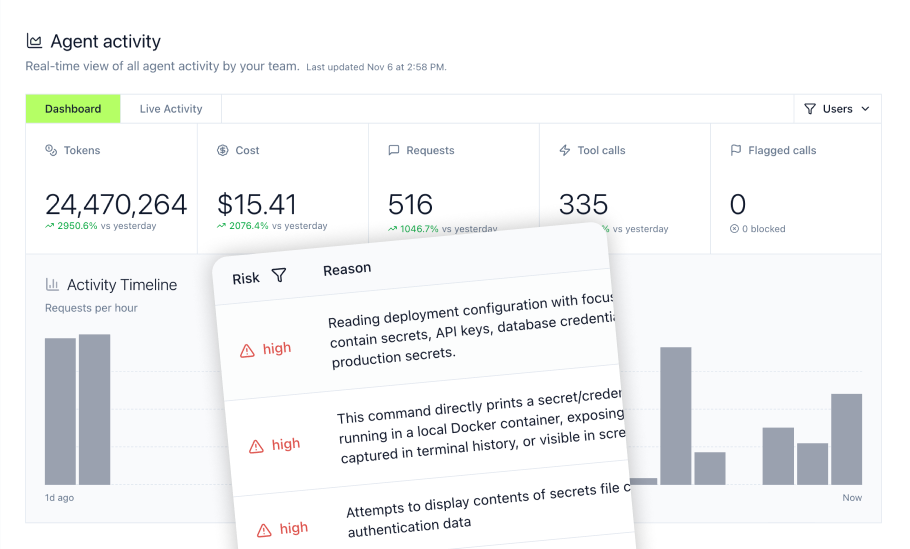
- Agent Monitor: Provides visibility into supported agent activity, usage, and token costs, with filtering by user, agent, model, and session.
- Mint Guard: Adds managed detection for prompt injection, credentials and secrets, PII, and harmful content.
- Gateway Middleware: Enables customer-authored policy, DLP integrations, redaction, transformations, and other enforcement logic in a JS sandbox.
Enterprise controls include SSO and SCIM, tamper-evident audit, operational controls such as shutdown controls, and SIEM export. MintMCP is SOC 2 Type II audited and compliant with HIPAA standards.
Whether deployed alongside an LLM gateway or used as the governance layer for agent access, MintMCP centralizes the identity, permissions, security controls, and observability needed to operate AI agents in production.
Visit MintMCP to start your free trial.
Frequently Asked Questions
What is the difference between an LLM gateway and an MCP gateway?
LLM gateways route requests to language model providers, handling concerns like load balancing, failover, caching, and cost tracking across multiple models. MCP gateways govern what AI agents can access through the Model Context Protocol, controlling tool connections, credentials, and audit trails. LLM gateways answer "which model handles this request." MCP gateways answer "what can this AI system access and how is it governed." Many enterprises need both capabilities deployed together.
How do AI gateways handle agent identity and authentication?
Gateway approaches to agent identity vary significantly across platforms. Some authenticate the application making requests rather than individual agents, creating attribution challenges when multiple agents share credentials. Agent Gateway systems provide first-class non-human identities where each autonomous agent has its own credential, scoped permissions, and audit trail, enabling clear attribution of which agent took which action.
Can different gateway types be used together in production?
Yes. LLM gateways and MCP gateways address different infrastructure layers and work as complementary capabilities. An LLM gateway handles model routing and provider management while an MCP gateway governs tool and data access. Organizations can deploy both to address model routing alongside tool governance, agent identities, and audit logging.
What enterprise compliance features matter for AI gateway selection?
Critical governance features for production AI deployments include SOC 2 Type II audit status, SSO and SCIM integration for identity management, RBAC for access control, comprehensive audit logging with tamper-evident capabilities, credential lifecycle management, and operational controls like kill switches. For regulated industries, evaluate HIPAA compliance support, air-gapped deployment options, and architecture built to support GDPR requirements. MintMCP is SOC 2 Type II audited and is compliant with HIPAA standards.
How can organizations track AI costs across teams and projects?
Cost attribution approaches vary across gateway platforms. LLM gateways typically track token usage by model and API key. For team-level and agent-level attribution, additional infrastructure is required. Agent Monitor provides usage and cost tracking by model, user, agent, and session, with human vs. agent split visibility and cache-hit rate analysis to support chargeback analysis across departments.
What security controls protect against prompt injection in tool calls?
LLM and AI gateways vary in how deeply they inspect agent and tool traffic. Security-focused gateway and guardrail layers like Mint Guard provide managed detection for prompt injection, credential exposure, PII, and harmful content in supported arguments and results. Gateway middleware enables custom policy enforcement and integration with external DLP systems for organizations with specific security requirements.