Enterprise teams evaluating AI platforms face a strategic choice between Claude and ChatGPT, yet the real challenge extends beyond selecting a model. Both platforms support the Model Context Protocol (MCP), although availability varies by plan, client, and administrator configuration. Claude supports remote MCP connectors across its supported surfaces, while ChatGPT provides full MCP support on the web for Business and Enterprise/Edu workspaces. This expanded capability creates governance requirements that become difficult to manage consistently across separate platform-specific control planes. Organizations need centralized security, authentication, and observability across whichever AI tools their teams adopt. An MCP Gateway provides the governance layer that makes either platform, or both, safe to deploy at scale.
This article compares Claude and ChatGPT across enterprise use cases, examines their respective strengths for coding, writing, and data analysis workflows, and explains how governance infrastructure determines deployment success regardless of which AI platform you choose.
Key Takeaways
- Governance infrastructure matters more than platform choice. Both Claude and eligible ChatGPT business workspaces can use MCP to access enterprise data sources, although support varies by plan and client. The critical question is how you control that access consistently across platforms.
- MCP adoption accelerated across foundation model providers. Protocol standardization in 2025 makes cross-platform governance essential regardless of model selection.
- Enterprise deployments require per-agent identity and scoped credentials. When each agent has its own credentials and scope, audit attribution becomes possible and credential hygiene improves at scale.
- Shadow AI detection addresses visibility gaps. Standard MCP specifications provide no visibility into off-gateway usage patterns in tools like Cursor and Claude Code.
- Virtual MCP Bundles reduce configuration complexity. Bundling tool access, policy enforcement, and audit logging into single governance units per team or role simplifies management.
Understanding the Enterprise AI Landscape
The Rise of AI Agents and the MCP Ecosystem
The Model Context Protocol has become a widely adopted interface between AI applications and external data sources, tools, and workflows. MCP enables AI agents to read databases, update CRM records, trigger CI/CD pipelines, and interact with dozens of internal systems through a unified protocol. Both Claude and ChatGPT support MCP, reducing dependence on platform-specific connectors. However, accessible data still depends on each client's MCP capabilities, authentication support, network access, permissions, and configuration.
This standardization created a new challenge: enterprises need governance that works across AI platforms rather than being locked into a single provider's security model. The shift from model selection to governance infrastructure reflects how enterprise AI has matured.
Key characteristics of the current landscape:
- Multi-model environments are standard. Engineering teams often use Cursor with Claude or GPT models, while business teams prefer ChatGPT's interface. Single-vendor commitments are rare.
- Data access is the differentiator. An AI model's value depends on what internal systems it can reach. MCP makes this access possible; governance makes it safe.
- Compliance responsibilities span platforms. Organizations subject to HIPAA obligations or evaluating controls through a SOC 2 program must account for relevant AI agent activity regardless of which model generated the response.
- Credential management complexity scales with adoption. Each MCP server connection, each team, and each agent potentially requires separate credential handling.
Key Challenges for Enterprise AI Adoption
Enterprise teams deploying Claude, ChatGPT, or both encounter consistent governance gaps:
Authentication fragmentation. Each AI platform handles identity differently. Enterprises need SSO integration, SCIM-based group management, and consistent access policies that apply across Claude, ChatGPT, Gemini, and Copilot deployments.
Tool-level access control. Enabling database reads while blocking writes, allowing Slack message retrieval while preventing message sends, or permitting GitHub read access without commit permissions requires granular policy enforcement at the MCP layer.
Audit trail requirements. Compliance teams need attributed records of prompts, tool calls, responses, and context. Claude and ChatGPT provide native enterprise logging and administration, but those controls remain platform-specific rather than forming one cross-platform audit layer.
Credential sprawl. Each MCP server connection requires authentication. Without centralized credential management, teams end up with API keys scattered across developer machines, configuration files, and environment variables.
MintMCP's MCP Gateway addresses these challenges through centralized authentication, tool-level access controls, and comprehensive audit logging across all connected AI platforms.
Claude for Enterprise: Strengths and Use Cases
Leveraging Claude for Advanced Text and Code Generation
Claude's architecture prioritizes extended context windows and nuanced reasoning, making it effective for enterprise workflows involving complex documents, lengthy codebases, or multi-step analysis tasks.
Primary strengths for enterprise use:
- Extended context handling. Claude can process and reference large documents, entire codebases, or extensive conversation histories. This matters for legal document review, technical documentation generation, and codebase analysis.
- Complex reasoning chains. Tasks requiring multi-step logic, such as debugging intricate systems or analyzing interdependent data sources, benefit from Claude's approach to structured problem-solving.
- Writing quality and consistency. Enterprise content teams report results using Claude for technical writing, documentation, and communication where tone consistency matters.
- Code generation accuracy. Claude Code and Claude's integration with Cursor provide coding assistance with strength in explaining existing code and generating documented implementations.
Enterprise deployment options:
- Claude Chat for web-based interaction and general business use
- Claude Code for terminal-based development workflows
- Cursor integration for IDE-embedded coding assistance
Integrating Claude into Enterprise Workflows
Claude's value increases when connected to enterprise data sources through MCP. Common integration patterns include:
Data analysis agents. Connect Claude to Snowflake, BigQuery, or PostgreSQL databases for natural language querying, report generation, and trend analysis.
Customer support workflows. Link Claude to Zendesk, Salesforce, or HubSpot for context-aware customer interaction summaries and response drafting.
Development automation. Integrate with GitHub, Linear, or Jira for issue triage, PR review assistance, and documentation maintenance.
Each integration requires proper credential handling, access scoping, and audit logging. MintMCP's Agent Monitor tracks Claude activity including off-gateway MCP usage in Cursor and Claude Code, detecting PII exposure and prompt injection attempts using built-in rules.
ChatGPT for Enterprise: Capabilities and Business Solutions
Unlocking Business Value with ChatGPT's Advanced Features
OpenAI's ChatGPT platform offers advantages for enterprise deployment, particularly around ecosystem breadth and organizational management features.
Primary strengths for enterprise use:
- Apps, plugins, and MCP integrations. ChatGPT supports workspace-managed plugins, apps, and custom MCP apps, providing multiple ways to connect external tools and data.
- Enterprise tier management. ChatGPT Enterprise and Business plans include shared workspaces and administrative controls designed for organizational deployment, with additional governance capabilities available on Enterprise.
- API flexibility. OpenAI's API infrastructure supports high-volume programmatic access with detailed rate limiting controls and usage tracking.
- Multimodal capabilities. Image generation, vision processing, and voice interaction expand use cases beyond text-only workflows.
- Custom GPT creation. Teams can build specialized assistants with preset instructions, knowledge bases, and tool access configurations.
Business subscription options:
- ChatGPT Plus for individual professional use
- ChatGPT Business for workgroup deployment with shared workspaces
- ChatGPT Enterprise for organization-wide deployment with SSO, compliance features, and admin controls
Strategic Deployment of ChatGPT Across Departments
ChatGPT's capabilities make it suitable for diverse departmental use cases:
Marketing and content teams. Use ChatGPT for campaign ideation, content drafting, social media scheduling assistance, and market research synthesis.
Sales operations. Connect to CRM systems for prospect research, email drafting, meeting preparation summaries, and competitive intelligence gathering.
HR and recruiting. Leverage ChatGPT for job description drafting, candidate screening assistance, policy documentation, and internal communication.
For enterprise ChatGPT deployments connecting to internal systems via MCP, governance remains critical. MintMCP provides ChatGPT setup integration with centralized authentication and access controls that work alongside ChatGPT's native enterprise features.
Direct Comparison: Claude vs. ChatGPT for Core Enterprise Functions
Evaluating Performance in Enterprise Scenarios
Performance varies by model version, plan, configuration, connected tools, and evaluation method. Enterprises should test current Claude and ChatGPT models against representative internal workloads rather than treating either platform as categorically stronger across an entire task type.
Useful evaluation areas include:
- Accuracy on representative coding and debugging tasks
- Long-context retrieval across internal documents and repositories
- Instruction following and tone consistency
- Tool-call accuracy and permission handling
- SQL and data-analysis correctness
- Latency, usage limits, and total operating cost
Teams should use the same prompts, context, tools, and scoring criteria when comparing the platforms.
Architectural Differences Impacting Enterprise Adoption
Beyond task performance, architectural choices affect enterprise deployment:
Context window handling. Context limits vary by model, plan, and product surface. Current Claude API models offer large context windows, while ChatGPT limits depend on the model enabled for the workspace. Enterprises should compare the exact models and configurations they plan to deploy rather than assuming one platform always supports more context.
API design philosophy. OpenAI's API prioritizes flexibility and programmability with parameter controls. Anthropic's API emphasizes simplicity with sensible defaults.
Safety and alignment approaches. Both platforms implement safety measures, but their approaches to content filtering, refusals, and edge cases differ. Enterprise teams should test both against their specific use cases.
Multimodal capabilities. ChatGPT offers native image generation, advanced voice, vision, and data-analysis tools. Claude supports image input, voice conversations, document processing, and the creation of diagrams, interactive visuals, prototypes, and presentations, but it does not natively generate photographs or illustrations.
Native governance remains platform-specific. Claude and ChatGPT both provide enterprise administration, access, and logging controls, but those controls do not create one policy, credential, and audit layer across multiple AI platforms. A governance layer like MintMCP can centralize these controls across Claude, Cursor, ChatGPT, Gemini, and Copilot.
Addressing Security and Governance in Enterprise AI with MintMCP
The MintMCP Bundle Architecture: Simplifying Governance
MintMCP's Bundle architecture packages tool access, policy enforcement, and audit logging into a role or use-case-specific governance unit.
Virtual MCP Bundles provide:
- Per-use-case endpoints. Each Bundle creates a distinct MCP endpoint with curated tool access, specific policy rules, and isolated audit trails.
- SCIM-driven membership. Bundle access can sync automatically with supported SCIM providers, including Okta and Microsoft Entra ID. Google Workspace can be used for SSO, but MintMCP's current provider table does not list SCIM provisioning support for Google Workspace.
- Tool-level access control. Enable database reads but block writes. Allow Slack message retrieval while preventing message sends. Control at the individual tool level, not just the server level.
- Directory-group access policies. SCIM-synced directory groups can be used in Virtual MCP access policies, keeping tool access aligned with identity-provider membership.
Agent Bundles extend governance to non-human principals:
- Per-agent identity. Each deployed agent receives its own persistent identity with scoped credentials that can be rotated independently.
- M2M authentication. Bearer API keys plus OAuth 2.0 client credentials per agent, with rotation and revocation independent of human users.
- Act-as-agent flows. Admin workflows for connectors requiring per-agent OAuth rather than shared service account tokens.
This architecture addresses the governance gap that choosing between Claude and ChatGPT does not solve. Whether your team uses Claude, ChatGPT, Gemini, or Copilot, MintMCP's Bundle model applies consistent governance across all platforms.
Real-time Monitoring and Threat Detection with Agent Monitor
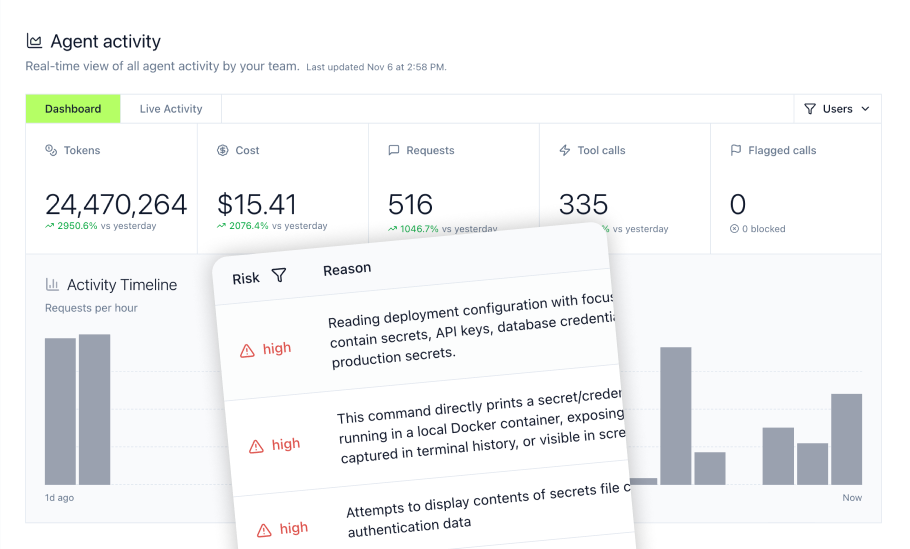
Agent Monitor extends governance beyond the MCP Gateway to track agent activity in real time across the organization, including MCP calls made outside the gateway.
Detection capabilities:
- PII exposure detection. Identifies when agents access or transmit personally identifiable information across tool calls.
- Credential leakage identification. Detects API keys, tokens, and secrets appearing in agent interactions.
- Risky bash command flagging. Flags potentially dangerous shell commands in coding agent workflows.
- Prompt injection attempt recognition. Identifies patterns consistent with prompt injection attacks.
Shadow AI discovery:
Standard MCP specifications provide no visibility into off-gateway usage patterns. Agent Monitor addresses this through hooks in Cursor and Claude Code that detect local MCP usage not routed through the governed gateway. MDM integration enables push of detect-only or enforce-mode configurations to developer machines.
Custom guardrail policies:
Beyond built-in rules, Agent Monitor supports custom policies with configurable block, flag, or alert actions. This enables enterprise-specific security requirements without waiting for vendor updates.
Implementing Robust Compliance and Data Protection for AI Agents
Integrating AI Agents with Existing Security Infrastructure
Enterprise security teams have existing investments in DLP, SIEM, and identity infrastructure. Effective AI governance integrates with these systems rather than replacing them.
DLP integration options:
MintMCP supports custom policy code execution on every tool call, enabling inline DLP integration with AWS Bedrock Guardrails, GCP DLP, Microsoft Purview, Nightfall, and Skyflow. The JS sandbox middleware architecture allows pre and post-phase hooks that can transform, mask, or block content based on DLP analysis before it reaches the AI model or before responses reach downstream systems.
SIEM export capabilities:
Attributed logging captures prompts, tool calls, responses, and context. Configurable retention and export to SIEM platforms including Microsoft Sentinel, Splunk, and S3 enables correlation with existing security monitoring.
Identity provider integration:
OAuth 2.0, SAML or OIDC-based SSO, and SCIM group sync help align MintMCP governance with existing identity infrastructure. Agent identities can use independently revocable and rotatable credentials.
Ensuring Auditability and Attribution in AI Workflows
Compliance investigations require attributed records of AI agent activity.
Audit trail capabilities MintMCP documents:
- Per-user attribution. Tool calls and monitored agent activity can be tied to authenticated user identities.
- Per-agent attribution. Autonomous-agent actions can be attributed to the agent's own identity rather than a shared human credential.
- Configurable retention. Enterprise customers can customize Agent Monitor retention per field.
- SIEM export. Tool-call, prompt-submission, and audit logs can be exported through OTLP or Splunk HEC for external monitoring and investigation.
Compliance posture:
MintMCP is SOC 2 Type II audited and compliant with HIPAA standards. Customers handling protected health information can request compliance documentation, and MintMCP signs Business Associate Agreements. Its infrastructure is penetration tested, with data encrypted in transit and at rest.
For detailed security documentation, visit the Trust Center or contact security@mintmcp.com.
Optimizing AI Agent Performance and Integration
Seamless Integration with Existing Enterprise Systems
MintMCP's integration approach prioritizes rapid deployment without requiring extensive engineering investment per connection.
Pre-configured connectors:
One-click activation of 50+ pre-configured connectors covers common enterprise systems including Salesforce, Slack, GitHub, Snowflake, Google Drive, Notion, and Stripe.
Custom connector support:
For internal systems or specialized tools, MintMCP hosts custom STDIO-based MCP servers from the community ecosystem. STDIO server support automatically converts locally-run MCP servers to hosted, production-ready services with OAuth wrapping, requiring no code changes. MintMCP scales up and operates connector instances on the customer's behalf with auto-scaling and isolated, sandboxed execution per connector.
Automating MintMCP Administration
MintMCP supports conversational administration through Admin MCP and version-controlled policy management through its Terraform provider.
Admin MCP:
Admin MCP lets authorized administrators manage users, deploy MCP servers, write guardrail rules, and review activity from a compatible MCP client, with administrative activity captured in the audit trail.
Configuration as code:
MintMCP's Terraform provider currently documents management of organization-wide global rules with plan, apply, and drift detection.
Middleware hooks:
Custom JavaScript middleware runs in a sandbox environment and can integrate external guardrail or DLP workflows using controlled network access, secret injection, and supported helper functions.
Future-Proofing Your Enterprise AI Strategy
The Evolving Role of the Model Context Protocol
MCP's December 2025 donation to the Linux Foundation's Agentic AI Foundation placed the protocol under a neutral, community-governed foundation. This standardization has several implications for enterprise strategy:
Reduced integration lock-in. MCP can allow enterprises to reuse many server connections and governance policies across Claude, ChatGPT, Gemini, and Copilot. Each client still requires platform-specific setup, authentication, and capability validation.
Governance becomes the differentiator. When protocol standardization commoditizes the connection layer, governance quality determines deployment success.
Tool update management. New MCP server capabilities appear regularly. Tool-update policies that auto-enable new upstream tools or require admin approval address silent capability expansion risks.
Preparing for the Next Wave of AI Agent Capabilities
Enterprise AI strategy should account for emerging patterns:
Coworker agents. Long-running agents that live in Slack, hold memory, continue work across days, and operate alongside employees represent a shift from transactional AI interactions to persistent AI collaboration. MintMCP's Agent Gateway provides the identity, permissions, memory, and monitoring infrastructure these agents require.
Enterprise agent memory. As agents maintain state across interactions, memory governance becomes critical. Private, team, org, and customer memory scopes require the same access control rigor as any other enterprise data. Memory should be company-owned, versioned, reviewable, auditable, and portable.
Model optionality. Teams want to choose which AI models to use, including cost-effective options, rather than being locked to specific providers. Governance infrastructure that works across models enables this flexibility.
Why MintMCP for Enterprise AI Governance
The choice between Claude and ChatGPT represents an important decision about capabilities and user experience, but it does not determine whether your AI deployment will be secure, compliant, and manageable at scale. Both platforms provide value in their respective areas. Claude offers extended context and reasoning depth; ChatGPT provides multimodal capabilities and workspace administration. Neither choice, however, solves the fundamental governance challenge enterprises face when deploying AI agents that access sensitive internal systems.
MintMCP addresses this challenge through centralized, cross-platform governance that works regardless of which AI models your teams prefer. The Bundle architecture packages tool access, policy enforcement, and audit logging into manageable units aligned with team structure and use cases. Agent Monitor extends visibility beyond the gateway to detect shadow AI usage and enforce guardrails in real time. Integration with existing SSO, SCIM, DLP, and SIEM infrastructure means MintMCP complements rather than replaces your security investments.
Organizations evaluating enterprise AI should test both Claude and ChatGPT against their specific workloads, but they should invest in governance infrastructure that will support whatever model choices their teams make today and in the future. MintMCP's MCP Gateway provides governed data and tool connections for the AI systems your teams already run, while the Agent Gateway layer handles identities, permissions, memory, and monitoring for agents working alongside your employees.
Frequently Asked Questions
How do enterprise pricing models differ between Claude and ChatGPT?
Both platforms combine workspace subscriptions with separate usage-based products. ChatGPT Business uses seat-based pricing, while ChatGPT Enterprise is sold through contracted plans that may include shared credits for advanced features. Claude Team and Enterprise also use seat-based access with flexible usage options, while Claude API usage is billed separately by token. Exact enterprise pricing, included usage, and limits depend on the current plan and contract.
Can enterprise teams safely use both Claude and ChatGPT simultaneously?
Yes, and this multi-platform approach is increasingly common. Engineering teams often prefer Claude Code or Cursor integration for development work, while business teams gravitate toward ChatGPT's interface for general tasks. The challenge is maintaining consistent governance across both. A centralized MCP Gateway ensures the same authentication, access control, and audit policies apply regardless of which AI platform a team member uses.
What happens to existing ChatGPT Enterprise or Claude deployments when adding MCP governance?
MCP governance layers complement rather than replace existing platform subscriptions. Your teams continue using Claude and ChatGPT through their familiar interfaces. The governance layer intercepts MCP tool calls, applying authentication, access control, and audit logging without changing the user experience. Most deployments involve configuring AI clients to route MCP traffic through the governed gateway.
How should enterprises approach AI platform selection for regulated industries?
Regulated industries should prioritize governance infrastructure over platform selection. Both Claude and ChatGPT can be deployed in compliant configurations, but the compliance burden falls on how you govern their access to sensitive data. Key considerations include audit trail completeness for compliance investigations, DLP integration for data classification enforcement, per-agent identity for access attribution, and the ability to demonstrate access controls to auditors.
What integration effort is required when switching between AI platforms?
MCP standardization can reduce integration rework when switching between Claude and ChatGPT, particularly when server connections and governance are centralized. Some platform-specific configuration, authentication, testing, and feature adaptation will still be required. The MCP server connections, credential management, and access policies defined in your governance layer apply regardless of which AI model consumes them. Teams can experiment with different models for different tasks without rebuilding integrations, as long as the governance infrastructure supports multi-platform deployments.