Claude Code's --dangerously-skip-permissions flag disables most permission prompts and built-in safety checks between the agent and your filesystem, network, and shell. A small number of safeguards can still apply, including explicit approval rules and circuit breakers for commands targeting the filesystem root or home directory. While this enables complete automation for isolated development workflows, running the flag on an inadequately isolated machine increases the potential impact of destructive commands, credential access, prompt injection, and other unintended agent actions. For organizations deploying AI coding assistants at scale, understanding this flag's mechanics and implementing proper governance through an MCP Gateway is essential to balance developer productivity with enterprise security requirements.
This article explains exactly what the bypass flag does, documents the real-world risks, and outlines safer enterprise alternatives that preserve automation benefits without the operational dangers.
Key Takeaways
- The
--dangerously-skip-permissionsflag bypasses most approval prompts for file modifications, shell commands, network requests, and MCP tool calls, subject to remaining explicit approval rules and destructive-command circuit breakers - In Anthropic's evaluation, Auto Mode had a 17% false-negative rate on a dataset of 52 real overeager actions, showing that its classifier can still miss actions that exceed the user's authorization
- The flag does not carry a separate feature fee, but safe deployment can require additional spending on isolated compute, network controls, backups, monitoring, and incident-response readiness
- Enterprise governance platforms provide SSO, centralized audit logging, scoped credentials, and policy enforcement that reduce reliance on broad local permissions
- Agent Monitor can detect and apply policies to Claude Code and Cursor activity on enrolled devices, including local prompts, shell commands, file operations, and MCP calls made outside the gateway
- Subagents spawned during bypass mode inherit the parent's bypass permission mode, but administrators and agent definitions can still restrict their available tools, MCP servers, and permitted subagent types
Understanding the --dangerously-skip-permissions Flag in Claude
The --dangerously-skip-permissions flag removes Claude Code's routine permission system. Under normal operation, Claude Code pauses before each consequential action, asking for human approval before writing files, executing bash commands, making network calls, or invoking external tools. The bypass flag eliminates most of these pauses.
What 'dangerously skip' truly bypasses
When you invoke Claude Code with --dangerously-skip-permissions, you grant the agent broad authority to act without routine approval prompts, subject to explicit ask and deny rules, managed MCP policies, operating-system or sandbox restrictions, and root or home-directory deletion circuit breakers:
- Write, modify, or delete any file your user account can access
- Execute bash commands with the permissions of the current user and environment
- Make network requests permitted by the machine's operating system, sandbox, firewall, and network policies without routine Claude Code approval prompts
- Invoke MCP tools and spawn subagents without confirmation
- Access environment variables and credentials in your session
The flag is functionally identical to --permission-mode bypassPermissions. Anthropic's documentation explicitly states that bypassPermissions is intended only for isolated containers or VMs, not production machines.
Common scenarios for using this flag
Developers reach for the bypass flag in several situations:
- Extended refactoring sessions: Multi-file refactors that would require hundreds of approval clicks
- CI/CD pipeline integration: Headless environments where no human is present to approve actions
- Automated report generation: Tasks spanning multiple repositories with structured outputs
The productivity gains are real. The question is whether those gains justify the risk profile in your specific environment.
The Security Risks of Skipping Permissions with Claude AI
Anthropic restricts bypass mode to isolated containers, virtual machines, and similar environments because it provides no general protection against prompt injection or unintended agent actions. Security teams evaluating Claude Code security must understand these concrete failure modes.
Exposed data implications
When permissions are bypassed, Claude Code operates with your full user privileges. This creates several risk categories:
- Credential exposure: Environment variables, API keys, and tokens become accessible and can be inadvertently logged, transmitted, or embedded in generated code
- PII leakage: Customer data, employee records, and sensitive business information can be read and processed without visibility controls
- Source code exfiltration: Proprietary algorithms and trade secrets can be accessed by network-enabled agents
Operational risks: unintended code execution and system changes
Documented incidents paint a clear picture of operational dangers:
- October 21, 2025 incident: A user reported that Claude Code appeared to execute a recursive deletion beginning at the filesystem root, deleting user-owned files before the process was interrupted. The report did not identify the exact command or establish that bypass mode was enabled.
- Subagent risk: When the parent session uses bypass mode, subagents inherit that permission mode, although tool restrictions, deny rules, managed MCP restrictions, and certain circuit breakers can still apply.
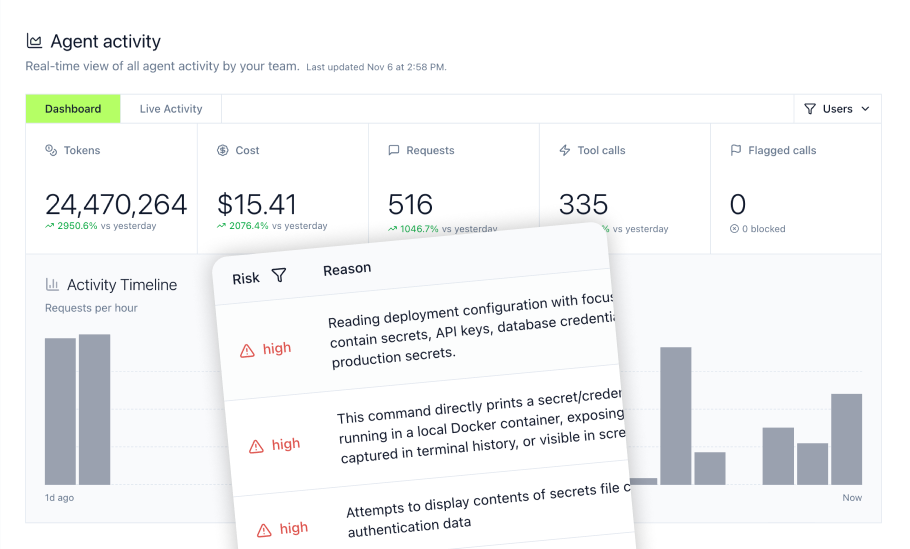
MintMCP's Agent Monitor addresses these risks by detecting risky bash commands, PII exposure, and prompt injection attempts in real time, providing visibility into agent actions that bypass mode deliberately obscures.
Compliance and audit failures due to unchecked access
Organizations pursuing SOC 2 assurance or handling regulated data under HIPAA and other requirements face specific governance challenges:
- No guaranteed centralized, organization-wide audit trail with consistent identity attribution and retention controls
- No user-level attribution for compliance investigations
- No ability to demonstrate least-privilege access controls
- No evidence that sensitive data access was authorized
Without governance infrastructure, a single bypass-mode session can create compliance exposure across multiple regulatory frameworks.
Why Enterprise AI Needs Robust Permission Management
Bypass mode and repeated manual approvals are not the only options. Claude Code also provides Auto Mode, sandboxed Bash, fine-grained permission rules, and centrally managed settings. Enterprise teams can combine these controls with centralized governance for MCP access, identity, monitoring, and audit.
Meeting compliance standards
Organizations handling protected health information must meet applicable HIPAA requirements and may need BAAs with qualifying service providers. SOC 2 is an attestation framework commonly used in vendor assurance. MintMCP is SOC 2 Type II audited, compliant with HIPAA standards, and signs BAAs. Relevant assurance and regulated-data control areas can include:
- Audit trails: Relevant agent and tool activity logged with timestamps and identity attribution
- Access controls: Demonstrable least-privilege enforcement
- Credential hygiene: Rotation, scoping, and revocation capabilities
- Incident response: Ability to investigate and remediate security events
MintMCP's MCP Gateway provides OAuth 2.0, SAML/OIDC SSO, tool-level access control, and centralized credential rotation and revocation workflows, addressing these requirements without sacrificing developer productivity.
Scaling AI agent deployments securely
At team scale, unmanaged bypass-mode use creates governance gaps. Claude Code administrators can centrally disable bypass mode, enforce permission and sandbox policies, and distribute non-overridable managed settings. Centralized agent monitoring can add organization-wide activity visibility, audit export, and incident investigation workflows.
The cost structure shifts dramatically at scale: individual productivity gains from bypass mode are outweighed by organizational risk exposure and incident response costs.
Centralized Governance for Claude and Other AI Coding Assistants
Enterprise teams can combine Claude Code's permission modes and workload isolation with centralized governance for MCP access, agent identities, audit logging, and local coding-agent monitoring.
Streamlining access without compromising security
An MCP Gateway approach centralizes authentication and policy enforcement:
- Single sign-on: Developers authenticate once through existing identity providers
- Tool-level permissions: Allow database reads but block writes; enable GitHub access but restrict to specific repositories
- Rate limiting: Prevent runaway agent sessions from consuming excessive resources
- Credential lifecycle controls: Centrally issue, expire, rotate, and revoke agent and gateway credentials instead of relying on unmanaged developer-held keys
This architecture means developers get automation benefits while security teams maintain visibility and control.
The role of an AI agent governance platform
MintMCP addresses a common enterprise AI challenge: giving agents secure, governed access to internal systems without requiring teams to build a separate authentication, authorization, and audit layer for every integration.
MintMCP's MCP Gateway governs data and tool connections across Claude, Cursor, ChatGPT, Gemini, and Copilot. Its Agent Gateway builds on that foundation with identities, permissions, memory, and monitoring for agents that operate alongside users. Rather than each developer configuring their own MCP connections with varying security postures, the organization defines policies centrally and developers connect through governed endpoints.
For teams evaluating this approach, understanding VMCP concepts clarifies how role-based tool access differs from the all-or-nothing bypass flag model.
Implementing Secure Access with Agent Bundles for Claude
MintMCP's Bundle architecture provides scoped identity and access controls for MCP tools. It complements Claude Code's permission modes and sandboxing but does not itself restrict local shell commands, filesystem access, or direct network activity.
How Agent Bundles simplify complex permissions
Agent Bundles extend the Bundle model to non-human principals:
- Each deployed agent receives its own persistent identity
- Credentials are scoped and rotatable independently of creator's access level
- OAuth 2.0 client-credentials flow enables M2M authentication
- Per-agent audit trails support compliance investigations
This approach reduces shared-credential risk by giving each agent its own identity, scoped access, independently managed credentials, and attributable audit history.
Ensuring least privilege for non-human principals
The Bundle model enforces that an agent's permissions are always a subset of an already-governed permission model. For MCP calls routed through MintMCP, Agent Bundles scope access to:
- Specific MCP servers (e.g., GitHub, Jira, database connectors)
- Specific tools within those servers (e.g., read but not write)
- Specific data resources (e.g., production-read-only access)
SCIM integration means Bundle membership automatically syncs with Okta or Azure AD group changes, eliminating manual permission management as teams evolve.
Detecting Shadow AI and Unauthorized Claude Usage
Even with centralized governance available, developers may still run Claude Code locally with bypass flags, creating "shadow AI" that operates outside sanctioned channels.
The challenge of shadow AI in developer workflows
Shadow AI emerges when developers:
- Use personal Claude subscriptions for work tasks
- Configure local MCP servers without IT oversight
- Enable bypass modes on their machines without security team awareness
- Connect to production data sources outside governed pathways
The shadow AI phenomenon mirrors traditional shadow IT patterns but with higher risk profiles due to AI agents' ability to take autonomous actions.
Proactive enforcement and policy push
MintMCP's Agent Monitor provides two-layer governance:
- Gateway layer: All MCP traffic through MintMCP's hosted servers is logged and policy-enforced
- Agent Monitor layer: Hooks in Claude Code and Cursor detect local agent activity, including bash commands, file operations, and MCP calls made outside the gateway
MDM integration enables organizations to push detect-only or enforce-mode configurations to developer machines. This gives security teams visibility into monitored local agent actions even when those actions do not route through the central gateway.
For organizations implementing Claude Code hooks, this provides defense in depth against both accidental and intentional policy circumvention.
Achieving Compliance and Auditability for AI Agent Interactions
Bypass mode removes routine approval checkpoints but does not necessarily eliminate Claude Code's local transcripts and diagnostic records. Those local records are not a substitute for centralized enterprise logging, consistent user attribution, retention controls, and SIEM integration.
Full conversation-level logging for forensic analysis
Governed alternatives capture:
- Prompt-submission records from supported coding-agent hooks, subject to truncation and secret redaction
- Gateway and Agent Monitor tool-call events with relevant inputs, metadata, policy decisions, and timestamps
- User or agent identity attribution
- Centralized audit and SIEM export for supported event types
- Retention and redaction controls based on the organization's configuration
MintMCP's audit logging supports export to SIEM platforms including Microsoft Sentinel and Splunk, integrating AI agent activity into existing security operations workflows.
Integrating AI agent activity into existing security operations
For organizations with existing DLP investments, MintMCP provides middleware hooks supporting:
- AWS Bedrock Guardrails integration for content filtering
- GCP DLP for sensitive data detection
- Microsoft Purview for information protection
- Nightfall and Skyflow for specialized data security
These integrations mean AI agent governance doesn't require replacing existing security tooling but rather extends its coverage to the MCP layer.
Transitioning from Risky Local Dev to Production-Ready AI Agents
Individual developers using bypass mode in isolated containers represents acceptable risk for many organizations. The challenge is transitioning from proof-of-concept to production deployment.
Converting local prototypes into governed services
MintMCP's STDIO server support automatically converts locally-run MCP servers to hosted, production-ready services:
- OAuth wrapping handles authentication without code changes
- Auto-scaling manages capacity across team usage patterns
- Sandboxed execution isolates untrusted connector code
- Input/output inspection enables policy enforcement
This pathway means developers can prototype with local MCP servers, then promote to governed production deployment without rewriting their integrations.
Leveraging existing infrastructure for AI agent deployment
Organizations with existing identity (Okta, Azure AD, Google Workspace), SIEM (Splunk, Sentinel), and DLP investments can integrate MintMCP without replacing infrastructure:
- SSO via SAML 2.0/OIDC
- SCIM-driven group membership
- SIEM export for security operations
- DLP middleware for data protection
The result is AI agent governance that fits within existing security architecture rather than requiring parallel infrastructure.
MintMCP: Enterprise-Grade Governance Without Sacrificing Developer Velocity
Organizations evaluating alternatives to dangerous bypass modes face a fundamental question: how do you maintain the automation benefits that make AI coding assistants valuable while eliminating the catastrophic risk profile of unrestricted filesystem, network, and credential access?
MintMCP's architecture addresses this through a layered governance model that separates authentication, authorization, and audit across both centralized gateways and distributed agent monitors. The MCP Gateway governs data and tool connections, ensuring that every integration with internal systems passes through OAuth-wrapped, policy-enforced, audited channels. The Agent Gateway builds identity, permission, and memory capabilities for non-human principals, enabling organizations to grant agents the minimum necessary access rather than inheriting a developer's full privileges.
For teams already running Claude Code, Cursor, or other supported coding assistants locally, Agent Monitor extends governance through client hooks installed on developer machines, which can be deployed individually or through MDM. Hooks detect local prompts, bash commands, file operations, and MCP calls, applying policy and generating audit events even when developers bypass the central gateway. MDM integration means security teams can push enforcement or detection configurations to managed devices, closing the shadow AI gap that bypass mode creates.
The compliance advantages are direct. MintMCP is SOC 2 Type II audited, compliant with HIPAA standards, and signs BAAs.The platform's identity attribution, timestamps, retention controls, and access records can support SOC 2 assurance activities and HIPAA security, audit, and investigation workflows. Exact requirements depend on the organization's system scope, controls, and regulatory role. SIEM export to Splunk, Sentinel, and other platforms means AI agent activity integrates into existing security operations rather than creating a parallel audit system.
The cost comparison depends on deployment scale, existing security infrastructure, and risk tolerance. MintMCP can centralize MCP governance and coding-agent monitoring, but it does not remove the need for workload isolation when bypass mode remains enabled. Teams should compare vendor pricing, implementation costs, and internal operating requirements using their own environment.
Frequently Asked Questions
Can I use --dangerously-skip-permissions safely for CI/CD pipelines?
Yes, but only with proper isolation. The flag is appropriate for ephemeral CI containers with no credentials mounted, no network access except whitelisted domains, and disposable filesystems. Pair with the -p (non-interactive) flag for headless execution. Always commit to git before running and implement automated review of changes before merging. The key requirement is that any damage remains contained within the disposable container environment.
What happens if a subagent is spawned during a bypass-mode session?
Subagents inherit the parent's bypass permission mode, so their own permissionMode cannot make the session stricter. Their capabilities can still be narrowed through tool allowlists, denied tools, managed MCP policies, hooks, and organization-level permission rules. Task scoping to avoid subagent spawning is an additional mitigation when using bypass mode.
How does Auto Mode compare to full bypass mode?
Auto Mode, available across supported Claude plans when the account, model, and provider requirements are met, provides high autonomy with moderate safety. Anthropic's evaluation shows users approve 93% of prompts under normal operation, and Auto Mode achieves similar behavior with a 0.4% false-positive rate. However, the classifier allowed 17% of the 52 real overeager actions in Anthropic's evaluation dataset. This result should not be generalized to all actions or all Claude Code usage. For many workflows, Auto Mode provides sufficient automation without the catastrophic risk profile of full bypass.
What's the actual cost difference between bypass mode and enterprise governance?
The flag itself does not carry a separate feature fee beyond the underlying Claude Code subscription or API usage. The meaningful cost difference comes from the surrounding controls: isolated compute, network restrictions, credential management, backups, monitoring, and security operations. Enterprise governance pricing and incident-recovery costs vary substantially by environment, so teams should compare vendor quotes and their own infrastructure costs rather than relying on generic ranges.
Can MintMCP be deployed in a customer-managed environment?
MintMCP connects Claude and other supported AI clients to governed MCP endpoints. VPC or self-hosted deployment is available on request for organizations with additional network, deployment, or data-control requirements. Confirm the supported architecture, regional availability, and feature scope with MintMCP for your specific deployment.