GLM 5.2 represents a shift in what open-weight large language models can deliver for enterprise AI deployments. Released in June 2026 by Zhipu AI under the MIT license, this 744-billion-parameter model delivers frontier performance while giving organizations control over their AI infrastructure. For teams deploying AI agents through tools like Claude, Cursor, ChatGPT, Gemini, and Copilot, understanding how to govern and integrate models like GLM 5.2 becomes critical, which is where platforms like MintMCP's MCP Gateway provide centralized authentication, access controls, and audit logging across agent-to-data connections.
This article breaks down what GLM 5.2 offers, how it compares to other models, practical implementation paths, and the governance considerations that determine whether your deployment succeeds or creates compliance headaches.
Key Takeaways
- GLM 5.2 delivers 62.1 on SWE-bench Pro, representing frontier-class performance in an open-weight model with an MIT license
- A 1-million-token context window can accommodate very large prompts and, in some cases, substantial portions of a codebase, though actual capacity depends on tokenization
- IndexShare architecture reduces per-token compute by 2.9x at full context length, with approximately 40B of the 744B parameters active per token
- Official Z.ai API pricing is $1.40 per million input tokens and $4.40 per million output tokens
- Enterprise deployments require governance infrastructure for identity management, audit trails, and compliance documentation when connecting AI agents to internal systems
What Defines Open Source AI Models Like GLM 5.2?
Open-weight AI models provide full access to model weights, enabling organizations to download, run, modify, and deploy them without vendor lock-in. GLM 5.2 exemplifies this approach by releasing its complete model under the MIT license, which permits commercial use, modification, redistribution, and derivative works, subject to retaining the required copyright and license notices.
The Open Source Philosophy Behind GLM 5.2
Unlike proprietary models where inference happens exclusively on vendor infrastructure, open-weight models shift control to the deploying organization. This creates several distinct characteristics:
Greater control over deployment and testing. Organizations can inspect model files, control the inference environment, and conduct their own evaluations. Open weights do not make model behavior fully interpretable, but self-hosting can help teams verify where inference data is processed.
Customization through fine-tuning. Teams can adapt GLM 5.2 to domain-specific tasks by training on proprietary data. A healthcare organization could fine-tune on clinical documentation; a legal firm could optimize for contract analysis.
Reproducibility and version control. Organizations can pin a specific model checkpoint, reducing unexpected changes to the weights. Outputs can still change when prompts, quantization, serving software, retrieval data, tools, or inference settings are updated.
Key Characteristics of Open Source LLMs
The open-weight category spans a spectrum of permissiveness:
- MIT license (GLM 5.2, DeepSeek V4 Pro): Permits use, modification, redistribution, and commercialization, subject to the license's notice requirements
- Modified MIT license (Kimi K2.7 Code): Permissive, with additional license conditions
- Apache 2.0 (Qwen3 Coder): Permissive and includes an explicit patent grant
- Conditional licenses (Llama 3.1): Commercial use allowed with restrictions based on company size or use case
GLM 5.2's MIT license places it at the most permissive end, which matters for enterprises that need legal clarity on intellectual property and derivative works.
Decoding GLM 5.2: Architecture and Capabilities
GLM 5.2 combines architectural innovations designed to improve long-context inference efficiency.
Core Components of GLM 5.2
Mixture-of-Experts (MoE) architecture. The model contains 744 billion total parameters, but only approximately 40 billion activate per token. This 5.4% activation rate reduces the number of parameters used for each token relative to activating all 744 billion parameters.
IndexShare sparse attention. IndexShare reuses one indexer across every four sparse-attention layers, reducing per-token FLOPs by 2.9x at a 1-million-token context length.
Dual reasoning modes. GLM 5.2 offers "High" and "Max" reasoning effort settings:
- High mode: Intended to reduce reasoning effort and latency relative to Max mode
- Max mode: Allocates greater reasoning effort for complex problems
High mode's effect on quality depends on the task, so teams should evaluate both settings using representative workloads.
Performance Benchmarks of GLM 5.2
On coding-specific benchmarks, GLM 5.2 demonstrates frontier capability:
| Benchmark | GLM 5.2 | GPT-5.5 | Claude Opus 4.8 |
|---|---|---|---|
| SWE-bench Pro | 62.1 | 58.6 | 69.2 |
| Terminal-Bench 2.1, Terminus-2 | 81.0 | 84.0 | 85.0 |
| FrontierSWE, Dominance | 74.4% | 72.6% | 75.1% |
These scores come from the comparison table published with GLM 5.2. Evaluation harnesses, prompts, context limits, and sampling settings differ across models, so the results should be treated as directional rather than perfectly controlled head-to-head measurements.
GLM 5.2 in Context: Comparing Large Language Models
Selecting the right model depends on your specific requirements around cost, context length, licensing, and deployment flexibility.
Comparing GLM 5.2 with Commercial LLMs
Cost analysis. GLM 5.2's official token prices are lower than GPT-5.5's $5 per million input tokens and $30 per million output tokens. Actual workload savings depend on output length, retries, caching, latency, and task-completion rates.
Data sovereignty. Closed API models require data transmission to vendor infrastructure. For regulated industries, self-hosting can reduce reliance on an external model API provider, although other infrastructure and service providers may still require data-processing agreements.
GLM 5.2 in the Open Source LLM Landscape
Among open-weight alternatives, GLM 5.2 competes with:
- DeepSeek V4 Pro: MIT-licensed with a 1M context window and official uncached API pricing of $0.435 per million input tokens and $0.87 per million output tokens
- Kimi K2.7 Code: Multimodal MoE architecture with a 256K context window and a Modified MIT License
- Qwen3 Coder: Apache 2.0 licensed with multilingual support, a native 256K context window, and optional extension to 1M with YaRN
GLM 5.2 offers a competitive combination of permissive licensing, long context, and coding performance, although other open-weight models also provide permissive licenses and long-context capabilities.
For teams running AI agents across multiple models and tools, Agent Monitor provides visibility into local agent activity and unmanaged tool usage in supported environments, independent of the underlying LLM.
Practical Use Cases and Applications
GLM 5.2's combination of long context, coding performance, and permissive licensing enables enterprise applications.
Accelerating Development with GLM 5.2
Agentic coding assistance. GLM 5.2 integrates with major AI coding agents including Claude Code, Cline, Cursor, Kilo Code, Hermes, and Roo Code. Teams can configure these agents to use GLM 5.2 as the backend model, reducing token charges relative to higher-priced proprietary models, while requiring task-specific evaluation to confirm output quality and total workload cost.
Large codebase analysis. The 1-million-token context window can reduce chunking for large repositories, but it does not guarantee that an entire 500K-line codebase will fit in one request. Retrieval, file selection, and context management may still be necessary depending on the programming languages, repository structure, and required output.
Enterprise Settings
Self-hosted deployment. Hardware requirements depend on precision, context length, inference software, and whether CPU offloading is used. The BF16 checkpoint requires roughly 1.5TB for model weights alone, so eight A100 80GB GPUs cannot hold it entirely in GPU memory. FP8 deployment also requires more aggregate memory than eight A100 80GB GPUs unless offloading or additional compression is used.
Custom fine-tuning. GLM 5.2 enables domain adaptation for organizations that need to train on proprietary codebases, adapt to internal coding standards, or optimize for specific frameworks.
For organizations connecting GLM 5.2 agents to internal systems like GitHub, Salesforce, or Snowflake, MintMCP provides pre-configured connectors with built-in authentication and access controls.
GLM 5.2 and the Generative AI Ecosystem
GLM 5.2 exists within a broader ecosystem of AI infrastructure, protocols, and governance requirements.
GLM 5.2's Role in AI Architecture
Large language models like GLM 5.2 serve as the reasoning engine, but production AI systems require additional infrastructure:
Model Context Protocol (MCP). When AI agents need to access tools and data sources, MCP provides the standardized communication layer. GLM 5.2 can power agents that communicate via MCP to databases, APIs, file systems, and third-party services.
Agent orchestration. GLM 5.2's OpenAI-compatible API can reduce integration work within frameworks such as LangChain and LlamaIndex, but teams still need to validate tool calling, structured outputs, prompts, error handling, and model behavior.
Prompt engineering and guardrails. Content filtering, output format enforcement, and safety guardrails remain essential regardless of the underlying model.
Synergies Between LLMs and AI Agents
AI agents combine LLM reasoning with tool access to perform work. GLM 5.2 serves as the reasoning component while MCP servers provide governed access to data and tools, memory systems maintain context, and monitoring systems track behavior.
MintMCP's Agent Gateway builds on its MCP Gateway foundation. The MCP Gateway governs data and tool connections, while the Agent Gateway manages agent identities, permissions, memory, and monitoring regardless of which LLM powers the agent's reasoning.
Learning Resources
For engineers and AI practitioners working with GLM 5.2, several resources exist.
Documentation and Tutorials
Official documentation. The Z.ai documentation portal provides API reference, setup guides, and configuration options for model capabilities and integration patterns.
Self-hosting tutorials. The KT-Kernel project provides deployment instructions including GPU configuration, memory optimization, and inference server setup.
Key skills to develop:
- OpenAI-compatible SDK usage (GLM 5.2 uses the same API format)
- Reasoning mode selection and prompt optimization
- Context window management for large documents
- Self-hosting infrastructure (vLLM, SGLang, KT-Kernel)
Experience with open-weight frontier models addresses a growing enterprise need for organizations seeking to reduce vendor lock-in.
Security, Compliance, and Ethical Considerations
Deploying any LLM at enterprise scale introduces security, compliance, and ethical requirements.
Mitigating Deployment Risks
Supply chain security. GLM 5.2 weights downloaded from HuggingFace or ModelScope require verification. Check checksums, verify provenance, and audit the download source. Self-hosted deployments place supply chain responsibility on your organization.
Training data provenance. Z.ai has not published complete details about GLM 5.2's training-data composition. For compliance documentation, organizations should note the level of transparency available.
Application-level safeguards. Do not assume that every hosted or self-hosted GLM 5.2 deployment includes the safeguards required for your use case. Verify the selected provider's behavior and implement appropriate application-level controls.
Access control requirements. When GLM 5.2 powers agents that access internal systems, the agent's permissions must be scoped appropriately.
Establishing Ethical AI Practices
Bias detection and monitoring. Open-weight access can support deeper inspection and controlled bias testing, while closed models can still be evaluated through black-box testing of their inputs and outputs.
Audit trail requirements. Depending on the use case and applicable rules, regulated organizations may need records of AI-assisted decisions or system activity. Organizations should define log retention, content, and access based on their legal, compliance, and audit requirements.
For organizations needing comprehensive agent security, governance infrastructure must address both the LLM layer and the tool-access layer where agents interact with sensitive data.
Enhancing GLM 5.2 with Enterprise Governance
Deploying GLM 5.2 in production requires more than model access. Enterprise governance addresses authentication, authorization, audit logging, and policy enforcement across all AI agent activity.
Leveraging MCP Gateway for GLM 5.2 Deployment
When GLM 5.2 powers agents that connect to enterprise systems via MCP, MintMCP Gateway provides the governance layer:
Centralized authentication. OAuth 2.0 and SAML authentication ensure only authorized users and agents access MCP servers. SSO integration with Okta and Azure AD enables existing identity infrastructure to govern AI agent access.
Tool-level access control. Fine-grained permissions enable database reads but block writes, allow Slack notifications but restrict channel creation, or permit GitHub commits only to specific repositories. This granularity applies whether the backing LLM is GLM 5.2, Claude, or any other model.
Audit logging. MintMCP records governed MCP activity with user or agent attribution. Verify the current logged fields and supported export destinations in the product documentation.
Compliance and Audit Readiness
Virtual MCP Bundles. MintMCP's Bundle architecture packages tool access, policy enforcement, and audit logging into single governance units per team or role. A data analysis team's Bundle might include BigQuery read access and Slack notifications; a development team's Bundle might include GitHub and Jira access with different policy rules.
Agent identity management. When GLM 5.2 powers autonomous agents, each agent can receive its own persistent identity with scoped credentials that rotate independently. This separates agent permissions from the human who deployed the agent, enabling proper audit attribution.
Policy enforcement. Custom policy code runs on every tool call, enabling:
- PII detection and masking before data reaches the LLM
- DLP integration with existing tools
- Prompt injection detection and blocking
- Credential leakage prevention
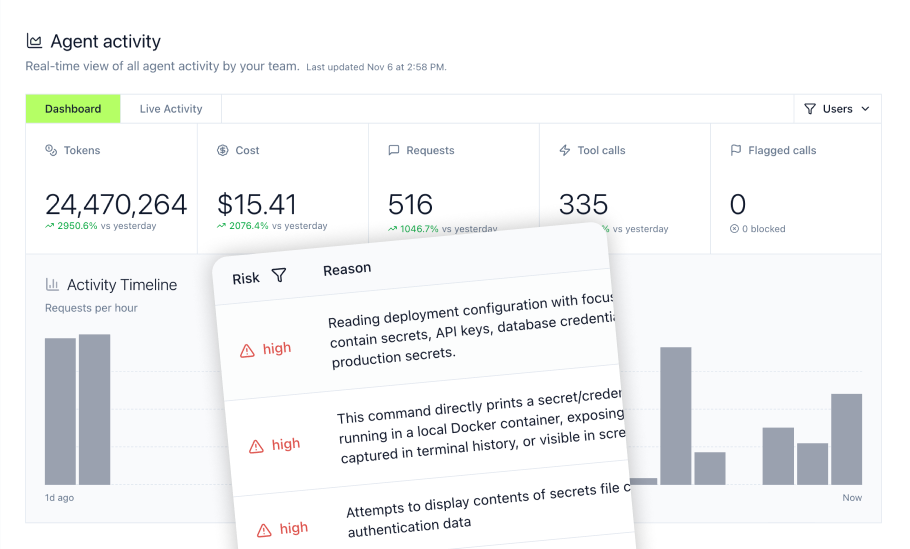
Shadow AI detection. For organizations where developers may use GLM 5.2 directly rather than through governed channels, Agent Monitor detects off-gateway MCP usage in tools like Cursor and Claude Code, providing visibility into unmanaged AI activity.
MintMCP is SOC 2 Type II audited with continuous compliance monitoring. For customers handling protected health information, MintMCP is compliant with HIPAA standards and documentation is available. Full security documentation is accessible at the Trust Center.
MintMCP: Enterprise Agent Governance for GLM 5.2 and Beyond
As organizations deploy open-weight models like GLM 5.2 to power AI agents at scale, governance becomes the critical success factor. GLM 5.2 provides the reasoning capability, but production deployments require infrastructure that ensures agents operate within security boundaries, compliance requirements, and organizational policies.
MintMCP's platform addresses this need through two integrated components. The MCP Gateway governs the foundational layer: how agents connect to tools and data sources. It provides centralized authentication, fine-grained authorization at the tool level, and comprehensive audit logging for every MCP interaction. This allows teams to restrict governed MCP access to approved resources and attribute logged MCP activity to a specific user or agent identity, regardless of the underlying model.
The Agent Gateway builds on this foundation to address agent-specific concerns. It manages persistent agent identities independent of the humans who deploy them, enforces policies that run on every tool invocation, and provides visibility into both governed and shadow AI activity. For organizations running GLM 5.2 agents that interact with GitHub, Salesforce, Snowflake, or internal databases, this means teams can retain the deployment flexibility of an open-weight model while applying authentication, authorization, logging, and policy controls to governed tool access.
This governance layer becomes especially critical when self-hosting GLM 5.2. While self-hosting gives you control over model weights and inference infrastructure, it also places the burden of security, compliance, and monitoring entirely on your organization. MintMCP fills that gap, providing enterprise-grade controls that work regardless of where your model runs or which LLM powers your agents. For regulated industries, this combination enables you to leverage open-weight models while maintaining the audit trails, access controls, and compliance documentation your frameworks require.
Frequently Asked Questions
What hardware is required to self-host GLM 5.2?
Hardware requirements depend on precision, context length, inference software, and whether CPU offloading is used. The BF16 checkpoint requires roughly 1.5TB for model weights alone, so eight A100 80GB GPUs cannot hold it entirely in GPU memory. FP8 deployment also requires more aggregate memory than eight A100 80GB GPUs unless offloading or additional compression is used.
When does self-hosting become more cost-effective than API access?
API versus self-hosting economics depend on model precision, GPU and CPU memory, offloading, utilization, context length, throughput, electricity, staffing, depreciation, and infrastructure lifetime. Self-hosting makes sense primarily for organizations with existing underutilized GPU clusters or compliance requirements that mandate on-premises deployment.
Can GLM 5.2 replace proprietary models for all enterprise use cases?
GLM 5.2 delivers frontier-class performance on coding benchmarks but shows gaps in other areas. For coding-focused use cases, document analysis, and agentic workflows with well-defined tool access, GLM 5.2 provides a compelling option. For use cases requiring maximum reasoning capability, evaluation across multiple models may be necessary.
How do I migrate existing workflows to GLM 5.2?
GLM 5.2's OpenAI-compatible API can reduce integration work, but migration effort varies by SDK, workflow complexity, tool-calling behavior, evaluation coverage, and production-control requirements. Test thoroughly across representative prompts and adjust reasoning mode settings based on your workload.
What governance is needed when GLM 5.2 agents access enterprise data?
Agent governance requirements are model-agnostic. When any LLM powers agents that connect to databases, APIs, or internal systems, organizations need authentication, authorization, audit logging, and policy enforcement. MintMCP provides this governance layer through its MCP Gateway and Virtual MCP Bundles, which apply regardless of whether GLM 5.2, Claude, or another model powers the underlying agent reasoning.