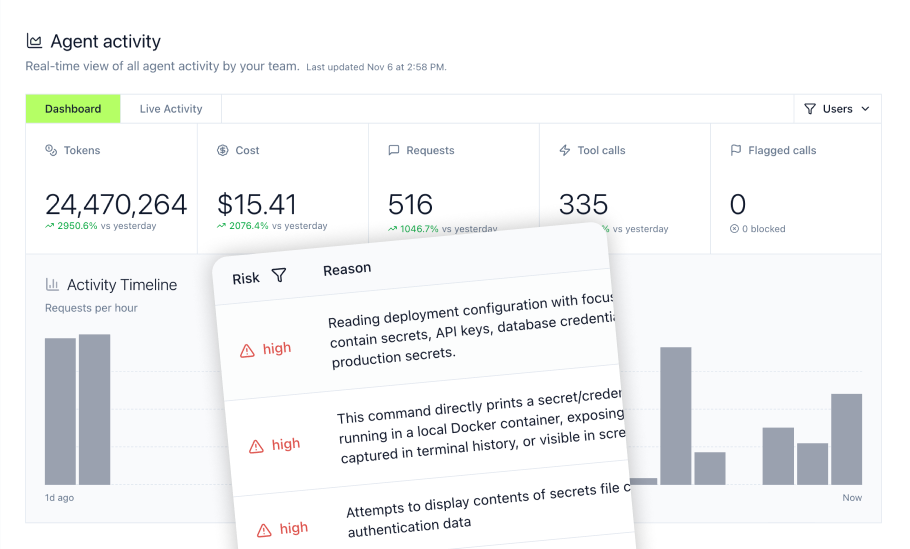
The advertised $20/seat/month price for Claude Enterprise is an access fee, not an all-inclusive subscription. Anthropic's enterprise tier uses a hybrid pricing model where the seat fee grants platform access while actual AI usage gets billed separately at API rates. This distinction can catch mid-market teams off guard when actual usage charges push their invoices above the advertised seat costs. For organizations deploying Claude alongside other AI tools like Cursor, ChatGPT, or Copilot, understanding the real cost structure is essential for accurate budgeting, and platforms like Mintive's MCP Gateway can help centralize governed tool access, while Agent Monitor helps track agent usage across supported environments.
This article breaks down Claude Enterprise's actual pricing structure, seat minimums, what's included at each tier, and how to model your real total cost of ownership before signing a contract.
Key Takeaways
- Claude Enterprise costs $20/seat/month as a base fee, billed annually, plus usage-based token consumption at API rates, with actual costs varying by model and workload
- Minimum seat requirements are 20 seats for self-serve or 50 seats for sales-assisted Enterprise procurement
- Anthropic began transitioning Enterprise renewals to usage-based pricing in November 2025 and introduced the single $20 Enterprise seat in February 2026, with renewal costs depending on existing contract terms and actual token consumption
- A 100-seat deployment starts at $2,000/month in seat fees, with illustrative totals of $2,300-$5,500/month ($27,600-$66,000/year) when monthly token consumption adds $300-$3,500
- Enterprise includes SSO, SCIM provisioning, 180-day audit log exports, Compliance API, and model-dependent context windows. HIPAA-ready configuration is available, but HIPAA-ready organizations use separate Chat and Chat + Claude Code seat types rather than the standard single-seat billing model
- Low seat utilization can increase the effective cost per active employee, making adoption tracking and change management important for Enterprise ROI
Understanding Claude's Pricing Structure
The Hybrid Pricing Model Explained
Claude Enterprise operates fundamentally differently from traditional SaaS subscriptions. The $20/seat/month price is an access fee that grants users entry to the platform. Every prompt, completion, and tool call then gets billed separately based on token consumption at standard API rates.
What the seat fee includes:
- Access to the Claude Enterprise admin console
- SSO and SCIM provisioning capabilities
- Model-dependent context windows up to 1 million tokens
- Compliance API access for audit log export
- 180-day audit log retention
- Native connectors for Google Drive, GitHub, Microsoft 365, and Slack
What gets billed separately:
- All token consumption (input and output tokens)
- Claude Code usage for developers
- Claude Cowork agent execution
- Model inference across all interactions
This structure means a user who sends minimal prompts may incur relatively low usage charges, while a developer using Claude Code extensively can generate substantially higher token costs depending on the models and workloads involved.
Token Consumption Rates
Claude Enterprise bills token usage at standard API rates. The exact per-token pricing varies by model. Claude Sonnet models cost less than Claude Opus models per million tokens. Organizations using the MCP Gateway to connect databases and enterprise tools should factor in the additional context these integrations add to each request.
Pricing Tier Comparison
Understanding where Enterprise fits requires comparing Claude's Free, Pro, Team, and Enterprise options. Claude also offers individual Max plans starting at $100/month for users needing higher usage limits, but these are not organizational subscriptions:
Free Tier:
- Cost: $0
- Access: Claude Sonnet 4.6, daily usage limits
- Limitations: No Claude Code, no Opus access, usage resets every 5 hours
Pro:
- Cost: $20/month ($17/month annual)
- Access: Claude Code, unlimited projects, all models
- Limitations: Individual use only, no SSO, 5-hour rolling usage limits
Team Standard:
- Cost: $20/seat/month (annual billing)
- Access: SSO, centralized billing, native connectors, admin controls
- Limitations: Usage caps, no Enterprise-only SCIM provisioning or audit log exports, and no Enterprise custom data retention controls
Team Premium:
- Cost: $100/seat/month (annual billing)
- Access: 5x Standard usage, with Claude Code included on both Standard and Premium seats
- Limitations: Same governance limitations as Standard
Enterprise:
- Cost: $20/seat/month + usage at API rates
- Access: Full governance suite, model-dependent context windows, HIPAA-ready
- Requirements: Minimum 20 seats (self-serve) or 50 seats (sales-assisted)
The critical distinction is that Team plans include bundled usage allowances, while Enterprise charges separately for every token. This makes Team Premium potentially cheaper for heavy users who stay within the 5x usage allocation.
What's Included in Claude Enterprise
Core Platform Features
Administrative Controls:
- SSO via Okta, Azure AD, Google Workspace with SAML support
- SCIM provisioning for automated user lifecycle management
- Role-based access control (RBAC) with custom roles
- Domain capture to prevent shadow accounts on Free/Pro tiers
- 180-day audit log retention with Compliance API export
AI Capabilities:
- Context windows of up to 1 million tokens on supported models for processing large codebases or document sets
- Claude Code terminal and IDE integration for developers
- Claude Cowork desktop agent for multi-step document and workflow automation
- Enterprise Search across connected workplace tools
Native Integrations:
- Google Drive, Gmail, Google Calendar
- GitHub repository access
- Microsoft 365 (Word, Excel, PowerPoint, OneDrive)
- Slack message search and summarization
Organizations deploying Claude alongside these integrations can benefit from MCP governance to enforce consistent access policies on governed tool connections, with Agent Monitor providing additional audit visibility into supported agent activity.
Security and Compliance
Anthropic maintains SOC 2 Type II attestation for its commercial products, while Claude Enterprise provides additional organization-level security and compliance capabilities:
- HIPAA-ready configuration available to eligible self-serve and sales-assisted Enterprise organizations, subject to enabling the required configuration and accepting a BAA
- GDPR-related data processing controls, with Anthropic acting as data processor and customer organizations retaining their responsibilities as data controllers
- US-only inference available at 1.1x standard API usage rates for Claude Opus 4.6, Sonnet 4.6, and later models, without increasing seat fees
- Custom chat and project data retention policies on Enterprise, with configurable retention periods and a minimum of 30 days
- Integration options for identity, security monitoring, and compliance workflows through supported identity providers, the Compliance API, and external security platforms
For organizations with existing security infrastructure, Mintive's Mint Guard provides managed runtime detection for threats such as prompt injection and PII exposure, while Rules and Gateway Middleware support custom policy enforcement on governed tool interactions.
Real-World Cost Analysis
Illustrative Total Cost of Ownership by Team Size
The headline seat price obscures the actual investment required. The following scenarios illustrate how total costs change with usage, assuming the published $20 monthly seat fee and different levels of token consumption. They are hypothetical estimates, not verified customer spending benchmarks:
50-Seat Deployment:
- Base seat fee: $1,000/month ($12,000/year)
- Moderate usage: +$150/month in token consumption
- High usage: +$1,750/month in token consumption
- Illustrative total range: $13,800-$33,000/year
100-Seat Deployment:
- Base seat fee: $2,000/month ($24,000/year)
- Moderate usage: +$300/month in token consumption
- High usage: +$3,500/month in token consumption
- Illustrative total range: $27,600-$66,000/year
200-Seat Deployment:
- Base seat fee: $4,000/month ($48,000/year)
- Moderate usage: +$600/month in token consumption
- High usage: +$7,000/month in token consumption
- Illustrative total range: $55,200-$132,000/year
These figures assume relatively uniform usage. Organizations with heavy Claude Code users may incur higher per-developer token costs, depending on model selection, session length, and coding workload.
The 2025-2026 Pricing Transition
Anthropic began transitioning Enterprise customers from legacy seat-based plans to usage-based billing during contract renewals in November 2025. In February 2026, the company introduced a single $20-per-seat monthly access fee, billed annually, with token consumption charged separately at standard API rates.
Before the transition (legacy Enterprise contracts):
- Certain seat-based plans included usage allowances or different seat types
- Pricing and included usage varied by contract
Current Enterprise model (introduced February 2026):
- $20/seat/month, billed annually
- All token consumption billed separately at standard API rates
The financial impact of renewal depends on existing contract terms, actual usage, and any negotiated commitments. Organizations approaching renewal should model their actual token consumption rather than assuming the lower seat fee reduces costs.
Cost Per Active User
The real cost calculation must account for adoption rates. The following scenarios illustrate how 10% and 30% seat utilization would affect effective costs per active employee. These are hypothetical adoption assumptions, not established industry benchmarks.
For a 100-seat deployment at $27,600/year with 30% adoption:
- Per-active-user cost: $920/year ($77/month)
With only 10% adoption:
- Per-active-user cost: $2,760/year ($230/month)
This makes change management and AI agent monitoring critical for realizing ROI. Organizations need visibility into who's actually using the platform and how intensively to optimize spend.
Implementation Requirements
Setup Timeline
Implementation complexity varies based on procurement, identity-provider configuration, security requirements, and connector setup.
Self-Serve (20 seats minimum):
- Purchase: Direct online signup with an annual seat commitment
- SSO configuration: Depends on identity-provider setup and testing
- SCIM provisioning: Requires directory synchronization and role mapping
- Connector setup: Varies by integration and permission requirements
- Total: Depends on payment activation and technical setup
Sales-Assisted (50 seats minimum):
- Contract negotiation: Depends on procurement, legal review, and commercial terms
- Technical setup: SSO, SCIM, connectors, and governance policies configured according to organizational requirements
- Total: Depends on contracting and deployment complexity
Common Implementation Challenges
Organizations consistently encounter these setup challenges:
SSO Authentication Failures:
- Verify SAML assertions include user email and display name attributes
- Test with a pilot user before enabling domain capture
- Use just-in-time provisioning while troubleshooting SCIM
SCIM Group Mapping:
- Map identity provider groups to Claude roles before enabling provisioning
- Audit group membership in admin console after sync
- Manually assign roles until SCIM mapping is verified
Usage Cost Overruns:
- Start with 30-day pilot using strict spend limits ($50-$100/user/month)
- Monitor per-user consumption daily during pilot phase
- Consider Team Premium for unpredictable heavy users
Connector Permission Scope:
- Enable read-only access initially
- Grant write permissions only to specific teams after audit
- Document which connectors have which permission levels
For organizations managing multiple AI systems, Mintive's governance platform provides centralized policy enforcement for governed tool connections, while Agent Monitor supports cost attribution across supported agent environments and available usage telemetry.
When Enterprise Makes Sense
Choose Enterprise When:
- IT/security requires SSO + SCIM for user lifecycle management
- Legal/compliance mandates audit logs with 180+ day retention
- You have 50+ active users with predictable usage patterns
- HIPAA compliance requires a Business Associate Agreement
- Custom chat and project data retention policies are required
Consider Team Plans Instead When:
- Team size is 5-50 employees without regulatory mandates
- Predictable costs matter more than per-token optimization
- Users are heavy consumers who benefit from bundled usage
- Governance requirements don't extend beyond basic SSO
Consider API + Third-Party Governance When:
- You need per-user authentication on shared agents
- Faster rollout without procurement delays is priority
- The 20/50-seat minimum creates waste during ramp-up
- You're managing multiple AI providers alongside Claude
Organizations in this last category often benefit from MCP Gateway solutions that provide enterprise governance across multiple AI systems through a unified control plane.
ROI Considerations
Productivity Upside
Research on 5,179 customer support agents found a 14% average productivity improvement measured by issues resolved per hour when workers received generative AI assistance. Actual financial returns depend on the workflows deployed, employee adoption, and measurable performance improvements.
Use case evaluation metrics:
- Engineering teams: Measure code comprehension time, debugging efficiency, development speed, and code quality
- Legal contract review: Track review time, missed clauses, and document accuracy against existing workflows
- Customer support: Measure ticket resolution time, issues resolved per hour, and customer satisfaction before and after AI deployment
Break-Even Analysis
At 30% adoption (illustrative scenario):
- 100 seats at $27,600/year investment
- 30 active users × 10 hours/week saved × $50/hour
- Potential gross labor-time value: ~$780,000/year
- Break-even: Depends on whether assumed time savings translate into realizable financial value after implementation and operating costs
At 10% adoption (illustrative scenario):
- Same investment: $27,600/year
- 10 active users × 10 hours/week saved × $50/hour
- Potential gross labor-time value: ~$260,000/year
- Break-even: Depends on measured productivity improvements, implementation costs, and actual usage charges
The critical success factor is driving adoption, which requires visibility into actual usage. Agent monitoring tools help identify which teams are gaining value and which need additional enablement.
Governance and Multi-Tool Considerations
Most enterprises deploy Claude alongside other AI tools. Engineering teams often use Cursor or GitHub Copilot. Business teams might use ChatGPT for specific workflows. This creates governance complexity:
- Multiple identity systems to manage
- Scattered audit trails across platforms
- Inconsistent policy enforcement
- Difficulty attributing costs across tools
Mintive's Agent Gateway builds on MCP Gateway governance by giving autonomous agents first-class identities, scoped permissions, and independently managed credentials. Organizations can establish consistent policies for tool access, credential management, and audit logging across supported integrations while retaining necessary native controls in each AI platform.
For teams evaluating Claude Cowork or building autonomous agents, understanding the governance requirements becomes even more critical as agents take actions across multiple systems.
Centralizing Enterprise AI Governance with Mintive
Organizations deploying Claude Enterprise alongside other AI tools face a fundamental challenge: each platform brings its own identity model, audit system, and security controls. While Claude Enterprise provides robust native governance for direct chat and workspace interactions, modern AI deployments extend beyond single-platform boundaries.
Mintive complements Claude Enterprise by providing:
- Unified Tool Governance: MCP Gateway governs how agents access databases, APIs, and enterprise tools, regardless of whether the request comes from Claude, Cursor, or custom applications. This creates consistent access policies and audit trails across your entire AI deployment.
- Cross-System Visibility: Agent Monitor tracks token consumption, tool invocations, and costs across supported environments. Instead of reconciling separate bills from multiple AI vendors, teams gain unified visibility into where AI spending occurs and which workflows generate value.
- Autonomous Agent Identity: Agent Gateway gives AI agents their own identities, credentials, and permissions. This allows Claude Cowork or custom agents to take actions using scoped, revocable credentials rather than sharing human credentials or overprivileged service accounts.
- Runtime Security Controls: Mint Guard adds managed threat detection for prompt injection, PII exposure, and harmful content, while Rules and Gateway Middleware support custom policy enforcement on tool interactions.
For organizations already invested in Claude Enterprise, Mintive extends governance beyond the chat interface to cover the complete AI integration surface. Teams can maintain Claude's native SSO, audit logs, and compliance features while adding centralized control over tool access, agent credentials, and cross-platform visibility. Learn more about enterprise MCP governance or explore how to track AI costs across your organization.
Frequently Asked Questions
How does Claude Enterprise billing work?
Claude Enterprise uses single-seat usage-based billing. Seat fees are billed annually upfront, while usage is charged separately at API rates. Self-serve organizations purchase usage credits in advance, while sales-assisted organizations receive monthly usage invoices billed in arrears. Spend limits and prepaid credit balances can stop usage when thresholds are reached. Self-serve Enterprise plans do not allow seat reductions during the annual term.
Can I start with fewer than 20 seats?
The 20-seat minimum applies to self-serve Enterprise purchases. If you need fewer seats, Team Standard or Team Premium may be more appropriate. Sales-assisted Enterprise requires 50 seats minimum but offers more flexibility in contract terms. Adding seats during the contract period is straightforward since you pay the prorated annual seat fee plus ongoing usage charges.
How do negotiated discounts work for larger deployments?
Claude Enterprise's published seat price is $20 per user per month, billed annually, with separate usage charges at API rates. Sales-assisted Enterprise contracts may include tailored commercial terms, usage commitments, and negotiated incentives, but discount levels are not publicly standardized. Organizations should confirm applicable pricing, minimum commitments, and any additional compliance requirements directly with Anthropic.
What happens if I exceed my expected usage budget?
Claude Enterprise bills token consumption at API rates and supports configurable spend limits. Admins can establish organization-wide and per-user limits to control costs. When a limit is reached, affected usage stops until the limit resets or an authorized administrator increases it. Self-serve organizations also stop usage when their prepaid credit balance is exhausted, while sales-assisted organizations receive monthly consumption invoices unless spend limits intervene.
How does Claude Enterprise compare to building on the API directly?
For equivalent token consumption, direct Claude API access avoids Enterprise's additional seat fee, regardless of usage intensity. However, API access does not automatically include Claude Enterprise's managed workspace, SSO, SCIM, audit logs, and compliance controls. The break-even point depends on the cost of implementing and maintaining those capabilities. Organizations running multiple AI tools can also evaluate third-party governance platforms to centralize supported tool access.