Claude Code operates as Anthropic's agentic AI coding tool, inspecting relevant files across codebases, writing multi-file edits, running tests, and executing shell commands from the terminal. Unlike traditional code completion tools, it executes multi-step engineering tasks with configurable filesystem permissions and contextual access to project code.
For enterprises deploying Claude Code at scale, this autonomy creates governance challenges: credential sprawl, fragmented visibility across agents and MCP connections, and audit gaps that complicate SOC 2 assessments and HIPAA security obligations. Organizations adopting Claude Code need infrastructure that governs what the agent can access, monitors what it does, and enforces security policies without slowing development velocity.
Mintive's MCP Gateway provides that governed connection layer between AI coding agents and enterprise systems, enabling IT and security teams to deploy Claude Code with centralized MCP access controls and audit trails for governed tool interactions. Agent Monitor extends visibility to supported local agent activity.
Key Takeaways
- Claude Code is included with Team Standard at $20-$25/seat/month, Team Premium at $100-$125/seat/month, and Enterprise at $20/seat/month plus usage; Premium seats provide higher usage limits
- Enterprise deployment timelines vary by team size, security requirements, and existing infrastructure, with phased pilots, policy validation, and organization-wide rollout recommended
- Managed settings delivered via server, MDM, or file-based deployment cannot be overridden by individual developers, enforcing organization-wide policy
- Claude Code can automate routine coding work, including boilerplate generation, tests, documentation, and PR descriptions, but productivity gains vary by task, workflow, and team
- CLAUDE.md configuration files describe project-level coding standards and architecture guidance; enforceable directory restrictions require permission rules, hooks, or sandbox controls
- Rakuten achieved 79% reduced time to market (24 days to 5 days) using Claude Code for feature development
Why Claude Code Demands Enterprise Governance Infrastructure
The Enterprise AI Adoption Challenge
Your developers are already using AI coding tools. The question is whether IT and security teams have visibility into which tools, what code is being generated, and what enterprise data those tools can access. Claude Code intensifies this challenge because it operates autonomously, deciding at runtime which tools to call, which files to read, and which commands to execute.
The core governance problems include:
- Fragmented telemetry: Native Claude Code monitoring provides activity and usage data, but organizations may need additional visibility across supported local agent activity and MCP connections
- Credential sprawl: API keys end up on developer laptops; a single leak exposes production systems
- Inconsistent access control: Native permissions govern Claude Code operations, but independently configured MCP servers can create inconsistent authorization policies
- Fragmented audit trails: Claude Code provides native audit and monitoring capabilities, but organizations using multiple AI clients and MCP integrations may need consolidated records for SOC 2, HIPAA, or internal risk reporting
- Configuration sprawl: Every developer configures MCP servers locally, creating multiple installs, authentication flows, and failure points
Spotify engineers now execute fleet-wide code migrations at speeds that were previously impossible. That velocity requires governance infrastructure that matches the pace of autonomous agent operations.
Why a Unified Gateway Matters
Claude Code connects to enterprise systems through MCP (Model Context Protocol) servers that provide access to databases, APIs, documentation systems, and CI/CD pipelines. Without centralized governance, each developer configures these connections independently, credentials scatter across machines, and security teams lose visibility.
A governed gateway approach addresses these challenges by routing approved MCP connections through centralized access controls, while managed Claude Code settings can restrict direct connections to unauthorized MCP servers. Mintive's MCP Gateway serves as that single entrypoint, authenticating users through your identity provider, curating which tools each role can access, injecting credentials per call, and logging every interaction. The Virtual MCP (VMCP) abstraction bundles multiple connectors behind one endpoint so users connect once instead of configuring each server individually.
Enterprise Security Architecture for AI Coding Assistants
Securing Claude Code Interactions
Claude Code's agentic architecture requires security controls at multiple layers. The agent has filesystem access, command execution capabilities, and the ability to connect to external systems through MCP servers. Native security features include permission prompts, sandbox mode, and managed settings, but enterprises need additional infrastructure for complete governance.
Native Claude Code security layers:
- Permission prompts: Claude Code asks before executing potentially dangerous operations like file writes, shell commands, or MCP tool calls
- Sandbox mode: Uses configurable filesystem and network isolation to restrict command execution, control writable paths and network destinations, and reduce permission prompts for permitted operations
- Managed settings: Organization-wide policies delivered via server, MDM, or file that cannot be overridden by developers
- CLAUDE.md files: Project-level instruction files describing coding standards and architecture guidance; enforceable restrictions require permissions and hooks
Mitigating Risks in AI Agent Operations
Enterprise Claude Code deployments face specific threat vectors that require dedicated controls:
- Prompt injection: Malicious content in tool results or file contents can hijack agent behavior
- Credential exposure: Agents may read .env files, SSH keys, or credential stores
- Command execution: Autonomous shell access enables system modification
- Data exfiltration: Agents can potentially send sensitive data through external tool calls
Mint Guard provides runtime security screening for MCP Gateway traffic, detecting prompt injection attempts, credentials and secrets in arguments or results, PII, and harmful content. In enforcing mode, it blocks high-confidence prompt injection attempts and records other detections. Native Claude Code permissions and supported Agent Monitor rules provide additional controls for local file and command operations.
Centralized Governance and Admin Controls
Implementing Role-Based Access
The Claude Code Enterprise admin console provides granular control over who can access Claude Code and what they can do with it. Enterprise administrators can configure seat types, manage SSO integration, and deploy organization-wide policies.
Admin console capabilities:
- User groups: Segment the organization for different policy enforcement
- Seat management: Assign Standard seats with Claude Code access or Premium seats with higher usage limits
- SSO/SCIM integration: Connect Okta, Azure AD, or Google Workspace for identity management
- Managed settings: Deploy permission policies, MCP allowlists, and security configurations
- Compliance API: Export audit logs for regulatory requirements
Permission policy structure:
The managed settings framework supports three permission levels for each operation category:
- Allow: Operation proceeds without prompting
- Ask: User must confirm before operation executes
- Deny: Operation blocked regardless of user input
These policies apply to file reads, file writes, shell commands, MCP server connections, and specific tool calls.
Streamlining AI Governance
For organizations running Claude Code alongside Cursor, ChatGPT, GitHub Copilot, and custom agents, managing governance across multiple platforms creates significant overhead. Native Copilot RBAC or Claude-specific controls require separate administration for each tool.
Mintive's approach consolidates governance across AI clients. The agent governance framework applies consistent policies to Claude Code, Cursor, ChatGPT, and other MCP-compatible clients through a single control plane. Directory groups from your identity provider drive both admin roles and tool access, eliminating per-platform policy management.
Per-Agent Identity and Credential Management
Why Unique Agent Identities Matter
When autonomous agents operate using whichever human credential was available during setup, audit logs collapse. You cannot distinguish agent actions from human actions, over-privileged agents access systems they should not reach, and credential rotation becomes impossible without disrupting operations.
Agent Identities solve this by treating each autonomous agent as a first-class non-human principal. Every agent receives its own identity, credential, scoped MCP access, and audit trail, separate from the human who created it.
Authentication mechanisms from simplest to most secure:
- Bearer keys: Static key on every request with name, expiry, and individual revocation
- M2M tokens: OAuth client-credentials exchange for short-lived tokens; secrets stay out of the request path
- Workload identity federation: The agent's own infrastructure (Kubernetes service account, cloud role, CI job identity) mints short-lived OIDC tokens; no secret stored at all
Delegating Credentials Safely
Claude Code connects to enterprise systems through MCP servers that require credentials. The authentication models for these connections determine security posture:
- Per-user OAuth: The MCP server authenticates as the specific user who triggered the operation
- Team credentials: Shared service account used by all team members
- Agent-owned credentials: Admin completes OAuth as the agent, creating dedicated agent access
For governed deployments, connectors should never hold long-lived secrets. Mintive's credential injection model means connectors receive credentials per call, with secrets encrypted at rest using rotated AES keys. When an agent is compromised or decommissioned, its credentials revoke independently without touching user accounts or other agents.
Programmable Security Policies and DLP
Customizing Security Controls
Claude Code's native permission system provides binary allow/deny controls. Enterprises often need more sophisticated policies that transform data, mask sensitive values, or integrate with existing DLP infrastructure.
Three-layer security model:
- Mint Guard: Managed detection policies for prompt injection, credentials, PII, and harmful content with off/monitoring/enforcing modes
- Rules: Declarative conditions matching tool names, arguments, patterns, or content with actions including flag, block, ask, mask, or notify
- Gateway middleware: Customer-authored JavaScript logic for transformations, external classifier integration, redaction, and custom policy enforcement
Gateway middleware runs in a sandboxed environment on matching MCP tool calls or supported Agent Monitor hook events. Use cases include blocking sensitive file access through supported hooks, redacting data in MCP arguments or results, enforcing resource-level access policies, and calling external DLP classifiers before permitted operations proceed.
Integrating Existing DLP Solutions
Organizations with investments in existing DLP and content security systems can integrate those controls into Claude Code governance. Pre-built middleware templates support AWS Bedrock Guardrails, Google Cloud Model Armor, OpenAI moderation, and Teleskope, while other API-accessible classifiers can be integrated through customer-authored JavaScript.
This approach keeps security policy in the tools that teams already operate rather than requiring separate AI-specific configuration.
Shadow AI Detection and Audit Logging
Uncovering Unsanctioned AI Use
Claude Code installed on developer endpoints operates outside traditional security perimeters. IT teams may not know which developers are using Claude Code, what repositories they are accessing, or what external MCP servers they have configured.
Agent Monitor captures supported Claude Code activity through lightweight local hooks, including pre-execution events where available. The visibility extends beyond gateway traffic to include:
- File reads: Including .env, SSH keys, and credential files
- Commands: Bash, package installs, git operations
- MCP tool calls: Both governed and ungoverned server connections
- Prompts: The actual instructions developers provide to Claude Code
This cross-platform visibility supports Claude Code, Cursor, Codex, and GitHub Copilot from a single monitoring surface, with coverage varying by client and supported hook events. Claude Code monitoring includes MDM-pushed configurations that enable detection and supported blocking controls on developer machines.
Comprehensive Audit Trails
Organizations following the NIST AI RMF can strengthen accountability through documented monitoring, access records, and audit trails. Claude Code's Enterprise plan includes a Compliance API for audit log export, but enterprises running multiple AI tools need consolidated logging.
Audit capabilities:
- Tool call logging: Every MCP call with user, agent, server, tool, timestamp, arguments, result, and guardrail decision
- Credential lifecycle events: Creation, rotation, revocation, and access
- Access policy changes: Who modified permissions and when
- Tamper-evident history: Access-grant records signed at write time, verifiable offline via published JWKS
SIEM export options include OTLP streaming to any OpenTelemetry collector and Splunk HEC integration, maintaining audit trails in the systems compliance teams already use.
Pricing Structures and Deployment Options
Understanding Enterprise Licensing
Claude Code access requires specific subscription tiers. The pricing structure creates distinct paths for individual developers, teams, and enterprises:
- Free ($0): Web and app features available; Claude Code terminal access excluded
- Pro ($20/month): Includes Claude Code; ~5x Free tier usage per 5-hour window with weekly caps
- Max 5x ($100/month): Includes Claude Code; 5x Pro capacity; monthly billing only
- Max 20x ($200/month): Includes Claude Code; 20x Pro capacity; extreme power users
- Team Standard ($25/month, $20 annual): Claude Code included; lower usage limits than Premium
- Team Premium ($125/month, $100 annual): Claude Code included; 5x Standard usage; minimum 2 members
- Enterprise ($20/seat/month annual billing + usage): New plans include Claude Code in the unified Enterprise seat; 20-seat self-serve minimum
Critical distinction: Team Standard seats at $25/month include Claude Code terminal access. Organizations planning Claude Code deployments can use Team Standard for regular workloads, Team Premium for higher usage capacity, or Enterprise for usage-based billing and advanced administration.
Choosing the Right Deployment Model
Enterprise plan advantages:
- All seats include Claude Code access
- Usage billed at API rates for predictable per-token costs
- SSO, SCIM, and admin console for centralized management
- Managed settings that cannot be overridden
- Custom data retention policies, with Zero Data Retention available for qualifying deployments
- HIPAA-ready option with a Business Associate Agreement and required configuration for covered Claude Code local sessions
Illustrative deployment timeline (adjust based on organizational requirements):
- Pilot phase (1-4 weeks): 5-20 volunteer developers, 1-2 repositories, baseline metrics
- Security hardening (5-8 weeks): Managed settings, hooks, MCP allowlists, telemetry configuration
- Full rollout (9-16 weeks): Organization-wide deployment with training and feedback channels
Total cost of ownership considerations:
Direct costs for 50 developers on Team Premium run approximately $60,000 annually with annual billing, or $75,000 annually with monthly billing, before optional usage credits. Organizations can reduce subscription costs by assigning Team Standard seats to developers with lighter workloads. Additional expenses may include security integration, implementation consulting, training, and ongoing governance administration, with costs varying by deployment complexity.
The ROI calculation centers on developer productivity. Organizations should measure time saved on representative coding tasks, apply their own developer cost assumptions, and account for review time, rework, and implementation expenses. Pilot data provides a more reliable basis for estimating productivity value per seat than generalized percentage improvements.
Deployment Architecture and Implementation Sequence
Step 1: Pilot Team Selection
Select 5-20 volunteer developers across different teams. Choose one low-risk repository, one production-adjacent repository, and one with representative CI/CD complexity. Establish baseline usage metrics and feedback channels before expanding.
Step 2: Authentication and Initial Install
Install Claude Code using Anthropic's recommended native installer, or use npm install -g @anthropic-ai/claude-code with Node.js 22 or later for npm installation. Authenticate using claude auth login with Anthropic credentials or configure SSO through the admin console for Enterprise deployments using SAML 2.0 or OIDC.
Step 3: CLAUDE.md Configuration
Create project-level CLAUDE.md files describing coding standards, architecture patterns, directory guidance, test requirements, and compliance expectations. Enforce mandatory restrictions through managed settings and hooks. Well-configured project files determine output quality more than prompt engineering.
Step 4: Managed Settings Deployment
Configure managed-settings.json with organization-wide policies including permission rules, secret path blocks, MCP server allowlists, and sandbox mode settings. Deploy via server-managed settings (admin console), MDM (macOS/Windows through Intune, Kandji, or JumpCloud), or file-based deployment. Verify with the /status command showing "Enterprise managed settings."
Step 5: Security Hardening
Configure hooks for pre-file-write security checks, post-edit linting, and session audit logging. Set up OpenTelemetry export to your monitoring stack. Integrate SAST/DAST tools into CI/CD pipelines. Test adversarial scenarios including prompt injection attempts, secret access attempts, and workflow file edits.
Step 6: Full Team Rollout
Expand to the engineering organization with tiered repository profiles. Run 90-minute hands-on training sessions. Establish "Claude Code champions" per team (20-30 developers each) who handle questions, iterate on Skills, and escalate policy changes.
Governing Claude Code at Enterprise Scale with Mintive
Enterprise Claude Code adoption requires balancing developer autonomy with security, compliance, and visibility. While native controls cover permissions, sandboxing, managed settings, and auditing, organizations using multiple AI coding tools need centralized governance across platforms.
Mintive provides unified governance through four core capabilities:
- MCP Gateway: Centralizes approved MCP connections, credentials, access policies, and audit trails across Claude Code, Cursor, ChatGPT, and custom agents.
- Agent Identities: Assigns each agent a distinct identity, scoped permissions, and independently managed credentials.
- Mint Guard: Screens MCP traffic for prompt injection, exposed credentials, PII, and harmful content, with enforcement based on configured policies.
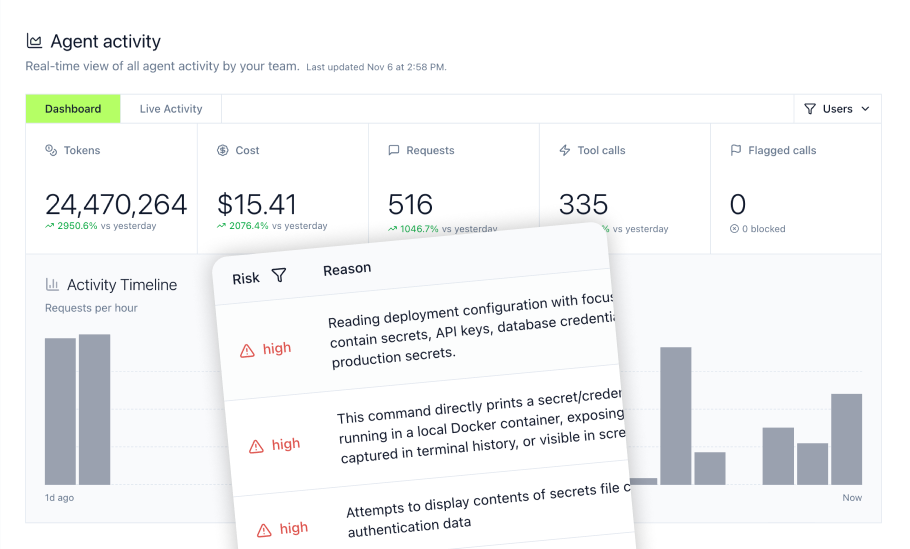
- Agent Monitor: Tracks supported coding-agent activity, including local operations beyond gateway traffic, through a centralized dashboard.
Gateway middleware adds custom security policies, DLP integrations, and data transformations without modifying individual MCP servers.
Together, these capabilities help teams:
- Maintain developer velocity through governed access to enterprise tools.
- Enforce consistent security policies across supported AI clients and agents.
- Support compliance with consolidated audit trails relevant to HIPAA security requirements and SOC 2 assessments.
Mintive provides the centralized governance infrastructure needed to scale Claude Code adoption while maintaining visibility, access control, and accountability.
Frequently Asked Questions
How does Claude Code handle data residency requirements for organizations operating in the EU?
Claude Code supports multiple deployment configurations, including direct Anthropic access and supported cloud providers such as Amazon Bedrock and Google Cloud's Agent Platform. Data residency and private networking options depend on the selected provider, region, and contractual configuration. Running Claude Code locally does not mean the underlying Claude model is self-hosted.
Can Claude Code integrate with on-premises systems not exposed to the internet?
Yes, through private network configurations. Mintive's MCP Gateway includes private network tunnel capabilities that establish outbound TLS connections from inside customer networks, enabling Claude Code to access internal databases and APIs without opening inbound firewall rules. All traffic through these tunnels receives the same screening and logging.
What happens when a developer runs Claude Code with the dangerously-skip-permissions flag?
This flag bypasses Claude Code's normal permission prompts and should be restricted in enterprise environments. Administrators can disable permission bypass through the permissions.disableBypassPermissionsMode managed setting. When enforced, developers cannot enable bypass mode, reducing the risk of unrestricted tool execution. Organizations should combine this setting with managed permission rules, sandboxing, and security monitoring.
How should organizations handle Claude Code access for contractors and temporary workers?
Enterprise seat management supports mixed employment types. Configure separate user groups in your identity provider for contractors with distinct permission policies. Consider shorter credential expiration periods and more restrictive MCP allowlists for contractor roles. When contractor engagements end, deprovision accounts through the identity provider and verify that Claude access, assigned seats, and relevant credentials are revoked.
What compliance certifications does Claude Code Enterprise support for regulated industries?
Anthropic maintains SOC 2 Type II attestation reports supported by independent third-party audits. HIPAA-ready Enterprise offerings are available with Business Associate Agreements for eligible organizations handling protected health information, subject to product-specific configuration and coverage requirements. Claude Code local sessions can qualify under supported HIPAA configurations without requiring Zero Data Retention. Claude for Government has FedRAMP High authorization.