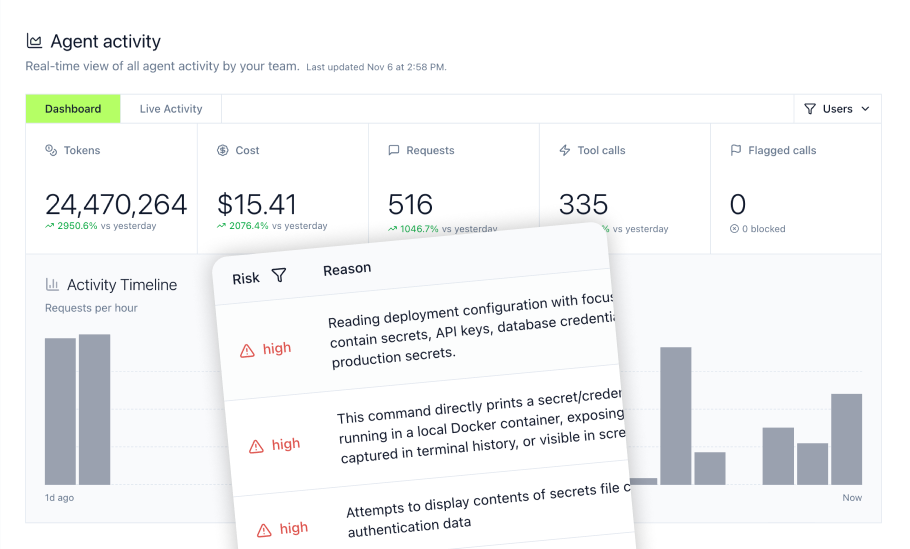
AI agents now power everything from code generation to customer support automation, yet most enterprises lack visibility into what these agents actually consume. With agents using 5-30x more tokens per task than standard chatbots, untracked usage translates directly to budget overruns and compliance blind spots. The challenge intensifies when teams deploy agents across local development environments, cloud APIs, and hybrid architectures simultaneously.
This article outlines practical approaches for tracking token usage across every deployment model, from desktop monitoring tools to enterprise control planes, with guidance on when each approach makes sense for your organization. Whether you need provider usage APIs and application telemetry for token tracking, or governed visibility into agent and tool activity through a centralized MCP Gateway and Agent Monitor, the right infrastructure depends on your scale, compliance requirements, and operational maturity.
Key Takeaways
- AI agents consume 5-30x more tokens per task than standard chatbots, making visibility essential for cost control
- Even as per-token costs fall, overall inference costs can continue rising because agentic workloads consume substantially more tokens and perform more tasks than standard chatbot interactions
- The amount of avoidable token spend varies by workload, but tracking can reveal duplicated context, excessive retries, unnecessary agent loops, and inefficient model selection
- OpenAI Chat Completions requires
stream_options: {"include_usage": true}to return aggregate token usage in a final stream chunk, which may be missing if the stream is interrupted - Local desktop tools provide zero-cost monitoring for individual developers, while enterprise control planes enable cross-provider attribution and budget enforcement
- Token optimization strategies can achieve substantial cost reductions in workloads with duplicated context, unnecessary loops, or avoidable high-cost model calls
- Shadow AI detection remains critical, as agents running outside governed infrastructure consume tokens without attribution or audit trails
Understanding AI Agent Token Usage: Why It Matters for Your Enterprise
Token consumption directly impacts two enterprise priorities: cost management and operational visibility. Unlike traditional API calls with predictable request patterns, AI agents make dynamic, multi-step decisions that compound token usage unpredictably. A single agentic workflow may involve several model calls, retrieval steps, and tool invocations, so teams should measure token consumption and latency across the complete workflow rather than only the final response.
The Financial Impact of Untracked Token Usage
Without tracking infrastructure, enterprises operate blind until monthly bills arrive. Unbounded agent loops, repeated retries, and recursive tool calls can rapidly increase model and infrastructure consumption when teams lack limits and anomaly alerts. The pattern repeats across organizations: teams deploy agents for productivity gains, but lack mechanisms to attribute costs to specific agents, users, or workflows.
The business case for tracking extends beyond cost avoidance. Accurate token attribution enables:
- Chargeback models that allocate AI costs to the teams and projects consuming them
- Capacity planning based on actual usage patterns rather than guesswork
- Performance optimization by identifying inefficient prompts or model selections
- Compliance documentation showing exactly which agents accessed which data and when
Optimizing LLM Workloads for Cost-Efficiency
Token efficiency varies dramatically across implementations. In a study of 30 ChatDev software-development tasks, the iterative code-review stage accounted for an average of 59.4% of total token consumption, while input tokens represented an average of 53.9%. The results are specific to that framework and workload, but they illustrate why repeated review loops and unnecessary context transfer deserve close monitoring.
The Landscape of AI Agents: Cloud, Local, and Hybrid Deployments
Modern enterprises run agents across three distinct deployment models, each with different tracking requirements and available tooling.
Cloud agents connect directly to provider APIs (OpenAI, Anthropic, Google) and offer native usage dashboards with basic consumption data. These dashboards show total token counts and monthly spend projections but typically lack per-agent or per-workflow attribution.
Local agent clients run on developer machines using tools like Claude Code, Codex, and Cursor. Cloud providers may still record the associated model usage, while local session files can provide additional project, session, and workflow attributions.
Hybrid deployments combine both models, with developers testing locally before deploying to cloud infrastructure. This creates the most complex tracking challenge: unified visibility requires either routing all traffic through a central gateway or aggregating telemetry from distributed sources.
Challenges of Distributed Agent Environments
The fundamental challenge is that each deployment model generates token data in different formats, locations, and cadences. Cloud providers expose usage through APIs with varying retention periods. Local tools write session logs to filesystem paths that differ across operating systems. Custom agent builds may not instrument token counting at all.
MintMCP's MCP Gateway addresses tool-access fragmentation by providing a unified authentication and logging layer across deployment scenarios. Whether teams run pre-configured connectors, custom STDIO-based servers, or cloud-hosted agents, governed MCP traffic routes through a single control point with consistent user and agent attribution for tool calls. Model-token attribution still requires provider usage APIs, application telemetry, or an AI gateway.
Core Challenges in Token Usage Tracking for AI Agents
Three primary obstacles prevent enterprises from achieving comprehensive token visibility.
Lack of Standardized Reporting APIs
Each AI provider implements usage reporting differently. OpenAI Chat Completions requires stream_options: {"include_usage": true} to return aggregate token usage in a final stream chunk, which may be missing if the stream is interrupted. Anthropic includes usage data in the final stream event by default. Claude Platform organizations can access granular usage and cost data through the Usage and Cost Admin API, while Claude Enterprise uses a separate Analytics API.
Reasoning models compound the problem. Reasoning models add billed reasoning tokens that do not appear in the visible response, and the amount can vary substantially by model, task, and reasoning effort. Capture the provider's reasoning-token field instead of estimating usage from visible output.
Attributing Usage to Specific Users or Teams
Native provider dashboards offer organization-level or project-level filtering but rarely support per-agent or per-workflow attribution. When marketing, engineering, and customer success teams share API credentials, finance cannot allocate costs accurately. When multiple agents run under a single service account, audit trails cannot determine which agent performed which action.
Solving attribution requires either application-level logging that tags every request with metadata (agent_id, user_id, feature_name) or a gateway architecture that injects attribution before requests reach the provider.
Leveraging Observability for AI Agent Performance and Costs
AI agent observability extends beyond token counting to encompass latency, error rates, cache hit ratios, and model selection patterns. This broader context transforms raw consumption data into actionable optimization insights.
Key Metrics for LLM Observability
Effective monitoring tracks:
- Token consumption broken down by input, output, cached, and reasoning tokens
- Latency per request including time spent waiting for model responses
- Error rates and retry patterns that inflate consumption through repeated attempts
- Cache hit ratios for prompts that could be served from stored responses
- Model selection distribution showing which models handle which request types
MintMCP's Agent Monitor provides org-level analytics on MCP adoption, usage patterns by team and tool, latency monitoring, and error tracking. This observability layer complements provider-side token tracking by surfacing tool usage, latency, errors, and agent activity alongside model-consumption data collected elsewhere.
Building a Comprehensive Monitoring Strategy
Start with cloud-native dashboards for immediate visibility into total spend. Add observability instrumentation when provider dashboards no longer provide the attribution, latency, error, or workflow detail your teams require. Move toward centralized governance when multiple providers, teams, or regulated workflows require common policies and audit controls.
Implementing Token Tracking for Cloud-Based AI Agents
Cloud agents offer the simplest starting point because provider dashboards provide baseline visibility without additional infrastructure.
Extracting Usage Data from Cloud Provider APIs
OpenAI exposes usage through Platform.openai.com with organization-level dashboards showing token consumption by model, project, and API key. The /v1/organization/usage/completions endpoint enables programmatic access with API key filtering.
Anthropic provides Console.anthropic.com with workspace and API key attribution. Claude Platform organizations can use the Usage and Cost Admin API for breakdowns by API key, workspace, model, and service tier, while Claude Enterprise uses a separate Analytics API for organization and user analytics.
For streaming completions, ensure your implementation includes the vendor-specific flag to surface token data rather than relying on delayed billing data.
Setting Up Cost Alerts and Budget Controls
Configure spend limits or notification thresholds where the provider supports them. Available alert channels and enforcement behavior vary by provider, so verify whether each limit is informational or blocks further requests.
The limitation of native dashboards is attribution granularity. MintMCP provides attributable MCP tool-call audit logs and, where supported and routed through the platform, conversation-level context. These records strengthen governance and investigations but do not replace model-provider token and billing data.
Strategies for Tracking Token Usage in Local and Custom AI Agent Builds
Local agent clients may store detailed session context and tool traces on the device, while cloud model providers still record usage associated with the relevant account or API key. Local monitoring is mainly needed for richer session, project, and workflow attribution.
Instrumenting Custom Agent Code for Token Counting
Desktop monitoring tools like Token Monitor read session logs from local tool directories (~/.claude, ~/.codex) and aggregate consumption across 28+ supported tools. Setup takes 5-10 minutes with automatic detection of common tool paths. Multi-device sync enables organization-wide aggregation.
Caution: Review the tool's source code, dependency history, data collection behavior, and synchronization settings before deploying it in environments handling sensitive data.
Using Proxies for Local Model Interactions
For custom agent builds, proxy layers intercept API calls before they reach providers. This approach enables:
- Token counting before requests leave the local network
- Request modification for cost optimization
- Centralized logging without application-level instrumentation
MintMCP Gateway hosts custom STDIO-based MCP servers, converting locally run services into managed infrastructure with governed access, logging, and user or agent attribution for MCP tool calls. Teams avoid building custom proxy infrastructure while gaining enterprise-grade observability for tool activity.
The Role of Centralized Governance in Token Usage Management
Centralized governance transforms token tracking from a reporting exercise into an enforcement mechanism.
Establishing Clear Usage Policies
Policy-driven governance enables:
- Hard limits that block requests after budget exhaustion
- Soft alerts that notify teams approaching thresholds
- Role-based allocations that distribute budgets across teams
- Model restrictions that prevent cost-inefficient selections
MintMCP's Bundle architecture ties SCIM group membership to curated MCP server lists and custom policy rules, centralizing governance for tool-consuming agents. Each Bundle becomes a governance unit with isolated audit trails and permission scopes.
Ensuring Auditability for Compliance
Regulated industries require not just tracking but provable audit trails. Agent Bundles extend governance to non-human principals, giving each deployed agent its own rotatable credentials and permission scope independent of the creator. This architecture enables precise tool-usage attribution alongside access control for compliance investigations.
Detecting and Mitigating Shadow AI Usage for Cost Control and Security
Shadow AI represents agents running outside governed infrastructure, consuming tokens without attribution, audit trails, or policy enforcement.
The Risks of Undetected Agent Activity
Developers installing AI coding assistants without IT approval create compliance exposure. Agents with direct API access bypass rate limits, DLP controls, and credential management. Token consumption accumulates without chargeback attribution.
MintMCP's Agent Monitor detects shadow AI through hooks in Cursor and Claude Code, identifying off-gateway MCP usage including:
- PII exposure in prompts or responses
- Credential leakage (API keys, tokens)
- Risky bash commands
- Prompt injection attempts
Implementing Policies for Unsanctioned Agent Use
Detection must pair with enforcement. MDM integration enables push of detect-only or enforce-mode configurations to developer machines. Block, flag, or alert actions can apply based on rule severity and organizational risk tolerance.
Best Practices for Optimizing AI Agent Token Consumption and Cost
With tracking infrastructure in place, optimization becomes actionable.
Techniques for Reducing Prompt and Response Lengths
- Semantic compression reduces tool output tokens by summarizing rather than returning raw data
- External state storage moves conversation history to databases instead of accumulating in prompts
- Response length limits constrain model output to necessary content
- Caching strategies serve repeated queries from stored responses
The savings from these techniques vary by workload, so teams should benchmark each change against a consistent cost and quality baseline.
Dynamic Model Switching for Cost-Efficiency
Not every request requires the most capable model. Dynamic routing based on query complexity, required accuracy, and budget constraints can reduce costs when lower-cost models meet the required quality threshold.
MintMCP Gateway provides rate limiting per user alongside granular tool-level access control, helping prevent runaway or unauthorized tool activity. Model routing and token-cost optimization remain separate AI gateway or application-layer responsibilities.
The Future of AI Agent Token Tracking: Standardization and Automation
The MCP ecosystem now reports close to half a billion monthly downloads across its Tier 1 SDKs and operates under the Linux Foundation's Agentic AI Foundation. This standardization wave creates opportunity for protocol-level telemetry that eliminates vendor-specific instrumentation.
Evolution of the Model Context Protocol
As MCP matures, expect native telemetry hooks that surface token data consistently across clients and servers. OAuth support added to the MCP specification in March 2025 indicates ongoing protocol evolution toward enterprise requirements.
AI-Powered Cost Prediction and Anomaly Detection
Future platforms will predict token consumption before execution, flag anomalous patterns in real-time, and automatically adjust routing based on budget constraints. Zero-trust architecture with mandatory authentication per request becomes baseline rather than optional.
MintMCP positions as infrastructure for this standardization wave, providing governed data connections for AI systems today while enabling protocol-native governance as standards mature.
Connecting Token Tracking to Agent Governance with MintMCP
Token tracking tells you what agents consume, but comprehensive governance also requires understanding who authorized that activity, which tools were invoked, and whether each action aligns with organizational policy. MintMCP connects token visibility to operational control through two complementary layers.
MCP Gateway
MCP Gateway governs the data and tool connections used across Claude, Cursor, ChatGPT, Gemini, and Copilot. It provides:
- Unified authentication for MCP access
- User and agent attribution for tool calls
- Centralized audit logs
- Tool-level access controls
- Visibility into which systems and data agents access
This attribution layer complements native model dashboards, which may show token consumption without explaining the downstream tool activity associated with it.
Agent Gateway
Agent Gateway extends this foundation to persistent agent identities, permissions, and memory. Long-running coworker agents in Slack require:
- Identities independent of their creators
- Scoped permissions that persist across sessions
- Traceable activity tied to each agent
- Company-owned memory that is versioned and auditable
- Portable knowledge that does not depend entirely on opaque vendor-controlled stores
These controls turn agents from anonymous scripts into governed enterprise resources.
Together, the layers divide responsibility clearly:
- Model providers track token consumption and billing
- MCP Gateway attributes tool calls to specific users or agents
- Agent Gateway governs agent identities, permissions, memory, and ongoing activity
This gives organizations more than basic cost allocation. It connects model consumption to the audit trails, access controls, and policy enforcement needed for enterprise and regulated environments.
For coworker agents that retain context across days, Agent Gateway applies Git-like memory principles to help teams maintain company knowledge that is:
- Versioned
- Reviewable
- Auditable
- Portable
- Governed by organizational permissions
As deployments scale from individual developers to enterprise-wide automation, MintMCP helps govern agent identities, permissions, memory, and tool activity. Model-consumption controls remain with provider telemetry, application instrumentation, or an AI gateway.
Frequently Asked Questions
How do reasoning models like o1/o3 affect token tracking?
Reasoning models generate billed reasoning tokens that do not appear in visible output but count toward consumption and billing. Reasoning models can generate substantial billed reasoning tokens beyond the visible response, so standard output-token counts alone may understate total usage. Ensure your SDK captures the reasoning_tokens field separately from output tokens, and budget accordingly for reasoning-heavy workloads.
What overhead do observability platforms add to agent latency?
Observability overhead varies by instrumentation method, sampling, exporter behavior, network placement, and workload. Benchmark the chosen platform against an uninstrumented baseline in your own environment rather than treating results from one test configuration as universal.
How should I handle token tracking for air-gapped or regulated environments?
For regulated or isolated environments, deploy token-tracking components inside approved infrastructure and verify data flows, encryption, retention, access controls, and SIEM requirements for the specific implementation. MintMCP offers VPC and self-hosted deployment options on request, but deployment architecture and feature availability should be confirmed for each environment.
What is the typical ROI timeline for implementing token tracking?
ROI depends on baseline model spend, the amount of usage that can be attributed and optimized, implementation costs, and the controls deployed. Establish a pre-implementation baseline and calculate payback from measured reductions in retries, duplicated context, unnecessary loops, and avoidable high-cost model calls rather than assuming a universal timeline.
Can token tracking help with prompt injection detection?
Token anomalies can be one signal of unusual behavior, but they do not prove prompt injection. MintMCP's Agent Monitor detects prompt injection attempts and other risky local-agent activity through built-in rules, while token-consumption analysis should come from provider or application telemetry.