Anthropic's Claude has become a cornerstone of enterprise AI strategy, but choosing between Claude Team and Claude Enterprise requires careful evaluation of your organization's scale, security requirements, and governance needs. While both plans provide access to Claude's advanced reasoning capabilities, the divergence in features around access controls, compliance certifications, and administrative tooling creates distinct use cases. For organizations deploying Claude alongside other AI tools like Cursor, ChatGPT, or Copilot, the governance challenge multiplies. Platforms like Mintive's MCP Gateway provide centralized control across heterogeneous AI environments without slowing engineering velocity.
This article breaks down the practical differences between Claude Team and Claude Enterprise, examines when each plan makes sense, and explores how enterprise AI infrastructure platforms extend governance capabilities beyond what either plan offers natively.
Key Takeaways
- Claude Team suits organizations with 2 to 150 users seeking collaborative AI access with SSO, administrative controls, and shared workspaces at predictable per-seat pricing
- Claude Enterprise addresses compliance-driven organizations requiring automated SCIM provisioning, audit logging, custom data retention, and advanced administrative controls
- Neither plan solves multi-vendor governance for organizations running Claude alongside Cursor, ChatGPT, Gemini, or Copilot, creating gaps that agent gateways fill
- Per-agent identity management becomes critical as organizations scale from 10 to 100+ AI agents, requiring dedicated credentials and audit trails separate from human users
- Runtime security controls combine Mint Guard's prompt-injection screening, PII and secrets detection, declarative Rules, and Gateway Middleware to identify and block configured risky actions before execution
- Enterprise rollout timelines vary based on identity integration, connector configuration, security reviews, policy complexity, and approved tool count
Understanding Claude AI Pricing: Team vs. Enterprise
Claude's pricing structure reflects the fundamental tension between accessibility and governance. Claude Team operates on a straightforward per-seat model designed for immediate deployment, while Claude Enterprise combines fixed seat fees with usage-based billing.
Claude Team Pricing
- Per-seat monthly pricing with included usage allowances
- Usage limits based on seat type and activity, with context window sizes determined by the selected model
- Shared workspace features for collaboration
- SSO, role-based permissions, and basic administrative controls
Claude Enterprise Pricing
- $20 per seat per month, billed annually, plus usage at API rates, with custom commercial arrangements available through sales-assisted Enterprise
- Context window sizes depend on selected model rather than plan
- Advanced administrative features including SSO and automated SCIM provisioning
- Dedicated customer success support through sales-assisted Enterprise arrangements
The pricing gap between tiers reflects more than feature differences. Enterprise pricing incorporates advanced compliance controls, usage-based billing, and administrative capabilities designed to support larger deployments, subject to applicable usage limits. Organizations evaluating total cost of ownership should factor in the governance overhead that Claude Team lacks, potentially requiring additional tools to meet security and compliance mandates.
Mintive's LLM Gateway provides governed routing for configured model requests to Anthropic's Claude alongside other supported providers, with policy-level budgets, model restrictions, and usage monitoring. Organizations using Claude Team can apply these controls to supported gateway-routed workloads.
Claude Team: Ideal for Collaborative Projects and Small-to-Midsize Businesses
Claude Team works best for organizations seeking collaborative AI access with built-in identity management, usage credit administration, and centralized workspace management. The plan supports SSO, role-based permissions, and connector controls, while Enterprise adds advanced audit, provisioning, and data governance capabilities.
When Claude Team Makes Sense
- Initial AI pilots: Teams testing Claude's capabilities before broader rollout
- Creative and content teams: Groups needing collaborative access without complex security requirements
- Development teams under 150 members: Engineering groups where individual API access creates unnecessary overhead
- Organizations without requirements for HIPAA-ready Claude access: Teams that do not need an Anthropic BAA or Enterprise-specific compliance controls
Core Collaborative Features
- Shared projects and collaboration with individual conversations private unless explicitly shared
- Centralized billing eliminating expense report complexity
- SSO, just-in-time provisioning, and workspace administration
- Consistent model access without individual API key management
Limitations to Consider
- SSO and just-in-time provisioning supported, but automated SCIM directory synchronization requires Enterprise
- Limited audit logging for compliance documentation
- Restricted administrative controls for policy enforcement
For organizations running multiple AI tools beyond Claude, governance gaps become more pronounced. Mintive's MCP Gateway addresses this by providing access to a directory of 10,000+ servers, including options for tools like GitHub, Jira, Salesforce, and Snowflake. Supported connectors can be configured and grouped behind governed Virtual MCP endpoints with SSO, RBAC, and audit trails.
Claude Enterprise: Powering Large-Scale AI Adoption with Advanced Governance
Claude Enterprise addresses the governance, compliance, and scale requirements that define enterprise AI deployments. The plan's feature set reflects the realities of regulated industries where audit trails, access controls, and data handling documentation are mandatory.
Enterprise-Grade Features
- SSO and SCIM integration: Build on Team's SSO capabilities with automated SCIM directory synchronization through existing identity providers (Okta, Azure AD, Google Workspace)
- Model-dependent context windows: Access long-context Claude models also available to Team subscribers, with Enterprise adding administrative and compliance controls
- Advanced administrative controls: Granular permissions, usage policies, and workspace management
- Audit logging: Track user activity for compliance documentation and security monitoring
- Custom data retention: Configure retention policies aligned with regulatory requirements
Compliance and Security Positioning
Enterprise customers may require documentation for SOC 2, HIPAA, and other applicable compliance frameworks. Claude Enterprise provides the audit infrastructure needed for evidence collection, though organizations must implement surrounding controls for complete compliance programs.
When Claude Enterprise Is Required
- Regulated workflows: Organizations requiring Enterprise-specific audit controls, retention policies, or Anthropic's HIPAA-ready configuration with a BAA
- Organizations requiring advanced provisioning: Teams that need SCIM synchronization, granular administrative permissions, and organization-wide audit capabilities
- Data-sensitive workflows: Contexts involving PII, PHI, or proprietary information requiring documented handling
- Multi-department deployments: Organizations needing granular access controls across business units
For enterprises requiring additional security layers, Mintive's Mint Guard screens MCP Gateway tool arguments and results for prompt injection, credentials/secrets, PII, and harmful content. In enforcing mode, it blocks high-confidence prompt injection while logging other detections, with Rules and Gateway Middleware supporting additional enforcement policies.
Maximizing Value: Integrating Claude with Enterprise AI Agent Infrastructure
The choice between Claude Team and Enterprise becomes more complex when Claude operates alongside other AI tools. Most enterprises run heterogeneous environments with Claude, Cursor, ChatGPT, Gemini, and Copilot deployed across different teams, creating governance fragmentation.
The Multi-Vendor Governance Challenge
- Each AI tool maintains separate user management
- Credentials scatter across developer laptops and configuration files
- Audit logs exist in different formats across disconnected systems
- Security policies require manual replication across platforms
How AI Agent Gateways Solve This
MCP gateways provide a governed entrypoint between AI clients and enterprise tools. Rather than managing MCP connections separately for each AI client, organizations route configured tool traffic through centralized controls. Mintive's Agent Gateway extends this foundation with first-class agent identities and scoped permissions, while Agent Monitor provides visibility into supported agent activity beyond gateway traffic.
Virtual MCPs (Bundles) represent the core abstraction: many connectors bundled behind one endpoint, so users connect once instead of configuring each server. Deerfield Group's CTO described the approach: "It's as simple as adding the bundle to your Claude or Codex, and it has all the tools our IT team has already vetted. The virtual bundles are our number one feature."
Key Infrastructure Capabilities
- SSO authentication: Users authenticate through existing identity providers for all AI tools
- SCIM-driven access: Directory groups determine which tools each role can access
- Credential injection: Connectors never hold long-lived secrets; credentials inject per-call
- Unified audit: Gateway-routed MCP tool calls logged across supported AI clients, with additional local agent activity captured through supported Agent Monitor integrations
Coursera deployed governed AI to 2,000 employees in weeks using this approach, with CTO Mustafa Furniturewala citing Virtual MCPs as key to abstracting setup complexity.
Ensuring Security and Compliance for Claude Deployments
Security teams evaluating Claude deployments face three interconnected challenges: access control, data protection, and auditability. While Claude Enterprise provides foundational capabilities, comprehensive security often requires additional infrastructure.
Access Control Requirements
- User authentication through enterprise identity providers
- Role-based access determining which features and data sources each user can reach
- Tool-level permissions controlling which MCP servers users can invoke
- Time-based access policies for temporary project assignments
Data Protection Mechanisms
- Prompt injection detection and blocking
- PII and secrets scanning in tool call arguments and results
- DLP integration with existing enterprise tools (AWS Bedrock Guardrails, GCP DLP, Microsoft Purview)
- Content transformation and masking for sensitive data
Auditability Standards
- Audit records for gateway tool calls and supported monitored agent activity, with tamper-evident access-grant history
- Tamper-evident records verifiable offline via published JWKS
- SIEM export to Sentinel, Splunk, or any OTLP collector
- Cost tracking by user, session, model, and tool
Mintive provides SOC 2 Type II audited infrastructure with continuous Drata monitoring and signs BAAs for customers handling PHI. The platform is compliant with HIPAA standards, with BAAs available for customers handling PHI. It encrypts data in transit and at rest, offers EU and US data residency options, and supports zero-trust access controls through enterprise SSO for employees and dedicated authentication mechanisms for autonomous agents.
Boosting Team Productivity with Claude and AI Tools for Business
The productivity case for Claude extends beyond individual task completion to organizational workflow transformation. Gartner projects that 75% of enterprise software engineers will use AI coding assistants by 2028, reflecting the technology's growing adoption.
Documented productivity gains: Modern Treasury's Engineering Leader reported that agents save Technical Account Managers "30 minutes to 4 hours per case" by automating bank integration lookups against internal documentation.
High-Impact Use Cases
- Code review and documentation: Automated analysis of pull requests and technical documentation generation
- Customer support augmentation: Agent-assisted ticket triage and response drafting
- Research and analysis: Synthesizing information across internal knowledge bases
- Workflow automation: Scheduled reports, data processing, and cross-system coordination
Scaling Productivity with Coworker Agents
For organizations ready to move beyond interactive Claude usage, Coworker Agents provide hosted autonomous agents that work alongside teams. These agents can:
- Operate through Slack channels, respond to mentions, or run through scheduled and manual triggers
- Run on schedules (nightly reports, weekly summaries)
- Maintain long-term memory across sessions
- Use the same governed access controls as human users
Stability AI's Head of Security noted after deploying company-wide in under a month: "I'm very happy that we found Mint. It solved our most immediate MCP problems."
Centralized Governance: The Key to Scalable Claude AI Adoption
Organizations scaling Claude from pilot to production face exponential governance complexity. What works for 10 users collapses at 100. What works for one department fragments across five.
Scaling Challenges
- Configuration sprawl: Every developer configures MCP servers locally, creating N installs, N auth flows, and N points of failure
- Credential management: API keys end up on developer laptops; one leak compromises everything
- Access control gaps: Agents reach any connected system with no oversight
- Missing audit trails: Can't satisfy compliance or internal risk reporting
The Bundle-First Approach
The solution centers on treating governance configuration as a deployable unit. A Bundle packages:
- SCIM directory groups determining membership
- Curated MCP tools approved for that role
- Custom security policies applied to those tools
- Audit trail configuration for compliance documentation
One Bundle per role eliminates the need to wire multiple objects across systems. This architecture allows teams to deploy governed AI to thousands of employees in weeks rather than months.
Practical Implementation
- Connect SSO (Okta, Azure AD, Google) and enable SCIM group sync
- Import or deploy MCP servers from catalog
- Create Bundles per role, map to directory groups, toggle tools on/off
- Distribute gateway URL to users for Claude Desktop, Cursor, Codex, or ChatGPT
- Configure middleware policies and DLP integrations
- Export audit logs to SIEM
Mintive offers a 7-day free trial with full feature access, no credit card required, enabling organizations to validate the approach before commitment.
Per-Agent Identity and Secure Credential Management for Claude-Powered Agents
As organizations move from interactive Claude usage to autonomous agents, identity management becomes the central governance question. When an agent sends 10,000 API calls daily, "who did what" requires granular attribution.
The Problem with Human-Scoped Credentials
- Agents inherit overly broad permissions from the humans who created them
- Credential rotation affects both human and agent access
- Audit logs can't distinguish agent actions from human actions
- Compromised agent credentials expose human account access
Per-Agent Identity Model
Every autonomous agent receives its own identity: its own credential, its own scoped MCP, its own audit trail, separate from the human who created it. This approach provides:
- Independent credential rotation: Revoke an agent's token without affecting users or other agents
- Scoped tool access: Each agent accesses only the connectors required for its function
- Clean attribution: Every call logged to the specific agent that made it
- Lifecycle management: Agents can be suspended, rotated, or decommissioned independently
Authentication Mechanisms
- Bearer keys: Static key on every request with name, expiry, and individual revocability
- M2M tokens: OAuth client-credentials exchange for short-lived tokens; secrets stay out of request paths
- Workload identity federation: The agent's own infrastructure (K8s service account, cloud role, CI job identity) mints short-lived OIDC tokens; no secret stored anywhere
Mintive's Agent Identities implement this model with OAuth 2.0 credentials, scoped tool access, and independent rotation capability. The "act as agent" admin flow allows an administrator to complete OAuth authorization on behalf of an agent when a connector requires agent-owned credentials.
Navigating the Costs: From Free AI Tools to Enterprise Budgets
AI tool costs extend beyond subscription fees. Organizations must account for usage-based model costs, infrastructure requirements, governance overhead, and productivity impact.
Cost Components to Track
- Subscription fees: Per-seat or enterprise licensing for Claude access
- Token consumption: Separate API charges where applicable, usage credits beyond Team allowances, and API-rate token billing on current Enterprise plans
- Infrastructure: Hosting, security, and compliance tooling
- Governance overhead: Time spent on access management, audit preparation, and policy enforcement
- Productivity impact: Value delivered versus time invested
Cost Visibility Requirements
Effective cost management requires granular tracking by user, agent, model, and session. Organizations need to identify:
- Which users or agents generate the most token spend
- Which models deliver the best cost/performance ratio for specific tasks
- Where runaway loops or over-provisioned agents create waste
- How to allocate costs for internal chargeback
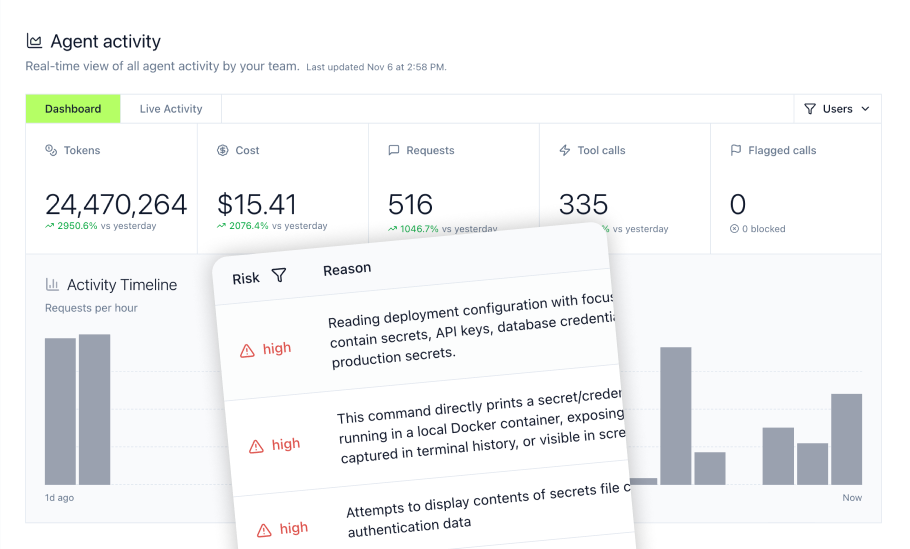
Mintive's Agent Monitor provides cost tracking broken out by user, session, model (GPT-4, Claude 3.5 Sonnet, etc.), and tool. Spend dashboards rank sessions by cost, useful for identifying runaway loops or over-provisioned agents. The platform supports usage-based chargeback analysis through estimated cost attribution by user, agent, model, and session. Organizations can use this data to inform internal cost allocation while reconciling estimates against provider invoices.
Customizable Security Policies and DLP for Advanced Claude Use Cases
Standard security policies can't anticipate every organizational requirement. Enterprises need programmable controls that integrate with existing security infrastructure.
Three-Layer Security Model
Mint Guard (Managed detection):
- Out-of-the-box detection for prompt injection, credentials/secrets, PII, and harmful content
- Blocks high-confidence prompt injection
- Off / Monitoring / Enforcing modes for gradual rollout
Rules (Declarative matching):
- Match tool names, argument patterns, or content via regex
- Actions include flag, block, ask-user, mask, and Slack notify
- Support matrix varies by agent and hook phase
Gateway Middleware (Custom logic):
- Sandboxed JavaScript on every matching call
- Transform, redact, rewrite, call external classifiers
- Pre-built templates for AWS Bedrock Guardrails, GCP DLP, Microsoft Purview, Nightfall, and Skyflow
Example Use Cases
- Block
.envfile reads to prevent credential exfiltration - Redact internal IP addresses from agent responses
- Enforce data residency rules by blocking calls to non-compliant regions
- Require approval for destructive database operations
The middleware approach keeps policy enforcement inline with tool calls rather than relying on external services. Security teams can assess MCP risks using Mintive's framework and implement controls based on specific organizational requirements.
Making the Decision: Claude Team vs. Enterprise
The choice between Claude Team and Enterprise depends on organizational maturity, compliance requirements, and scale trajectory.
Choose Claude Team when:
- User count remains within Claude Team's 150-seat limit
- No regulatory compliance requirements mandate audit trails
- Single-team deployment without cross-departmental governance needs
- Testing Claude capabilities before broader commitment
Choose Claude Enterprise when:
- SCIM directory synchronization and advanced identity governance are required beyond Team's existing SSO and JIT capabilities
- Audit logging mandated for compliance documentation
- Custom data retention, Compliance API access, or advanced enterprise security controls are required
- Multi-department deployment requiring granular access controls
Consider supplementary governance infrastructure when:
- Running Claude alongside Cursor, ChatGPT, Gemini, or Copilot
- Deploying autonomous agents requiring per-agent identity
- Requiring runtime security screening beyond native capabilities
- Needing unified audit trails across heterogeneous AI tools
For organizations in the third category, the Claude plan choice becomes secondary to the governance infrastructure wrapping it.
Why Mintive for Enterprise Claude Deployments
Organizations deploying Claude at scale need governance infrastructure that makes AI tools deployable, measurable, and swappable across models, clients, and environments. Mintive's platform provides:
- Virtual MCPs (Bundles) that package curated connectors, SCIM groups, and security policies into one-click deployments
- MCP Gateway with SSO, RBAC, and audit trails for every supported tool
- Agent Identities giving autonomous agents their own credentials, scopes, and audit trails
- Mint Guard for runtime security screening with prompt injection blocking and PII detection
- Agent Monitor for cost tracking by user, agent, model, and session
- Coworker Agents for hosted autonomous agents with long-term memory and governed access
Mintive holds SOC 2 Type II attestation with continuous monitoring, signs BAAs for HIPAA-compliant deployments, and supports EU and US data residency. The platform integrates with existing identity providers (Okta, Azure AD, Google) and exports audit logs to any SIEM.
Start your 7-day trial with full feature access, no credit card required.
Frequently Asked Questions
How does Claude Enterprise handle data residency requirements for organizations with EU or APAC operations?
Claude Enterprise provides data handling documentation required for compliance programs, but specific data residency configurations depend on your deployment approach. Mintive offers EU and US data residency options, with VPC and self-hosted deployments available on request. Organizations must separately verify Anthropic's inference location, connected data sources, and applicable regional controls to satisfy end-to-end requirements.
Can we use Claude Team initially and migrate to Enterprise later without losing conversation history?
Anthropic supports upgrading an existing Team organization directly to Enterprise while preserving chat history, conversations, projects, shared content, memberships, and roles. Organizations should use the existing-organization upgrade workflow rather than creating a separate Enterprise organization if preserving this data is a priority. Governance policies, audit trails, and access configurations persist regardless of underlying plan changes.
What happens when a Claude-powered agent needs access to on-premises databases not exposed to the internet?
Neither Claude Team nor Enterprise natively bridges to private network resources. Mintive's private network tunnel maintains a single outbound TLS connection to the gateway, allowing databases and internal APIs to be reached, screened, and logged like external tools without opening inbound firewall rules. This enables Claude agents to query internal systems while maintaining governance controls.
How do we handle scenarios where different departments need different Claude capabilities or access to different data sources?
Create role-based Virtual MCP Bundles that package appropriate tools for each department. Sales gets CRM and email connectors; Engineering gets GitHub and database access; Finance gets accounting system connectors. Each bundle inherits from directory groups via SCIM, so user department changes automatically adjust AI tool access without manual reconfiguration.
What's the recommended approach for testing Claude security policies before enforcing them organization-wide?
Implement policies in monitoring mode before enforcement. Mintive's Mint Guard supports Off, Monitoring, and Enforcing modes, allowing security teams to observe what policies would block without actually blocking it. This provides data to tune detection thresholds and rule specificity. Gateway middleware also supports dry-run mode for custom policies during validation periods.