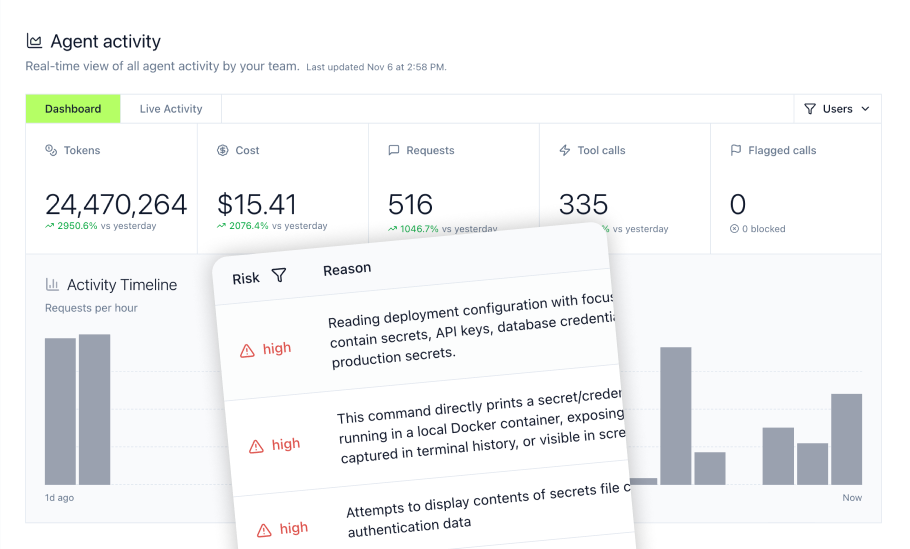
The gap between AI agent adoption and AI agent governance has become a defining challenge of enterprise AI in 2026. As organizations move AI agents from pilots into production, many are deploying them faster than they can track, secure, or audit. The result: sprawling agent fleets, credential chaos, compliance exposure, and shadow AI that security teams discover only after something breaks. An MCP gateway addresses part of this challenge by centralizing authentication, access control, and audit logging for MCP-routed data and tool connections. MintMCP's Agent Gateway adds identities, permissions, memory, and monitoring for agents that work alongside users, while Agent Monitor extends visibility to local agent activity.
Key Takeaways
- 82% of organizations discovered shadow AI agents in the past year despite believing they had visibility into their agent deployments
- Mature governance frameworks reduce uncertainty around agent permissions, acceptable actions, monitoring, and failure response as deployments scale
- Multi-agent systems introduce coordination, misalignment, and verification failure modes that do not appear in the same way in individual agent execution
- AI use is widespread, but most organizations are still experimenting or piloting rather than scaling AI across the enterprise
- Agent adoption remains concentrated in experimentation and limited scaling rather than organization-wide deployment
- Human-centric IAM patterns need to be extended for agents with unique non-human identities, delegated authority, scoped credentials, and runtime authorization
The Scale Wall: Why Agent Adoption Stalls at Enterprise Level
Your AI agent strategy likely started with a few pilots. A coding assistant here, a customer service bot there, maybe a data analysis agent for the analytics team. Each worked well in isolation. Then you tried to scale.
This is where most enterprises hit what we call the "scale wall." McKinsey's 2025 survey found that 23% of respondents said their organizations were scaling an agentic AI system somewhere in the enterprise, while another 39% were experimenting. In any individual business function, no more than 10% reported scaling agents. The agents may work in pilots. Enterprise-wide scale remains limited.
The problem isn't technology. It's the gap between deployment velocity and governance maturity. Widespread AI adoption does not necessarily translate into enterprise-wide scale. McKinsey's 2025 survey found that most organizations were still experimenting or piloting rather than scaling AI across the enterprise.
1. The Proliferation Problem: Managing a Diverse Fleet of AI Agents
The first problem that appears at scale is agent sprawl. Your organization isn't running one type of agent. You're running Claude for code review, Cursor for development, ChatGPT for customer-facing workflows, Copilot embedded in your IDE, Gemini for data analysis, and custom-built agents for specialized tasks.
Each agent type has different:
- Authentication requirements
- Permission models
- Audit capabilities
- Data access patterns
- Tool integrations
When the Cloud Security Alliance surveyed enterprises about their agent visibility, 82% discovered shadow AI agents in the past year despite 68% reporting high confidence in their visibility. The math doesn't add up because the problem isn't awareness. It's that teams deploy agents faster than central IT can track.
Categorizing AI Agent Types for Effective Governance
Before you can govern agents, you need an agent taxonomy. Most enterprises run agents across these categories:
- Coding Assistants: Claude Code, Cursor, GitHub Copilot, Windsurf, Replit agents
- Conversational Agents: ChatGPT, Claude Chat, Gemini, custom chatbots
- Workflow Automation Agents: Agents that trigger actions across systems without human intervention
- Data Analysis Agents: Agents querying databases, generating reports, accessing data warehouses
- Custom Internal Agents: Purpose-built agents for specific business processes
Each category has different risk profiles and governance requirements. A coding assistant with repository access poses different risks than a customer service agent with CRM access.
Addressing the Shadow AI of Unsanctioned Agent Deployments
Shadow AI represents the modern version of shadow IT, but with higher stakes. When developers install MCP servers locally or teams spin up agents without IT approval, they create ungoverned access paths to production systems.
The challenge: traditional discovery tools look for installed software. Shadow AI agents often run through browser extensions, local MCP configurations, or IDE plugins that don't show up in standard asset inventories.
According to the CSA survey, 53% of organizations operate agents autonomously for low-risk tasks while requiring human review for higher-risk actions. When shadow agents operate autonomously with production access, the blast radius of a misconfiguration or security incident expands significantly.
2. Security Blind Spots: Securing AI Agents GitHub Integrations and Beyond
The second problem at scale is security architecture. Traditional security models assume humans are the actors. Humans authenticate, humans make requests, humans can be challenged with MFA. AI agents break every assumption in that model.
When agents connect to GitHub, Salesforce, Jira, or internal databases, they often operate through user-delegated credentials or service accounts. If those permissions are broad or shared across agents, the resulting access can exceed what each agent needs for its specific task.
Protecting Sensitive Data Across Agent Workflows
AI agent security requires rethinking data protection for machine-speed operations. Agents don't just read data. They transform it, combine it with other sources, pass it to external APIs, and potentially expose it in prompts sent to LLM providers.
Key security concerns at scale include:
- Credential leakage: Agents may inadvertently include API keys, tokens, or passwords in their outputs or logs
- PII exposure: Agents processing customer data may send sensitive information to external model providers
- Risky bash commands: Coding agents with shell access can execute destructive operations
- Prompt injection: Malicious inputs can trick agents into unauthorized actions
- Data exfiltration: Agents with broad read access can be weaponized to extract sensitive information
Traditional DLP tools weren't designed for agent workflows. They look for patterns in emails and file transfers, not in JSON-RPC messages between an MCP client and server.
Mitigating Risks of Malicious Agent Actions
Agentic AI changes the operating model entirely. AI agents don't just predict outcomes, they take action. They perceive their environment, reason through options, and execute decisions autonomously, often coordinating with other agents and systems, often continuously, outside business hours, at machine speed.
This means security controls must operate at runtime, not post-hoc. By the time your SIEM alerts on suspicious activity, the agent may have already completed hundreds of additional actions.
Runtime security for agents requires:
- Inline policy enforcement: Block risky actions before execution, not after detection
- Context-aware access: Adjust permissions based on what the agent is trying to do, not just who it is
- Circuit breakers: Automatically halt agents exhibiting anomalous behavior
- Input validation: Inspect and sanitize all inputs before agents process them
- Output filtering: Prevent sensitive data from leaving through agent responses
3. Compliance Catastrophe: Ensuring Auditability for AI Agents at Scale
The third problem is compliance. When an auditor asks you to explain every decision an agent made over the past six months, can you answer? For most organizations, the honest answer is no.
The governance gap between adoption and auditability creates material compliance risk. The EU AI Act is now being enforced in phases, with the highest penalties, up to €35 million or 7% of worldwide annual turnover, applying to prohibited AI practices while other violations have different penalty ceilings.
Achieving Regulatory Compliance with Agent Activity
Compliance requirements for AI agents span multiple regulatory frameworks:
EU AI Act: Some AI systems used for employment and worker management can fall into the Act's high-risk category depending on their intended purpose. The high-risk rules for Annex III systems are scheduled to apply from December 2, 2027, so workforce agents should not be treated as automatically high-risk solely because they are used at work.
US State and Local Regulations: California's employment discrimination rules address automated-decision systems in hiring and employment; New York City's Local Law 144 requires bias audits and notices for covered automated employment decision tools; and Colorado's updated automated decision-making law is scheduled to take effect January 1, 2027.
Industry-Specific Requirements: Healthcare organizations face HIPAA compliance for patient data access by agents. Financial services must comply with SEC, FINRA, and FCRA requirements for automated decision-making.
The common thread is a need for documented governance and traceability appropriate to the applicable law or framework. Audit records should capture observable inputs, actions, tool calls, policy decisions, outputs, and responsible identities where required rather than assuming every framework requires reconstruction of an agent's hidden reasoning or every alternative it considered.
Building an Irrefutable Audit Trail for AI Decisions
Audit logging for agents requires capturing:
- Who initiated the action: User identity, agent identity, or system trigger
- What tools were called: Every MCP tool invocation with parameters
- What data flowed through: Inputs and outputs for each step
- When it happened: Timestamps with sufficient precision for reconstruction
- What policies applied: Which rules were evaluated and what decisions resulted
- What decision context was recorded: Relevant inputs, outputs, policy decisions, and escalation or approval events
Traditional logging captures API calls. Agent audit trails need richer observable workflow context, including multi-step tool activity and cross-system coordination, without relying on access to hidden reasoning chains.
4. Integration Overload: Connecting AI Agents Tools to Enterprise Systems
The fourth problem is integration complexity. Every agent needs access to systems: databases, CRMs, code repositories, communication tools, and internal applications. Each integration requires authentication, authorization, error handling, and ongoing maintenance.
This is a common last-mile problem in enterprise AI. The models and agents may work in isolation, but giving them secure, governed access to production data and systems can become a substantial integration and governance effort.
Streamlining Integrations for Business Process Automation
The integration burden multiplies with agent count. If you have 50 agents needing access to 20 systems, you're managing 1,000 potential integration points. Each with its own:
- OAuth flows or API key management
- Rate limits and quota monitoring
- Schema changes and API versioning
- Error handling and retry logic
- Permission scoping and access reviews
Integration work can become a major part of the deployment effort because each connection introduces authentication, authorization, schema, reliability, and maintenance requirements. The integration burden can grow faster than the agent logic itself.
Reducing Engineering Overhead for Agent Connectivity
The solution isn't building more integrations. It's abstracting the integration layer so agents connect through a governed gateway rather than directly to each system.
This approach provides:
- Centralized credential management: One place to rotate, revoke, and audit credentials
- Consistent authentication: OAuth brokering handles the complexity of different auth flows
- Tool-level access control: Enable database reads but block writes, allow Slack messages but not file uploads
- Protocol normalization: Convert diverse upstream protocols (stdio, HTTP, SSE) to a single downstream interface
- Pre-built connectors: Reduce custom integration work with maintained connector libraries
5. Orchestration Chaos: Managing Agent Interactions with AI Orchestration Tools
The fifth problem emerges when agents coordinate. Individual agents may test safely in isolation, but multi-agent interactions introduce additional failure modes involving coordination, misalignment, verification, and compound action chaining.
When your inventory agent communicates with your pricing agent, which triggers your ordering agent, which updates your supplier portal, you have a workflow no single team owns and no single tool monitors.
Defining Complex Workflows Across Multiple AI Agents
Multi-agent orchestration creates emergent behaviors that were never explicitly programmed. An inventory agent sees low stock. A pricing agent sees high demand. An ordering agent sees authorization from both. The result: automated orders at inflated prices that no human approved.
Orchestration challenges include:
- Feedback loops: Agents responding to each other's outputs in cycles
- Conflicting objectives: Different agents optimizing for different goals
- Coordination failures: Agents duplicating work or contradicting each other
- Cascading errors: One agent's mistake propagating through downstream agents
- Attribution ambiguity: Unclear which agent is responsible for a given outcome
Ensuring Consistent Policy Enforcement in Orchestrated Agent Chains
System-level monitoring is required beyond individual agent controls. This means:
- Workflow-level policies: Rules that apply to agent interactions, not just individual actions
- Dependency tracking: Understanding which agents rely on outputs from other agents
- Blast radius limiting: Circuit breakers that isolate failing agents from healthy ones
- Provenance tracking: Tracing decisions across multi-step workflows
- Human escalation paths: Clear triggers for when automated workflows require human review
Governance is not inherently a drag on agent adoption. Clear policies, permissions, monitoring, and escalation paths can reduce uncertainty about what agents are allowed to do and how failures are handled.
6. Credential Complexity: Solving the Identity Crisis of AI Agent Workforces
The sixth problem is identity. Traditional IAM systems were primarily designed around human and application access patterns. AI agents introduce additional requirements such as first-class non-human identity, delegation, scoped credentials, and runtime authorization.
Agents:
- Never log in or out
- Operate continuously, 24/7
- Delegate to other agents
- Invoke tools dynamically
- Scale rapidly across many concurrent instances
When agents inherit permissions from users or service accounts, they gain access far beyond what they need for their specific tasks. When credentials are shared across agents, a compromise of one exposes all.
Assigning Unique Identities to Each AI Agent
Agent identity requires treating agents as first-class principals in your identity infrastructure, separate from the humans who create or invoke them.
Each agent needs:
- Unique identifier: Distinct from user IDs and service account IDs
- Scoped permissions: Access limited to specific tools and data needed for its function
- Independent credentials: Rotatable and revocable without affecting users or other agents
- Audit attribution: All actions traceable to the specific agent that performed them
- Lifecycle management: Onboarding, permission changes, and decommissioning tracked like employee records
Implementing Secure Credential Rotation for Automated Workflows
Credential hygiene for agents means:
- Per-agent credentials: No shared keys or tokens across agents
- Automatic rotation: Credentials refreshed on schedule without manual intervention
- Just-in-time access: Permissions granted for specific tasks, then revoked
- Delegation chains: Clear tracking of which agent authorized which action
- Revocation without disruption: Ability to kill one agent's access without affecting others
Per-agent credentials and scoped permissions reduce shared-secret risk and make individual agent access easier to rotate, revoke, and audit.
7. Performance and Observability Gaps: Monitoring AI Agents Usage and Health
The seventh problem is visibility. You can't manage what you can't measure. For most organizations, agent observability means checking if the agent is running, not understanding what it's doing, how well it's performing, or where it's failing.
Gaining Real-time Insights into Agent Performance
Agent observability requires tracking:
- Usage patterns: Which agents are used, by whom, how often, and for what
- Latency metrics: How long tool calls take, where bottlenecks occur
- Error rates: What's failing, why, and how frequently
- Resource consumption: Token usage, API call volumes, compute costs
- Behavioral anomalies: Deviations from expected patterns that may indicate problems
Real-time visibility means dashboards that update continuously, not reports generated weekly. When an agent starts behaving strangely, you need to know in seconds, not days.
Diagnosing and Resolving Issues in Agent Workflows
Debugging agent workflows is harder than debugging traditional software. Agents make decisions based on context that may not be reproducible. They interact with external systems that return different results at different times. They coordinate with other agents whose state you may not control.
Effective agent debugging requires:
- Full request/response logging: Every tool call captured with inputs and outputs
- Replay capability: Ability to re-run agent workflows with the same inputs
- Dependency mapping: Understanding which external systems and agents a workflow touches
- Root cause analysis: Tools for tracing failures back to their source
- Performance profiling: Identifying which steps in a workflow consume the most time or resources
How MintMCP Addresses AI Agent Workforce Management at Scale
Each of these seven problems points to the same underlying need: a governance layer purpose-built for AI agents that operates at machine speed, scales with your agent fleet, and integrates with your existing identity and security infrastructure.
MintMCP's approach combines two connected capabilities:
MCP Gateway provides governed data and tool connections for AI systems including Claude, Cursor, ChatGPT, Gemini, and Copilot. The gateway centralizes authentication, normalizes protocols, enforces tool-level access control, and captures audit logs for MCP-routed tool activity.
Agent Gateway provides identities, permissions, memory, and monitoring for agents that work alongside users. This addresses the agent identity crisis by giving each agent its own credentials and permission scope, independent of human users.
Key capabilities that address the seven problems:
- Virtual Bundles (VMCPs): Package tool access, policy, and audit for each team or use case into a single governance unit. SCIM-driven membership means your IdP groups automatically map to agent permissions.
- Agent Bundles with M2M auth: Per-agent credentials with OAuth 2.0 client-credentials flow. Rotate or revoke one agent's access without touching others.
- Shadow AI detection: Agent Monitor tracks agent activity across your organization, including off-gateway MCP usage in Cursor and Claude Code. MDM integration enables policy enforcement on developer machines.
- Programmable middleware: JS sandbox with hooks for pre and post processing of every tool call. Built-in templates for AWS Bedrock Guardrails, OpenAI moderation, and jailbreak detection. Connect your existing DLP investment inline.
- Hosted MCP runtime: MintMCP operates and scales connector instances on your behalf, including auto-scaling and isolated execution per connector. Deploy and run connectors without managing Kubernetes pods.
- Conversation-level logging: Full audit trail capturing prompts, tool calls, responses, and context with per-user attribution. Export to SIEM platforms including Sentinel, Splunk, and S3.
MintMCP is SOC 2 Type II audited, compliant with HIPAA standards, and penetration tested. MintMCP also provides data encryption in transit and at rest, data residency options, and an uptime SLA. Customers handling protected health information can request HIPAA documentation and BAAs.
For teams hitting the scale wall with AI agent deployments, MintMCP provides the security governance foundation that makes sustainable scaling possible. Visit the product tour to see how governance accelerates agent deployment rather than constraining it.
Frequently Asked Questions
What are the primary security challenges of managing a large AI agent workforce?
The main challenges are credential sprawl, sensitive-data exposure, prompt injection, and machine-speed actions. Enterprises need scoped agent identities, runtime policy enforcement, and guardrails that can block risky actions before execution.
How can enterprises ensure compliance and auditability for AI agent actions?
Requirements vary by regulation, but enterprises generally need traceable records of identities, tool calls, data flows, policy decisions, timestamps, and approvals. Logs should support incident and regulatory review, with appropriate retention and export to existing security systems.
What is shadow AI in the context of agent management and how can it be detected?
Shadow AI refers to agents deployed without IT or security approval. Detection can combine endpoint monitoring, visibility into MCP and agent activity, and integrations with developer tools such as Cursor and Claude Code.
How does credential management for AI agents differ from traditional user credentials?
Agents can operate continuously, invoke tools dynamically, and delegate work without human-shaped login sessions. They therefore benefit from unique identities, scoped credentials, automated rotation, delegation tracking, and independent revocation.
What role do AI orchestration platforms play in scaling agent deployments?
AI orchestration platforms coordinate workflows involving multiple agents. They can provide dependency tracking, workflow-level controls, provenance, and failure-handling mechanisms for risks that emerge when agents interact across multi-step processes.