Your AI agent forgets everything between sessions. The question enterprises face is not whether to give agents persistent memory, but where that memory should live. As organizations deploy autonomous agents across Claude Code, Cursor, ChatGPT, and custom harnesses, the memory architecture they choose affects how directly they can inspect, version, review, govern, and move agent state. The Mintive (formerly MintMCP) Coworker Agents demonstrate how company-owned, Git-backed memory enables enterprises to maintain full control over their agent workforce while preserving the portability and auditability that regulated industries require.
Key Takeaways
- Git-based agent memory can avoid some managed-service and embedding costs, but total cost depends on hosting, model usage, maintenance, retrieval architecture, and operational requirements
- Over 60,000 open-source projects and agent frameworks had adopted AGENTS.md by December 2025 as a standard for providing coding agents with project-specific guidance
- Instruction-following reliability generally declines as prompts accumulate constraints, but the practical threshold varies by model and workload, and there is no universal point at which semantic search becomes mandatory
- Memory poisoning attacks can achieve high injection success under controlled conditions, making memory provenance, audit trails, and appropriate review controls important regardless of storage approach
- Company-owned memory with Git principles (scoped, versioned, reviewable, auditable, portable) eliminates vendor lock-in while enabling compliance with internal governance requirements
- Git-native memory can use existing repository workflows, while both self-hosted and managed approaches have setup and ongoing operational requirements
The Problem with Vendor Blobs: Why Opaque Agent Memory Fails Enterprise AI
When agent memory lives inside a proprietary vendor database, organizations lose visibility into what their agents know, how that knowledge changes, and who modified it. Vector stores and knowledge graphs excel at semantic search but create governance blind spots that enterprise security teams cannot accept.
Hidden Workflows and Data
Managed memory services vary in how they expose and govern memory changes. Some provide audit logs, administrative controls, and export capabilities, but they may not provide Git-style diffs, commits, branching, approval workflows, or deterministic rollback of complete memory state.
Security teams asking "what did our agent learn last week?" receive API queries rather than commit logs. When compliance auditors request evidence of memory governance, organizations cannot produce tamper-evident records because the vendor controls the storage layer.
The Cost of Lock-In
Production-tier managed memory requires ongoing subscription and embedding API charges. But financial cost understates the strategic risk. Vendor lock-in manifests in three ways:
- Data format dependency: Changing schemas, embedding models, or retrieval architectures can require data transformation, re-indexing, or re-embedding
- API coupling: Application code depends on vendor-specific retrieval endpoints
- Migration cost: Moving to another provider requires rebuilding the entire memory infrastructure
Security Blind Spots
Memory poisoning attacks represent a growing threat. Research demonstrates high injection success rates under controlled conditions when attackers manipulate agent memories through adversarial inputs. Without audit trails showing exactly how memories entered the system, forensic investigation becomes impossible.
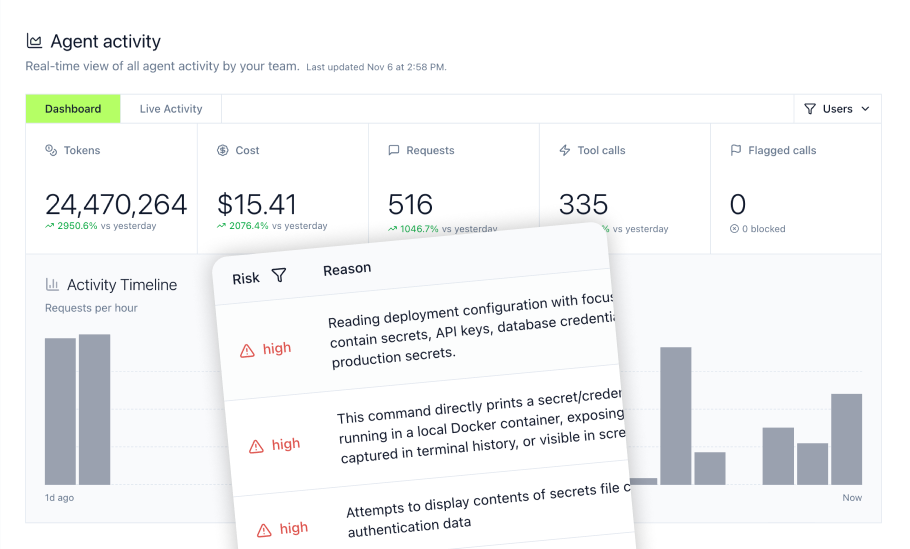
Organizations using Mintive's Agent Monitor gain visibility into agent activity across sessions, but the memory layer itself must also support inspection. When memories live in opaque vendor blobs, security teams cannot verify whether extracted facts were legitimate or injected by malicious prompts.
Git as the Foundation for Company-Owned Agent Memory
Git provides the primitives that enterprise memory governance requires: atomic commits with author attribution, branching for safe experimentation, merge workflows for approval, and complete history for audit. Treating agent memory as code applies decades of software engineering best practices to AI infrastructure.
Defining Company-Owned Memory
Company-owned memory means the enterprise controls:
- Storage location: Files live in repositories you own, not vendor infrastructure
- Access permissions: Standard Git access controls determine who can read and modify memories
- Version history: Every change creates a commit with author, timestamp, and reason
- Export format: Plain text (markdown, JSON) works everywhere without conversion
Mintive's Coworker Agents implement this architecture with repo-as-source-of-truth: CLAUDE.md stores instructions, progress.md captures memory, and the complete history remains reviewable in Git.
Leveraging Git's Core Strengths
Git-native memory tools introduce snapshot and rollback capabilities for agent state. The architecture stores memories as plain files with full version history. Branch isolation enables testing memory changes without affecting production. Rollback requires a single git checkout command. Diff visualization shows exactly what changed between memory versions.
Architectural Benefits
Zero-infrastructure operation eliminates database management overhead. Over 60,000 open-source projects and agent frameworks had adopted AGENTS.md by December 2025 to provide coding agents with project-specific guidance, demonstrating broad adoption of repository-based agent context.
The critical constraint: instruction-following reliability generally declines as prompts accumulate constraints, but the practical threshold varies by model and workload. For enterprise use cases involving coding assistants, documentation agents, and project-specific workflows, simple file-based approaches can provide sufficient context without semantic search complexity when the relevant memory remains compact enough for the model and task.
Enhanced Auditability and Traceability with Git-Versioned Agent Memory
Every Git commit creates a versioned record with author metadata, timestamp, and commit message. Because Git history can be rewritten, enterprises need controls such as protected branches, restricted force pushes, retention policies, and external audit logging when stronger tamper resistance is required.
From Opaque Blobs to Transparent Commits
When agent memory changes:
- Git approach: Developer commits facts.json with message "Added Q3 revenue figures from finance team review"
- Vendor approach: API call inserts vector embeddings with no human-readable changelog
Mintive's audit and observability features complement Git-based memory by logging tool calls, credential lifecycle events, and access-policy changes. The combination improves traceability: Git can track reviewable memory changes, while Agent Monitor provides visibility into supported agent activity such as prompts, commands, file access, MCP tool calls, usage, and cost.
Meeting Compliance Demands
Compliance frameworks require demonstrating who accessed sensitive data and when. Git's blame command traces every line of memory to its author. Pull request history shows approval workflows. Branch protection rules enforce review requirements.
Organizations can export this history to SIEM systems for centralized security monitoring. The combination of Git audit trails and Mintive's tamper-evident access logging creates the evidence chain that regulators require.
Investigating Agent Actions
When an agent makes an unexpected decision, forensic investigation proceeds through:
- Identify the problematic action via Agent Monitor logs
- Check memory state at the time of the action using git log
- Trace memory origin using git blame to find who added the relevant fact
- Review approval history through pull request records
- Restore previous state if necessary via git revert
This workflow is straightforward when memory changes are maintained in Git, while managed systems vary in the history, provenance, rollback, and audit capabilities they expose.
Facilitating Collaboration and Review for AI Agents
Development teams already collaborate through Git. Applying the same workflows to agent memory eliminates context switching and leverages existing expertise.
Agent Memory as Code
Pull requests enable structured review of memory changes:
- Reviewers verify that new facts are accurate before they reach production
- CI checks validate memory format and detect potential injection patterns
- Branch protection requires approval from designated memory custodians
- Merge strategies handle conflicts when multiple team members update memories
Mintive's Coworker Agents security extends this approach with sandbox execution, restricted egress, and secret brokering. The agent sees only what it needs while the team maintains full visibility into its operating state.
Collaborative AI
When 50 developers share a coding agent, everyone needs the same context. Git provides instant synchronization:
- Clone the repository to get current memory state
- Pull changes as teammates update shared knowledge
- Propose updates through branches and pull requests
- Resolve conflicts using standard merge workflows
Portability and Interoperability: Breaking Free from Vendor Lock-in
Plain text files in Git repositories work with any tool that reads files. This portability protects long-term investments in agent infrastructure.
Moving Agent Memory
Switching AI providers or agent harnesses with Git-based memory requires:
- Point the new agent at the same repository
- Configure file paths in the new environment
- Run the agent
Compare this to vendor migration, which requires:
- Export existing memories (if the vendor supports export)
- Transform data format to match the new vendor's schema
- Re-embed all content using the new vendor's embedding model
- Validate semantic search accuracy in the new system
- Update all application code to use new API endpoints
Future-Proofing Your Investments
Mintive's positioning toward enterprise AI governance begins with governed data and tool access through the MCP Gateway, then extends to first-class agent identities. Git-based memory supports this vision by ensuring:
- No single vendor dependency constrains future architecture decisions
- Standard formats (markdown, JSON) remain readable decades from now
- Self-hosting eliminates concerns about vendor shutdown or pricing changes
- Open tooling provides alternatives if any component becomes unsatisfactory
Securing Agent Memory in Git
Git repositories integrate with enterprise identity systems through existing infrastructure. RBAC policies that govern code access extend naturally to agent memory.
Granular Access Control
Directory-based access controls enable:
- Private memory: Individual developers have personal repositories only they access
- Team memory: Department-level repositories with team membership via SCIM groups
- Organization memory: Company-wide facts accessible to all authenticated users
- Customer memory: Isolated repositories for each client engagement
Mintive's Agent Gateway provides agents with their own non-human identities and scoped MCP access. Repository permissions and credentials remain governed through the organization's Git infrastructure.
Agent Identity and Versioned State
Agent repository access can be configured through the organization's Git infrastructure with:
- Credentials appropriate to the agent or workload
- Scoped read/write repository permissions
- Independent credential lifecycle controls where supported by the Git provider
- Commit attribution configured for the agent or workload
Enterprise Security Integration
SSO and SCIM integration governs supported Mintive roles, groups, and access policies. Git repository access remains governed through the organization's Git provider and its identity and repository-permission controls.
Operationalizing Git-Based Agent Memory
Production deployment follows established DevOps patterns that teams already understand.
Integration into Workflows
Setup follows familiar repository workflows:
- Create repository with memory file structure
- Configure agent to read from memory files
- Set up branch protection rules for memory changes
- Establish review workflows for memory pull requests
Best Practices
- Cap memory files at 30 items to stay within reliable instruction limits
- Archive old memories rather than letting files grow indefinitely
- Prune weekly to prevent context bloat
- Use hierarchical loading to load relevant sections dynamically
- Budget 4-8 hours monthly for memory maintenance and review
Mintive's configuration as code capabilities extend this approach to gateway configuration and global rules, enabling declarative management of the entire agent infrastructure.
Scalability and Performance Considerations
Git handles agent memory at enterprise scale when properly architected.
Optimizing Git Repositories
Large organizations should:
- Use per-team repositories rather than monolithic memory stores
- Implement shallow clones when agents need only recent history
- Consider Git LFS for any binary attachments
- Monitor repository size and archive historical memories periodically
Instruction-following reliability provides a practical constraint on how much memory should be loaded at once, but the useful limit depends on the model and workload. When semantic retrieval becomes necessary because relevant context no longer fits efficiently into the working context, organizations can implement hybrid approaches that index Git-stored memories for retrieval while maintaining version control for governance.
When Vendor Approaches Make Sense
Git-based memory is not universally superior. Choose managed services when:
- Multi-user personalization requires isolated memories for thousands of users
- Semantic search is mandatory because context exceeds instruction limits
- Automatic extraction saves significant manual curation effort
- No DevOps capacity exists for self-hosted infrastructure
The decision framework: start with Git-based approaches for governance and portability benefits. Graduate to hybrid solutions when you hit limitations that semantic search solves.
Mintive's Approach to Git-Centric Agent Memory Architecture
Mintive's enterprise AI governance model starts with governed data and tool access through the MCP Gateway, then extends that foundation to first-class agent identities and scoped permissions through Agent Gateway. Coworker Agents add persistent autonomous work with company-owned memory based on Git principles.
As enterprises scale their agent workforce, they need to answer:
- Which agents exist, and who owns them?
- What tools and data can they access?
- What actions have they taken?
- What memory do they retain?
- How can access be restricted or revoked?
Git-based memory addresses the memory side of this governance problem with transparent, version-controlled, company-owned infrastructure. Combined with Mintive's governance controls, teams can:
- Track memory changes through commits and version history
- Review changes before they reach production
- Use Agent Monitor for visibility into supported agent activity
- Export supported audit data to SIEM systems
- Keep memory portable across models and agent harnesses
- Reduce dependence on proprietary memory formats
This architecture lets organizations govern agent identity, permissions, activity, and memory while keeping the underlying AI stack flexible across Claude, Cursor, ChatGPT, Gemini, and custom agents.
Organizations evaluating their memory architecture can start with Mintive's MCP data risk guidance and explore how Coworker Agents keep persistent memory company-owned, reviewable, and portable.
Frequently Asked Questions
How does Git-based memory handle the context window limits of modern LLMs?
Git-based memory works within the broader constraint that instruction-following reliability generally declines as prompts accumulate context and constraints. The practical threshold varies by model, workload, and how the context is structured. Implementations like AGENTS.md can use hierarchical loading patterns where agents read high-level context files first, then load relevant detailed sections based on the current task. When context requirements exceed what can be handled efficiently in the active context, organizations can implement hybrid approaches that index Git-stored memories using embedding-based retrieval while maintaining Git as the source of truth for governance.
What happens when multiple agents need to update the same memory simultaneously?
Git's conflict resolution mechanisms handle concurrent memory updates through standard branching and merging workflows. Each agent operates on a branch, proposes changes through commits, and merges after automated or human review. For high-frequency updates, organizations can assign memory ownership to specific agents (Agent A owns pricing facts, Agent B owns technical specifications) or implement queue-based write patterns where a single coordinating process commits changes from multiple agents sequentially. The merge conflict workflow also provides an opportunity for human review before potentially contradictory facts enter production memory.
Can Git-based memory support real-time retrieval performance for latency-sensitive applications?
Git-backed memory can provide fast access when relevant files are already local, but end-to-end retrieval latency depends on repository size, synchronization, networking, caching, indexing, and the agent runtime. Latency-sensitive systems can keep Git as the authoritative source while indexing approved memory into a faster retrieval layer.
How do you handle sensitive information like PII within Git-based agent memory?
Enterprise deployments apply multiple controls: repository-level access restrictions limit who can read memories containing sensitive data, branch protection rules require security review for changes to sensitive memory files, and pre-commit hooks scan for PII patterns before allowing commits. Mintive's Mint Guard provides additional protection by detecting PII in supported tool call arguments and results and, where enforcement is configured, blocking or masking risky data flows. Organizations subject to data residency requirements can host Git repositories in specific geographic regions while using Mintive's access policies to enforce data handling rules at the agent interaction layer.
What is the recommended migration path from a vendor memory solution to Git-based memory?
Migration proceeds in phases to minimize risk. First, determine what data and metadata the existing provider can export. Second, transform the available records into an open format such as markdown or JSON and establish the repository structure and access controls. Third, validate retrieval and agent behavior in parallel before changing the system of record. Finally, cut over reads and writes after validation. Migration duration depends on export capabilities, memory volume, schema complexity, retrieval architecture, and validation requirements.