Organizations deploying AI agents across Claude, Cursor, ChatGPT, Gemini, and Copilot face a critical infrastructure decision: self-host your MCP gateway or choose a managed solution. While MetaMCP offers a free, open-source proxy for aggregating MCP servers, enterprises increasingly need governance, compliance, and operational controls that self-hosted options cannot deliver out of the box. This guide compares eight MetaMCP alternatives, examining when self-hosted makes sense and why managed MCP gateways provide faster time-to-production for compliance-requiring organizations.
Key Takeaways
- MintMCP provides managed MCP infrastructure with one-click deployment, centralized governance, Virtual MCPs, and a directory of 10,000+ MCP servers
- Open-source gateways like MetaMCP have no software licensing fees, while self-hosted deployments require teams to manage infrastructure, security hardening, maintenance, and applicable compliance requirements
- Virtual MCP Bundles enable role-based access through SCIM-driven group membership, curated tools, and access policies without manual per-user configuration
- Agent identity becomes essential as organizations scale from 10 to 100+ autonomous agents and need attributable audit trails
- Total cost depends on infrastructure and governance requirements, with managed platforms reducing operational responsibilities while self-hosted deployments offer greater infrastructure control
- Runtime guardrails stop dangerous actions through prompt injection detection, declarative rules, and custom DLP integration
Understanding MetaMCP: A Capable but Limited Starting Point
MetaMCP is an open-source MCP proxy and aggregator released under the MIT license. It serves as a single endpoint connecting AI clients to multiple MCP servers, reducing per-server configuration overhead. For developers experimenting with MCP or small teams without compliance requirements, MetaMCP provides a zero-cost entry point.
MetaMCP Strengths
- Completely free with MIT licensing
- Active community with 2,500+ GitHub stars
- Native MCP rate limiting per endpoint and user
- Tool-level remixing with granular schema control
- Reduces context window overhead by abstracting servers
MetaMCP Limitations
- OIDC-based SSO and endpoint access controls are available, but SCIM-driven provisioning and comprehensive enterprise audit capabilities differ from dedicated governance platforms
- Self-operated MCP server hosting rather than vendor-managed connector operations
- Acknowledged slow development velocity by maintainers
- No vendor-provided compliance attestations, leaving organizations responsible for applicable security controls and compliance documentation
- No dedicated agent identity or non-human principal support
MetaMCP works well for developer proof-of-concept work and teams with strong DevOps capacity willing to build governance layers themselves. However, as organizations move toward production deployments with compliance requirements, operational costs often exceed managed platform fees.
1. MintMCP: Managed Enterprise MCP and Agent Governance
MintMCP provides enterprise infrastructure for governing AI clients and autonomous agents across the Model Context Protocol ecosystem. The platform makes AI systems deployable, governed, measurable, and swappable by centralizing tool access, agent identity, credentials, permissions, monitoring, guardrails, and auditability.
MintMCP Enterprise Capabilities
- SOC 2 Type II audited and compliant with HIPAA standards, with Business Associate Agreements available for organizations handling protected health information
- MCP server directory featuring 10,000+ listed servers, with searchable listings and information about supported authentication methods and tools
- Virtual MCP Bundles provide per-use-case endpoints with SCIM-driven membership, curated tools, and access policies
- Agent Gateway gives autonomous agents first-class non-human identities with scoped permissions, M2M authentication, and independent credential rotation
- Supported hosted connector operations mean MintMCP operates certain connector runtimes, reducing customer infrastructure management
- One-click deployment helps teams launch governed MCP connections quickly, with production readiness depending on connector configuration and access policies
MintMCP Core Capabilities
MCP Gateway: Single governed entrypoint with Virtual MCPs, hosted/remote/STDIO connectors, credential injection, tool curation, and RBAC
Agent Gateway: Bearer keys, M2M tokens, workload identity federation, and per-agent OAuth for independent credential lifecycle
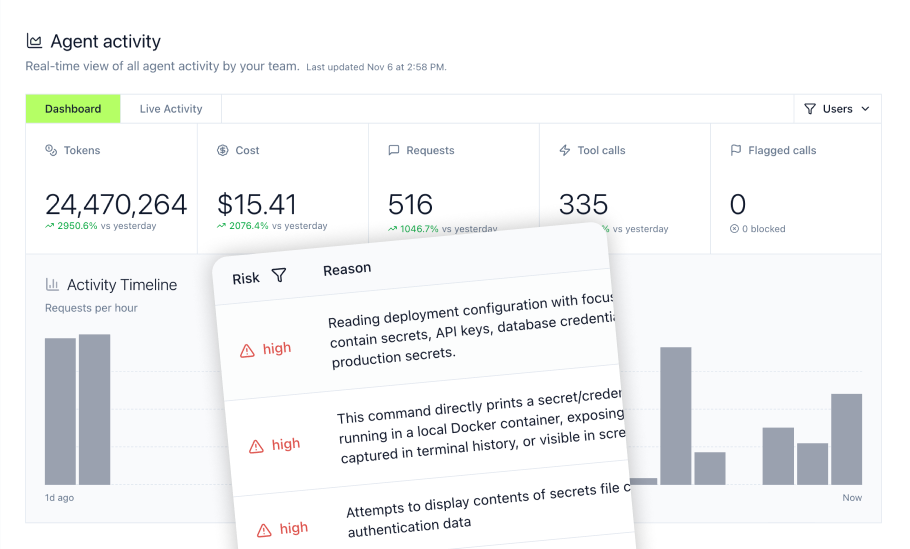
Agent Monitor: Real-time visibility into prompts, file access, commands, MCP tool calls, usage, and token costs across supported environments
Guardrails: Mint Guard for prompt injection detection, Rules for declarative enforcement, Gateway Middleware for custom DLP integration
Coworker Agents: Long-running agents with company-owned memory, Slack triggers, and sandboxed execution
Pricing
MintMCP offers a 7-day free trial with access to MCP Gateway, LLM Proxy, and enterprise governance features. Pricing is customized based on team size and requirements, with per-user licensing and platform fees that scale with usage.
2. Composio
Composio positions itself as an agent integration platform with an extensive catalog of pre-built SaaS toolkits. The platform appeals to developers building agentic applications who prioritize breadth of integrations.
Composio Strengths
- Extensive catalog of pre-built SaaS toolkits for agent integrations
- Managed OAuth flows for supported integrations, with options for customer-managed authentication credentials
- SOC 2 Type II audited
- Framework-agnostic support for LangChain, CrewAI, LlamaIndex, and OpenAI Agents
- Free tier with 100,000 tool calls per month
Composio Limitations
- Managed SaaS-first, with VPC and self-hosted deployment options available for enterprise customers
- Governance focuses on agent integrations, authentication, access policies, and execution auditability
- BAA availability is offered as an add-on, with customers responsible for evaluating HIPAA compliance requirements
- Custom tools and MCP integrations are supported, although teams may need additional development for integrations outside the existing catalog
Pricing
- Free: 100,000 tool calls/month
- Pro: $29/month with usage credit included
- Enterprise: Custom pricing with SSO, SCIM, BAA, and white-labeling
3. TrueFoundry
TrueFoundry provides a complete AI infrastructure platform combining LLM gateway, MCP gateway, and model serving capabilities. The platform targets ML platform teams who want one control plane for their entire AI stack.
TrueFoundry Strengths
- Unified LLM gateway, MCP gateway, and model serving
- Self-hosted enterprise options with VPC, on-premises, and air-gapped deployments
- Enterprise deployment options designed for large-scale AI infrastructure
- MCP server discovery and registry capabilities
TrueFoundry Limitations
- Heavier platform complexity than standalone MCP gateways
- Custom server deployment and hosting requirements depending on configuration
Pricing
- Developer: Free for up to 3 users, with 10,000 requests per user/month
- Pro: $25/user/month with 20,000 requests per user/month, pooled across the team
- Enterprise: Custom pricing for advanced security, governance, and deployment requirements
4. Obot.ai
Obot.ai delivers an open-source enterprise control plane under MIT license with fine-grained authorization and Kubernetes-native deployment. The platform appeals to infrastructure teams comfortable with container orchestration.
Obot Strengths
- MIT-licensed core platform with additional authentication options through Community registration and unlimited users and devices through Enterprise licensing
- Kubernetes-native deployment built for K8s from the ground up
- Fine-grained authorization at user, role, group, server, and tool levels
- Hosted and remote MCP support
- 850+ GitHub stars
Obot Limitations
- Production self-hosting typically uses Kubernetes, while Docker supports development and smaller deployments
- Self-hosted deployments require customers to operate infrastructure and implement applicable security and compliance controls
- Smaller community than MetaMCP
Pricing
- Obot: Free, with up to 100 users and 100 devices
- Obot Community: Free registration adds enterprise authentication providers while retaining 100-user and 100-device limits
- Obot Cloud: Hosted offering with a free trial
- Obot Enterprise: Custom pricing for unlimited users, devices, and enterprise support
5. Portkey
Portkey operates primarily as an AI gateway for LLM traffic routing, with MCP gateway capabilities added as an extension. The platform serves developer and platform engineering teams managing multi-model deployments.
Portkey Strengths
- Established AI gateway with routing, caching, and fallback capabilities
- Open-core model with self-hosted options
- OAuth 2.1 and SSO support
- Hybrid deployment across EKS, AKS, GKE, AWS Marketplace, and air-gapped environments
Portkey Limitations
- MCP gateway is secondary to core LLM gateway functionality
- Advanced enterprise deployment and governance requirements may involve custom pricing
- Less focused on MCP-specific governance than dedicated platforms
Pricing
- Developer: Free
- Production: $49/month
- Enterprise: Custom pricing
6. Docker MCP Gateway
Docker MCP Gateway provides a container-native approach to MCP server management, leveraging Docker's infrastructure. The platform targets developers already embedded in the Docker ecosystem.
Docker MCP Gateway Strengths
- Native Docker integration with familiar tooling
- Container-based isolation for MCP servers
- Profile-based configuration management
- Free and open-source
Docker MCP Gateway Limitations
- The open-source MCP Gateway is primarily suited to container-native MCP operations, while Docker also offers a separate Enterprise Gateway for centralized governance
- Enterprise identity, group-based access controls, and policy integration are provided through Docker's separate MCP Enterprise Gateway offering
- Limited to container environments
Pricing
The open-source MCP Gateway is free. Docker MCP Enterprise Gateway is a separate commercial offering with pricing available through Docker Sales.
7. Microsoft MCP Gateway
Microsoft MCP Gateway provides a Kubernetes management layer for MCP server deployments. The project targets platform teams already invested in Microsoft's cloud ecosystem.
Microsoft MCP Gateway Strengths
- Open-source under MIT license
- Entra ID integration for authentication
- Kubernetes-native resource management
- Microsoft ecosystem compatibility
Microsoft MCP Gateway Limitations
- Kubernetes-only deployment model
- Infrastructure-layer focus rather than application governance
- Custom server deployment requirements
Pricing
Free and open-source.
8. Kong AI Gateway
Kong AI Gateway extends Kong's established API gateway platform to support MCP traffic. The solution targets organizations with existing Kong investments.
Kong AI Gateway Strengths
- Extends proven Kong API gateway infrastructure
- Enterprise-grade features from mature platform
- Self-hosted and managed (Konnect) deployment options
- Plugin ecosystem for extensibility
Kong AI Gateway Limitations
- Requires Kong platform investment and expertise
- MCP support is extension of API gateway rather than primary focus
- Complex for teams without existing Kong deployment
Pricing
- Kong Gateway OSS: Free core API gateway functionality
- Kong MCP Gateway: Enterprise functionality requiring paid plugins
- Kong Konnect: Commercial plans with MCP capabilities depending on subscription
- Enterprise: Custom pricing
Self-Hosted vs Managed: The Total Cost Analysis
The absence of software licensing fees does not mean a self-hosted MCP gateway has no operating costs. Organizations must account for infrastructure, implementation, security hardening, maintenance, monitoring, and any compliance controls required for their deployment.
MintMCP (Managed) Cost Considerations
- Software licensing: Custom pricing based on team size and usage
- Infrastructure: Supported hosted connector operations managed by MintMCP
- Implementation: Centralized deployment and connector configuration
- Compliance: Vendor security controls and documentation support customer compliance programs
- Maintenance: Supported hosted infrastructure operated by MintMCP
MetaMCP (Self-Hosted) Cost Considerations
- Software license: $0 under the MIT license
- Infrastructure: Cloud or on-premises hosting costs
- Implementation: Internal deployment, authentication, and security configuration
- Compliance: Organization-specific controls, documentation, and audit requirements
- Maintenance: Internal responsibility for updates, reliability, monitoring, and operations
The relative cost depends on existing infrastructure, staff capacity, deployment scale, and security requirements. Organizations should compare vendor quotes against their actual operating costs rather than assuming managed or self-hosted infrastructure is universally cheaper.
When Self-Hosted Makes Sense
- Organizations with existing infrastructure and operations teams that can absorb additional gateway management responsibilities
- Strict data sovereignty requirements where no data can leave internal infrastructure
- Teams with existing DevOps capacity and Kubernetes expertise
- Non-regulated environments without specific compliance requirements
When Managed Platforms Win
- Teams seeking to reduce ongoing infrastructure management and operational overhead
- Organizations requiring compliance certifications on accelerated timelines
- Companies without dedicated DevOps or platform engineering resources
- Regulated industries (healthcare, finance) where audit failures carry material risk
Virtual MCPs: The Governance Abstraction That Changes Deployment
MintMCP's Virtual MCP architecture represents a fundamental shift in how organizations deploy MCP infrastructure. Instead of configuring each MCP server individually across every developer workstation, Virtual MCPs bundle approved connectors and curated tools behind one governed endpoint.
How Virtual MCPs Work
- One endpoint serves a role, team, use case, or agent
- SCIM-driven group membership syncs with directory services
- Tool curation limits which tools each role can access
- Credential injection happens per-call without storing secrets locally
- Audit trails capture every tool call with full context
Practical Benefits
- Deployment: Roll out MCP access organization-wide by assigning groups to Virtual MCPs
- Security: Least privilege emerges from role design rather than per-user configuration
- Operations: Update connectors once at the gateway instead of on every endpoint
- Compliance: Single audit stream per Virtual MCP simplifies reporting
MetaMCP supports server aggregation, OIDC authentication, endpoint controls, and credential configuration, but does not document the same SCIM-driven membership and centrally governed tool access model provided by MintMCP's Virtual MCPs.
Agent Identity: Why Autonomous Agents Need Their Own Credentials
As organizations scale from a handful of AI experiments to dozens or hundreds of autonomous agents, agent identity becomes the central governance question. MintMCP's Agent Gateway treats autonomous agents as first-class non-human principals.
The Agent Identity Problem
- Agents running on shared credentials collapse audit logs
- Shared credentials over-privilege agents and break rotation policies
- No distinction between human and agent actions makes compliance reporting impossible
- Long-lived OAuth tokens create credential hygiene risks
MintMCP Agent Gateway Capabilities
- Bearer keys: Static keys with named identities, expiration, and individual revocation
- M2M tokens: OAuth client-credentials exchange for short-lived tokens
- Workload identity federation: Agent infrastructure mints short-lived OIDC tokens with no stored secrets
- Per-agent Virtual MCPs: Purpose-built tool access scoped to each agent's needs
- Independent credential lifecycle: Rotate or revoke one agent without affecting others
MetaMCP, Docker MCP Gateway, and Microsoft MCP Gateway offer different authentication and access-control capabilities. Organizations requiring dedicated non-human agent identities, independent credential rotation, scoped MCP access, and attributable per-agent audit trails should evaluate whether these capabilities are available in their chosen deployment or require additional identity infrastructure.
Runtime Security: Guardrails That Stop Dangerous Actions
Visibility into agent activity is necessary but insufficient. Organizations also need runtime controls that determine whether an action should proceed. MintMCP provides three complementary guardrail layers.
Mint Guard
Managed detection policies for prompt injection, secrets and credentials, PII, and harmful content. Operates in off, monitoring, or enforcing modes with centrally-maintained detection without customer-authored rules.
Rules
Declarative conditions matching tool names, argument patterns, or content via regex. Actions include flag, block, ask-user, mask, and Slack notification depending on integration point.
Gateway Middleware
Customer-authored JavaScript running in a sandbox for custom logic. Integrates with external DLP systems, classifiers, and resource allowlists. Ships with templates for AWS Bedrock Guardrails, Google Cloud Model Armor, OpenAI moderation, and Teleskope.
Self-hosted platforms vary in their built-in security controls. Organizations should evaluate existing policy enforcement, monitoring, and DLP capabilities alongside the additional controls they would need to operate themselves.
Compliance and Security: Building Trust in AI Systems
Enterprise AI deployments require security foundations that satisfy auditors, regulators, and internal risk teams. MintMCP provides SOC 2 Type II audited infrastructure, is compliant with HIPAA standards, and makes Business Associate Agreements available. Customers remain responsible for meeting their applicable compliance obligations.
MintMCP Security Capabilities
- SOC 2 Type II audited with continuous compliance monitoring through Drata
- Compliant with HIPAA standards with Business Associate Agreements available
- Penetration tested with data encrypted in transit and at rest
- Data residency options and uptime SLA
- SIEM export via OTLP or Splunk HEC for tool calls, prompts, and access changes
- Tamper-evident access-grant history signed at write time with offline verification, alongside audit logging for tool calls and configuration changes
Trust Center: https://trust.mintmcp.com/
Open-source platforms like MetaMCP have no software licensing fees, but self-hosted deployments require organizations to manage infrastructure, security, maintenance, and applicable compliance controls. SOC 2 assessment costs depend on organizational scope, existing controls, and auditor requirements. Organizations subject to HIPAA must also implement appropriate administrative, physical, and technical safeguards, as outlined in the HHS HIPAA Security Rule.
MintMCP: The Managed Path to Enterprise MCP Governance
MintMCP provides a managed approach to enterprise AI governance that eliminates the operational burden of self-hosting while delivering production-ready infrastructure designed for regulated environments. Organizations gain:
- Centralized governance across all AI clients through a single MCP Gateway supporting Claude, Cursor, ChatGPT, Gemini, and Copilot
- Virtual MCP architecture that bundles approved connectors, curated tools, and SCIM-driven access policies into role-specific endpoints
- First-class agent identity through the Agent Gateway, giving autonomous agents bearer keys, M2M tokens, and independent credential lifecycle management
- Runtime protection via Mint Guard for prompt injection detection, declarative Rules for policy enforcement, and Gateway Middleware for custom DLP integration
- Enterprise-grade security with SOC 2 Type II audited infrastructure, HIPAA compliance, and BAA availability
The platform's directory of 10,000+ MCP servers and hosted connector operations reduce the time from deployment decision to production-ready MCP access. While open-source alternatives like MetaMCP offer infrastructure control without licensing fees, organizations must evaluate their existing governance capabilities, operate infrastructure and security controls, and maintain applicable compliance documentation.
Frequently Asked Questions
What is the fundamental difference between a self-hosted and a managed MCP gateway?
Open-source gateways like MetaMCP provide software at no licensing cost, but organizations bear responsibility for infrastructure, security, compliance, and maintenance. Managed gateways operate supported hosted connector infrastructure and provide centralized security controls, reducing deployment and maintenance work while customers configure access policies.
How does MintMCP's Virtual MCP enhance AI governance within an enterprise?
Virtual MCPs bundle approved connectors and curated tools behind one governed endpoint per role or use case. SCIM integration syncs membership with directory groups automatically, eliminating per-user workstation MCP configuration while enforcing least privilege through role design rather than manual grants.
Why is it crucial for autonomous AI agents to have their own distinct identities and credentials?
Agents operating through human credentials or shared API keys collapse audit trails, over-privilege the agent, and break credential rotation. Per-agent identity enables independent credential rotation and revocation, scoped tool access, attributable audit logs, and separation between human and agent actions for compliance.
What are the key security capabilities MintMCP offers to prevent risky AI agent behavior?
MintMCP provides three guardrail layers: Mint Guard for managed detection of prompt injection, secrets, PII, and harmful content; Rules for declarative pattern matching with flag, block, or mask actions; and Gateway Middleware for customer-authored JavaScript integrating external DLP systems.
Can MintMCP integrate with existing enterprise security tools like DLP or SIEM?
Yes. Gateway Middleware includes templates for AWS Bedrock Guardrails, Google Cloud Model Armor, OpenAI moderation, and Teleskope DLP. SIEM export supports OTLP and Splunk HEC for tool calls, prompt submissions, gateway requests, and access policy changes across supported enterprise security platforms.