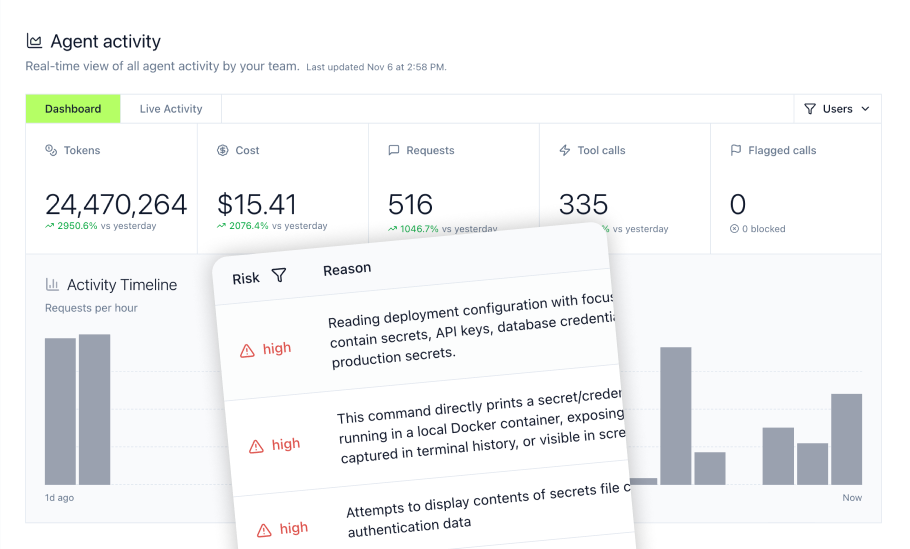
For cybersecurity companies deploying AI agents, MCP gateways have become essential infrastructure. The Model Context Protocol connects AI assistants to internal tools and data, but without proper security controls, each connection multiplies the attack surface. A well-architected MCP gateway provides the authentication, monitoring, and governance layer that transforms experimental AI deployments into production-ready systems.
The stakes are significant. Security research has documented serious vulnerabilities in MCP ecosystems, including the mcp-remote npm package vulnerability that was exposed to OS command injection when connecting to untrusted servers and patched in mcp-remote v0.1.16, raising the stakes for robust gateway controls in enterprise deployments. Meanwhile, organizations increasingly rely on generative AI for critical operations, and security teams face the challenge of enabling innovation without creating new vulnerabilities.
Key Takeaways
- Performance varies dramatically, from low-overhead gateway benchmarks for real-time security operations to higher-latency approaches for deep threat scanning
- Open-source options provide code transparency for security audits, while managed platforms offer faster deployment and review paths
- Threat detection capabilities now differentiate platforms beyond basic authentication and logging
- Gateway controls address systemic MCP risks including command injection, unrestricted network access, and file leakage
- Compliance requirements such as SOC 2 Type II audits, HIPAA documentation, and BAAs can reduce procurement friction for regulated industry sales
- Open-source transparency benefits security-conscious environments requiring code audits
- Existing infrastructure integration with Kong, Traefik, or Docker simplifies operations but may offer fewer MCP-specific primitives
1. MintMCP Gateway
MintMCP Gateway is SOC 2 Type II audited, compliant with HIPAA standards, penetration tested, and built with auditability across agent actions. For cybersecurity companies selling to healthcare, finance, or government clients, this security posture can materially shorten vendor security assessments and reduce repetitive security questionnaires.
What Makes MintMCP Different:
MintMCP transforms local STDIO-based MCP servers into production services with one-click deployment, adding OAuth brokering for stdio and hosted MCP servers without manual configuration. The platform provides Virtual MCP Bundles, meaning per-use-case endpoints with SCIM-driven membership, tool curation, and access policy, so teams and agents access only the tools they need.
MintMCP is listed in the Cursor Hooks Partners Program, which is relevant for security development teams governing coding agents. Hosted MCP connectors for Snowflake, Elasticsearch, and Gmail run through MintMCP with built-in authentication flows.
Security + Operations:
- Complete audit trails for security reviews, incident investigations, and privacy governance
- Centralized observability with external DLP and guardrails integrations
- Enterprise SSO, SCIM-driven RBAC, and OAuth brokering for stdio and hosted MCP servers
- Tool-level allowlisting and rule-based policy
- Agent Bundles with M2M auth and “act as agent” flow
- Gateway plus Agent Monitor coverage for Claude, Cursor, ChatGPT, Gemini, and Copilot governance
For most security workflows, predictable governance and auditability matter more than shaving microseconds. MintMCP prioritizes policy enforcement, identity, and traceability at production scale.
Best For: Cybersecurity companies requiring audited governance, identity controls, and regulated-industry security review readiness
2. Operant AI
Operant AI focuses on runtime security for AI agents and MCP-connected environments, including threat research around agentic attack paths such as "Shadow Escape" zero-click attacks.
Primary Focus:
The platform implements 3D Runtime Defense, Discovery, Detection, Defense, providing protection across the AI agent lifecycle. Operant automatically catalogs MCP tools and discovers AI agents in real time across environments, addressing the shadow MCP problem that affects enterprise deployments.
Security Capabilities:
- Shadow Escape attack detection for zero-click exploits
- OWASP Top 10 threat mapping for AI agents
- AI-DR, Detection & Response, for cloud and AI workloads
- Real-time agent behavior monitoring
- MCP security research documentation
Tradeoffs to consider
Security-first runtime defense is useful for detecting agentic threats, but teams should also evaluate whether their gateway layer supports SCIM-driven RBAC, per-use-case tool bundles, audit logs, credential management, and agent identity governance. MintMCP addresses those needs through Virtual MCP Bundles, Agent Bundles, OAuth brokering, and centralized observability.
Best For: Security teams prioritizing threat research and advanced attack prevention
3. Lasso Security
Lasso Security provides an open-source gateway built for MCP threat prevention. The platform gives security teams code visibility for infrastructure review, which can be important for organizations requiring gateway-level inspection before deployment.
Architecture and Capabilities:
Lasso's plugin-based architecture enables modular security capabilities including prompt injection detection, command injection prevention, and PII masking with Presidio integration. The platform analyzes MCP server reputation based on behavior patterns and code analysis, addressing supply chain concerns.
Security Capabilities:
- Real-time threat detection with plugin architecture
- PII masking and redaction
- MCP server reputation scoring
- Supply chain security analysis
- Prompt and command injection detection
Performance Consideration: Deep security scanning can add latency, which may be acceptable for high-assurance workflows but should be tested against real-time security operations requirements.
Tradeoffs to consider
An open-source, threat-prevention-first gateway can provide transparency and extensibility, but customers may need to operate deployment, connector runtime, scaling, identity integration, and policy administration themselves. MintMCP addresses this with managed SaaS-first deployment, hosted MCP connectors, SSO and SCIM-driven RBAC, and centralized audit logs.
Best For: Security teams requiring code transparency and customizable threat detection
4. Bifrost by Maxim AI
Bifrost is an OSS-first, self-hosted-first gateway option for developer, platform engineering, and AI or ML teams. Published benchmarks report about 11µs gateway overhead in sustained 5,000 RPS tests, though real-world latency depends on deployment configuration and workload.
Performance Architecture:
The stateless security architecture keeps tool execution control client-side, preventing unauthorized API calls through explicit execution models. Bifrost's built-in tool registry eliminates external infrastructure requirements while the Apache 2.0 license ensures open-source flexibility.
Technical Capabilities:
- Published benchmarks report about 11µs gateway overhead in sustained 5,000 RPS tests, instance-dependent
- Self-hosted Go binary or Docker deployment model
- Native Prometheus metrics and OpenTelemetry support
- Tool registry for gateway-managed tool definitions
Tradeoffs to consider
A low-overhead, self-hosted gateway can be attractive for latency-sensitive teams, but cybersecurity companies should evaluate the operational work required to run the gateway, manage connector runtimes, and enforce enterprise identity policies. MintMCP addresses this with managed SaaS-first deployment, hosted MCP connectors, Virtual MCP Bundles, Agent Bundles, and audit-ready governance.
Best For: Real-time security operations requiring minimal gateway overhead
5. Lunar.dev MCPX
Lunar.dev MCPX delivers granular RBAC with permissions configurable at global, service, and individual tool levels. For cybersecurity companies managing complex access policies across multiple teams and tools, this granularity prevents over-permissioning.
Governance Capabilities:
Tool customization capabilities allow description rewriting and parameter locking, enabling security teams to modify how AI agents perceive and interact with sensitive tools. The platform integrates AI Gateway features for end-to-end traffic inspection with prompt sanitization.
Key Features:
- Tool-level access control lists
- Consumer tags for role-based profiles
- Budget constraints and rate limits
- Immutable audit trails with Prometheus metrics
- DLP and observability integrations
Performance: Latency depends on policy depth, deployment model, and traffic inspection configuration.
Deployment Options: Managed service, VPC, or on-premises
Tradeoffs to consider
Granular tool policies and traffic inspection are important, but teams should evaluate whether the platform provides MCP-specific primitives such as Virtual MCP Bundles, Agent Bundles, stdio and hosted-server OAuth brokering, tool-update policy, and Admin MCP. MintMCP provides these primitives as part of its data-permissions-first gateway model.
Best For: Organizations requiring strict data access policies and tool customization
6. Kong AI Gateway
Kong extends API gateway technology to MCP, offering organizations an incremental path from existing infrastructure. The platform converts REST API endpoints to MCP servers without manual code, exposing existing services to AI agents.
Enterprise Integration:
Unified governance applies the same policies to traditional APIs and MCP traffic, simplifying security management for teams already operating Kong infrastructure. Session-aware, stateful routing with protocol translation handles the complexity of MCP's bidirectional communication.
Enterprise Capabilities:
- REST-to-MCP conversion without coding
- OAuth 2.1 authorization with AI security plugins
- Centralized hub for all MCP servers
- RBAC, ABAC, Zero Trust implementation
- Detailed audit trails
Tradeoffs to consider
An API gateway extension can be efficient for teams already standardized on Kong, but cybersecurity companies should evaluate whether API-centric governance covers MCP-specific needs such as per-use-case Virtual MCP Bundles, per-agent identity, tool-update policy, hosted MCP connectors, and stdio or hosted-server OAuth brokering. MintMCP focuses on those MCP and agent governance primitives directly.
Best For: Organizations with existing Kong deployments wanting unified governance
7. TrueFoundry Gateway
TrueFoundry consolidates model serving, MCP orchestration, and monitoring into a single control plane, reducing fragmentation across AI infrastructure. Public references often cite low single-digit millisecond gateway overhead in best-case scenarios, while actual latency depends on deployment configuration, policy depth, and workload.
Infrastructure Consolidation:
MCP Server Groups enable logical team isolation while the interactive playground generates production-ready code snippets across multiple languages. OAuth 2.0 Identity Injection supports On-Behalf-Of, OBO, authentication, maintaining user context through agent interactions.
Infrastructure Capabilities:
- Low-latency gateway architecture with best-case overhead dependent on configuration
- 350+ requests per second per core in referenced gateway benchmarks
- Azure AD integration and comprehensive rate limiting
- Hybrid on-premise and cloud deployment
- Consolidated billing and usage tracking
- Fallback mechanisms for high availability
Tradeoffs to consider
A unified AI control plane can fit ML platform teams, but cybersecurity companies should evaluate whether the gateway provides data-permissions-first MCP governance for IT, Security, and AI Operations. MintMCP emphasizes SSO, SCIM-driven RBAC, Virtual MCP Bundles, Agent Bundles, hosted MCP connectors, and one audit stream across internal employee and internal-agent access.
Best For: Organizations wanting unified AI infrastructure management
8. Obot Platform
Obot provides a comprehensive open-source enterprise option. The Kubernetes-native platform includes gateway, catalog, chat client, and orchestration, creating a complete stack for organizations requiring self-hosted deployment.
Enterprise Open Source:
The Nanobot framework enables advanced agent orchestration on top of MCP, while GitOps workflows bring infrastructure-as-code practices to MCP server management. Enterprise IdP support includes Okta and Microsoft Entra integration.
Platform Capabilities:
- Built-in MCP Catalog with auto-documentation
- Complete open-source visibility
- Kubernetes-native deployment
- Full data control for sensitive environments
- Active development with frequent releases
Tradeoffs to consider
Obot is strong for Kubernetes-fluent teams that want full infrastructure control, but self-hosted-first deployment can require customers to operate the gateway, connector runtime, scaling, and Kubernetes production environment. MintMCP addresses this with managed SaaS-first deployment, hosted MCP connectors, VPC or self-hosted options on request, and centralized governance for internal employee and agent access.
Best For: Organizations requiring on-premises deployment and complete infrastructure control
9. MCP Manager by Usercentrics
Built by privacy and consent management vendor Usercentrics, MCP Manager applies enterprise governance concepts to AI infrastructure. The three-pillar approach, Deployment, Observability, Security, provides lifecycle management.
Governance Expertise:
Granular RBAC extends to individual tools and features, not just servers. The platform supports Remote, Managed, and Workstation MCP deployments, accommodating diverse enterprise environments without forcing infrastructure changes.
Governance Capabilities:
- End-to-end traceable logging for compliance
- Runtime guardrails and prompt injection protection
- Data exfiltration prevention
- SSO integrations and SCIM support
- Protection tracker documenting threat mitigations
Tradeoffs to consider
MCP Manager covers governance and deployment visibility, but teams should evaluate support for MintMCP-style MCP primitives such as Virtual MCP Bundles with SCIM-driven membership, Agent Bundles with M2M auth, OAuth brokering for stdio and hosted MCP servers, and hosted MCP connectors run by the provider.
Best For: Large organizations requiring granular access controls across diverse deployment types
10. Peta (Agent Vault)
Peta addresses a primary security concern in MCP deployments: credential exposure. Agents receive scoped, short-lived tokens instead of raw API keys, reducing credential theft risk if an agent is compromised.
Credential Security Architecture:
The three-component architecture, Peta Core (vault), Console (policy), Desk (approvals), separates secrets management from policy configuration and human oversight. Human-in-the-loop approval workflows integrate with Slack and Microsoft Teams for high-risk actions.
Security Capabilities:
- Server-side encrypted vault for API credentials
- Short-lived token issuance
- Fine-grained per-agent, per-tool permissions
- Dynamic provisioning with health checks
- Real-time approval notifications
Tradeoffs to consider
A credential-vault-first architecture is useful for reducing raw secret exposure, but cybersecurity companies should evaluate whether it also provides full MCP gateway governance, including SSO and SCIM-driven RBAC, per-use-case tool bundles, audit logs, hosted connector runtime, tool-update policy, and agent identity controls. MintMCP combines credential management with gateway and agent governance.
Best For: Organizations prioritizing credential security with human approval gates
11. Docker MCP Gateway
Docker applies container isolation principles to MCP security, running each server in a separate container with configurable limits. Cryptographically signed container images address supply chain concerns through verified code provenance.
Container Isolation Approach:
Teams already using Docker can deploy without learning new tools. Docker Compose integration brings familiar workflows to MCP management while container isolation helps prevent one compromised server from affecting others.
Security Capabilities:
- Container isolation per MCP server
- Signed images for supply chain verification
- Configurable resource limits
- Docker Desktop integration for secure experimentation
- Familiar operational model for Docker teams
Performance Note: Container management can add latency, which may be acceptable for many use cases but should be tested for real-time security operations.
Tradeoffs to consider
A container-first gateway is familiar for Docker teams and useful for isolation, but it may not address higher-level MCP governance needs such as SSO and SCIM-driven RBAC, Virtual MCP Bundles, Agent Bundles, hosted MCP connectors, tool-update policy, or centralized audit streams. MintMCP provides those governance controls above the connector runtime layer.
Best For: Container-first organizations with existing Docker investments
12. Traefik Hub
Traefik Hub implements the Triple Gate Pattern, simultaneous protection across AI, MCP, and API layers, providing defense-in-depth for organizations that cannot tolerate single points of failure. Task-Based Access Control, TBAC, enables dynamic authorization based on operation context.
Multi-Layer Protection:
On-Behalf-Of, OBO, Authentication with OAuth 2.0 token exchange maintains user identity through complex agent workflows. Organizations already using Traefik gain unified management without deploying separate MCP infrastructure.
Security Capabilities:
- Triple Gate Pattern for multi-layer protection
- Task-Based Access Control
- OAuth 2.0 token exchange
- Cloud-native design leveraging existing infrastructure
- API gateway foundation
Tradeoffs to consider
A multi-layer API and MCP gateway can fit teams already operating Traefik, but cybersecurity companies should evaluate whether it provides MCP-native governance such as Virtual MCP Bundles, Agent Bundles with M2M auth, stdio and hosted-server OAuth brokering, hosted MCP connectors, tool-update policy, and Gateway plus Agent Monitor coverage. MintMCP focuses on those internal employee and internal-agent governance needs.
Best For: Organizations requiring defense-in-depth with existing Traefik deployments
Deploy Enterprise AI with MintMCP
The Model Context Protocol has fundamentally changed how enterprises connect AI assistants to their data and tools. MintMCP Gateway provides a managed path from pilot to production, offering one-click deployment, identity controls, and auditability without requiring teams to build the gateway layer from scratch.
With SOC 2 Type II audited controls, compliance with HIPAA standards, hosted connectors for enterprise data sources, Virtual MCP Bundles, and rule-based tool access, MintMCP removes technical barriers that keep organizations stuck in AI pilot mode. Whether securing access to Snowflake data warehouses, Elasticsearch knowledge bases, or custom enterprise tools, MintMCP provides the infrastructure that makes AI deployment practical, governed, and secure.
For a deeper understanding of MCP gateway architecture, see the guide to understanding MCP gateways. Ready to transform AI infrastructure? Visit mintmcp.com to schedule a demo.
Frequently Asked Questions
What is an MCP Gateway and why is it essential for cybersecurity companies?
An MCP Gateway sits between AI agents and the tools they access, providing authentication, monitoring, and governance controls. Without a gateway, MCP connections operate as black boxes: limited audit trails, limited access controls, and limited visibility into what agents access. For cybersecurity companies, this creates risk exposure and makes regulated security reviews harder. An LLM Proxy can further extend visibility by monitoring coding agent behavior.
How do MCP Gateways help with compliance regulations like SOC 2 and GDPR?
MCP Gateways provide audit trails and access controls that support compliance programs by improving traceability, least-privilege enforcement, and review readiness. Complete logs capture tool calls and data access for SOC 2 audits. Role-based permissions help enforce minimum necessary access. Exportable audit logs, role-based access control, and well-defined data handling processes support GDPR-aligned governance requirements. However, gateway features alone don't guarantee compliance. SOC 2 Type II audited platforms provide an independent auditor’s report over security controls.
What is the difference between an MCP Gateway and an LLM Proxy in terms of security?
An MCP Gateway controls traffic between AI agents and tools, handling authentication, authorization, and monitoring for tool access. An LLM Proxy sits between AI clients and model providers, monitoring prompts, responses, and tool calls before they execute. Many organizations deploy both: gateways for tool governance and proxies for broader agent behavior monitoring.
Can MCP Gateways integrate with existing enterprise tools and data sources securely?
Yes, enterprise MCP gateways support pre-built connectors for common data sources like Snowflake, Elasticsearch, and CRM systems. Secure integration requires proper authentication configuration, typically OAuth 2.0 or SAML, plus access controls limiting which agents can reach which data. The best platforms add encryption in transit, audit logging, and rate limiting to prevent abuse.
What security signals should a top MCP Gateway provide for cybersecurity needs?
SOC 2 Type II audited controls provide strong validation, based on an independent auditor’s assessment of controls over time. For regulated environments, teams should also evaluate penetration testing, encryption in transit and at rest, enterprise SSO, audit trails, role-based access control, HIPAA documentation, BAA availability, and data residency options where required.