Enterprises are rolling out AI agents faster than they can govern them. Claude, Cursor, ChatGPT, and Copilot are already on employee laptops, but security teams cannot see which tools these systems access, which credentials they use, or what actions they take. Microsoft MCP Gateway and Azure API Management address parts of this problem, but organizations increasingly need purpose-built solutions for the Model Context Protocol era.
This guide examines platforms for governing MCP connectivity, with particular focus on how MintMCP approaches governed MCP connectivity, autonomous agent identity, monitoring, and runtime controls for regulated enterprises.
Key Takeaways
- MintMCP differentiates its Virtual MCP model through per-use-case endpoints with SCIM-driven membership, curated tools, and centrally managed access policies
- Microsoft MCP Gateway is open-source (MIT license) and provides Kubernetes-native routing, MCP server lifecycle management, Entra ID authentication, and basic role-based authorization, but requires self-managed infrastructure and additional enterprise governance capabilities
- Azure API Management extends traditional API lifecycle management into MCP governance but creates platform dependencies through its Azure-based management plane
- Managed connector hosting reduces operational overhead as MintMCP operates supported hosted connectors, allowing teams to deploy governed MCP connections without managing the connector runtime themselves
- Agent identity is the emerging governance challenge as enterprises scale from 10 to 100+ autonomous agents and need attributable audit trails
- Open-source options (Bifrost, LiteLLM) provide self-hosted deployment flexibility but require organizations to manage infrastructure, operations, and compliance responsibilities according to their deployment model
Understanding the MCP Gateway Landscape
The Model Context Protocol standardizes how AI clients connect to enterprise tools. As organizations deploy AI agents across their infrastructure, they face a consistent set of problems.
- Visibility gaps: Security teams cannot see which tools agents call, what data flows through, or which actions they take.
- Credential sprawl: API keys end up scattered across developer laptops. One leak exposes keys to the kingdom.
- Missing audit trails: Incomplete logs make audit preparation, accountability, and AI risk management more difficult.
- Configuration sprawl: Every developer configures every MCP server locally, creating N installs, N auth flows, and N points of failure.
Microsoft's solutions address some of these challenges, but each comes with significant tradeoffs.
Microsoft MCP Gateway Limitations
Microsoft MCP Gateway is an open-source Kubernetes-native routing solution for MCP traffic. It provides session-aware routing on Azure Kubernetes Service (AKS) with Azure Entra ID integration.
What it does well:
- Free open-source code (MIT license)
- Purpose-built for AKS deployments
- Session-aware routing for existing MCP servers
- Native Azure AD integration
- MCP server lifecycle management
- Tool registration and management
Enterprise governance considerations:
- MCP server lifecycle management requires self-operated Kubernetes infrastructure
- Entra ID authentication and basic role authorization are supported
- Advanced organization-wide governance may require additional components
- No vendor-operated managed connector hosting
- No equivalent to MintMCP's first-class agent identity and Agent Bundle model
Teams choosing Microsoft MCP Gateway must operate their own Kubernetes infrastructure and configure additional controls for enterprise-wide agent identity, monitoring, guardrails, and compliance workflows.
Azure API Management Constraints
Azure API Management is a mature platform with over a decade of production use. Microsoft added MCP support to extend its API lifecycle management capabilities.
Core strengths:
- Rich policy engine for authentication, quotas, and rate limits
- Deep integration across Azure services
- Proven enterprise reliability
- Azure Monitor integration
Key constraints:
- Azure-based management plane creates a platform dependency, although self-hosted gateways support hybrid and multi-cloud deployments in supported tiers
- Complex XML policy configuration
- Not purpose-built for MCP
- Absence of MintMCP's specific Virtual MCP and first-class Agent Bundle model
- No hosted connector runtime
Azure API Management provides MCP governance within an Azure-managed control plane, while MintMCP focuses on centrally governed tool access and autonomous agent governance across supported AI environments.
1. MintMCP: Enterprise MCP and AI Agent Governance
MintMCP provides enterprise infrastructure for governing AI clients and autonomous agents across the MCP ecosystem. Its role is to make AI systems deployable, governed, measurable, and swappable by centralizing tool access, agent identity, credentials, permissions, monitoring, guardrails, and auditability.
MintMCP's Governance Approach
MintMCP is SOC 2 audited and compliant with HIPAA standards. The platform provides access controls, audit trails, and compliance documentation to help regulated organizations meet their security and governance requirements. Customers handling protected health information can also request HIPAA documentation and a business associate agreement (BAA).
The platform's data-permissions-first architecture starts from governed access to enterprise data and tools, then extends that foundation to autonomous agents. This approach differs fundamentally from solutions that bolt security onto existing routing infrastructure.
Core Capabilities
Virtual MCPs (VMCPs): The key abstraction that bundles approved connectors and a curated tool surface behind one governed endpoint. VMCPs serve as the unit of deployment, access control, tool curation, audit, and administration.
- Agent Gateway: Treats autonomous agents as first-class non-human principals with their own identities, credentials, scoped permissions, and attributable audit trails.
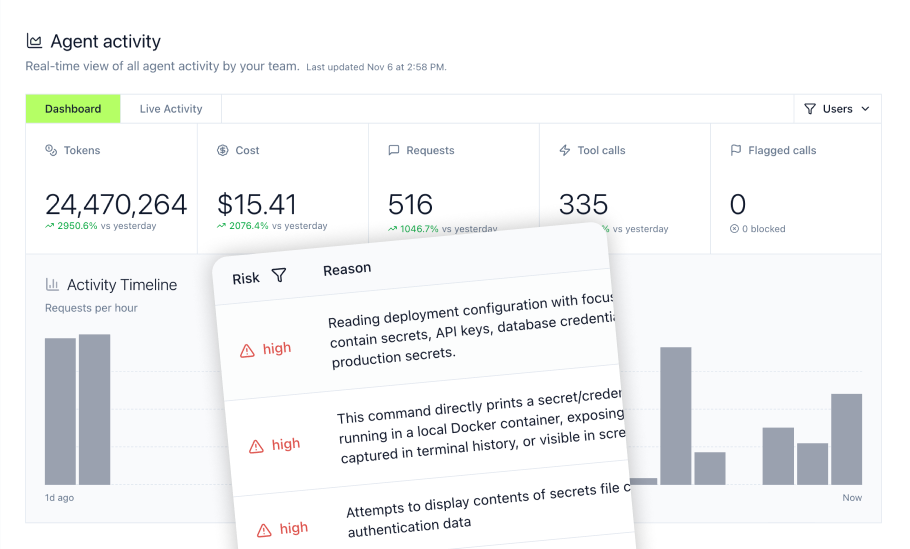
- Agent Monitor: Provides visibility into supported agent activity including prompts, file access, commands, MCP tool calls, usage, and token costs.
- Guardrails: Three-layer runtime controls through Mint Guard (managed detection), Rules (declarative matching), and Gateway Middleware (customer-authored JavaScript).
Hosted Connectors: MintMCP operates supported connector instances so customers deploy and govern access without managing the runtime themselves.
Enterprise Features
- SSO and SCIM integration with Okta, Microsoft Entra, and Google
- RBAC driven by directory groups
- Audit trails with tamper-evident access-grant history signed at write time
- SIEM export via OTLP or Splunk HEC
- Org-wide kill switch for incident response
- Configuration as code for gateway management
Agent Identity Management
Each autonomous agent receives its own identity with:
- Bearer keys for simple authentication
- M2M tokens via OAuth client-credentials exchange
- Workload identity federation for zero-secret deployments aligned with CISA Zero Trust principles
- Independent credential rotation and revocation
- Per-agent audit attribution
Pricing
MintMCP uses custom pricing based on active AI agent users, team size, usage, and deployment requirements. Organizations can request a tailored quote, with enterprise support and deployment options available based on their needs.
Best For:
- Regulated industries (healthcare, finance, government) requiring compliance documentation
- Multi-cloud enterprises avoiding platform dependencies
- Organizations deploying multiple AI clients (Claude, Cursor, ChatGPT, Gemini, Copilot)
- Teams scaling from 10 to 100+ autonomous agents
- Security teams needing visibility into supported agent activity and runtime controls
2. Microsoft MCP Gateway
Microsoft MCP Gateway is an open-source solution for routing MCP traffic through Azure Kubernetes Service. Released under the MIT license, it provides free infrastructure for teams comfortable managing Kubernetes deployments.
Key Capabilities
- Session-aware routing for MCP connections
- MCP server lifecycle management
- Tool registration and management
- Azure Entra ID integration
- Prometheus metrics for observability
- Kubernetes-native deployment patterns
- Full source code access for customization
Technical Requirements
- Kubernetes expertise required
- AKS deployment recommended
- Self-managed MCP server infrastructure
- Custom compliance layer needed
- No managed connector hosting
Architecture Approach
Microsoft MCP Gateway combines session-aware routing with MCP server lifecycle management, tool registration, Entra ID authentication, and basic role-based authorization. Teams still operate the Kubernetes infrastructure and must configure additional controls for enterprise-wide agent identity, monitoring, guardrails, and compliance workflows.
Deployment Considerations
Production costs depend on Kubernetes infrastructure, workload requirements, monitoring, maintenance, and security operations. Organizations should account for infrastructure expenses and the engineering time needed to operate the gateway and maintain applicable compliance controls.
3. Azure API Management
Azure API Management is Microsoft's comprehensive API management solution, now extended with MCP support. It serves organizations fully committed to the Azure ecosystem with existing APIM investments.
Platform Strengths
- Mature API lifecycle management
- Comprehensive policy engine
- Deep Azure service integration
- Azure Monitor for observability
- Key Vault integration for secrets
- 99.95% uptime SLA (Premium tier)
MCP-Specific Capabilities
- Exposing existing REST API operations as MCP tools
- Managing and securing existing remote MCP servers
- Policy-based authentication and authorization
- Rate limiting, quota management, and request/response transformation
- Monitoring through Azure Monitor and Application Insights
- MCP server discovery through Azure API Center
Pricing Structure
- Developer tier: Intended for non-production development and evaluation
- Consumption tier: Usage-based pricing
- Basic and Standard tiers: Dedicated capacity with tier-specific pricing
- Premium tier: Advanced enterprise deployment and networking features
- V2 tiers: Separate Basic v2, Standard v2, and Premium v2 options
Pricing varies by region, capacity, usage, and deployment configuration.
Limitations for MCP Workloads
- Not purpose-built for MCP governance
- XML policy configuration complexity
- Azure-based management introduces platform dependencies, although supported self-hosted gateways can run across cloud and on-premises environments
- Absence of MintMCP's specific Virtual MCP and first-class Agent Bundle model
- No hosted connector runtime
4. Bifrost (Maxim AI)
Bifrost is an open-source AI gateway focused on performance, published under the Apache 2.0 license. It handles both LLM model routing and MCP tool connections through a single gateway.
Performance Metrics
Bifrost reports 11 microseconds of gateway overhead at 5,000 requests per second in a vendor-published benchmark using a specific test configuration. This measures the gateway's added latency, not the total time required to complete an LLM request. Results depend on workload, infrastructure, and deployment conditions.
Technical Capabilities
- Unified LLM and MCP gateway
- 23+ provider integrations
- Prometheus and OpenTelemetry observability
- OIDC SSO support (Enterprise tier)
- Self-hosted deployment model
Architecture
Bifrost runs as a Go binary or Docker container. Enterprise features including SSO and audit logs require the paid tier. There is no managed SaaS offering.
Operational Requirements
- Self-hosting required
- Infrastructure management burden
- DevOps expertise needed
- Smaller community than established alternatives
Pricing
- Open-source core: Free (Apache 2.0)
- Enterprise features: Quote-based
5. Kong AI Gateway
Kong AI Gateway extends the established Kong API Gateway platform into AI and MCP territory. It leverages Kong's mature plugin ecosystem and enterprise deployment experience.
Platform Foundation
Kong has over a decade of production API gateway deployments. The AI Gateway adds:
- MCP protocol support
- AI-specific plugins
- Model routing capabilities
- Semantic caching
Deployment Options
- Konnect SaaS control plane with self-hosted data plane
- Fully self-hosted deployment
- Hybrid configurations
Enterprise Features
- Enterprise security and compliance controls
- SLA-backed dedicated gateway deployments, with coverage varying by service configuration
- Plugin-based extensibility
- Multi-region deployment options
Considerations
- Steep learning curve for new users
- Enterprise features require paid tiers
- Plugin pipeline affects performance
- API gateway heritage, not MCP-native
- Agent identity and access controls are available through Kong's broader AI and Agent Gateway offerings, with capabilities dependent on product and tier
Pricing
- Open-source gateway: Free
- Konnect Plus: From $25/month for a serverless gateway control plane, with additional AI model proxying and usage charges
- Enterprise: Custom annual pricing
Pricing varies by gateway deployment, usage, and enabled capabilities.
6. LiteLLM
LiteLLM is a popular open-source LLM proxy with MCP support. Its Python-based architecture and broad provider integrations make it a common choice for development teams.
Integration Breadth
LiteLLM supports 100+ LLM providers, making it the broadest option for model routing. MCP support extends this to tool connections.
Technical Features
- Python-based proxy with optional beta Rust acceleration for supported routes
- Python SDK for development
- OpenTelemetry integration
- Langfuse, Arize, and LangSmith observability
- JWT/OIDC authentication (Enterprise)
Deployment Model
- Open-source core (MIT license)
- Self-hosted deployment required
- Enterprise tier for SSO, RBAC, and support
Operational Reality
LiteLLM's open-source gateway is free to self-host, with infrastructure and operational costs depending on deployment architecture and workload. Enterprise pricing is quote-based and varies by annual gateway request capacity, deployment configuration, and support requirements.
Limitations
- Self-hosting required
- Focus on LLM routing over MCP governance
- Enterprise support SLA requires paid tier
7. Portkey
Portkey provides an LLM gateway with MCP support, now part of Palo Alto Networks following its May 2026 acquisition. The platform combines model routing with enterprise security features.
Core Capabilities
- LLM model routing and fallback
- MCP protocol support
- Usage analytics and cost tracking
- Prompt management
Deployment Options
- Managed SaaS (default)
- Enterprise deployments on EKS, AKS/ACA, GKE
- AWS Marketplace availability
- Air-gapped options
Enterprise Security
The Palo Alto Networks acquisition brings security-focused resources. Enterprise features include SSO, audit logging, and compliance capabilities.
Considerations
- Combines LLM gateway capabilities with agent security and governance
- Supports MCP connectivity alongside broader AI gateway infrastructure
- Now part of Palo Alto Networks' AI security portfolio following its May 2026 acquisition
Enterprise MCP Governance Evaluation Criteria
When comparing MCP gateways and AI gateway platforms, enterprises should evaluate:
- Identity and access control: Support for per-user permissions, directory integration, and first-class agent identities
- MCP governance: Centralized tool curation, credential management, and role-specific endpoints
- Monitoring and security: Audit logging, agent activity visibility, runtime guardrails, and SIEM integration
- Deployment and operations: Managed hosting, self-hosted options, infrastructure requirements, and ongoing maintenance
- Compliance support: Security documentation, auditability, data protection controls, and regulatory requirements
MintMCP's Agent Gateway extends governed MCP access to autonomous agents through individual identities, scoped permissions, and attributable audit trails.
Comparing Total Cost of Ownership
Direct software costs tell only part of the story. True TCO includes infrastructure, operations, implementation, and compliance preparation.
MintMCP TCO Considerations
- Managed connector hosting reduces infrastructure management requirements
- Centralized governance reduces the need to maintain separate MCP configurations
- SOC 2 Type II audit documentation and HIPAA-related security controls support enterprise compliance workflows
- Pricing depends on organizational requirements, team size, and usage
Operational Costs of Self-Hosted Options
Self-hosted gateways such as Microsoft MCP Gateway, Bifrost, and LiteLLM may require:
- Kubernetes, container, or other hosting infrastructure
- Ongoing maintenance, monitoring, and security updates
- Engineering time for deployment and configuration
- Additional security and compliance processes
Managed platforms can reduce operational responsibilities, while self-hosted options provide greater infrastructure control. The overall cost depends on deployment scale, existing infrastructure, and internal engineering capacity.
Making the Right Choice
The MCP gateway market divides into three categories:
- Managed MCP and Agent Governance: MintMCP combines managed MCP connectivity with first-class agent identities, monitoring, runtime guardrails, and enterprise access controls. The platform is SOC 2 Type II audited and compliant with HIPAA standards, with managed hosting that reduces infrastructure management requirements.
- Microsoft MCP Solutions: Microsoft MCP Gateway provides Kubernetes-native routing, server lifecycle management, and basic authorization. Azure API Management extends API lifecycle management into MCP governance and supports hybrid deployment through its self-hosted gateway. Both involve distinct infrastructure and management requirements.
- Self-Hosted and Hybrid Options: Bifrost and LiteLLM offer open-source gateway components, while Kong provides open-source, hybrid, and enterprise gateway offerings. Operational responsibilities, enterprise controls, and compliance requirements depend on the selected product and deployment model.
Why MintMCP for Governed MCP Access
For enterprises deploying AI agents across Claude, Cursor, ChatGPT, Gemini, and Copilot, MintMCP provides the governance layer that makes these systems deployable, governed, measurable, and swappable without slowing the rollout.
The platform addresses the emerging challenge of agent identity at scale. As organizations move from 10 to 100+ autonomous agents, they need first-class non-human identities with individual credentials, scoped permissions, and attributable audit trails. MintMCP's Agent Gateway treats agents as distinct principals rather than proxying user credentials.
MintMCP's Virtual MCP abstraction simplifies governance. Instead of configuring each MCP server individually, security teams bundle approved connectors behind role-specific endpoints with SCIM-driven membership. Users connect once through SSO and receive curated tool access based on their role.
Organizations handling protected health information benefit from MintMCP's SOC 2 audited infrastructure and HIPAA-compliant controls. The platform provides audit trails, runtime guardrails, and security documentation that support regulatory requirements without requiring custom compliance infrastructure.
Managed connector hosting reduces operational overhead. Teams can deploy governed MCP connections in minutes, with MintMCP operating the connector runtime, handling updates, and maintaining uptime.
Frequently Asked Questions
What are Azure API Management's primary limitations for AI-driven enterprises?
Azure API Management extends traditional API lifecycle management into MCP governance. Its limitations include dependence on an Azure-based management plane, XML-based policies, and the absence of MintMCP's specific Virtual MCP and first-class Agent Bundle model. Azure API Management supports hybrid and multi-cloud deployment through self-hosted gateways in supported tiers, but organizations must evaluate the associated infrastructure and governance requirements.
How does MintMCP's Virtual MCP concept differ from standard API gateway deployments?
Virtual MCPs bundle multiple connectors and a curated tool surface behind a single governed endpoint. Users connect once through SSO rather than configuring each MCP server individually. VMCPs serve as the unit of deployment, access control, tool curation, and audit. Standard API gateways lack this abstraction, requiring separate configuration for each backend service. Learn more in the MCP Gateway documentation.
Can MintMCP provide governance for AI agents using tools outside its gateway?
Yes. Agent Monitor provides visibility into supported agent activity beyond gateway traffic. This includes prompts, commands, file access, MCP tool calls, usage, and costs. Coverage varies by client, agent, and hook phase, but the architecture extends governance beyond traffic routed through the MCP Gateway.
What security features does MintMCP offer to prevent prompt injection and data exfiltration?
MintMCP's Guardrails provide three-layer runtime controls. Mint Guard offers managed detection for prompt injection, credentials, PII, and harmful content. Rules provide declarative pattern matching with actions including flag, block, ask, mask, and notify. Gateway Middleware enables customer-authored JavaScript for DLP integrations, external classifiers, and custom policy enforcement.
How does MintMCP manage identity and permissions for autonomous agents?
MintMCP's Agent Gateway treats autonomous agents as first-class non-human principals. Each agent can have its own identity, credentials, scoped MCP access, independent credential expiration, and attributable audit trails. Authentication approaches include bearer keys, OAuth client-credentials (M2M tokens), and workload identity federation where the agent's infrastructure mints short-lived OIDC tokens.