Claude Skills transform Anthropic's AI assistant from a general-purpose tool into a specialized workflow engine that follows your organization's exact processes. While Skills deliver significant productivity gains, they also introduce governance challenges that most enterprise teams overlook: Skills can execute code, instruct Claude to use MCP tool connections to access sensitive data, and operate outside standard security controls. Organizations deploying Claude Skills at scale need a structured approach to authentication, access control, and audit logging through platforms like MintMCP Gateway that centralize governance across AI agent activity.
This article breaks down what Claude Skills are, how they function, and the concrete steps enterprises must take to govern them effectively across teams, compliance requirements, and security boundaries.
Key Takeaways
- Claude Skills are reusable instruction packages that teach Claude specific workflows, launched October 2025 with enterprise governance features added December 2025
- Skills initially load only their name and description, then load full instructions and supporting files through progressive disclosure when relevant
- Organization-wide Skill management is available on Team and Enterprise plans; Team standard seats cost $20 per seat per month with annual billing or $25 per seat per month with monthly billing
- Skills can run Python, Bash, and JavaScript inside Claude's sandboxed code-execution environment, so bundled scripts and enabled network access still require software-level security review
- Agent Skills and code execution are not ZDR-eligible, so enterprises must account for Anthropic's documented retention policies in their data-governance design
- Skills can reduce repeated prompting by packaging reusable instructions, scripts, and reference materials for recurring workflows
- Agent Skills are published as an open standard that can be adopted by compatible AI tools, improving portability without guaranteeing identical behavior across platforms
What Claude Skills Are and Why They Matter for Enterprise AI
Claude Skills are packaged instruction sets that teach Claude how to handle specific workflows consistently. Rather than explaining your quarterly business review format every conversation, a Skill packages that knowledge into a folder Claude loads automatically when users request relevant outputs.
The Architecture Behind Claude Skills
Each Skill contains a required SKILL.md file with frontmatter metadata, optional scripts for automation, and reference materials Claude can access. The system uses progressive disclosure:
- Level 1: Skill metadata, including the name and description, loads first
- Level 2: Instructions load when the Skill triggers
- Level 3: Detailed files and scripts load on demand
This architecture minimizes context window consumption while giving Claude access to deep organizational knowledge when needed.
Pre-Built vs. Custom Skills
Anthropic provides native document creation Skills for PowerPoint, Excel, Word, and PDF generation across Free, Pro, Max, Team, and Enterprise plans. Users on all of these plans can also create and upload custom Skills, while organization-wide provisioning is limited to Team and Enterprise plans. Custom Skills let organizations encode proprietary workflows, compliance checklists, and domain expertise.
Partner Skills from Atlassian, Canva, Figma, Notion, Stripe, and Zapier extend functionality through the Skills Directory. These integrations transform specifications into Jira backlogs, create multi-platform campaigns, or automate payment workflows.
Understanding the difference between Skills and prompts helps teams determine when custom Skill development makes sense versus simpler prompt engineering approaches.
Why Skills Create Governance Requirements
Skills introduce three enterprise concerns that standard AI usage does not:
- Code execution: Skills can run Python, Bash, and JavaScript inside Claude's sandboxed code-execution environment, with network egress controlled by plan and organization settings
- Data access: Skills can instruct Claude to use MCP tools that are already configured and authorized in the user's environment
- Proliferation: Users on all Claude plans can create personal Skills, while Team and Enterprise sharing is controlled by owner settings; once organization-wide sharing is enabled, member-published Skills do not require an approval step
These capabilities make Skills powerful productivity tools but require governance frameworks most organizations lack for AI systems.
Establishing an AI Governance Framework for Claude Skills
Governing Claude Skills requires policies that address who can create Skills, what those Skills can access, and how the organization monitors Skill usage across teams.
Defining Skill Development and Deployment Policies
Start with clear ownership of the Skill lifecycle:
- Creation: Determine which roles can develop custom Skills and what review process applies
- Testing: Require validation in personal accounts before organization-wide deployment
- Approval: Establish who can provision Skills to the organization (only Organization Owners, not Admins or Members)
- Maintenance: Assign responsibility for updating Skills as workflows change
Most enterprises benefit from a tiered approach: IT or AI Operations owns the Skill catalog, but business teams can request new Skills through a standard intake process.
Building Governance Around the Bundle Concept
Effective governance groups related capabilities rather than managing individual Skills in isolation. MintMCP's Bundle architecture provides a model: package tool access, policy enforcement, and audit logging into governance units aligned with teams or roles.
For Claude Skills, this model applies to the MCP tools that Skills may reference, not to the Skill packages themselves:
- Role-based tool sets: Sales users receive approved CRM tools; engineering users receive approved development tools
- Cascading tool policies: Organization-level MCP rules apply broadly, while team-level policies add constraints
- Isolated MCP audit trails: Each Bundle maintains separate records for governed tool activity
This approach reduces MCP tool-access sprawl, while Anthropic's native controls remain responsible for Skill provisioning and sharing.
Documenting Skill Governance in Standard Operating Procedures
Governance frameworks require documentation that teams can reference and auditors can review:
- Skill inventory: Catalog of all deployed Skills with descriptions, owners, and risk classifications
- Security review checklist: Steps for vetting Skills before deployment
- Incident response: Procedures for disabling Skills that exhibit unexpected behavior
- Change management: Process for updating Skills and communicating changes to users
These documents become audit artifacts demonstrating the organization's approach to AI governance.
Essential AI Governance Tools for Managing Claude Skills at Scale
Anthropic's native controls provide a starting point but leave gaps that enterprise governance tools must fill.
Native Anthropic Controls
Anthropic's enterprise deployment features enable:
- Organization-wide provisioning: Deploy Skills to all users from a central admin console
- Default activation: Organization-provisioned Skills are enabled automatically, and individual members can disable them for themselves
- Audit events: Track Skill-sharing activity, including who shared a Skill, with whom, and whether it was shared peer-to-peer or organization-wide; audit logs do not include Skill contents
- SSO integration: Connect to Okta and Microsoft Entra ID for authentication
These controls address basic deployment but do not cover the full governance picture.
Gaps in Native Governance
Several critical capabilities remain outside Anthropic's native tooling:
- Cross-surface deployment: Skills do not sync across Claude.ai, API, and Claude Code; each surface requires separate deployment
- MCP connection governance: Skills that reference MCP tools need external controls on which servers they can access
- Real-time policy enforcement: Native controls manage Skill availability but not what Skills do during execution
- Shadow AI detection: No visibility into Skills or MCP usage outside approved channels
Implementing Centralized Control
MintMCP Gateway addresses these gaps by centralizing authentication, access control, and audit for MCP-connected systems that Skills depend on. When Claude follows a Skill that invokes MCP tools for databases, CRMs, or internal systems, the Gateway can enforce:
- Tool-level access control: Allow database reads but block writes
- User identity forwarding: Track which user's Skill made each data request
- Rate limiting: Prevent runaway Skills from overwhelming backend systems
- Policy execution: Run custom checks on every tool call
This creates a governed path for Skills to access enterprise data rather than direct, unmonitored connections.
For organizations building Claude Skills, MintMCP's Bundle model lets teams expose approved MCP tools through role-based endpoints with scoped access policies, so Skills can reference only the tool connections available to that user or agent.
Ensuring AI Compliance with Regulatory Standards for Skill Usage
Skills operating in regulated environments must meet compliance requirements that Anthropic's platform alone cannot satisfy.
Understanding Data Handling Limitations
A critical compliance consideration: Agent Skills and code execution are not ZDR-eligible. Anthropic documents separate retention behavior for these features, so organizations in healthcare, finance, and other regulated industries must verify their contract, BAA coverage, and feature eligibility before processing sensitive data.
Meeting SOC 2 Requirements
SOC 2 Type II audited deployments for Skills require demonstrating:
- Access controls: Only authorized users can create, modify, or deploy Skills
- Audit trails: All Skill activity is logged with user attribution
- Change management: Skill updates follow documented approval processes
- Monitoring: Anomalous Skill behavior triggers alerts and investigation
MintMCP's tool governance capabilities provide audit infrastructure for MCP Gateway tool calls, Agent Monitor tool activity and prompt submissions, and access-policy changes with user or agent attribution. Logs can be exported through OTLP to compatible observability platforms or directly to Splunk HEC for retention and analysis.
HIPAA Considerations
Anthropic's current API eligibility table marks Agent Skills and server-side code execution as ineligible for HIPAA readiness. Healthcare organizations should not process PHI through these features under Anthropic's standard BAA unless their specific contract explicitly provides different coverage.
An MCP Gateway can add an auditable record of governed MCP tool calls, but it does not make an Anthropic feature HIPAA-eligible or replace Anthropic's own compliance controls.
Building Audit-Ready Documentation
Compliance audits require evidence that governance controls work as designed:
- Skill deployment logs: Records of when Skills were provisioned and to whom
- Access reviews: Periodic validation that Skill permissions match job functions
- Security assessments: Documentation of Skill vetting before deployment
- Incident records: Any security events involving Skills and their resolution
These artifacts demonstrate due diligence to auditors and reduce findings during compliance reviews.
Mitigating AI Risk in Claude Skill Implementations
Skills introduce attack vectors that traditional application security does not address.
Code Execution Risks
Skills can execute Python, Bash, and JavaScript inside Claude's sandboxed container. If network egress or MCP connections are enabled, this capability enables powerful automation but also means:
- Malicious Skills can exfiltrate data through network calls or file system access
- Poorly written Skills can damage systems through unintended commands
- Injected prompts can manipulate Skill behavior in ways the Skill author did not anticipate
Treat Skill deployment as equivalent to software installation. Require the same review processes you would apply to any code running in your environment.
Security Vetting Checklist
Before deploying any Skill, security teams should follow a validation checklist:
- Read the entire SKILL.md file for unexpected instructions
- Audit all scripts in the Skill folder
- Check for external URLs that could be malicious callbacks
- Verify no credentials are hardcoded in files
- Test in isolation before organization-wide deployment
High-risk indicators include code execution, MCP references, network access patterns, hardcoded credentials, and broad filesystem permissions.
Prompt Injection Defense
Skills can be targets for prompt injection attacks where malicious input manipulates Skill behavior. Defense strategies include:
- Input validation: Skills should validate user inputs before processing
- Output filtering: Check Skill outputs for sensitive data before displaying
- Context isolation: Limit what information Skills can access about other conversations
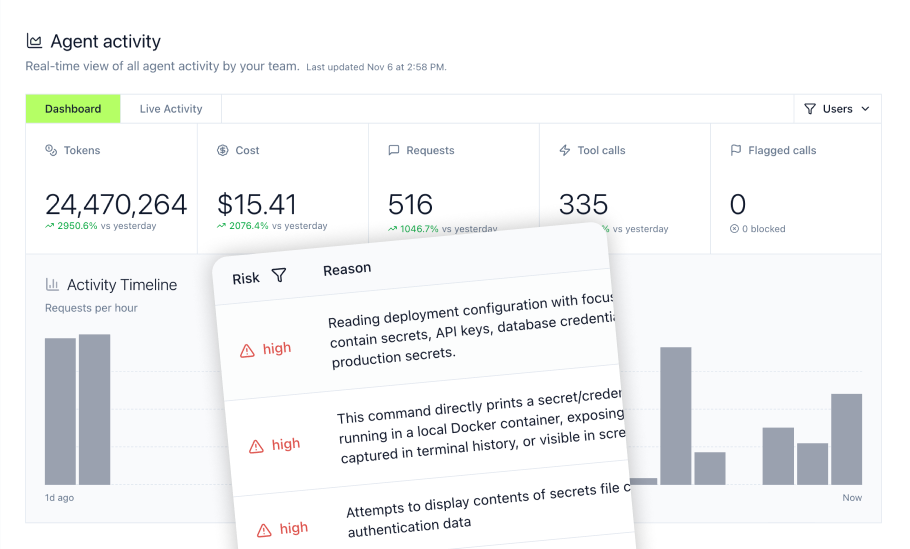
Agent Monitor tracks MCP tool calls, Bash commands, file access, and prompt submissions from supported coding agents, and it can block risky operations through rules. Prompt-injection screening, PII detection, and secret scanning can be applied through MintMCP Gateway rules or customer-authored middleware.
Implementing Technical Controls
Layer technical controls around Skill execution:
- Network segmentation: Limit what systems Skills can reach
- Credential management: Use short-lived tokens rather than persistent API keys
- Rate limiting: Prevent Skills from making excessive requests
- Kill switches: Maintain the ability to disable Skills immediately if needed
MintMCP's customer-authored Gateway middleware runs in a JS sandbox and can call external DLP or content-safety services, including AWS Bedrock Guardrails, Google Cloud Model Armor, OpenAI moderation, Teleskope, or an internal API. Pre- and post-call middleware can allow, block, or mask MCP tool arguments and results.
Building an Enterprise AI Platform to Securely Deploy Claude Skills
Secure Skill deployment requires infrastructure beyond what Anthropic provides natively.
Authentication and Identity Management
Enterprise deployments need SSO integration so Skill access inherits from existing identity systems:
- SAML and OAuth 2.0 authentication for user access
- SCIM provisioning to automatically grant and revoke Skill access based on group membership
- MFA enforcement for Skill creation and administration
MintMCP Gateway provides OAuth 2.0 authentication with centralized credential management for MCP connections. When Claude uses MCP tools referenced by a Skill, users authenticate through the Gateway and MintMCP centralizes credential handling for those connector calls.
Implementing Zero-Trust Architecture
Zero-trust principles apply to Skill governance:
- No default tool access: MCP tools referenced by Skills remain limited to permissions explicitly granted to the user or agent
- Continuous verification: Every governed MCP tool call verifies the requesting user or agent's authorization
- Least privilege: Users and agents receive only the tool permissions required for their functions
- Assume breach: Design controls assuming a Skill could be compromised
This architecture limits blast radius when a Skill behaves unexpectedly or an attacker manipulates Skill behavior.
Scaling Governance Across Teams
As Skill adoption grows, governance must scale without becoming a bottleneck:
- Self-service within guardrails: Teams can deploy approved Skills without IT involvement
- Automated compliance checks: Policy engines validate Skills before deployment
- Federated administration: Team leads manage their Skill sets within organization policies
- Consolidated visibility: Central dashboards show Skill usage across all teams
MintMCP's Bundle model supports this scaling by packaging SCIM group membership, curated tool lists, and custom policy rules into governance units that teams can manage independently while organization-wide policies cascade automatically.
Accelerating Enterprise AI Adoption with Pre-Built Skill Integrations
The Skills ecosystem provides shortcuts to value that reduce implementation time.
Leveraging Partner Skills
The Skills Directory offers integrations from Atlassian, Canva, Figma, Notion, Stripe, and Zapier. Partner Skills can reduce custom development by providing workflows that teams can review and enable for supported services.
Connecting Skills to MCP Servers
Skills become more powerful when combined with MCP servers that provide data access. MintMCP provides 50+ managed connectors and can host custom STDIO-based MCP servers for services including Salesforce, GitHub, Slack, HubSpot, Notion, Linear, Gmail, and Stripe.
This combination creates workflows where:
- A Skill defines how to process a request
- MCP servers provide the data the Skill needs
- The Gateway governs what data the Skill can access
- Audit logs capture MCP calls routed through the Gateway, while other Skill activity remains subject to Anthropic or coding-agent logging
For example, a customer onboarding Skill could orchestrate MCP calls to Stripe for payment setup, Notion for documentation, and Slack for notifications, all governed through a single Bundle with appropriate access controls.
Building a Skill Library
Organizations benefit from curating internal Skill libraries:
- Standard workflows: Document creation, meeting preparation, status reports
- Domain expertise: Industry-specific analysis, regulatory interpretation
- Integration patterns: Common multi-system workflows the organization uses frequently
Open-source repositories provide starting points for compliance-focused workflows including ISO 27001, GDPR, and HIPAA gap analysis.
The Role of Agent Bundles in Governing Claude Skills for Specific Roles
Skills governance becomes more effective when aligned with organizational structure.
Implementing Role-Based Skill Access
Different roles need different Skills:
| Role | Appropriate Skills | Access Level |
|---|---|---|
| Sales | Proposal generation, CRM analysis, meeting prep | Full read, limited write |
| Engineering | Code review, documentation, incident response | Full access to dev systems |
| Finance | Report generation, audit prep, compliance checks | Read-only to financial data |
| Marketing | Campaign creation, analytics, content production | Marketing platform access |
MintMCP's Agent Gateway builds on the MCP Gateway by governing agent identities, permissions, memory, and monitoring. Agent Bundles give each agent its own identity, scoped MCP tools, and independently rotatable credentials. They govern the agent and its tool access, not the Claude Skill file itself, so audit logs can attribute MCP calls to the specific agent identity.
Streamlining Policy Enforcement
Bundle-based governance simplifies policy management:
- Inheritance: Team Bundles inherit organization policies automatically
- Override: Teams can add constraints but not remove organization requirements
- Sync: Changes to IdP groups automatically update Bundle membership
- Isolation: Each Bundle maintains separate audit trails
This architecture lets security teams set guardrails while business teams manage their own Skill deployments within those constraints.
Managing Agent Credentials at Scale
Skills that reference external systems need credentials. Managing these credentials securely requires:
- Per-agent credentials: Each agent gets its own API keys rather than sharing service accounts
- Independent rotation: Agent credentials can be rotated or revoked without changing human-user access
- Instant revocation: Compromised credentials can be disabled immediately
- Audit trail: Every credential use is logged with agent attribution
MintMCP's OAuth brokering handles the complexity of credential management for Skills that reference MCP servers, including servers that require OAuth flows not designed for containerized environments.
Detecting and Governing Shadow AI Usage for Unsanctioned Claude Skills
Skills governance must extend beyond approved channels to detect unauthorized usage.
The Shadow AI Problem
Employees can create and use Skills without organizational awareness:
- Personal Pro accounts: Users bypass corporate controls with personal subscriptions
- Unauthorized MCP connections: Skills reference data sources outside approved channels
- Ungoverned sharing: Users share Skills through unofficial channels
This shadow AI pattern creates compliance gaps, security blind spots, and data leakage risks.
Detecting Off-Gateway Activity
MintMCP's Agent Monitor addresses shadow AI through hooks in Cursor and Claude Code that detect MCP usage outside the governed Gateway:
- Activity detection: Identify when users connect to MCP servers directly
- Policy alerting: Notify security teams of ungoverned connections
- Usage analytics: Track shadow AI prevalence across the organization
This visibility lets organizations understand the scope of ungoverned Skill usage before attempting enforcement.
Enforcement Options
Once shadow AI is detected, organizations have several response options:
- Awareness: Educate users about approved alternatives
- Soft blocking: Warn users but allow activity to continue
- Hard blocking: Prevent unauthorized connections entirely
- MDM integration: Push detect-only or enforce-mode configurations to managed devices
MintMCP's MDM integration enables consistent policy application across developer machines, ensuring corporate governance extends to AI tools used in development environments.
Migrating Shadow Skills to Governed Channels
Rather than simply blocking shadow AI, effective governance provides an approved path:
- Identify valuable shadow Skills: Discover what users have built outside approved channels
- Assess security requirements: Determine what governance the Skill needs
- Migrate to governed platform: Move the Skill to the corporate environment with appropriate controls
- Decommission shadow usage: Redirect users to the governed version
This approach captures the productivity benefits users found in shadow AI while establishing proper governance.
How MintMCP Enables Enterprise-Grade Claude Skills Governance
Organizations deploying Claude Skills at scale face a fundamental challenge: Anthropic's native controls manage Skill deployment and availability, but they do not govern the MCP tools that Skills reference, monitor runtime behavior, or provide centralized audit trails across AI surfaces. MintMCP complements Anthropic's Skill provisioning controls by governing MCP data access and supported coding-agent activity during execution.
MintMCP Gateway centralizes authentication, access control, and audit for every MCP tool call that Skills trigger, whether those calls originate from Claude.ai, the API, Claude Code, or autonomous agents. Tool-level policies enforce read vs. write permissions, mask sensitive fields before they reach Skills, and rate-limit requests to backend systems. Customer-authored middleware running in a sandboxed JavaScript environment can integrate external DLP services including AWS Bedrock Guardrails and Google Cloud Model Armor to inspect and transform data in transit.
Agent Gateway extends this foundation by giving each AI agent its own persistent identity, scoped MCP credentials, and independent audit trail. When a Skill references MCP tools, Agent Bundles determine which tools that agent can access, what policies apply, and how logs attribute activity. This matters for compliance: instead of attributing all Skill activity to a single service account, audit logs show which specific agent identity made each data request, enabling per-agent access reviews and incident investigation.
Agent Monitor completes the governance stack by detecting MCP usage outside the Gateway through hooks in coding environments like Cursor and Claude Code. IT teams gain visibility into shadow Skills that bypass approved channels, enabling migration to governed deployments rather than blanket blocking. Monitor tracks tool calls, Bash commands, and file access with configurable rules that can alert on or block risky operations, extending governance beyond the data center to every developer workstation.
Together, these capabilities transform Claude Skills from an ungoverned productivity tool into a governed enterprise asset. Organizations can deploy Skills confidently across regulated industries, knowing that MCP access is authenticated, tool calls are audited, sensitive data is protected, and shadow AI is detected before it becomes a compliance incident.
Frequently Asked Questions
Can Skills access data from any MCP server, or is access controlled?
A Skill can reference MCP tools that are already available in the user's Claude environment, but it cannot bypass the client's MCP configuration or the server's existing permissions. Without additional controls, a Skill could instruct Claude to use any configured MCP tool for databases, CRMs, file systems, or other exposed systems. Enterprise deployments should route all MCP traffic through a gateway that enforces access policies, limiting which tools specific agents can use and what operations they can perform. Tool-level access control can allow read operations while blocking writes, or permit access to certain data fields while masking others.
How do Skills handle sensitive data like PII or PHI?
Skills do not provide Skill-specific DLP or field-level data classification by themselves. Data referenced through MCP tools or uploaded files is still subject to Claude's platform controls, but organizations may need separate DLP and access policies for regulated data. Organizations handling sensitive information must implement external controls: DLP integration that scans inputs and outputs for sensitive patterns, MCP Gateway policies that mask or block sensitive fields before they reach Skills, and audit logging that captures what data Skills accessed. External controls can reduce exposure, but they do not make Agent Skills or server-side code execution eligible for PHI processing under Anthropic's standard HIPAA-ready API arrangement.
What happens when Anthropic updates pre-built Skills or Partner Skills?
Anthropic and partner vendors can update Skills without requiring explicit customer approval, potentially changing Skill behavior or capabilities. Organizations should monitor Skill update notifications, review changes before they take effect in production environments, and maintain rollback capability if updates cause issues. MintMCP's tool-update policy can require approval before new upstream MCP tools become active, but it does not version or approve changes to the Skill package itself. Organizations should review Skill updates separately before deployment.
How should organizations handle Skills created by employees who leave?
Skills created by departing employees pose continuity and security risks. Organizations should maintain an inventory of all deployed Skills with ownership records, transfer ownership of valuable Skills to team leads or a central AI operations function, review and audit Skills before transfer to ensure no security concerns, and decommission Skills that are no longer needed rather than leaving them active without owners. SCIM integration helps automate access revocation when employees depart, but Skill ownership transfer requires explicit administrative action.
Can Skills be version-controlled like code?
Claude.ai does not provide Git-style source control for uploaded Skills, while Anthropic's Skills API supports versioned custom Skills. Organizations should still maintain Skill source files in Git as the source of truth, track changes through pull requests, and deploy approved versions to each Claude surface. This provides an independent audit trail and rollback path while accounting for the fact that Skills do not automatically sync across Claude.ai, the API, and Claude Code.