DeepSeek V4 represents a shift in the enterprise AI landscape, offering frontier-class reasoning capabilities at substantially lower cost than many proprietary alternatives. Released as a preview in April 2026, DeepSeek V4-Pro-Max delivers 80.6% on SWE-bench Verified in published evaluations. However, API traffic routes through servers in China, creating data sovereignty challenges that require careful architectural planning. Organizations deploying DeepSeek V4 agents need governance infrastructure for agent identities, tool and data permissions, policy controls, and audit trails. An MCP Gateway governs the enterprise tools and data those agents can access, while the application or a dedicated model-routing layer selects between DeepSeek and other models.
This article covers DeepSeek V4's technical capabilities, benchmark performance, integration requirements, and the enterprise governance considerations that determine whether this model fits your AI infrastructure strategy.
Key Takeaways
- DeepSeek V4 comes in two variants: V4-Pro (1.6T parameters, 49B active) and V4-Flash (284B parameters, 13B active), both with 1-million-token contexts
- API list pricing is substantially lower than many proprietary frontier models, with V4-Flash at $0.14/M cache-miss input and $0.28/M output; actual savings depend on workload mix
- V4-Pro-Max scores 80.6% on SWE-bench Verified, competitive for agentic coding workflows
- MIT-licensed weights enable self-hosting without model licensing fees, making DeepSeek V4 one of several open-weight options for infrastructure control
- Data sovereignty is the critical constraint: API traffic routes to China, requiring careful assessment for regulated workloads
- Context caching can sharply reduce input-token costs when exact reusable prefixes produce cache hits, but matching is best effort
- Enterprise deployments require agent identities, tool permissions, and audit controls independent of model-provider selection
Understanding DeepSeek V4's Capabilities
DeepSeek V4 enters a market dominated by closed-source models from OpenAI, Anthropic, and Google. What sets it apart is the combination of frontier-level performance with open weights under an MIT license.
DeepSeek V4's Architectural Innovations
The model uses a hybrid attention architecture combining CSA (Compressed Sparse Attention) and HCA (Heavily Compressed Attention). In the one-million-token setting, V4-Pro uses 27% of the single-token inference FLOPs and 10% of the KV cache required by DeepSeek V3.2. These figures describe long-context efficiency rather than a universal reduction in end-to-end inference cost.
The Mixture-of-Experts (MoE) approach activates only a subset of parameters per inference. V4-Pro runs 49B active parameters from its 1.6T total, while V4-Flash activates 13B from 284B. This sparse activation pattern explains the cost efficiency without proportional capability loss.
Key Features for Enterprise Applications
Three reasoning modes give developers control over chain-of-thought depth:
- Non-think: Direct responses without explicit reasoning, lowest token usage
- Think-high: Balanced reasoning for most complex tasks
- Think-max: Maximum reasoning effort for difficult problems, generally with higher latency and output-token usage
1M-token context window for long documents, codebases, and conversation histories. This is comparable to the context capacity of current million-token frontier models from other providers.
OpenAI-compatible and Anthropic-compatible API formats can reduce migration work, but they do not provide complete feature parity. Teams must test tool definitions, response parsing, unsupported content types, and provider-specific fields before production migration.
Comparative Analysis with Existing Models
DeepSeek V4 competes on capability while differentiating on cost and deployment flexibility:
- Context window: DeepSeek V4 supports 1M tokens, comparable to current frontier offerings
- Self-hosting: DeepSeek V4 (MIT license) enables infrastructure control
- API pricing: V4-Flash costs $0.28/M output tokens, while V4-Pro costs $0.87/M output tokens
The trade-off is data routing. DeepSeek's API processes requests through servers in China, subject to Chinese data laws. For many enterprise workloads, this creates compliance friction that self-hosting or careful data classification must address.
DeepSeek V4 Performance and Benchmarks
Benchmark performance determines whether DeepSeek V4 can replace or complement existing model deployments.
DeepSeek V4's Position on Industry Leaderboards
In DeepSeek's internally developed evaluation framework, V4-Pro-Max achieves 80.6% on SWE-bench Verified, while V4-Flash-Max reaches 79.0%. V4-Flash is priced at $0.28/M output tokens regardless of the selected reasoning effort.
Beyond SWE-bench, DeepSeek V4 demonstrates performance across reasoning and coding evaluations including HumanEval, MBPP, and MATH benchmarks. Enabling reasoning modes can materially increase output-token usage and latency. DeepSeek does not publish a fixed multiplier, so teams should budget from measured workloads.
Methodologies for AI Model Evaluation
Enterprise teams evaluating DeepSeek V4 should run domain-specific evaluations beyond published benchmarks. Production performance varies based on prompt structure, task complexity, and caching efficiency.
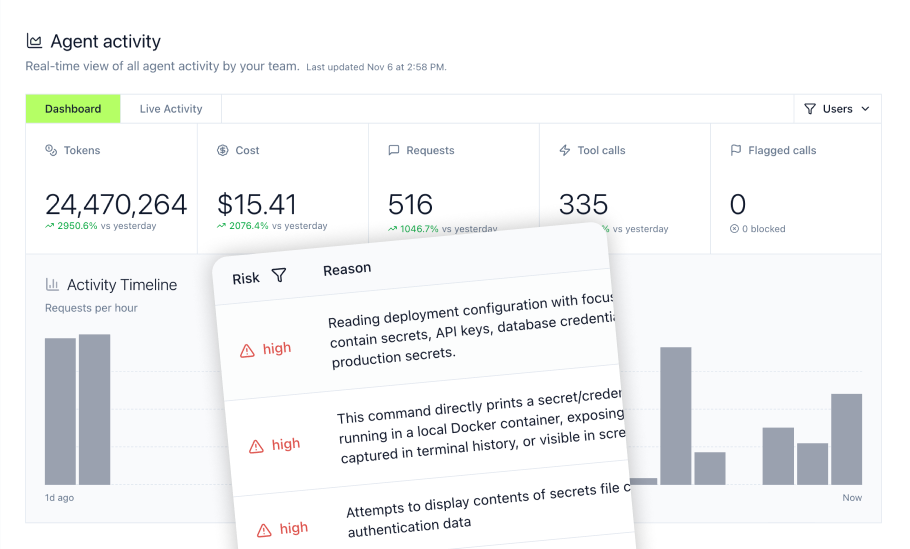
For teams running AI agents, an Agent Monitor provides visibility into MCP calls and local agent activity such as Bash commands, file access, and installed MCP tools. This helps security and platform teams investigate agent behavior across workflows.
Integrating DeepSeek V4 into Enterprise Platforms
Moving from evaluation to production requires addressing authentication, SDK integration, and infrastructure decisions.
Strategic Considerations for Enterprise Adoption
API integration path (2-4 hours setup):
- Create account at platform.deepseek.com
- Generate and secure API key in environment variables
- Install OpenAI Python SDK:
pip install openai - Configure base URL:
https://api.deepseek.com - Select model:
deepseek-v4-flashordeepseek-v4-pro
Self-hosting path:
- Hardware requirements depend on the model variant, weight format, quantization, context length, concurrency target, and serving framework
- Do not treat four A100s or eight H100s as verified minimum configurations without a tested deployment specification
- Benefits include greater data control and no model-provider per-token fee, but compute, power, storage, networking, redundancy, and operational support remain ongoing costs
Best Practices for Secure Integration
Environment variable storage for API keys. Never hardcode credentials or commit them to repositories.
Context caching structures prompts with repeated system messages first. Cache-hit input tokens are billed at lower rates than cache-miss tokens, but DeepSeek does not guarantee a particular hit rate. Teams should measure actual cache-hit usage before forecasting savings.
Error handling must check finish_reason in every response. A length value indicates truncation requiring higher max_tokens.
Addressing the Last Mile Problem
Raw API access creates governance gaps. When multiple teams deploy DeepSeek V4 agents alongside other models, organizations face fragmented credential management, inconsistent access controls, no unified audit trail for agent actions, and manual compliance verification.
The Agent Gateway pattern addresses these gaps by centralizing agent identities, permissions, memory, monitoring, and audit controls. MintMCP builds this layer on its MCP Gateway foundation, which governs agent access to enterprise tools and data. Model-provider routing remains a separate application or LLM gateway function.
Governance and Security for DeepSeek V4 Deployments
DeepSeek V4's data routing creates specific compliance challenges that governance infrastructure must address.
Ensuring Data Privacy and Security
API data flows to China by default. DeepSeek does not publish at-rest encryption details for hosted API infrastructure, and I could not verify a public SOC 2 Type II attestation covering DeepSeek's hosted API.
Self-hosting can support data sovereignty when inference, storage, logs, backups, administrative access, and subprocessors remain within the required jurisdiction. The MIT license permits this without licensing fees. Organizations can deploy the open weights in an EU region or select a hosting provider that contractually guarantees the required processing location.
GDPR requires careful assessment of the transfer to China. DeepSeek states that it directly collects, processes, and stores personal data in China. Because China does not have an EU adequacy decision, organizations processing EEA personal data need an appropriate transfer mechanism, transfer-risk assessment, and applicable safeguards.
Implementing Robust Access Control
DeepSeek API requests are authorized with API keys. Enterprise SSO, verified per-user identity, and agent-level authorization need to be implemented outside the model API. DeepSeek supports a caller-supplied user_id for user-level isolation and request labeling, but it does not authenticate that end user.
Enterprise deployments need additional layers:
- SSO integration through an intermediary gateway
- Per-team credential scoping rather than shared API keys
- Automatic credential rotation independent of manual processes
- Usage attribution to individual users or agents
The security governance model in MintMCP provides these controls through Bundles. Each Bundle ties SCIM group membership to curated tool lists, custom policy rules, and isolated audit trails. Agent Bundles extend this to non-human principals with their own rotatable credentials.
Mitigating Risks: PII and Prompt Injection
PII detection requires inline inspection before requests reach DeepSeek APIs. Prompt injection defense depends on input validation and output filtering. DeepSeek V4 inherits standard LLM vulnerabilities to adversarial inputs.
MintMCP's Gateway Middleware runs JavaScript hooks on every tool call, enabling integration with AWS Bedrock Guardrails, Google Cloud DLP, Microsoft Purview, Nightfall, and Skyflow. Pre- and post-phase hooks can transform or block requests containing sensitive data.
DeepSeek V4 Use Cases
Cost savings materialize when the model handles actual workloads effectively.
Transforming Data Analysis
Illustrative approach: After extracting text from each PDF, V4-Flash can process contracts that fit within its combined context and output limits. Structured outputs can support clause extraction.
Estimated impact: Calculate savings from the organization's measured cache-miss input, cache-hit input, and output-token volumes. Production results depend on document complexity and validation requirements.
Enhancing Customer Service
Implementation: DeepSeek V4-Flash can handle selected routine queries at lower public list prices than many proprietary frontier models, while the application routes cases requiring a different capability or risk profile to another model.
Governance requirement: Agents accessing customer data need scoped permissions and audit trails. MintMCP's Agent Identities provide per-agent credentials with rotation independent of human user accounts.
Optimizing Software Development
Illustrative approach: Integrate V4-Pro into a compatible development workflow for code generation and review, using reasoning modes selectively for complex tasks.
Estimated impact: Calculate API savings from measured token usage and validate quality through an internal coding evaluation.
The Model Context Protocol in DeepSeek V4 Integration
The Model Context Protocol standardizes how AI agents connect to tools and data sources. DeepSeek V4 deployments benefit from this standardization through consistent integration patterns.
DeepSeek V4 and the MCP Ecosystem
DeepSeek V4 supports function and tool calling, but its API does not natively consume MCP server definitions. An MCP-capable host or gateway must discover the available MCP tools, present compatible tool definitions to the model, and execute the selected calls. With this adapter in place, DeepSeek-powered agents can use the same governed MCP servers as agents powered by other models.
Benefits of a Unified Protocol
Connector reuse: Build an MCP server once, use it across multiple model providers.
Credential consolidation: MCP Gateway handles OAuth brokering so agents don't manage individual credentials.
Policy consistency: The same access rules apply regardless of which model powers the agent.
MintMCP's MCP Gateway hosts and governs custom MCP servers alongside hundreds of prebuilt connectors, with enterprise authentication and tool-level access controls.
Ensuring Compliance and Auditability
Enterprise deployments require documentation, audit trails, and compliance attestations.
Meeting Regulatory Requirements
HIPAA: DeepSeek's public materials do not advertise a BAA, and its privacy policy says the service is not designed or intended to process sensitive personal data. Workloads involving PHI should use an infrastructure provider that will sign a BAA and implement the required safeguards.
GDPR: DeepSeek's public API involves processing and storage in China. Organizations handling EEA personal data must assess the transfer mechanism, contractual safeguards, subprocessors, and technical controls. EU-only hosting or self-hosting may be preferable for workloads with strict residency requirements.
Establishing Comprehensive Audit Trails
DeepSeek API responses include usage objects with token counts, but no compliance-grade logging exists at the API level.
Enterprise requirements include:
- Full conversation-level logging with prompt, tool calls, and responses
- Per-user attribution for every request
- Configurable retention policies
- Export capability to SIEM platforms
MintMCP provides conversation-level logging with export to Sentinel, Splunk, and S3. Immutable audit records support compliance investigations while configurable retention handles data minimization requirements.
Total Cost of Ownership
Cost comparisons must account for direct API pricing, infrastructure investment, and operational costs.
Direct API Cost Comparison
Assuming 80 million uncached input tokens and 20 million output tokens per month:
| Model | Input Cost | Output Cost | Monthly Total |
|---|---|---|---|
| DeepSeek V4-Flash | $11.20 | $5.60 | $16.80 |
| DeepSeek V4-Pro | $34.80 | $17.40 | $52.20 |
| GPT-5.6 Sol | $400.00 | $600.00 | $1,000.00 |
| Claude Opus 4.8 | $400.00 | $500.00 | $900.00 |
These figures use public list prices and exclude cache discounts, batch discounts, reasoning-token variation, and infrastructure costs. Competitor totals should be refreshed from each provider's current official pricing.
Self-Hosting Economics
The break-even point depends on hardware or cloud-GPU pricing, utilization, concurrency, context length, energy, staffing, redundancy, and depreciation. Teams should calculate it from measured demand rather than applying a universal token threshold.
Hidden Cost Considerations
Context caching misses: Caching is best effort, and no fixed percentage of repeated input is guaranteed to receive the cache-hit rate. Prompt-prefix changes can cause more input to be billed at the cache-miss price.
Thinking mode overhead: Reasoning modes can increase output-token usage substantially, but the increase is workload-dependent. Test representative prompts before forecasting monthly costs.
Governance infrastructure: API-only deployment without governance creates compliance risk. Factor in cost of audit, access control, and compliance tooling.
Enterprise Governance for DeepSeek V4 Deployments
Organizations deploying DeepSeek V4 face a fundamental challenge: the model's cost advantages and open weights create deployment flexibility, but its data routing and API limitations require governance infrastructure that most enterprises lack. The gap between raw model access and production-ready deployment is where MintMCP delivers value.
DeepSeek V4's API uses API-key authentication and supports a caller-supplied user_id for user-level isolation and request labeling. It does not independently verify that identity or provide enterprise SSO, tool-level access control, or a compliance-grade audit trail. When agents access enterprise systems through DeepSeek, organizations need a governance layer that enforces who can access what data, under what conditions, with full auditability. MintMCP's MCP Gateway provides this foundation by governing agent access to enterprise tools and data sources, independent of which model powers the agent.
The governance challenge extends beyond authentication. DeepSeek V4 agents interacting with production systems need scoped permissions that mirror human access controls. An agent processing customer support tickets should access only the CRM records it needs, not the entire database. An agent generating code should connect to specific repositories, not all internal code. MintMCP's Bundle architecture ties SCIM group membership to curated tool lists and custom policy rules, enabling teams to grant agents the minimum necessary access.
Data sovereignty requirements further complicate DeepSeek V4 deployments. Organizations subject to GDPR or HIPAA cannot route regulated data through DeepSeek's China-based API without careful legal assessment. Self-hosting addresses data residency but introduces operational complexity. MintMCP's governance model works identically whether DeepSeek V4 runs via public API, cloud partner hosting, or self-hosted infrastructure, enabling organizations to route agent traffic through governed endpoints while the application layer handles model selection.
Audit trails complete the governance picture. Regulatory investigations and security incidents require full reconstruction of what each agent did, when, and why. MintMCP provides immutable conversation-level logging with export to enterprise SIEM platforms, giving security teams the visibility they need while configurable retention policies handle data minimization requirements.
Frequently Asked Questions
Can DeepSeek V4 agents use the same MCP servers as other agents?
Yes, through an MCP-capable host or gateway. DeepSeek supports tool calling, but the host must translate MCP tool definitions and results into the model's supported tool-call format. Organizations using MintMCP's MCP Gateway can connect DeepSeek V4 agents through the same governed endpoints as agents powered by other models. The MCP connector built once works across all models.
What happens if DeepSeek V4 quality declines on a specific task?
The application or a dedicated model-routing layer can trigger fallback based on task classification, errors, or evaluated quality. MintMCP can continue enforcing the same agent identity, tool permissions, and audit controls regardless of which model the application selects, ensuring production reliability without manual intervention.
How does DeepSeek V4's context window affect token costs?
The 1M context window can reduce or avoid chunking for inputs that fit within the model's context and output limits, but larger corpora may still require chunking or retrieval. Context caching dramatically changes this calculus. If the same document context repeats across multiple queries, cached tokens cost $0.0028/M versus $0.14/M for cache-miss input, making large-context single-call patterns cost-effective for iterative analysis when cache hits occur.
Does DeepSeek V4 support fine-tuning?
Fine-tuning requires self-hosted deployment. The MIT license permits this without vendor approval. Fine-tuning and continued training requirements depend on the adaptation method, precision, sequence length, optimizer state, and distributed-training configuration. Organizations using cloud GPU providers can access fine-tuning capability without hardware ownership.
How do I migrate existing integrations to DeepSeek V4?
Basic text integrations may require only a base URL and model-name change, but production migration time depends on tool calling, structured outputs, unsupported provider-specific features, testing, and staged validation. Run quality comparisons on sample prompts before production cutover. The migration timeline extends to 2-3 weeks for full validation and staged rollout.