Claude Skills transform AI assistants from generic chatbots into specialized experts that follow your organization's exact processes—but deploying untested skills to production creates substantial risk. Teams that skip validation risk shipping skills that produce plausible but costly mistakes in production. Because many production failures trace back to inadequate pre-deployment testing, validation checklists become essential insurance against costly errors. The Mintive (formerly MintMCP) MCP Gateway provides the enterprise infrastructure—authentication, monitoring, and audit trails—that makes systematic skill validation possible at scale.
This article outlines actionable validation frameworks for Claude Skills, covering pre-creation checks, development validation, production-readiness audits, and ongoing compliance management based on Mintive's production-tested validation guides.
Key Takeaways
- Front-load validation effort: Inadequate pre-deployment testing is a common source of production failures, so investing time in validation before team deployment reduces avoidable errors
- Use a phased validation process: Pre-creation, development, and pre-production checks catch errors at stages where fixes remain less expensive
- Teams using documented validation checklists are better positioned to catch issues before deployment than those shipping without systematic review
- Token efficiency matters: Keep SKILL.md files under 500 lines with detailed content moved to reference subdirectories for progressive loading
- Cross-model testing is mandatory: Instructions that work with Opus may fail with Sonnet or Haiku—test across all tiers before production
- Security requires explicit controls: Skills accessing sensitive data need defined permission checks, path restrictions, and audit trail requirements
- Mintive's MCP Data Risk Framework provides structured assessment for evaluating skill security posture
The Imperative for Validation: Why Claude Skills Need Checklists
Understanding the "Before Production" Mandate
Claude Skills are SKILL.md files that package domain expertise, workflows, and quality standards into portable instructions Claude automatically invokes when relevant. Unlike traditional software where bugs produce error messages, skill failures often manifest as plausible-looking but incorrect outputs—making them harder to detect and more dangerous in production.
The complexity compounds because skills interact with live business data and systems. A skill that queries your Snowflake data warehouse or drafts customer emails through Gmail integration operates on real information with real consequences. Validation isn't optional overhead—it's the mechanism that prevents AI-assisted decisions from becoming AI-caused problems.
The Cost of Unvalidated Skills
Organizations deploying skills without systematic validation face predictable failure patterns:
- Undertriggering: Skills don't activate when users need them because descriptions lack the keywords people actually use
- Overtriggering: Skills activate inappropriately, applying invoice-processing logic to unrelated documents
- Incomplete workflows: Users get stuck mid-process because skills lack verification steps or escape hatches
- Security gaps: Hardcoded credentials, unrestricted file access, or missing permission checks expose sensitive systems
Each failure category requires different validation approaches. Mintive's Claude Skills Tips guide highlights structured checklist practices for reducing these risks before deployment.
Foundation: Mintive's Gateway for Robust Claude Skill Infrastructure
Securing Claude Skill Access with OAuth & SAML
Enterprise skill deployment requires more than uploading SKILL.md files to individual Claude accounts. Organizations need centralized governance—unified authentication, access controls, and audit logging across all skill interactions.
Mintive's MCP Gateway transforms local Claude skills into production-ready services with:
- OAuth 2.0 and SAML integration: Enterprise authentication wrapping for all MCP endpoints ensures only authorized users access specific skills
- Role-based access control: Configure tool access by role—enable read-only operations for analysts while restricting write tools to administrators
- One-click deployment: Deploy STDIO-based MCP servers instantly with built-in hosting, eliminating local installation requirements
The Gateway's SOC 2 Type II attestation provides the compliance foundation many regulated industries look for. Skills handling financial data or customer PII benefit from enterprise-grade security without custom infrastructure buildout.
Real-time Observability for Deployed Skills
Validation doesn't end at deployment. Production skills require continuous monitoring to catch issues that testing missed or that emerge from changing data patterns.
The Gateway provides:
- Live dashboards: Server health, usage patterns, and security alerts visible in real-time
- Complete audit trails: Every skill interaction, access request, and configuration change logged for compliance review
- Anomaly detection: Automated alerts when skill behavior deviates from established baselines
This observability layer enables the "trust but verify" approach essential for AI governance—teams can deploy skills confidently while maintaining visibility into actual production behavior.
Integrating Data Sources: Ensuring Claude Skill Accuracy with MCP Connectors
Validating Data Retrieval from Snowflake
Skills that query business data require validation of both the skill logic and the data integration itself. Mintive's Snowflake MCP Server connects Claude skills directly to data warehouses, enabling natural language queries against production data.
Validation requirements for data-connected skills include:
- Query accuracy testing: Verify that natural language questions translate to correct SQL through Cortex Analyst
- Permission verification: Confirm skills only access authorized tables and views
- Output format validation: Ensure query results render correctly in skill output formats
- Error handling: Test behavior when queries timeout, return empty results, or hit rate limits
Product and finance teams using Snowflake-connected skills for reporting should validate against known-correct results before trusting skill-generated analytics.
Testing Email Automation with Gmail MCP
Skills that draft and send communications through Gmail integration carry reputational risk—incorrect emails sent to customers or partners damage relationships in ways technical fixes cannot repair.
Gmail skill validation must verify:
- Recipient accuracy: Skills correctly identify intended recipients from context
- Content appropriateness: Generated drafts match organizational tone and include required elements
- Threading integrity: Replies maintain correct conversation threads
- Send controls: Production skills use draft-then-send workflows rather than automatic dispatch
The controlled command flow—search, draft, review, then send—provides human checkpoints that catch skill errors before external visibility.
Agent Monitor: Catching Command Errors and Sensitive Data Exposure
Real-time Blocking of Risky Skill Operations
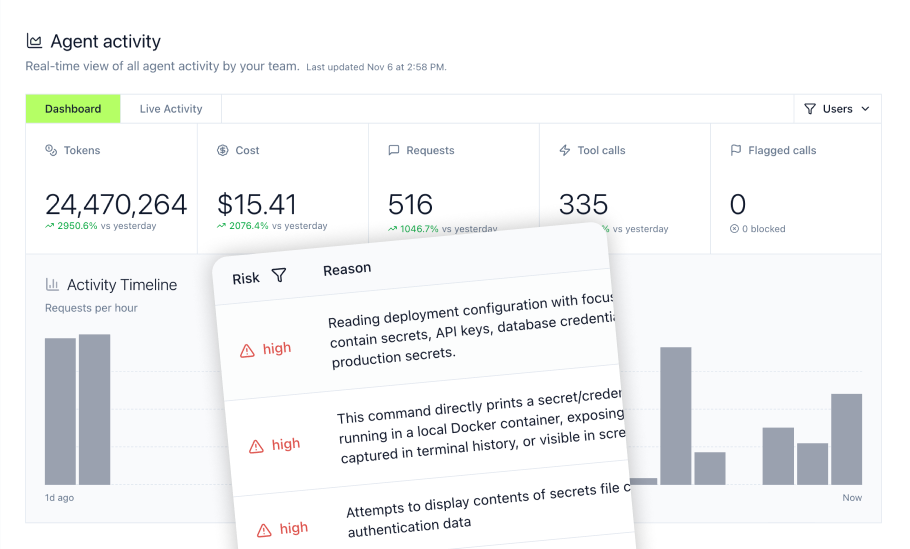
Coding agents and Claude skills with system access can read files, execute commands, and interact with production infrastructure. Mintive's Agent Monitor uses hooks in Claude Code, Cursor, GitHub Copilot, and Codex to capture file reads, commands, and MCP tool calls before they happen.
Critical protection capabilities:
- Tool call tracking: Monitor every MCP tool invocation, bash command, and file operation
- Dangerous command blocking: Prevent execution of destructive commands in real-time
- Sensitive file protection: Block access to
.envfiles, SSH keys, credentials, and configuration containing secrets - MCP inventory visibility: See all installed MCPs and their permissions across teams
Without monitoring, organizations cannot see what skills access or control their actions. Agent Monitor provides essential visibility for security teams managing AI tool deployments.
Auditing Command History for Compliance
Regulated industries require demonstrable control over AI system behavior. Agent Monitor maintains complete audit trails of:
- Every bash command executed by skills
- All file access attempts (successful and blocked)
- Tool call patterns across users and teams
- Configuration changes and permission modifications
These logs support SOC 2, HIPAA, and GDPR audit requirements while enabling forensic analysis when issues occur.
Building Your Claude Skill Validation Checklist: Key Areas
Functional Correctness: Does It Do What It's Told?
The Anthropic Skills Best Practices documentation emphasizes structured testing against defined success criteria:
Pre-creation validation:
- Task is genuinely repetitive (performed 3+ times weekly)
- Workflow articulated in 5 steps or fewer
- Success criteria defined with 2-3 example outputs
- Failure modes identified and documented
Development validation:
- YAML frontmatter uses lowercase, hyphenated naming
- Description includes WHAT (functionality) and WHEN (trigger contexts)
- Steps numbered or bulleted—no walls of text
- One instruction per step avoiding compound sentences
Performance & Scalability Under Load
Skills performing well in testing may degrade under production volumes. Validate:
- Response times acceptable with realistic data volumes
- Token usage stays within context limits for typical requests
- Progressive loading works correctly for reference files
- Rate limits handled gracefully with appropriate retry logic
The 500-line SKILL.md limit exists because larger files consume context inefficiently. Move detailed content to reference subdirectories that load only when needed.
Operationalizing Compliance: Audit Trails for Claude Skill Actions
Ensuring Deployment Architecture Verification
Organizations operating across jurisdictions face data residency requirements that constrain where AI processing occurs. Organizations with strict regional data-handling requirements should verify deployment architecture, hosting regions, and processing boundaries during evaluation rather than assuming explicit multi-region data residency controls.
The MCP Data Risk Framework outlines assessment criteria for evaluating skill security posture:
- Data classification: What sensitivity level does the skill access?
- Processing location: Where does inference occur?
- Retention policies: How long do logs and outputs persist?
- Access controls: Who can invoke the skill and view outputs?
Generating Compliance Reports for AI Tools
Compliance audits require demonstrable evidence of control implementation. Mintive's audit capabilities generate reports showing:
- Complete interaction logs with timestamps and user identification
- Access request approvals and denials
- Configuration change history with responsible parties
- Security event responses and remediation
For organizations subject to SOC 2 or GDPR-related audit requirements, these reports reduce audit preparation burden while providing reviewers the evidence trail they require.
User Access and Control: Validating Permissions for Claude Skills
Defining "Who Can Use Which AI Tools"
Not every employee should access every skill. A skill that modifies production databases requires different access controls than one that summarizes meeting notes.
Mintive's authentication models support:
- Shared service accounts: Admin-configured credentials for team-wide tool access
- Per-user OAuth flows: Individual authentication ensuring actions trace to specific users
- Granular tool access: Enable specific operations (read) while excluding others (write) by role
Centralized Management of API Keys for Secure Skill Interaction
Skills connecting to external services require credentials. Hardcoding API keys in SKILL.md files creates security vulnerabilities—anyone with skill access gains those credentials.
Centralized credential management through Mintive eliminates this risk:
- API keys and tokens stored securely outside skill files
- Credentials injected at runtime based on user permissions
- Rotation and revocation managed centrally without skill updates
- Audit trails track which credentials accessed which services
From Shadow AI to Sanctioned AI: The Mintive Approach
Transforming Local Skills into Production-Ready Services
The gap between a working prototype and production deployment spans more than technical functionality. Production skills require authentication, monitoring, compliance documentation, and ongoing maintenance—infrastructure most development teams lack.
Mintive's philosophy: "Deploy in minutes, not days. Turn shadow AI into sanctioned AI."
The transformation involves:
- One-click deployment: Local STDIO servers become hosted services without infrastructure management
- Automatic OAuth protection: Enterprise authentication wraps endpoints automatically
- Built-in monitoring: Usage tracking, performance metrics, and security alerts from day one
- Compliance alignment: SOC 2 Type II attestation and HIPAA-compliant security controls
Addressing Critical Enterprise AI Challenges
With only 18% of organizations having enterprise-wide AI governance councils, most companies lack frameworks for responsible skill deployment. Mintive provides the governance infrastructure that enables AI adoption without organizational risk.
The platform addresses:
- Cost control: Track spending per team, project, and tool
- Compliance requirements: Complete logs for regulatory audits
- Security governance: Policy enforcement and access controls
- Operational visibility: Real-time dashboards for monitoring usage patterns
For engineering leaders evaluating AI infrastructure options, Mintive's enterprise deployment guide provides implementation roadmaps based on organization size and compliance requirements.
Why Mintive for Claude Skills Validation and Production Deployment
Organizations deploying Claude Skills face a critical decision: build validation infrastructure in-house or adopt a purpose-built platform. Mintive eliminates the months-long timeline of custom infrastructure development by providing production-ready validation and governance from day one.
The platform's architecture addresses the complete validation lifecycle. During development, teams use Mintive's STDIO server deployment to test skills in controlled environments with full observability. Agent Monitor uses coding-agent hooks to capture tool calls and apply rules that block risky operations before they reach production systems. When skills interact with sensitive data sources like Snowflake or Gmail, centralized credential management ensures no API keys leak into skill files.
Pre-production validation benefits from Mintive's role-based access controls—staging environments can restrict skill access to QA teams, while production deployments can be limited to approved users and roles. The SOC 2 Type II attestation provides a stronger audit-readiness foundation without custom security buildout, particularly valuable for organizations in financial services or handling customer PII.
Post-deployment, continuous monitoring surfaces issues validation missed. Real-time dashboards track skill activation patterns, identifying undertriggering or overtriggering scenarios. Complete audit trails document every skill interaction, supporting forensic analysis when outputs diverge from expectations. For teams managing dozens of skills across multiple projects, this centralized observability transforms skill governance from reactive firefighting to proactive quality management.
Mintive positions its platform around faster deployment and centralized security controls, with a "deploy in minutes" approach intended to reduce infrastructure overhead without slowing AI adoption.
Frequently Asked Questions
How do I test Claude Skills across different model tiers?
Cross-model testing catches failures that only appear with lower-capability models. Test each skill with Claude Opus (highest capability), Sonnet (production workhorse), and Haiku (cost-optimized tier). Instructions that rely on implicit understanding may work with Opus but fail with Haiku. Document model-specific behaviors and either adjust instructions for universal compatibility or specify minimum model requirements in skill metadata.
What's the recommended process for updating production skills?
Production skill updates should follow the same validation checklist as new deployments. Create a copy of the existing skill, apply modifications, run the complete pre-production audit, then deploy using a staged rollout—initially to a subset of users before organization-wide availability. Maintain version history to enable rollback if issues emerge. Mintive's audit trails track configuration changes, providing forensic capability when updates cause unexpected behavior.
How do Claude Skills differ from MCP servers?
Claude Skills are instruction packages (SKILL.md files) that teach Claude domain expertise and workflows—they operate within Claude's native capabilities. MCP servers provide Claude with access to external tools and data sources through the Model Context Protocol. Use Skills when you need Claude to follow specific processes or apply organizational knowledge. Use MCP servers when Claude needs to query databases, call APIs, or interact with external systems. Many production deployments combine both: Skills reference MCP tools using qualified names like Snowflake:run_snowflake_query to access external data while following skill-defined workflows.
What validation is required for cross-team skills?
Cross-team skills require additional validation beyond single-team deployments. Test trigger accuracy with users from each target team—different teams often use different terminology for the same concepts. Validate that permission requirements work across organizational boundaries. Document skill capabilities and limitations clearly since users won't have access to the original developers for clarification. Consider creating team-specific skill variants if workflow requirements differ substantially between groups.
How should I handle skills accessing production systems?
Maintain separate skill versions for production and development environments with explicit environment indicators in skill names (e.g., process-invoices-prod vs. process-invoices-dev). Production skills should include additional safeguards: confirmation prompts before write operations, restricted access permissions, and comprehensive logging. Development skills can operate with relaxed controls for testing flexibility. Never deploy development-configured skills to production users—the access patterns and error handling requirements differ fundamentally.