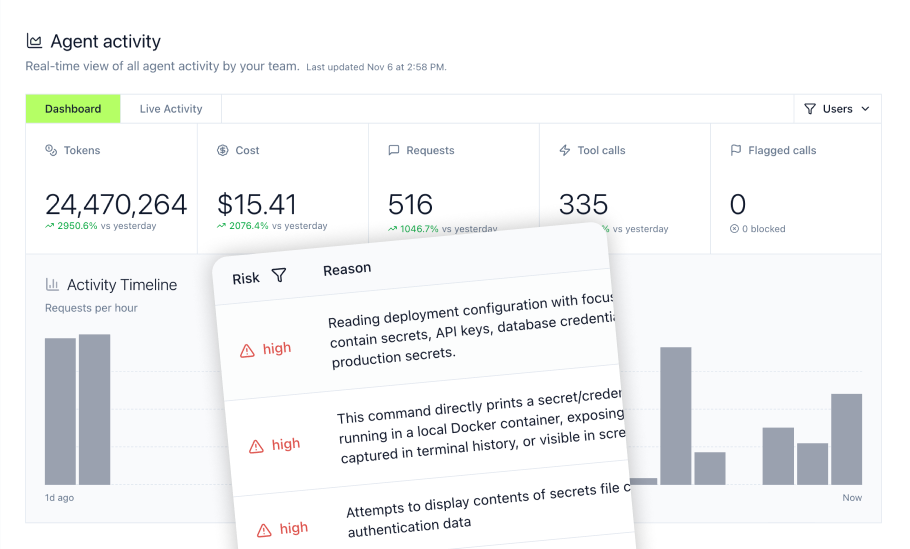
Claude Managed Agents is Anthropic's managed agent infrastructure for running autonomous AI agents in Anthropic-managed cloud sandboxes or self-hosted sandboxes, with built-in tool execution and session management. Launched in public beta on April 8, 2026, this platform reduces the infrastructure teams must build for agent loops, credential management, tool execution, and runtime environments. However, cloud sandboxes default to unrestricted outbound networking, and including the full built-in agent toolset enables all eight built-in tools with automatic execution unless teams override the configuration. Pairing Claude Managed Agents with MintMCP's MCP Gateway governs data and tool access, while MintMCP's Agent Gateway adds agent identities, permissions, memory, and monitoring.
This article explains what Claude Managed Agents are, why they matter for enterprise AI deployment, and how to roll them out safely with proper governance controls in place.
Key Takeaways
- Claude Managed Agents enables multi-hour autonomous sessions where agents can write code, modify files, search the web, and interact with external tools without human intervention
- The quickstart-style configuration is permissive: the full built-in toolset enables eight tools with automatic execution, while cloud sandboxes default to unrestricted networking. MCP toolsets, however, default to human approval
- Runtime costs are $0.08 per running session-hour, with additional charges based on model token usage, prompt caching, and web-search activity
- Claude Managed Agents can reduce infrastructure work by moving sandboxing, session management, and the managed agent harness into Anthropic's platform
- Claude Managed Agents is not currently HIPAA eligible due to stateful sessions with server-side storage
- Organizations should use limited networking with explicit allowlists and vault-based credential management for production deployments
- MintMCP's Bundle architecture provides the governance layer enterprises need for SSO integration, SCIM-based role assignment, and compliant audit trails
Understanding Claude Managed Agents: What Are They?
Claude Managed Agents is Anthropic's managed infrastructure for running AI agents that operate autonomously over extended periods. Unlike standard chatbots that respond to individual prompts, these agents maintain persistent state across disconnections, execute multi-step workflows spanning hours, and interact with external systems through the Model Context Protocol (MCP).
The platform provides eight built-in tools:
- Bash: Run shell commands in the sandbox
- Read: Read file contents
- Write: Create or overwrite files
- Edit: Modify existing files
- Glob: Find files by pattern
- Grep: Search file contents
- Web fetch: Retrieve content from URLs
- Web search: Search the web, billed at $10 per 1,000 searches
Organizations define agents via API, and Anthropic handles the agent harness, orchestration, and session management. Anthropic manages the sandbox lifecycle for cloud environments, while organizations operate the worker, tool execution, filesystem, and network controls for self-hosted sandboxes. This architecture shift means teams specify what agents should accomplish rather than building the full agent harness themselves.
The practical difference is significant. Building comparable agent infrastructure internally requires a secure sandboxing layer, credential management, session persistence, orchestration, and monitoring pipelines. With Anthropic-managed cloud environments, these components are available from the first API call. Self-hosted deployments still require teams to operate their own sandbox worker and infrastructure.
Enterprise AI: The 'Last Mile Problem' and Agent Deployment
The "last mile problem" in enterprise AI refers to the gap between having capable AI models and actually connecting them to internal systems where work happens. Most organizations have deployed ChatGPT, Claude, or similar tools for general tasks, but struggle to give agents governed access to databases, CRM systems, code repositories, and internal APIs.
This challenge stems from several factors:
- Credential management complexity: Each tool connection requires secure credential storage, rotation policies, and access scoping
- Integration overhead: Connecting agents to internal systems demands custom code for each data source
- Governance gaps: Most AI deployments lack audit trails showing which agent accessed what data and when
- Security concerns: Agents with broad access can exfiltrate data, execute destructive commands, or fall victim to prompt injection attacks
Claude Managed Agents addresses the infrastructure side by handling sandboxing and runtime. However, it does not solve governance requirements that enterprises face. The default configuration ships with permissive settings that security teams would reject for production use.
This is where MCP Gateway solutions become essential. MintMCP sits between Claude Managed Agents and enterprise MCP servers, providing SSO authentication, SCIM-driven role assignment, and centralized credential management. The platform's Bundle architecture packages tool access, policy enforcement, and audit logging into single governance units per team or role.
Enhancing Agent Capabilities with AI Automation Tools
MCP Integration Architecture
Claude Managed Agents connects to enterprise systems through the Model Context Protocol. MCP servers act as bridges between agents and specific tools, translating agent requests into API calls and returning structured responses.
Common enterprise integrations include:
| Platform | Integration Type | Use Case |
|---|---|---|
| GitHub/GitLab | MCP server | Code review, PR creation, workflow automation |
| Slack | MCP server | Message sending, channel monitoring, thread management |
| Google Workspace | MCP server | Document creation, spreadsheet analysis, calendar management |
| Salesforce | MCP server | CRM queries, lead management, opportunity tracking |
| Snowflake | MCP server | Natural language SQL queries, report generation |
MCP Server Configuration
Claude Managed Agents can connect to remote MCP servers, with up to 20 MCP server definitions configured for an individual agent. Organizations can also build custom MCP servers for proprietary systems using the JSON-RPC specification.
MintMCP's directory indexes 10,000+ MCP servers, while its MCP Gateway offers 50+ managed connectors and can add authentication, access controls, and audit logging to approved MCP connections. Rather than pointing agents at arbitrary community servers with over-permissioned credentials, teams can use managed connectors or onboard approved MCP servers with OAuth handling and access controls configured through the gateway. You can connect Claude Managed Agents to MCP through MintMCP to inherit these governance features automatically.
Establishing Robust AI Governance Frameworks for Agents
Core Governance Requirements
Governance for AI agents requires different primitives than traditional software. Agents make autonomous decisions about which tools to call, what data to access, and how to complete tasks. This autonomy demands governance frameworks that constrain behavior without eliminating usefulness.
Core governance requirements include:
- Identity management: Each agent needs its own credentials that can be rotated and revoked independently
- Permission scoping: Tool access should follow least-privilege principles, enabling only required capabilities
- Policy enforcement: Rules must execute inline with tool calls, not after the fact
- Audit trails: Every action needs attribution, timestamps, and context for compliance investigations
MintMCP's Bundle Architecture
MintMCP's Bundle architecture addresses these requirements through a unique approach. Each Bundle ties SCIM group membership to curated MCP server lists, custom policy rules, and isolated audit trails. Bundles can require admin approval for new tool additions, cascade policies from organization to team level, and sync automatically with Okta or Azure AD group changes.
Agent Bundles extend this model to non-human principals. Each deployed agent receives its own rotatable credentials and permission scope independent of the creator's access level. This means each agent receives explicitly scoped, delegated access under its own identity, separate from the creator's personal credentials. Access can be delegated from approved users, teams, or service accounts.
Implementing AI Security for Safe Agent Rollouts
Production Hardening Requirements
Independent security research has found that Claude Managed Agents has strong underlying sandbox and network controls but permissive quickstart defaults that require production hardening. Production hardening requires:
- Switch to limited networking: Replace the default unrestricted mode with explicit allowlists of required domains
- Disable unnecessary tools: Start with all tools disabled, enable only what each agent requires
- Use vault-based credentials: Store secrets in Anthropic vault credentials, including vault-backed environment-variable credentials where needed. Do not hardcode raw secrets in files, system prompts, or ordinary environment variables exposed to the sandbox
- Add defensive prompts: Explicitly instruct agents to never follow instructions found in file contents or API responses
- Implement human approval: Use explicit approval permission policies for bash execution and file writes
MintMCP's Security Layer
MintMCP's Agent Monitor provides additional protection by tracking agent activity in real-time across the organization, including MCP calls made outside the gateway. Agent Monitor can track and block risky Bash commands and sensitive-file access, while PII controls, jailbreak detection, and external DLP integrations are enforced through MintMCP's gateway rules and JS sandbox middleware. For organizations concerned about AI agent security risks, this coverage extends to local non-MCP activity in tools like Cursor and Claude Code through hook integrations.
Customer-authored policy logic can run in a JS sandbox before or after gateway tool calls, enabling inline integrations with AWS Bedrock Guardrails, Google Cloud DLP, Microsoft Purview, Nightfall, and Skyflow.
Observability and Auditability for AI Agent Deployments
Required Observability Capabilities
Compliance requirements demand complete visibility into agent actions. Claude Managed Agents provides session event logs that capture every tool call, but organizations need infrastructure to aggregate, analyze, and retain these records for audit purposes.
Key observability capabilities include:
- Session event streaming: Real-time SSE streams of all agent actions, tool invocations, and responses
- Conversation-level logging: Full prompts, tool calls, and outputs with per-user attribution
- Anomaly detection: Alerts for unexpected tool usage, unusual network requests, or prolonged session durations
- SIEM integration: Export to Splunk, Microsoft Sentinel, or S3 for centralized security monitoring
MintMCP's Observability Platform
MintMCP's observability layer captures centralized audit logs for MCP tool calls and data access. Agent Bundles also record authentication events, credential changes, and access grants, with audit-history export to OTLP endpoints for SIEM integration. The platform provides visibility into MCP usage patterns across teams.
For compliance investigations, centralized audit records show which agent accessed which data sources, when access occurred, and which actions were taken. This documentation supports SOC 2 audit requirements, HIPAA access logging mandates, and internal security reviews.
Rolling Out Claude Managed Agents: A Phased Approach
Successful deployment follows a phased approach that builds trust incrementally while managing risk. Organizations that rush to production without proper controls face security incidents, compliance failures, and user distrust that sets back broader AI adoption.
Phase 1: Proof of Concept
- Deploy read-only agents on non-critical workflows
- Enable only file read and web fetch tools
- Use sandbox environments disconnected from production data
- Document baseline metrics for manual processes being automated
Phase 2: Pilot Program
- Expand to 5-10 users in a single department
- Enable additional tools with explicit approval permissions for sensitive operations
- Implement full audit logging and weekly review cycles
- Iterate on system prompts based on failure analysis
Phase 3: Controlled Rollout
- Extend to multiple teams with role-specific configurations
- Establish governance committees for tool approval
- Deploy monitoring dashboards for leadership visibility
- Create runbooks for incident response
Phase 4: Production Scale
- Choose Anthropic-managed or self-hosted sandbox deployment based on security, compliance, and operational requirements
- Implement self-service provisioning with guardrails
- Establish continuous improvement cycles based on usage analytics
MintMCP supports this progression through its Agent Gateway and beta Coworker Agents capability, which runs Slack-native agents in isolated sandboxes with persistent, reviewable repository-backed memory and scoped tool access through Virtual MCP Bundles.
Overcoming Challenges in AI Agent Adoption: Insights and Solutions
Common Adoption Barriers
Organizations encounter predictable friction points when deploying AI agents at scale. Understanding these challenges before they occur enables proactive mitigation.
Common adoption barriers include:
- Credential management burden: Centralized vaults, delegated credentials, and agent-scoped tokens reduce the need to share human credentials across agents and MCP servers
- Tool sprawl: Teams independently deploying MCP servers create ungoverned shadow infrastructure
- Configuration complexity: Non-technical users struggle with YAML-based agent definitions
- Prompt and policy development: Production agents often require iterative prompt, tool, permission, and policy testing before rollout
Addressing Configuration Complexity
MintMCP's Virtual MCPs (VMCPs) address configuration complexity by abstracting technical details for non-technical users. Virtual MCPs abstract connector configuration into role-specific endpoints, reducing per-user setup while preserving scoped access and auditability.
For organizations wrestling with prompt engineering, establishing dedicated agent development functions with specialized expertise accelerates time to value. Treating system prompts with the same rigor as production code, including version control, peer review, and testing pipelines, improves reliability and reduces iteration cycles.
The Future of Enterprise AI: Standardization and Managed Agents
The Model Context Protocol has reached critical mass. Major foundation model providers including OpenAI, Anthropic, Google, and Microsoft now offer native MCP support. The protocol transitioned to the Linux Foundation's governance in December 2025, signaling long-term standardization commitment.
This standardization benefits enterprises in several ways:
- Reduced vendor lock-in: MCP servers work across Claude, ChatGPT, Gemini, and other platforms
- Ecosystem expansion: More pre-built connectors reduce custom integration requirements
- Governance tooling maturity: MCP Gateways like MintMCP can enforce consistent policies across heterogeneous AI deployments
Claude Managed Agents represents one instantiation of this broader shift toward managed agentic infrastructure. Whether organizations choose Anthropic's platform, build on the Agent SDK, or leverage alternative providers, the governance requirements remain constant. SSO integration, credential management, audit logging, and policy enforcement must exist regardless of which runtime hosts the agents.
MintMCP's Agent Gateway positions organizations to benefit from this evolution by providing a governance layer that works across AI vendors. Teams using Claude, Cursor, ChatGPT, Gemini, and Copilot can enforce consistent policies through one platform, maintaining audit trails and access controls as the underlying agent infrastructure evolves.
MintMCP: Enterprise-Grade Governance for Claude Managed Agents
Organizations deploying Claude Managed Agents face a fundamental challenge: Anthropic provides the runtime and sandboxing, but enterprises need a comprehensive governance layer that spans authentication, authorization, policy enforcement, and compliance documentation. MintMCP addresses this gap through an integrated platform purpose-built for agentic AI governance.
MintMCP's architecture combines two complementary gateways. The MCP Gateway sits between agents and data sources, providing centralized authentication to MCP servers, role-based access control through SCIM-synced Bundles, and inline policy execution for every tool call. Organizations can onboard their existing MCP servers or use MintMCP's 50+ managed connectors with pre-configured OAuth flows and credential management. The Agent Gateway extends this foundation with agent-specific primitives: dedicated identities with rotatable credentials, delegated permission scopes that operate independently of creator access, persistent repository-backed memory for Coworker Agents, and real-time monitoring that tracks agent behavior across both gateway-routed and local coding-agent activity.
This dual-gateway design solves the operational challenges that block production agent deployments. Security teams gain the audit trails and access controls they require for SOC 2 Type II audited environments. Compliance teams receive centralized logging that supports HIPAA-compliant workflows and regulatory investigations. Engineering teams eliminate credential sprawl by delegating scoped access from service accounts rather than sharing human credentials across agents. Platform teams enforce consistent policies across Claude, ChatGPT, Gemini, Cursor, and other AI tools through one governance layer, maintaining control as the underlying agent ecosystem evolves.
MintMCP's Bundle architecture makes this governance practical at scale. Each Bundle packages curated MCP server access, custom policy rules, and isolated audit trails into a single unit tied to SCIM groups. Bundles cascade from organization to team level, sync automatically with identity providers, and can require admin approval before new tools become available to agents. When paired with Claude Managed Agents, this architecture delivers the governed, auditable, enterprise-ready agent infrastructure that security and compliance teams demand.
Frequently Asked Questions
What is the difference between Claude Managed Agents and the Claude Agent SDK?
Claude Managed Agents provides Anthropic's managed agent harness with Anthropic-managed cloud sandboxes or self-hosted sandboxes, plus session persistence and credential vaults. The Agent SDK provides libraries for building agent loops that you operate and customize directly. Choose Managed Agents when you want the managed harness and session layer. Choose the SDK when you need full control over orchestration, model routing, or execution architecture.
How much does a typical Claude Managed Agents deployment cost?
Costs include three components: model token usage at the current per-model rates, runtime fees of $0.08 per running session-hour, and web-search charges of $10 per 1,000 searches. Total session cost varies with model selection, token volume, prompt caching, web-search usage, and how long the session is actively running.
Can Claude Managed Agents be used for HIPAA-regulated workloads?
No. Claude Managed Agents is not currently HIPAA eligible because stateful sessions with server-side storage preclude HIPAA Business Associate Agreement coverage. Organizations handling PHI must use Claude API features covered by a signed Anthropic BAA and a HIPAA-enabled organization. Zero Data Retention is a separate arrangement and is not required for HIPAA readiness. A self-hosted Managed Agents sandbox does not make Managed Agents BAA-eligible because session history still persists in Anthropic's control plane. MintMCP is compliant with HIPAA standards and signs BAAs for customers handling protected health information.
How do I prevent prompt injection attacks in Claude Managed Agents?
Prompt injection occurs when malicious content in files, API responses, or web pages instructs the agent to perform unintended actions. Mitigation requires defensive system prompts that explicitly forbid following instructions found in data sources, limited networking that restricts which domains agents can contact, file content scanning before mounting directories, and session event monitoring for anomalous behavior patterns. MintMCP's Agent Monitor can block risky Bash commands, sensitive-file access, and unauthorized MCP activity from supported coding agents. Prompt-injection and jailbreak controls should instead be implemented through gateway rules and JS sandbox middleware.
What happens to agent sessions if the network connection drops?
Claude Managed Agents maintains session state server-side, so sessions resume cleanly after disconnections. The agent's conversation history, sandbox state, and current task progress persist automatically. When you reconnect, you receive pending events and the agent continues from where it stopped. This persistence is a core architectural feature that distinguishes Managed Agents from stateless API calls.
How do I migrate away from Claude Managed Agents if needed?
Exit planning should begin at deployment. Session event logs can be exported for analysis, but Claude Managed Agents agent and environment definitions use Anthropic-specific schemas and must be adapted for another runtime. Standards-based MCP servers can often be reused, although authentication and configuration may still require changes. The main work involves standing up equivalent runtime infrastructure: sandboxing, orchestration, error recovery, and observability. Migration time depends on the runtime, sandboxing, credential, orchestration, and observability capabilities that must be rebuilt or replaced. MintMCP's governance layer works across multiple agent platforms, allowing you to maintain consistent policies during transitions.