Your team's shared Google Doc has 47 saved prompts. Every morning, you copy-paste the same instructions into Claude, explaining your brand voice, reporting format, and analysis framework—again. New hires ask "which prompt do I use for this?" and get conflicting answers. You've successfully given everyone AI access, but you haven't scaled AI expertise. While organizations are rapidly expanding AI use, the gap between casual adoption and enterprise-ready deployment is costing businesses more than they realize. The solution lies in moving beyond one-shot prompting to structured, governed AI workflows—a transition that platforms like Mintive Gateway (formerly MintMCP) make possible through centralized MCP deployment, security controls, and compliance audit trails.
This article explains why traditional prompting fails at scale, how Claude Skills solve the hidden costs of repeated instructions, and what governance infrastructure enterprises need to deploy AI tools safely across teams.
Key Takeaways
- One-shot prompting creates three hidden costs: token waste from repeated context, inconsistent outputs across team members, and training overhead for every new hire
- Claude Skills use progressive disclosure, loading a lightweight overview first and pulling detailed instructions only when needed—making it easier to maintain multiple workflows without unnecessary context bloat
- Production-ready Skills need operational discipline, and Mintive's Claude Skills guide emphasizes practical patterns like letting the AI draft the Skill, shipping before/after artifacts, and using validation checklists before rollout
- As AI usage spreads through disconnected tools and personal workflows, governance becomes essential—Mintive provides the audit trails and access controls missing from standalone Claude deployments
- Skills alone do not solve enterprise governance, because organizations still need centralized access controls, auditability, and policy enforcement around AI tool use
- Mintive's three enterprise guides—Claude Skills Tips, Claude Cowork, and MCP Data Risk—provide actionable frameworks for scaling AI operations safely
The Limitations of One-Shot Prompt Engineering for Enterprise Claude Deployments
When Simple Prompts Fall Short
One-shot prompting works for individual exploration but breaks down the moment you try to scale. Every conversation starts fresh—Claude has no memory of your company's reporting standards, brand voice guidelines, or analysis frameworks. The result is three compounding costs that most organizations don't track:
Token Bloat Tax: Copy-pasting the same 2,000-word context into every chat consumes your usage limits and increases response latency. A team of 10 running 20 AI-assisted tasks daily wastes 400,000 tokens on repeated instructions alone.
Consistency Debt: When five analysts interpret "follow brand guidelines" differently, you get five different output styles. Quality becomes unpredictable, requiring senior review of AI-generated work that should be routine.
Training Overhead: Every new hire needs "how to prompt AI" onboarding. Without standardized workflows, institutional knowledge stays locked in individual prompt libraries that walk out the door when employees leave.
Why Enterprise AI Needs More Than Just Good Prompts
McKinsey's latest AI survey shows that adoption is broad, but most organizations still have not embedded AI deeply enough into workflows to realize material enterprise-level benefits. The gap isn't prompt quality—it's infrastructure. Enterprises need:
- Reusable workflows that encode expertise once and deploy organization-wide
- Automatic triggering so users don't need to remember which prompt applies
- Governance controls showing who used which AI capability, when, and with what data
- Compliance documentation for SOC2, HIPAA, and GDPR requirements
Claude Skills address the first two needs. Mintive's enterprise guides address all four by combining Skills best practices with gateway-level security and observability.
Unlocking Claude's True Potential: From Basic Prompts to Advanced MCP Skills
What Are Claude Skills?
Skills are packaged instruction sets—SKILL.md files with optional scripts and resources—that Claude automatically uses when relevant. Unlike prompts you paste repeatedly, Skills install once and trigger based on conversation context. The architecture uses progressive disclosure: only metadata loads at startup, with full instructions activating only when needed.
This design enables teams to maintain multiple specialized workflows without exhausting context windows. A finance team can have separate Skills for variance analysis, budget forecasting, and expense categorization—all available simultaneously without competing for token space.
Configuring Claude with Mintive's Centralized Gateway
While individual users can create personal Skills through Claude's built-in skill-creator, enterprise deployment requires centralized management. Mintive's MCP Gateway provides:
- One-click installation of pre-configured MCP servers with built-in governance
- Virtual servers enabling team-based access controls—marketing sees marketing Skills, finance sees finance Skills
- OAuth protection wrapping any local MCP server with enterprise authentication automatically
- Audit logging of every Skill invocation for compliance documentation
The Claude Skills Tips guide focuses on three practical ideas for rollout: let the AI help write the Skill, ship before/after artifacts that show the improvement clearly, and use validation checklists to catch quality issues before production.
Enterprise Compliance and Security: Protecting Claude's Internal Tool Access
The Governance Gap in Standalone Skills
Claude Skills alone don't provide visibility into data access patterns. You can deploy a Skill that queries your Snowflake warehouse, but without additional infrastructure, you cannot answer:
- Which employees used that Skill last month?
- What data did they access?
- Did any queries touch PII without proper authorization?
- Are usage patterns consistent with job functions?
For organizations in regulated industries, these blind spots create audit failures. Many organizations still lack mature, enterprise-wide AI governance even as regulators and procurement teams increasingly expect documentation of AI-to-data interactions.
Mintive's Security Layer for Claude Deployments
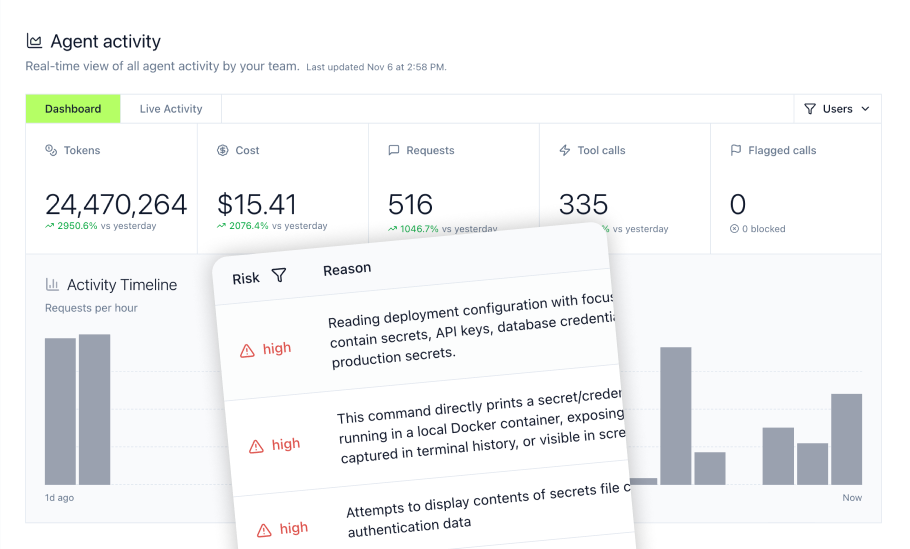
Mintive addresses governance gaps through its Agent Monitor, whose hooks capture Claude Code actions before execution, and its MCP gateway for tool access control:
Complete Audit Trails: Every MCP tool invocation, bash command, and file operation gets logged. The security documentation details how these logs support auditability, internal controls, and regulated review processes.
Granular Access Controls: Configure tool access by role—enable read-only operations for analysts while restricting write tools to administrators.
Real-time Guardrails: Block dangerous commands, protect sensitive files (.env, SSH keys, credentials), and alert on anomalous usage patterns.
Sensitive File Protection: Prevent AI agents from accessing configuration files that could expose production credentials.
The MCP Data Risk guide provides a framework for assessing which data sources are appropriate for AI access, classification criteria for sensitive information, and implementation patterns that balance utility with protection.
Scaling Claude Workflows: Bridging AI Tools with Internal Data and Services
Connecting Claude to Enterprise Systems
Skills define what Claude should do. MCP servers define what Claude can access. The combination enables AI workflows that span internal systems:
Data Analysis: The Snowflake MCP Server lets Claude query data warehouses using natural language. Finance teams automate reporting; product teams run cohort analysis—all with governance controls ensuring appropriate access.
Customer Support: The Gmail MCP Server enables Claude to search, draft, and send communications within approved workflows. Support tickets get faster responses with consistent tone.
Knowledge Management: The Elasticsearch MCP Server powers AI-accessible knowledge bases. HR teams build instant policy lookup; product teams create documentation search.
The Cowork Pattern for Business Teams
Mintive's Claude Cowork guide is structured as a practical onboarding path for non-engineers, covering why Cowork matters, what to do in your first 15 minutes, which connectors and systems plug in cleanly, and which repeatable workflow patterns tend to stick.
Cowork patterns enable:
- Business analysts creating data transformation Skills without SQL expertise
- Marketing teams building content production workflows using brand guidelines
- Operations staff automating report generation from multiple data sources
The guide includes templates for common use cases, reducing the "blank page problem" that stalls AI adoption in non-technical departments.
From Shadow AI to Sanctioned AI: Governing Claude Across the Enterprise
The Shadow AI Problem
When IT restricts AI access, employees find workarounds. Personal Claude accounts proliferate. Sensitive data gets pasted into consumer AI tools without audit trails. Shadow AI continues to spread through personal accounts and disconnected tools—and the solution isn't more restriction. It's providing governed alternatives that are easier to use than shadow tools.
Mintive's Governance Framework
Mintive Gateway transforms shadow AI into sanctioned AI through:
Enterprise SSO: SAML and OIDC integration with existing identity providers means users authenticate once. No separate Claude credentials to manage or leak.
Role-Based Access Control: Define which teams access which MCP servers. Sales connects to CRM data; engineering connects to repositories; neither sees the other's tools without explicit permission.
Policy Enforcement: Automatic enforcement of data access policies. If an MCP tool shouldn't touch customer PII, the gateway blocks it—regardless of what users attempt.
Self-Service Access: Developers request AI tool access through governed workflows, receiving instant provisioning instead of waiting for IT tickets.
This approach increases AI adoption by removing friction while maintaining the controls compliance teams require. The goal is to reduce friction for users while still giving security and compliance teams centralized control.
Optimizing Claude Agent Performance and Cost with Centralized Observability
Visibility Into AI Operations
Without centralized monitoring, AI costs become unpredictable. Teams exceed usage limits, hit rate throttling, and can't explain why certain workflows take longer than others.
Mintive's observability layer provides:
- Real-time usage tracking across Claude Code, Cursor, ChatGPT, and other clients
- Cost analytics with breakdown by team, project, and tool
- Performance metrics showing response times, error rates, and usage patterns
- Data access logs documenting exactly what each AI tool accesses
Budget Control and Capacity Planning
Enterprise AI deployments require predictable costs, so Mintive's LLM gateway enforces per-group budgets that stop new model calls at the limit and allowed-model lists that control model choice. Usage and cost per call also help teams plan capacity through:
- Reviewing model usage against group budgets
- Identifying high-consumption workflows for optimization
- Forecasting capacity needs based on adoption trends
- Allocating AI costs to appropriate business units
The payoff from governed AI workflows can be significant, but realizing it depends on visibility into which tools are being used, where costs are accumulating, and which workflows need refinement.
Rapid Deployment and Enterprise Readiness for Claude with Mintive Gateway
Deploy in Minutes, Not Months
Traditional MCP deployment requires local installations, credential management, and manual security configuration. Mintive's one-click deployment transforms this process:
- STDIO server hosting: Deploy containerized MCP servers without local installations
- Automatic OAuth wrapping: Add enterprise authentication to any MCP server instantly
- Pre-configured compliance: Built-in audit logging, access controls, and monitoring
The deployment guide details implementation patterns for common enterprise scenarios, from pilot programs to full-scale rollouts.
Enterprise Infrastructure Features
Production AI deployments require infrastructure enterprises can trust:
- Enterprise security controls: SSO/SCIM, audit logging, and SIEM export
- Encryption protections: TLS 1.3 in transit and AES-256 at rest
- SOC 2 Type II attestation: Independently audited security controls
Real-World Applications of Claude with Mintive
Finance Teams
Use case: Monthly variance analysis and reporting
Before Skills: 8 hours manually analyzing Excel data, applying formulas, and formatting presentations
After Skills + Mintive: 1 hour with consistent format, automatic anomaly detection, and complete audit trail
Result: Faster reporting cycles with more consistent outputs and better auditability
Legal Teams
Use case: Vendor contract review
Before Skills: Junior attorneys produce inconsistent risk assessments; senior attorneys spend time on first-pass reviews
After Skills + Mintive: Standardized 15-point checklist encoded in Skill; junior attorneys produce senior-level output; governed access to contract database
Result: More consistent first-pass reviews and clearer governance around document access
Marketing Teams
Use case: Content production at scale
Before Skills: Variable brand voice across writers; 2 hours editing per blog post; SEO optimization frequently missed
After Skills + Mintive: Brand guidelines encoded in Skill; automatic SEO optimization; consistent structure across all content
Result: Higher throughput with more consistent editorial output
Why Enterprise-Grade Governance Matters
Organizations that move from ad-hoc prompting to governed Skills deployments consistently report three transformative outcomes: institutional knowledge that survives employee turnover, predictable AI costs that finance teams can budget, and compliance documentation that satisfies auditors on the first review.
Mintive Gateway makes this transition practical by solving the operational gap between Claude Skills and enterprise requirements. While Skills standardize what Claude does, Mintive standardizes who can invoke those Skills, which data they touch, and how usage is tracked. The combination turns AI from a productivity experiment into governed infrastructure.
The platform's strength lies in meeting security teams where they are: SAML integration eliminates shadow accounts, role-based access control maps cleanly to existing org structures, and SIEM export feeds AI activity into the same monitoring stack used for other critical systems. For development teams, the value is speed—virtual MCP servers deploy in minutes, OAuth wrapping eliminates credential management, and pre-built connectors for Snowflake, Gmail, and Elasticsearch reduce integration work from weeks to hours.
Start with Mintive's three enterprise guides: Claude Skills Tips for converting prompt libraries, Claude Cowork for non-technical user onboarding, and MCP Data Risk for defining what AI should access. These frameworks, combined with Gateway's security controls, provide the foundation for scaling AI operations safely across hundreds or thousands of users.
Frequently Asked Questions
How do Claude Skills differ from ChatGPT Custom GPTs?
Skills use progressive disclosure architecture, loading a lightweight overview first versus full context loading for GPTs. Multiple Skills compose automatically in single conversations—you don't need to switch between specialized assistants. Skills also trigger based on conversation context rather than requiring manual selection. However, GPTs offer public sharing via GPT Store, which Skills currently lack.
Can I use Claude Skills without Mintive?
Yes. Individual users can create and use Skills directly in Claude, without Mintive. However, standalone Skills lack enterprise governance: no visibility into which Skills employees use, no centralized access controls, and no audit trails for compliance. Mintive adds the security and observability layer that transforms Skills from personal productivity tools into enterprise infrastructure.
What happens if a Skill triggers when I don't want it to?
Skill triggering depends on description quality. Vague descriptions cause inappropriate activation; overly specific descriptions prevent legitimate triggering. The Claude Skills Tips guide covers trigger optimization techniques. As a workaround, you can always explicitly invoke Skills by name ("Use my financial-analysis Skill") or disable specific Skills temporarily in Claude settings.
How do I migrate existing prompt libraries to Skills?
Start with high-frequency, high-value prompts: the ones your team copy-pastes most often. Use Claude's built-in tooling to turn those into draft Skills, compare before/after artifacts so the improvement is obvious, and run a validation checklist before broader rollout. The Claude Skills Tips guide is especially useful here because it focuses on practical conversion and quality-control patterns rather than one-off prompting tricks.
What compliance certifications does Mintive have?
Mintive Gateway maintains SOC 2 Type II attestation. The platform provides complete audit logs supporting SOC2, HIPAA, and GDPR compliance requirements. For detailed security documentation, visit the security overview.
How does Mintive handle data residency requirements?
For data-location requirements, contact Mintive directly during security review to confirm available deployment options.
What's the ROI timeline for implementing Skills with Mintive governance?
ROI depends on how often teams repeat the same workflows, how much review and rework those workflows currently require, and how much governance overhead exists today. The fastest wins usually come from converting high-frequency prompt libraries into reusable Skills, then layering governance and observability on top as usage spreads.