GitHub Copilot now powers more than 26 million users, with 90% of Fortune 100 companies adopting AI coding assistants. While these tools promise up to 55% faster coding in controlled studies, they introduce security vulnerabilities that traditional scanning tools miss entirely. In a HiddenLayer survey, 77% of organizations reported breaches involving their AI systems in the past year—underscoring the need for governance across AI tooling, making security architecture as critical as functionality. Enterprise teams require solutions like MCP Gateway to enforce authentication, audit trails, and centralized governance across all AI tool interactions.
This article outlines the specific security risks GitHub Copilot introduces to enterprise environments, provides compliance frameworks for regulated industries, and details the controls necessary to achieve AI productivity gains without compromising organizational security.
Key takeaways
- Secret leakage runs 40% higher in repositories using Copilot than traditional development, with GitGuardian reporting 6.4% of repositories using Copilot had leaked secrets
- Enterprise deployment requires 60-90 days, not the "minutes" vendors advertise—proper security configuration demands cross-functional teams spanning security, compliance, and development leadership
- **First-year total cost can vary widely for 100-developer teams once you add security reviews, enablement, and integrations—**often exceeding license spend when accounting for licenses, security reviews, integrations, and learning curve productivity loss
- Unified governance platforms provide the only scalable approach for organizations using multiple AI tools (Copilot, Claude, ChatGPT) simultaneously
Understanding the enterprise challenge of 'shadow AI in coding
Shadow AI—developers using unapproved AI tools without IT oversight—grows 120% year-over-year. Engineers install ChatGPT extensions, paste proprietary code into Claude, and configure Copilot on personal accounts to accelerate their work. This creates an invisible attack surface that security teams cannot monitor, audit, or protect.
The productivity pressure driving shadow AI adoption is real. AI coding assistants deliver measurable gains: 8.69% increase in pull requests per developer, 84% improvement in successful builds, and meaningful time savings on repetitive tasks (varies by team and workflow). Blocking these tools outright pushes developers toward workarounds that create greater risk.
The core challenge: Organizations must enable AI tools that developers want while maintaining the security controls that enterprises require. This balance demands:
- Centralized visibility into which AI tools teams are using
- Policy enforcement that doesn't slow development workflows
- Audit trails satisfying SOC2, HIPAA, and GDPR requirements
- Real-time blocking of risky tool calls before data exposure occurs
Enterprises addressing shadow AI effectively don't prohibit AI tools—they provision sanctioned alternatives with proper governance through platforms like MCP Gateway that turn shadow AI into sanctioned AI.
Code snippet risks: Supply chain vulnerabilities and intellectual property exposure
GitHub Copilot trains on billions of lines of public code, creating two distinct risk categories: suggesting code with existing vulnerabilities and potentially exposing proprietary algorithms to external systems.
Supply chain vulnerability risks:
- 29.1% of AI-generated Python code contains security weaknesses including SQL injection, cross-site scripting, and authentication bypass vulnerabilities
- AI suggestions sometimes include deprecated libraries with known CVEs
- Copilot may recommend code patterns that mirror vulnerable open-source implementations
- Package suggestions may reference hallucinated or non-existent packages, creating supply chain confusion
Intellectual property exposure:
- Developers paste proprietary algorithms into prompts, transmitting trade secrets to external AI models
- Code context windows up to 4,000 tokens may include sensitive business logic
- Without proper tier selection, customer code enters training datasets
- CamoLeak vulnerability (CVSS 9.6) demonstrated how prompt injection techniques could extract private source code
Organizations must treat AI-generated code as untrusted external contributions requiring the same security review as third-party libraries. Automated scanning tools specifically designed for AI-generated vulnerabilities become mandatory, not optional.
Data exfiltration and sensitive information leakage via code assistants
AI coding assistants create new data exfiltration vectors that bypass traditional DLP controls. Unlike email or cloud storage, code completion tools transmit data through IDE extensions that most security tools ignore.
Primary leakage mechanisms:
- Prompt context leakage: Copilot analyzes surrounding code to generate suggestions, potentially transmitting sensitive configuration data
- Credential exposure: Developers working near .env files or configuration blocks may inadvertently include secrets in prompt context
- Training data incorporation: Free/Pro tiers include no guarantees against code entering training datasets
Research demonstrates repositories using Copilot exhibit 6.4% secret leakage rates—40% higher than traditional development. Exposed secrets include AWS credentials, database passwords, API tokens, and SSH keys.
Mitigation requirements:
- Integrate secrets scanning (e.g., GitGuardian/TruffleHog) and enforce centralized AI governance so risky prompts/tool calls can be blocked and audited
- Exclusion of sensitive repositories from AI tool access entirely
- LLM Proxy deployment to block dangerous commands and protect sensitive files
- Content filtering rules configured for organization-specific sensitive patterns
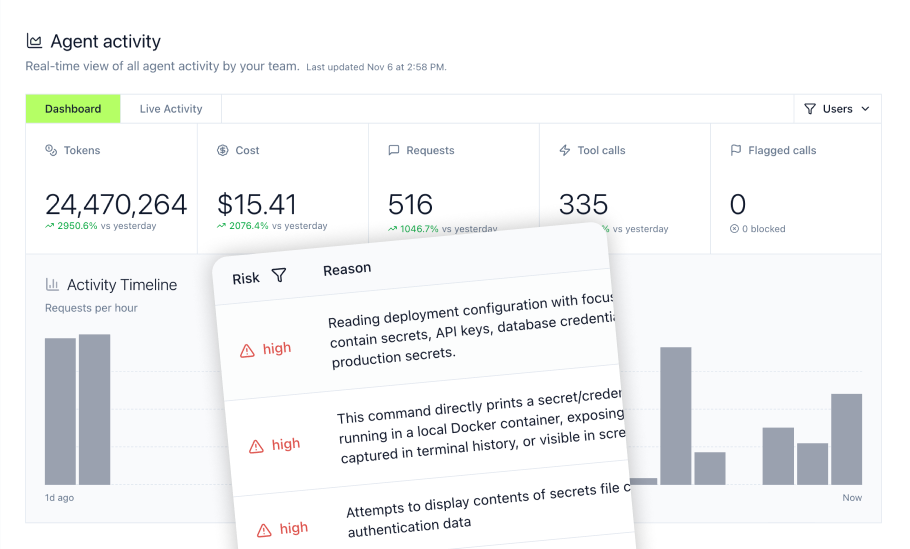
The LLM Proxy provides essential protection by monitoring every tool invocation, blocking risky operations like reading environment secrets, and maintaining complete audit trails of all file access and command execution across coding agents.
The OWASP top 10 for AI and how copilot intersects with traditional web app security
AI coding assistants introduce novel attack vectors that extend beyond traditional OWASP Top 10 categories while simultaneously amplifying existing web application vulnerabilities.
Traditional OWASP vulnerabilities amplified by AI:
- Injection flaws: AI suggestions may include unsanitized user inputs in database queries, replicating patterns from training data
- Broken authentication: Copilot sometimes suggests hardcoded credentials or insecure session management patterns
- Security misconfiguration: Default configurations in AI-suggested code often lack production hardening
- Vulnerable components: Suggestions may reference outdated library versions with known exploits
AI-specific vulnerabilities (OWASP LLM Top 10):
- Prompt injection: Attackers craft malicious code comments that manipulate AI suggestions to insert vulnerabilities
- Training data poisoning: Malicious code in public repositories can influence future AI suggestions
- Sensitive information disclosure: AI models may memorize and reproduce sensitive patterns from training data
- Insecure output handling: AI-generated code executed without validation creates arbitrary code execution risks
Organizations should pair governance (tool-call visibility/control) with their existing AppSec scanners (e.g., Semgrep/CodeQL) to catch insecure patterns in AI-generated code
Ensuring compliance: GDPR HIPAA and SOC2 considerations for ai-generated code
Regulatory compliance frameworks weren't designed for AI-assisted development, creating ambiguity that enterprises must address proactively.
SOC2 requirements:
- GitHub provides Copilot compliance reporting (for example, SOC reporting is available for Copilot Business/Enterprise
- Complete audit logging of all AI interactions mandatory for Trust Services Criteria
- Third-party vendor assessments must now include AI coding tool providers
HIPAA considerations:
- If you have HIPAA obligations, treat PHI in prompts as prohibited unless your legal team has a signed BAA (or equivalent) covering the specific AI service
- PHI must never enter AI prompt context—requires repository exclusion policies
- Audit trails must demonstrate AI tool access controls and data handling
- Healthcare organizations report additional 3-6 months validation requirements
GDPR implications:
- Microsoft Data Protection Agreement supports GDPR requirements for Business/Enterprise tiers
- Data subject access requests must include AI interaction logs
- Cross-border data transfer concerns when prompts transmit to US-based AI models
- Right to erasure extends to any personal data in AI training (zero-training guarantee required)
MCP Gateway provides complete audit logs for SOC2, HIPAA, and GDPR compliance across all AI tool interactions, centralizing compliance documentation that would otherwise require management across multiple vendor platforms.
Implementing security controls: From access management to Real-Time monitoring
Secure GitHub Copilot deployment requires layered controls spanning identity management, content filtering, and continuous monitoring.
Identity and access management:
- SAML 2.0 SSO integration with existing identity providers (Okta, Azure AD)—20-30 hours IT effort
- SCIM provisioning for automated user lifecycle management
- Role-based access controls determining which developers access which repositories
- Repository-level exclusions for sensitive codebases (payment processing, authentication systems)
Content filtering configuration:
- Enable "Block suggestions matching public code" filter—not enabled by default
- Configure organization-specific sensitive data detection patterns
- Set up code exclusion rules for regulated data handling functions
- Deploy secrets scanning integration for real-time credential detection
Monitoring infrastructure:
- SIEM integration (Splunk, Datadog, CloudWatch) for audit log forwarding—25-35 hours setup
- Real-time alerting for anomalous AI tool usage patterns
- Dashboard implementation for compliance reporting
- Quarterly security reviews by professional firms ($8K-$15K each)
Organizations requiring unified control across multiple AI tools benefit from MCP Gateway's OAuth and SSO enforcement, which automatically wraps enterprise authentication around any MCP endpoint regardless of vendor.
Governance frameworks: Centralized control over AI assistant tooling and usage
Only 18% of organizations have established enterprise-wide AI governance councils, yet organizations with formal AI strategies report 80% success rates versus 37% for those without structured approaches.
Essential governance components:
- Policy documentation: Clear guidelines on approved AI tools, acceptable use cases, and prohibited actions
- Tool inventory: Complete visibility into installed AI assistants, their permissions, and usage patterns
- Rate controls: Limits on AI API consumption to manage costs and prevent abuse
- Exception handling: Defined processes for developers requiring access outside standard policies
Governance implementation timeline:
- Weeks 1-4: Security assessment, pilot group identification, risk documentation
- Weeks 5-8: SAML integration, audit logging, content filtering configuration
- Weeks 9-12: Developer training, policy rollout, scaled deployment
- Ongoing: Quarterly policy reviews, security assessments, compliance audits
The LLM Proxy supports governance frameworks by providing complete visibility into installed MCPs, monitoring usage patterns across teams, and enabling granular tool access control by role. This visibility transforms fragmented AI tool usage into governed, auditable infrastructure.
Observability and auditability: Gaining visibility into ai-assisted development workflows
Coding agents operate with extensive system access—reading files, executing commands, and accessing production systems through MCP tools. Without monitoring, organizations cannot see what agents access or control their actions.
Required observability capabilities:
- Tool call tracking: Monitor every MCP tool invocation, bash command, and file operation from all coding agents
- MCP inventory: Track which MCPs are installed and their usage across development teams
- Command history: Complete audit trail of every bash command, file access, and tool call for security review
- Real-time dashboards: Live monitoring for server health, usage patterns, and security alerts
Audit trail requirements for compliance:
- Every AI interaction logged with timestamp, user identity, and action taken
- Prompt content captured for security review (with appropriate retention policies)
- Tool invocations correlated with code changes for incident investigation
- Export capabilities for external audit firm review
Organizations using multiple AI tools face fragmented visibility across vendor platforms. Understanding MCP gateways enables consolidation of audit trails into unified compliance documentation regardless of which AI tools individual developers prefer.
Protecting enterprise data: Guardrails for AI agent access to internal systems
AI coding assistants increasingly connect to internal systems—databases, CRM platforms, issue trackers, and CI/CD pipelines—expanding the attack surface beyond code generation.
Data access control requirements:
- Database connections: Read-only access by default, write operations requiring explicit approval
- Credential management: Centralized API key and token management, never stored in code
- File system boundaries: Explicit allow-lists for directories AI tools can access
- Network segmentation: AI tools isolated from production systems and sensitive data stores
Guardrail implementation:
- Block access to .env files, SSH keys, and credential configurations
- Prevent execution of dangerous commands (rm -rf, chmod 777, etc.)
- Restrict file access to approved project directories only
- Monitor and alert on attempts to access sensitive resources
The LLM Proxy blocks dangerous commands in real-time and protects sensitive files from access, providing guardrails that prevent data exposure before it occurs rather than detecting incidents after the fact.
Addressing cost and performance metrics of AI code generation tools
True cost of ownership extends far beyond license fees. Organizations planning AI coding tool deployment must budget for the complete implementation cycle.
Direct costs (100-developer organization):
- GitHub Copilot Enterprise licenses: $46,800/year
- Initial security review: $15,000-$50,000
- Quarterly security audits: $32,000-$60,000/year
- SAML/SIEM integration: $18,000-$27,000 one-time
- Security scanning tools: $48,000-$66,000/year
Hidden costs:
- 11-week learning curve before full productivity gains materialize
- Temporary 10-15% productivity dip during ramp-up ($150K-$225K opportunity cost)
- Security team overhead: 0.25 FTE dedicated to AI security monitoring
- Breach costs can be material (IBM reports a ~$4.44M global average cost of a data breach
ROI realization:
Organizations achieving 11%+ productivity gains see 200%+ ROI in year one. Organizations achieving less than 5% productivity or experiencing security breaches see negative ROI. Proper governance and security investment determines which outcome organizations achieve.
Understanding enterprise AI infrastructure economics helps leadership make informed decisions about tool selection, tier requirements, and security investment levels.
Frequently asked questions
Can GitHub copilot access my private repositories without permission?
GitHub Copilot requires explicit organizational enablement before accessing any private repositories. Administrators control which repositories Copilot can analyze through organization-level settings. However, the CamoLeak vulnerability demonstrated that prompt injection attacks could potentially extract private source code through maliciously crafted code comments. Organizations should implement repository-level exclusions for highly sensitive codebases regardless of Copilot's default access controls.
What happens if a developer uses the free tier with company code?
Free tier users have no contractual protection against their code entering GitHub's training datasets. Any proprietary algorithms, business logic, or trade secrets pasted into Copilot prompts on Free accounts could potentially influence future model training and appear in suggestions to other users. Organizations should enforce Business tier minimum through SSO controls and actively block Free tier usage on corporate networks and devices.
How do I prove AI tool compliance to auditors?
Auditors require documentation demonstrating controlled AI tool access, comprehensive interaction logging, and policy enforcement mechanisms. Export audit logs showing user identity, timestamp, actions taken, and data accessed for each AI interaction. Provide SOC2 attestation reports from your AI tool vendors. Document your security review schedule and remediation processes. Organizations using MCP Gateway can generate consolidated compliance reports across all AI tools rather than assembling documentation from multiple vendor platforms.
Should we block GitHub copilot entirely until we have governance in place?
Blocking creates shadow AI risk—developers will use personal accounts or alternative tools without any organizational visibility. A phased approach works better: deploy monitoring immediately to understand current usage, configure security controls in pilot groups, then expand governed access as controls mature. The 60-90 day implementation timeline allows organizations to build proper governance while maintaining developer productivity through sanctioned alternatives.
What's the minimum viable security configuration for copilot?
At minimum: Business tier ($19/user) for zero-training guarantee, SAML SSO integration, "Block suggestions matching public code" filter enabled, secrets scanning tool integration (GitGuardian/TruffleHog), repository exclusions for sensitive codebases, and SIEM integration for audit logging. Skip any of these and you're accepting risks that likely exceed the productivity benefits. Budget $94,000 minimum first-year investment for 100 developers including security reviews.