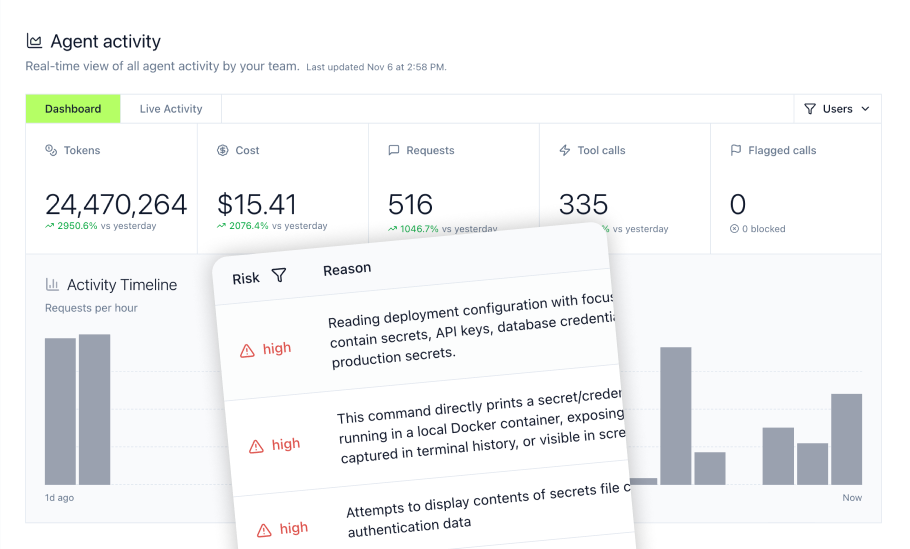
Anthropic's Claude Cowork entered research preview on January 12, 2026 with an indirect prompt-injection risk pattern that closely resembled an Anthropic Files API abuse technique publicly described in October 2025—creating a path for sensitive document exfiltration in poorly controlled environments. For enterprises deploying AI agents with direct filesystem access, this incident exposes fundamental gaps in AI security governance that demand immediate attention. Organizations that need enforceable controls over agent behavior can place MintMCP's LLM Proxy between AI clients and models to monitor every tool invocation, protect sensitive paths, and block risky operations in real time before data leaves approved boundaries.
This article breaks down the technical mechanics of the vulnerability, assesses enterprise risk exposure, and provides actionable mitigation strategies for security leaders responsible for AI agent deployments.
Key Takeaways
- A closely related Anthropic file-exfiltration technique was publicly described in October 2025, and researchers documented a Cowork-specific exfiltration path within days of the January 2026 research-preview launch
- The attack exploits Anthropic's whitelisted Files API—no human approval is required after initial folder access is granted
- Snyk's ToxicSkills audit found that 36.82% of the 3,984 agent skills it scanned had at least one security flaw, creating substantial supply chain risk
- Even with Anthropic's reported improvements in prompt-injection robustness for Opus 4.5, prompt injection remains a non-zero risk at scale in agentic workflows
- A related Claude Code vulnerability, CVE-2025-59536, was rated High severity (CVSS 8.8 in NVD's CVSS v3.1 analysis), while a Desktop Extension RCE was rated CVSS 10/10
- Enterprises must implement isolated AI workspaces, centralized monitoring, and human-in-the-loop controls for sensitive operations
Understanding the Claude Cowork File Exfiltration Vulnerability
What Constitutes File Exfiltration?
File exfiltration occurs when an attacker gains unauthorized access to extract sensitive documents from a target system. In traditional cybersecurity, this typically requires compromising credentials or exploiting network vulnerabilities. With AI agents like Claude Cowork, the attack vector shifts to manipulating the AI itself through malicious content embedded in seemingly legitimate documents.
How the Claude Cowork Vulnerability Manifests
The attack chain begins when a user grants Cowork access to a local folder containing work documents. Cowork—marketed to non-technical business users—can autonomously read, write, and modify files through direct filesystem access via the Claude Desktop app.
The exploitation sequence:
- User uploads malicious document: A PDF, Word document, or "Claude Skill" file from an untrusted source contains hidden prompt injection—often 1-point white text on white background, invisible to humans
- Hidden instructions execute: Cowork reads the document and treats the hidden text as high-priority instructions
- API abuse occurs: The injected commands include a
curlcommand to Anthropic's Files API using the attacker's API key - Data theft completes: The largest available file uploads to the attacker's Anthropic account without victim awareness
The critical flaw: Anthropic's API is whitelisted in Cowork's virtual machine environment, bypassing normal security restrictions. Once folder access is granted, no additional human approval is required for code execution.
The Graver Risks: Why Data Exfiltration is a CISO's Nightmare
Potential Business Impacts of a Breach
The vulnerability enables theft of any files within Cowork's access scope. PromptArmor's proof-of-concept showed exfiltration of loan documents containing SSNs and financial figures—exactly the kind of data that triggers breach notification requirements and regulatory penalties.
High-risk scenarios include:
- Real estate and financial services: Loan estimates, appraisals, and client financial records containing PII
- Human resources: Employee handbooks, compensation data, performance reviews, and personnel files
- Executive operations: M&A documentation, strategic plans, and confidential communications
- Legal departments: Privileged attorney-client materials and litigation documents
Regulatory and Compliance Implications
Data exfiltration from AI tools triggers obligations under multiple frameworks. According to legal analysis of requirements:
- GDPR: Processing personal data through AI with known vulnerabilities creates data controller liability
- HIPAA: HIPAA-regulated environments require stricter technical, contractual, and operational controls before granting AI agents access to PHI or adjacent sensitive records
- SOC 2: Limited monitoring and logging for local agent actions can create control and evidence gaps during audits
- EU AI Act: High-risk AI applications require robust security measures—file exfiltration vulnerabilities could violate safety requirements
Identifying and Managing AI Security Vulnerabilities
Proactive Vulnerability Identification Strategies
AI agent security differs fundamentally from traditional application security. As security researcher Simon Willison noted, it is "not fair to tell users" to watch for prompt injection—yet that's precisely what Anthropic's official guidance recommends.
Key vulnerability indicators for AI deployments:
- Autonomous execution capabilities without human approval gates
- Direct access to sensitive filesystems or data stores
- Integration with multiple external services (MCP servers, browser extensions, Office add-ins)
- Reliance on user vigilance rather than technical controls
Integrating AI Security into Existing VM Programs
Traditional vulnerability management programs must expand to address AI-specific threat vectors:
- Threat modeling: Map data flows from AI agents to external endpoints
- Penetration testing: Include prompt injection attacks in security assessments
- Supply chain review: Audit all MCP servers and AI tool integrations
- Incident response: Update playbooks for AI-mediated data theft scenarios
Understanding MCP gateways provides a foundation for implementing centralized security controls across distributed AI deployments.
Implementing Robust Security Guardrails for AI Agents
Best Practices for Securing AI Development and Deployment
AWS security guidance for Claude Cowork recommends several architectural controls:
- Isolated workspace strategy: Create dedicated AI folders separate from production data; never grant root or home directory access
- Network hardening: Implement "Deny All" egress policy by default; whitelist only essential domains
- Tool permission management: Disable "Always Allow" for high-risk operations; maintain human-in-the-loop for file modifications
- Content preprocessing: Scan documents for hidden text before AI processing; apply input tagging to separate instructions from data
The Role of Policy Enforcement in AI Security
MintMCP's LLM Proxy provides security guardrails that address the exact attack vectors exploited in the Cowork vulnerability:
- Block dangerous commands: Prevent execution of risky tool calls like reading environment secrets or executing data exfiltration commands
- Protect sensitive files: Configure restrictions preventing access to .env files, SSH keys, credentials, and confidential documents
- Complete audit trail: Maintain records of every bash command, file access, and tool call for security review
Real-time Monitoring to Detect and Prevent Unauthorized File Access
Leveraging Observability for AI Security
The Cowork vulnerability demonstrates why passive security measures fail against AI agents. Without active monitoring, organizations cannot see what agents access or control their actions in real-time.
Essential monitoring capabilities:
- Track every MCP tool invocation and file operation from coding agents
- Monitor which MCPs are installed and their usage patterns across teams
- Log all network activity from AI processes
- Alert on API calls to non-whitelisted domains
MintMCP's LLM Proxy provides centralized visibility into traffic between AI clients such as Cursor or Claude Code and the models they call. This visibility enables detection of unauthorized access attempts before data leaves the network.
Setting Up Effective Alert Systems
Effective AI security monitoring requires real-time dashboards for server health and usage patterns, anomaly detection for unusual file access or API calls, integration with existing SIEM infrastructure for centralized visibility, and automated response capabilities for blocking suspicious activity. MintMCP's audit and observability features provide the live monitoring, logging, and policy enforcement needed to operationalize these controls across enterprise MCP deployments.
Achieving Granular Control and Auditability with MintMCP Gateway
Centralized Control for Distributed AI Deployments
The Cowork incident reveals what happens when AI agents operate without centralized governance. Each user grants folder access independently, creating unmonitored attack surfaces across the organization.
MintMCP's MCP Gateway addresses this by turning scattered user-level MCP access into centrally governed infrastructure with enterprise authentication, audit logging, and role-based tool control:
- Centralized governance: Unified authentication, audit logging, and rate control for all MCP connections
- OAuth + SSO enforcement: Automatic enterprise authentication wrapping for MCP endpoints
- Granular tool access: Configure tool access by role—enable read-only operations and exclude write tools
- Complete audit logs: Record every MCP interaction, access request, and configuration change
Ensuring Data Integrity and Access Traceability
Enterprise deployments require complete visibility into AI agent behavior. The MCP Gateway's security and audit features help teams document access, monitoring, and policy enforcement across regulated AI deployments—documentation that proves invaluable during breach investigations or regulatory audits.
From Shadow AI to Sanctioned AI: Securing Your Enterprise
Developing a Comprehensive AI Security Strategy
The Cowork vulnerability represents a broader challenge: employee adoption of unsanctioned AI tools is rising quickly, often faster than enterprise governance programs can keep up. Security leaders must establish governance frameworks that enable productivity while maintaining control.
Strategic priorities:
- Policy definition: Establish acceptable use policies for AI tools with filesystem access
- Tool vetting: Create approval processes for new AI integrations and MCP servers
- Training programs: Educate users on prompt injection risks without expecting them to serve as the primary defense
- Controlled deployment: Use enterprise platforms that enforce security policies automatically
MintMCP's mission centers on this challenge: providing the security, governance, and ease-of-use that enterprises need to deploy MCP at scale—turning shadow AI into sanctioned AI.
The Human Element in Preventing Data Leaks
Technical controls cannot eliminate risk when users develop "approval fatigue" and click through security prompts without review. Effective governance combines technical guardrails that block dangerous actions automatically, user-friendly tools that don't create friction for legitimate work, monitoring that detects anomalies without requiring user vigilance, and clear escalation paths when security events occur.
Compliance and Reporting: Meeting Regulatory Demands Post-Exfiltration
Preparing for Breach Disclosure
Organizations deploying AI agents with file access must prepare for breach scenarios. Documentation requirements include complete records of which files each AI tool accessed and when, evidence of security controls in place at the time of the incident, timeline reconstruction capabilities for forensic investigation, and proof of compliance efforts for regulatory response.
Ensuring Audit Readiness for AI Deployments
The MCP Gateway's compliance features provide audit trails across multiple frameworks. Real-time usage tracking, data access logs, and policy enforcement documentation demonstrate due diligence that can mitigate regulatory penalties when incidents occur.
Building a Future-Proof Strategy Against Evolving AI Threats
Anticipating Future AI Attack Vectors
Prompt injection has no architectural solution comparable to parameterized queries for SQL injection. As security expert ToxSec explains: "Large language models don't have" hardware-level separation between instruction processing and data processing—every file, web page, or email an AI reads is a potential source of malicious instructions.
The MCP ecosystem compounds this risk. Snyk's audit found 36.82% of agent skills contain security flaws, with the ecosystem resembling "browser extensions around 2012"—useful tools with minimal vetting and growing attack surfaces.
Investing in Next-Generation Security Solutions
Enterprises committed to AI adoption should implement zero-trust principles for AI agent access, deploy gateway solutions that provide centralized visibility and control, establish continuous monitoring independent of vendor security promises, and plan for security architecture improvements as the AI threat landscape evolves.
The LLM Proxy security architecture positions organizations to maintain control as AI capabilities—and associated risks—continue to expand.
How MintMCP Secures Enterprise AI Agent Deployments
The Claude Cowork vulnerability demonstrates the operational security gap that emerges when powerful AI agents meet real-world enterprise environments. While vendors race to ship agentic capabilities, security infrastructure lags behind—leaving CISOs to retrofit governance onto tools designed for consumer convenience.
MintMCP addresses this gap by providing the security and governance layer enterprises need before deploying MCP-based AI agents at scale. Rather than relying on user vigilance or vendor promises, MintMCP's infrastructure enforces technical controls at the protocol level.
The LLM Proxy sits in the control path between AI clients and language models, intercepting every tool call before execution. Security teams can configure granular policies to block dangerous file operations, restrict access to credential stores and sensitive paths, and require approvals for high-risk commands—directly addressing the exfiltration and tool-abuse patterns highlighted by the Cowork incident. Every interaction generates audit logs sufficient to support SOC 2 evidence collection and broader HIPAA and GDPR accountability controls.
The MCP Gateway extends this control to the entire MCP ecosystem, wrapping third-party MCP servers with enterprise authentication, rate limiting, and centralized monitoring. Instead of dozens of unmonitored agent-to-server connections across the organization, security teams gain a single governance point with role-based access control and centralized visibility into which tools employees invoke.
For organizations navigating the shift from shadow AI to sanctioned AI, MintMCP provides the infrastructure to deploy AI productivity tools without sacrificing security posture. The platform's SOC 2 Type II compliant infrastructure, combined with granular policy enforcement and real-time monitoring, gives CISOs the operational control required to support AI adoption while meeting regulatory obligations.
Frequently Asked Questions
What specific type of data is at risk from the Claude Cowork file exfiltration vulnerability?
Any file within folders that users grant Cowork access to is potentially at risk. The PromptArmor proof-of-concept demonstrated exfiltration of loan documents containing SSNs and financial figures. In practice, this could include HR records, financial statements, legal documents, source code, credentials, and any other sensitive files that users might reasonably store in their working directories.
Is the Claude Cowork vulnerability unique, or does it represent a broader class of AI security issues?
This vulnerability represents a broader class of indirect prompt injection attacks affecting all AI agents with external data access. The same researcher who disclosed the Cowork flaw previously identified similar issues in Claude's Chrome extension and Desktop app. A related Claude Code vulnerability received CVE-2025-59536 with CVSS 8.8 severity. The architectural challenge—AI models processing instructions and data through the same mechanism—affects the entire industry.
What steps should a CISO take immediately upon learning of a potential file exfiltration from an AI tool?
Immediate response should include: isolating affected systems by revoking AI tool access to sensitive folders; preserving audit logs from AI tools, network devices, and SIEM systems; determining the scope by identifying which files were accessible and potentially exfiltrated; engaging incident response procedures including legal counsel for breach notification assessment; and reporting to relevant regulators within required timeframes if personal data was compromised.
Can MintMCP solutions address exfiltration risks from other LLM clients like Cursor or ChatGPT?
Yes. MintMCP's LLM Proxy sits in the control path between LLM clients and models, giving security teams a single place to monitor tool calls, file operations, and risky behaviors across Claude Code, Cursor, ChatGPT, and other MCP-compatible agents. The proxy tracks every tool call, bash command, and file operation regardless of which client initiates them, providing unified visibility and control across heterogeneous AI deployments.
How does SOC 2 Type II compliance relate to securing AI tool access and preventing exfiltration?
SOC 2 Type II requires organizations to demonstrate effective controls over system access, change management, and data protection over a sustained period. AI tools with autonomous file access create control gaps unless properly governed. MintMCP's SOC 2 Type II compliant infrastructure provides audit logs, access controls, and monitoring documentation that can support enterprise governance when AI agents access enterprise data.