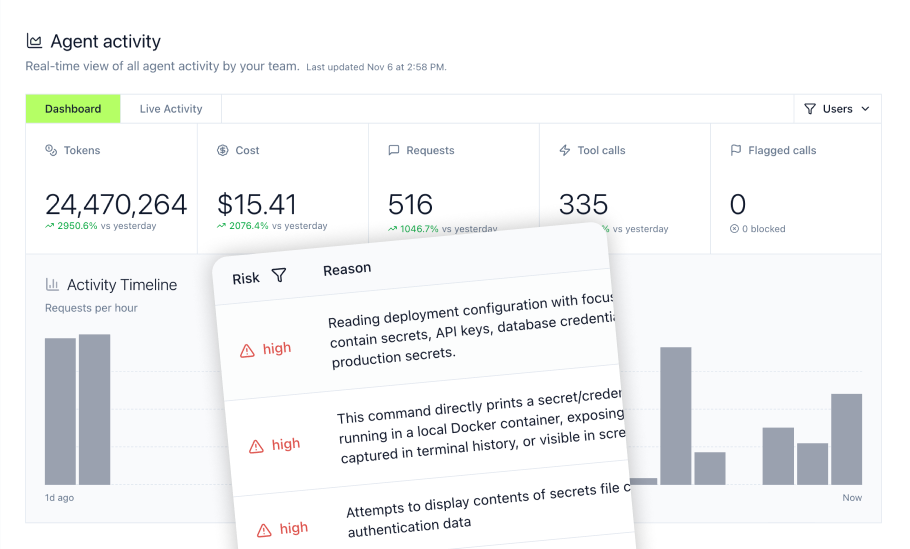
Claude Code's productivity gains come with significant security risks that most enterprises underestimate. Critical vulnerabilities CVE-2025-59536 and CVE-2026-21852 demonstrated how attackers could achieve remote code execution and steal API credentials through malicious repository configurations—all before users could read the trust dialog. While Anthropic has patched these specific flaws, the underlying governance gaps remain in most organizations. Enterprise teams need robust LLM Proxy solutions to monitor coding agent behavior, block dangerous commands, and prevent credential theft across their development environments.
This article provides actionable strategies for preventing Claude API key exfiltration, covering threat assessment, vulnerability identification, credential management, real-time monitoring, access controls, and compliance requirements.
Key Takeaways
- CVE-2025-59536 enabled remote code execution through malicious repository configurations that executed commands before users could read trust dialogs
- Stolen coding-assistant credentials can expose proprietary code, trigger unauthorized API usage, and create material incident response costs for affected organizations
- A single stolen API key can expose shared workspace files and resources, creating enterprise-wide risk in collaborative environments
- Anthropic patched the disclosed issues before Check Point Research published its findings on February 25, 2026, but governance frameworks remain essential for ongoing protection
- Configuration files (.claude/settings.json) must be treated as executable code, not passive data
- Real-time monitoring of coding agent tool invocations, bash commands, and file operations is now a baseline security requirement
Understanding the Threat: Why Claude API Key Exfiltration Poses a Major Enterprise Security Risk
API key exfiltration represents one of the most severe threats to enterprise AI deployments. When attackers obtain Claude API credentials, they gain complete access to associated workspaces, shared files, and accumulated context—potentially exposing proprietary algorithms, customer data, and strategic business information.
Why this matters for enterprises:
- Lateral movement risk: A single compromised key provides access to all shared workspace files, affecting 5-50+ developers per workspace
- Financial exposure: Unlimited API usage charges until key revocation, plus direct costs from data breach response
- Regulatory implications: Unauthorized access to code containing PII, financial data, or healthcare information can create material audit, contractual, and regulatory exposure, depending on the data involved and the organization's compliance scope
- Supply chain attacks: Untrusted repositories can serve as attack vectors, spreading compromised code to customer deployments
The Check Point Research disclosure revealed that attackers could redirect Claude Code's API calls to malicious servers using the ANTHROPIC_BASE_URL configuration parameter. This exfiltration occurred before trust dialog confirmation, capturing full API keys in plaintext Authorization headers.
Identifying Vulnerabilities: Common Scenarios Leading to Claude API Key Data Loss
Understanding how API keys leak is essential for implementing effective prevention. The primary attack vectors fall into three categories: configuration-based attacks, supply chain compromises, and developer workflow gaps.
Configuration-based attack vectors
- Malicious hooks execution: Attackers embed commands in .claude/settings.json that execute on SessionStart before users can review warnings
- MCP user consent bypass: The enableAllProjectMcpServers setting allows commands to execute immediately upon running Claude
- Base URL redirection: Modified ANTHROPIC_BASE_URL points API calls to attacker-controlled servers
Developer workflow vulnerabilities
- Hardcoded credentials: API keys committed to source code repositories remain a common security violation
- Unsecured environment files: .env files containing API keys accessible to AI assistants without proper exclusion rules
- Unvetted repository cloning: Developers opening untrusted projects without security review
Shadow AI proliferation
Shadow AI continues to expand as developers adopt unapproved AI tools that bypass enterprise security controls, leaving security teams without visibility into what data is being accessed or where it is flowing. Without visibility into which tools are accessing what data, security teams cannot enforce protective policies.
MintMCP's LLM Proxy addresses these vulnerabilities by monitoring every MCP tool invocation, bash command, and file operation from coding agents—providing the visibility enterprises need to detect and block exfiltration attempts in real-time.
Implementing Robust Claude API Key Management with Centralized Credentials
Effective API key management requires centralized control, rotation policies, and least-privilege access principles. Enterprises should eliminate scenarios where individual developers manage their own API keys without oversight.
Centralized credential management practices
- Key vault integration: Store sensitive secrets in enterprise secret management systems, and route approved MCP access through a centralized governance layer with policy enforcement and auditability
- Rotation policies: Implement automated key rotation on 30-90 day cycles with immediate rotation capability for suspected compromises
- Least privilege scoping: Create separate API keys per project sensitivity level rather than sharing production keys across teams
- Credential injection: Deliver keys to applications at runtime rather than storing in configuration files
Workspace isolation strategies
Organizations should implement tiered workspace access based on data sensitivity. Development workspaces use individual developer keys for experimentation and learning. Staging environments employ team-scoped keys for integration testing and code review. Production workspaces restrict access to service account keys used only in automated pipelines. Sensitive projects handling financial, healthcare, or legal data require completely isolated workspaces with enhanced monitoring.
Content exclusion patterns for protecting credentials
# Prevent AI processing of sensitive files
my-org/my-repo:
- ".env*"
- "*.pem"
- "*.key"
- "/secrets/"
- "/.claude/settings.json"
- "/internal-config.yaml"
The MCP Gateway provides centralized governance for approved MCP connections, with pre-configured credentials, access policies, and audit controls that reduce credential sprawl across development teams.
Real-time Monitoring and Detection: Preventing API Key Exfiltration Incidents
Proactive detection requires continuous monitoring of AI assistant behavior, network traffic analysis, and anomaly alerting. Organizations cannot rely solely on preventive controls—they must also detect exfiltration attempts in progress.
Essential monitoring capabilities
- Tool call tracking: Monitor every MCP tool invocation, bash command, and file operation from all coding agents
- Network traffic analysis: Alert on Claude traffic to non-Anthropic domains indicating potential credential redirect attacks
- Usage pattern analysis: Detect unusual API usage spikes that may indicate stolen key abuse
- Configuration change monitoring: Track all modifications to .claude/settings.json files across repositories
Anomaly detection indicators
- API calls to unexpected endpoints (not *.anthropic.com)
- Sudden increase in API usage outside normal working hours
- Access attempts to sensitive directories (.ssh, .env, credentials)
- Large file uploads to AI endpoints
- MCP server initialization from untrusted sources
MintMCP provides real-time monitoring for tool activity across coding assistants, including MCP invocations, bash commands, and file access events. These audit trails give security teams the visibility needed to investigate suspicious behavior and respond to exfiltration attempts quickly.
Establishing Granular Access Controls and Policies for Claude API Usage
Role-based access controls and policy enforcement ensure that only authorized users access AI tools with appropriate permissions. Organizations must move beyond binary allow/deny decisions toward granular tool-level governance.
Access control framework components
- Role-based access control (RBAC): Define who can use which AI tools and access what data based on job function
- Attribute-based access control (ABAC): Apply dynamic policies based on user attributes, data sensitivity, and context
- Policy enforcement points: Automatically enforce data access and usage policies at the gateway level
- API rate limiting: Prevent credential abuse through usage throttling and quota enforcement
Granular tool access configuration
Organizations should configure tool access by role—for example, enabling read-only database operations while excluding write tools for junior developers. The MCP Gateway supports this granular control through its virtual MCP server capabilities.
Authentication integration requirements
- OAuth 2.0 and SAML: Enterprise authentication with automatic SSO integration for all MCP servers
- Per-user authentication flows: Individual OAuth flows rather than shared service accounts for traceability
- Session management: Automatic session timeout and re-authentication requirements for sensitive operations
Securing Coding Agents: Protecting Sensitive Files and Blocking Dangerous Commands
Coding agents operate with extensive system access—reading files, executing commands, and accessing production systems through MCP tools. Without specific controls, these agents can inadvertently expose credentials or execute malicious instructions from compromised repositories.
Sensitive file protection requirements
- Block access to credential files: Prevent access to .env files, SSH keys, API tokens, and certificates
- Restrict configuration reads: Prevent AI assistants from reading their own configuration files which could enable manipulation
- Sandbox environment execution: Run AI-assisted code in isolated environments before production deployment
Dangerous command blocking
Security guardrails should block risky tool calls in real-time, including:
- Commands that read environment secrets
- Network calls to unauthorized external endpoints
- File system operations targeting sensitive directories
- Execution of obfuscated or encoded commands
Human-in-the-loop enforcement
Security best practices recommend treating AI-generated code with the same scrutiny as code from untrusted external sources. Implement mandatory code review for all AI-generated changes to security-sensitive files, authentication systems, and data access layers.
MintMCP's LLM Proxy provides sensitive file protection that prevents access to .env files, SSH keys, and credentials while maintaining complete audit trails of all operations—essential for both prevention and forensic analysis.
Ensuring Compliance and Auditability for AI Agent Interactions and API Usage
Regulatory compliance requires comprehensive audit trails that document every AI interaction, access request, and configuration change. Organizations in regulated industries face additional scrutiny when AI tools process sensitive data.
Compliance framework requirements
SOC 2 Type II requires documented AI tool access controls and change management, with configuration file changes requiring audit trails. HIPAA mandates Business Associate Agreements for PHI processing, creating exposure risk when code accesses patient records. GDPR requires Data Processing Agreements for EU citizen data, treating code containing PII sent to AI servers as data processing activity. PCI-DSS demands network segmentation for cardholder data and prohibits AI assistant use in cardholder data environments.
Audit trail requirements
- Complete logs of every MCP interaction, including tool invocations and data access
- Configuration change history with user attribution
- Access request records with approval workflows
- Compliance reports formatted for SOC 2, HIPAA, and GDPR auditors
Industry-specific considerations
- Financial services: Document AI use in trading systems and maintain model risk management frameworks
- Healthcare: Obtain BAAs from AI providers and implement content exclusion for healthcare data directories
- Government/Defense: Self-hosted AI only for Controlled Unclassified Information with continuous monitoring
MintMCP Gateway has a SOC 2 Type II attestation and is HIPAA compliant, providing audit trails that support SOC 2 evidence collection, HIPAA, and GDPR accountability workflows. The platform also offers data residency options that organizations can evaluate within their broader privacy and governance requirements.
How MintMCP Enables Secure AI Coding Assistant Governance at Enterprise Scale
The goal of enterprise AI governance is not to block AI adoption but to enable it safely. Organizations that implement overly restrictive policies simply drive AI usage underground, creating larger security blind spots. MintMCP addresses this challenge by transforming shadow AI into sanctioned AI while maintaining developer productivity.
MintMCP provides the governance infrastructure enterprise security teams need to reduce API key exfiltration risk across their development environments. The platform monitors MCP tool invocations, bash commands, and file-access events from coding agents like Claude Code, Cursor, and ChatGPT, giving security teams real-time visibility into agent activity. This monitoring helps organizations detect credential theft attempts and investigate suspicious behavior quickly.
The platform's centralized credential management eliminates the risk of individual developers managing their own API keys without oversight. Organizations route approved MCP access through MintMCP's governance layer, which enforces consistent access policies and maintains audit trails for compliance requirements. Role-based access controls ensure that only authorized users can access sensitive tools and data based on their job function.
MintMCP enables organizations to deploy approved MCP servers quickly, transforming local MCP servers into production-ready services with monitoring, logging, and governance built in. The platform blocks access to sensitive files including .env files, SSH keys, and credentials while automatically alerting security teams to suspicious behavior patterns like API calls to unexpected endpoints or access attempts to credential directories. This layered approach to security enables enterprises to realize the productivity gains from AI coding assistants without accepting unmanaged security risk.
Frequently Asked Questions
What immediate steps should security teams take if they suspect Claude API key compromise?
Assume potential compromise if any developer opened untrusted repositories using vulnerable pre-patch Claude Code versions, and prioritize review of environments that had not yet received Anthropic's fixes as of the February 25, 2026 disclosure. Immediately rotate all API keys in affected workspaces, review API usage logs for anomalous activity patterns, audit all .claude/settings.json files for suspicious configurations (particularly unexpected ANTHROPIC_BASE_URL values), and enable enhanced monitoring on all AI tool traffic. Document all findings for potential regulatory notification requirements. The rotation process should begin immediately, with timing determined by the number of affected keys, dependent systems, and internal approval workflows.
How do AI coding assistant vulnerabilities differ from traditional software security threats?
Traditional security tools assume predictable, deterministic software behavior. AI coding assistants introduce autonomous decision-making and configuration-as-code execution patterns that create novel attack surfaces. Repository configuration files (.claude/settings.json) function as executable logic rather than passive data, enabling supply chain attacks through seemingly harmless JSON files. This paradigm shift requires security teams to extend code review rigor to all project configuration files and implement monitoring specifically designed for agentic AI behavior patterns.
Can enterprises safely use Claude Code in regulated industries like healthcare and finance?
Yes, with appropriate governance frameworks. Healthcare and financial-services teams should combine provider-side contractual and configuration controls with runtime governance over agent behavior, including content exclusion, tool-level policy enforcement, audit trails, and human review for code touching sensitive systems. The key is implementing layered controls rather than outright prohibition.
What metrics should enterprises track to measure AI coding assistant security program effectiveness?
Track shadow AI detection rates (percentage of unapproved tools identified and remediated), mean time to detect suspicious AI tool behavior, API key rotation cycle compliance, developer training completion rates, and security incident counts related to AI tools. Also monitor false positive rates in your blocking rules to ensure security controls aren't impeding legitimate developer productivity. Quarterly executive reports should include cost avoidance estimates based on prevented incidents and compliance audit pass rates for AI tool governance controls.
How should enterprises handle the transition from individual developer API keys to centralized credential management?
Begin with an amnesty period where developers disclose all personal API keys in use without penalty. Inventory all active keys and their associated workspaces, then create a migration plan that maintains developer access while transferring keys to centralized management. Implement service account keys for shared resources and per-developer keys for individual work that flow through your credential management system. Provide clear documentation on the new access request process to prevent developers from reverting to personal keys. Plan for temporary workflow friction during the transition period, and reduce it with documentation, staged rollout, and clear access-request processes.