AI agents have moved beyond simple question-and-answer interactions to become persistent digital coworkers capable of sustained collaboration across weeks and months. The dividing line between demonstration-quality agents and production-ready systems is structured memory architecture. Organizations deploying AI agents without governed memory infrastructure face regulatory exposure, unpredictable costs, and agents that forget critical context between sessions.
Enterprise memory is not just a vector database or a longer prompt. It is governed infrastructure: scoped across private, team, organization, and customer contexts; owned by the company; versioned; reviewable; auditable; and portable where practical. With 76% of organizations reporting that governance frameworks lag AI adoption, the need for robust memory architecture has become urgent.
This article examines the technical foundations, security requirements, and infrastructure decisions that enable AI agents to function as reliable enterprise coworkers through MCP gateway solutions that provide centralized governance. MintMCP frames this as two connected layers: MCP Gateway for governed data and tool connections, and Agent Gateway for the identities, permissions, memory, and monitoring needed to run long-running agents alongside employees.
Key Takeaways
- Memory is infrastructure, not a feature: Structured memory pipelines can reduce latency and token costs versus full-context prompting in memory-heavy workloads, making governed memory economically attractive at production scale
- Context windows alone cannot solve memory problems: Long context windows still suffer from "lost in the middle" retrieval failures, while full-history prompting creates substantial cost challenges for enterprise deployments
- Enterprise memory needs governance: Private, team, organization, and customer memory scopes should be company-owned, versioned, reviewable, auditable, and portable
- Four distinct memory types require explicit coordination: Working, semantic, episodic, and procedural memory serve different functions, and production systems must manage transitions between them
- Hybrid architectures can improve relational recall: Combining semantic search with graph-style memory can help agents preserve relationships across entities, timestamps, and prior interactions
- Memory poisoning creates persistent cross-session attacks: Unlike one-time prompt injection, poisoned memory can subtly steer agent behavior over extended periods
- Per-agent identity enables audit attribution: Each AI agent requires its own rotatable credentials and permission scope independent of human user access levels
- Agent Gateway extends MCP Gateway for memory-aware agents: MCP Gateway governs data and tool connections, while Agent Gateway governs agent identities, permissions, memory, and monitoring
Understanding AI Agents: The Foundation of Digital Coworkers
AI agents represent a fundamental shift from stateless language models to goal-oriented systems capable of executing multi-step workflows. Unlike traditional chatbots that process each query independently, AI agents with memory retain context, recognize patterns over time, and adapt based on past interactions. This capability proves essential for knowledge-intensive applications where feedback loops and adaptive learning determine success.
Digital coworkers are long-running agents that can live in Slack, hold memory, continue work across days, and operate alongside employees. That persistence makes memory governance central to the architecture. A production digital coworker needs a durable identity, scoped tool access, reviewable memory, and monitored actions rather than an opaque memory store that security teams cannot inspect.
Common Enterprise Agent Types
- Data analysis agents querying databases and generating reports across multiple sessions
- Customer support agents accessing CRM and ticket systems while maintaining conversation history
- Development workflow agents connecting to GitHub, Jira, and CI/CD pipelines with learned team conventions
- Compliance agents requiring audit-ready logs of all data access decisions
The distinction between agents and agentic AI matters for architecture decisions. Agents operate within defined boundaries using explicit tool access, while agentic AI systems demonstrate greater autonomy in task decomposition. Both require persistent memory to function as reliable coworkers rather than stateless utilities.
The Critical Role of Memory in Effective AI Agent Performance
Despite models reaching large token context windows, research demonstrates fundamental limitations in relying on context alone. The "Lost in the Middle" finding shows that models can perform worse when relevant facts are positioned mid-prompt, even when those facts technically fit inside the context window.
Beyond the Context Window: Why Long-Term Memory Matters
Full-history prompting creates both reliability and economic problems at scale. Organizations attempting to maintain conversation history through context window expansion face substantial monthly costs for enterprise deployments. Even at these costs, retrieval can remain unreliable as context length increases.
Structured memory pipelines address these limitations through extraction, consolidation, selective retrieval, and temporal management. Extraction converts raw conversation text into retrievable knowledge units. Consolidation merges related facts and resolves contradictions. Selective retrieval fetches only relevant memories for each interaction. Temporal management tracks when facts were learned, whether they remain valid, and whether they need review.
For enterprise deployments, memory should follow Git-like principles. Memories should have ownership, scopes, version history, review workflows, audit trails, and portability. This makes memory more inspectable than opaque vendor-controlled stores and gives security, compliance, and operations teams a way to understand what the agent knows and why it used that context.
The Princeton CoALA framework identifies four distinct memory layers that production systems must coordinate: working memory (active context window), semantic memory (facts and preferences), episodic memory (interaction history), and procedural memory (learned behaviors). Systems treating memory as a single storage problem experience failures where agents cannot distinguish temporary context from permanent facts.
Architecting for Persistent Identity and State: Agent Bundles and Credentials
Production AI agents require persistent identity that survives session boundaries, credential rotation, and organizational changes. This architectural requirement goes beyond simple state management to encompass authentication, authorization, audit attribution, and memory scope.
Securing Agent Identity at Scale
Each AI agent operating in an enterprise context needs its own identity separate from the human users who created or manage it. This separation enables independent credential rotation without disrupting other agents or users, audit attribution tracing specific actions to specific agent instances, scoped permissions limiting each agent to precisely the tools and data it requires, and revocation capabilities allowing immediate access termination for compromised agents.
MintMCP's Bundle architecture packages tool access, policy enforcement, and audit logging into single governance units per team, role, use case, or agent identity. Agent Bundles extend this model to non-human principals, providing each deployed agent with M2M authentication tokens that can be rotated independently. For connectors that require per-agent OAuth, MintMCP supports an "act as agent" flow so agents can operate with explicit identity rather than shared service-account credentials.
This approach addresses a core security concern for enterprise agent deployments: each agent should operate with its own credentials, scope, and revocation path rather than inheriting broad human or shared service-account permissions. It also gives teams a clear place to connect memory scope to identity, so an agent retrieves only the private, team, organization, or customer memory it is allowed to use.
Building Secure and Governed Context: The Model Context Protocol Foundation
The Model Context Protocol (MCP) standardizes how AI agents connect to external tools and data sources. This protocol layer provides the foundation for consistent memory governance across different AI platforms and agent implementations.
MCP enables standardized tool definitions that agents can invoke regardless of underlying implementation, consistent authentication patterns through OAuth 2.0 and bearer tokens, transport flexibility supporting stdio and Streamable HTTP with legacy SSE support where required, and vendor neutrality allowing the same governance policies across Claude, Cursor, ChatGPT, Gemini, and Copilot.
Understanding MCP data risk is essential for organizations deploying agents with persistent memory. The protocol itself provides no visibility into off-gateway usage patterns, making complementary monitoring necessary for complete coverage.
For memory-aware agents, MCP Gateway and Agent Gateway play different roles. MCP Gateway governs the data and tools an agent can reach. Agent Gateway governs the agent as an operating identity, including its permissions, memory scopes, and monitoring across time.
Infrastructure for Scaling AI Agent Memory: Gateways and Server Management
Centralized gateway infrastructure addresses the operational complexity of managing hundreds of MCP server connections across an organization. Without centralization, each team maintains its own credential stores, access policies, and audit logs, creating fragmented governance.
Centralizing Agent Access to Data Sources
MintMCP Gateway manages MCP server deployment across three scenarios:
- Pre-configured connectors: Hundreds of prebuilt connectors, with custom connectors deployable through MintMCP's hosted connector runtime
- Community server hosting: Converting locally run stdio MCP servers to hosted, production-ready services with OAuth wrapping
- Virtual MCPs (VMCPs): Bundling multiple servers with role-based and use-case-based tool access for specific use cases
The gateway provides credential management, rate limiting per user, team, or agent, and granular tool-level access control. Organizations can enable database reads while blocking writes, or permit CRM queries while restricting record modifications.
Infrastructure considerations for memory-enabled agents include hybrid storage architectures combining vector search with graph databases, consolidation pipelines that merge related facts and resolve contradictions, retention policies specifying how long different memory types persist, and staleness detection identifying when stored facts may no longer be valid. They should also include memory ownership, version history, review workflows, portability, and auditability so memory remains governed enterprise infrastructure rather than an uncontrolled cache.
Ensuring Data Integrity and Security: DLP, Auditing, and Compliance for AI Agents
Memory introduces data governance requirements that most agent frameworks do not address natively. Stored information must carry provenance tracking, access control enforcement, temporal validity markers, and decision traces to meet regulatory requirements.
Protecting Sensitive Information with AI
Organizations subject to GDPR, CCPA, HIPAA, or SOX cannot treat AI memory as an uncontrolled cache. Memory systems must support selective forgetting for "right to be forgotten" requests, access logging documenting which memories influenced which decisions, retention schedules enforcing automatic purging based on data classification, and content-level scanning detecting PII, credentials, and sensitive data before storage.
MintMCP executes custom policy code in a JS sandbox on every tool call, enabling inline DLP integration with AWS Bedrock Guardrails, Google Cloud DLP, Microsoft Purview, Nightfall, and Skyflow. Audit logging captures agent actions, tool calls, access context, and per-user and per-agent attribution, with configurable retention and export paths for SIEM platforms including Sentinel and Splunk.
MintMCP is SOC 2 Type II audited, with continuous compliance monitoring via Drata. Enterprise SSO, complete audit trails, PII detection, and role-based access control are built into every layer of the platform. Customers handling protected health information can request HIPAA documentation. MintMCP signs BAAs. For detailed security documentation, teams can review the MintMCP Trust Center. The MCP security whitepaper details the security architecture and compliance controls.
Monitoring and Control: Detecting Shadow AI and Enforcing Policies
Gateway-based governance covers traffic flowing through managed infrastructure but misses local agent activity that bypasses centralized controls. Shadow AI, where employees use AI tools outside approved channels, creates compliance gaps and security blind spots.
Gaining Visibility Over Decentralized Agent Activity
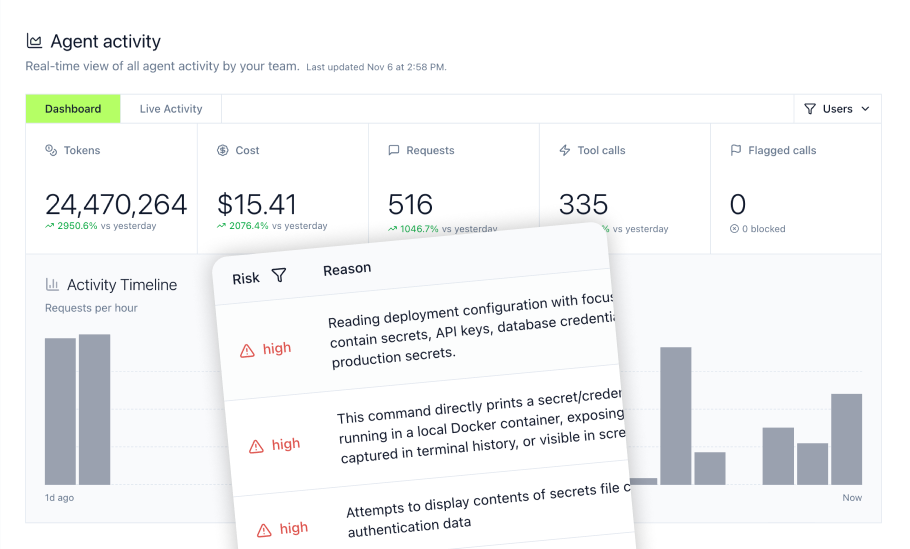
Agent Monitor tracks agent activity in real time across the organization, including local coding-agent activity through hooks in Cursor and Claude Code. This two-layer approach provides coverage that gateway-only monitoring cannot match: MCP Gateway governs approved tool traffic, while Agent Monitor extends visibility to local non-MCP agent activity such as file reads, shell commands, and prompt submissions.
Detection capabilities include PII exposure in agent outputs and tool calls, credential leakage including API keys and tokens, risky bash commands that could modify systems or exfiltrate data, prompt injection attempts targeting agent behavior, and off-gateway agent activity in developer tools.
Centralized configuration helps teams apply detect-only or enforce-mode policies consistently across developer environments. Custom guardrail policies support block, flag, and alert actions based on organizational requirements.
Memory poisoning represents an emerging threat vector where attackers inject malicious content into long-term storage. Unlike one-time prompt injection, poisoned memories persist across sessions and can subtly influence agent behavior over extended periods. The OWASP AI guidelines recommend memory quarantine patterns where new memories undergo validation before promotion to long-term storage.
Enhanced Capabilities: How Long-Term Memory Transforms AI Agent Workflows
Organizations with governed memory infrastructure can reduce repeated setup work, improve continuity across sessions, and make agent behavior easier to audit over time.
Practical workflow improvements include customer support agents surfacing prior resolutions from episodic memory, code assistants remembering team formatting conventions and project context, and financial analysis agents tracking analyst preferences and report formats across multi-week research projects.
The economic case for structured memory becomes clearer as usage scales. Structured memory can reduce repeated full-context prompting by retrieving only the context needed for a task, which can lower latency and token costs for memory-heavy workflows. Organizations should benchmark these savings against their own workloads, context length, model mix, and retention requirements.
Integrating with Existing Ecosystems: Identity, DLP, and LLM Platforms
Memory-enabled agents must integrate with enterprise identity management, security tooling, and AI platforms already in use. Isolated memory solutions create silos that undermine governance objectives.
Seamless Integration into Enterprise IT Stacks
MintMCP integrates with identity providers (Okta, Azure AD, Google Workspace for SSO and SCIM group synchronization), SIEM platforms (Microsoft Sentinel, Splunk, S3 for centralized security monitoring), DLP vendors (Nightfall, Skyflow, Purview, Bedrock Guardrails, Google Cloud DLP), and AI platforms (Claude, Cursor, ChatGPT, Gemini, and Copilot).
REST APIs and SDKs enable programmatic management for CI/CD integration and infrastructure-as-code workflows. Middleware hooks support custom DLP pipeline integration for organizations with existing security tool investments. The MCP servers catalog provides pre-configured connectors that integrate with the gateway's authentication and policy enforcement layer, enabling rapid deployment without custom development.
For teams deploying long-running agents, these integrations support the Agent Gateway layer as well: agent identity, scoped memory, monitored activity, and policy enforcement across the tools agents use.
The Evolution of AI Agents: From Stateless Interactions to Intelligent Coworkers
The trajectory from stateless chatbots to memory-enabled coworkers represents a fundamental architectural shift. Agents with memory move beyond processing tasks independently to recognizing patterns over time and adapting based on historical interactions.
MCP adoption has continued as major AI platforms added support, signaling maturation from experimental protocol to enterprise infrastructure standard.
Architectural evolution continues in several directions: self-evolving memory (agents learning extraction patterns from usage rather than pre-configured pipelines), federated memory (multi-agent systems with shared organizational knowledge and private user-specific layers), and privacy-preserving memory architectures (approaches that limit exposure of sensitive memory content during retrieval). Organizations building memory infrastructure today position themselves to adopt these capabilities as they mature, while those treating memory as an afterthought will face increasingly complex retrofits.
The durable shift is that memory is becoming an enterprise governance object. As AI coworkers become long-running agents that hold memory, continue work across days, and operate alongside employees, teams need memory systems that follow Git-like principles: scoped, company-owned, versioned, reviewable, auditable, and portable.
Why MintMCP Fits Enterprise AI Agent Memory Governance
MintMCP provides centralized gateway management, agent monitoring, and enterprise governance controls for production AI agent deployments. The platform helps teams govern tool access, agent activity, memory scope, and audit reporting across AI workflows.
MintMCP provides two connected layers for enterprise AI agent governance. Its MCP Gateway governs data and tool connections for the AI systems users already run, including Claude, Cursor, ChatGPT, Gemini, and Copilot. Its Agent Gateway builds on that foundation with controls for agent identities, permissions, memory, and monitoring.
MintMCP's data-permissions-first architecture starts with SSO, SCIM-driven RBAC, IdP groups, Virtual MCP Bundles, tool-level policy, and audit, then enables agents on top. This ensures an agent's access is a subset of an already-governed permission model.
MintMCP's Bundle architecture addresses the per-agent identity challenge by packaging governance into reusable units that can be assigned to both human and machine principals. Each Bundle can include:
- Tool access policies
- Policy enforcement rules
- Audit trails
- Scoped permissions for specific teams, roles, use cases, or agents
- Independent credential rotation and revocation paths
- Memory scopes for private, team, organization, or customer context
Agent Bundles extend this model with per-agent identity, scoped tools, M2M authentication, and an "act as agent" flow for connectors that require per-agent OAuth. This approach helps ensure that every agent operates with explicitly scoped permissions and audit attribution rather than inheriting broad human permissions that create security risks.
MintMCP's dual-layer monitoring strategy provides coverage that gateway-only monitoring cannot match:
- MintMCP Gateway governs MCP traffic flowing through managed infrastructure
- Agent Monitor tracks local agent activity through hooks in developer tools like Cursor and Claude Code
Together, these layers help address shadow AI by detecting PII exposure, credential leakage, and risky commands across approved and decentralized workflows.
For organizations requiring regulatory alignment, MintMCP is SOC 2 Type II audited, with continuous compliance monitoring via Drata. Enterprise SSO, complete audit trails, PII detection, and role-based access control are built into every layer of the platform. Customers handling protected health information can request HIPAA documentation, and MintMCP signs BAAs. The platform also integrates with existing enterprise security stacks, including:
- Identity providers: Okta, Azure AD, and Google Workspace
- SIEM platforms: Sentinel, Splunk, and S3
- DLP vendors: Nightfall, Skyflow, Purview, Bedrock Guardrails, and Google Cloud DLP
These integrations help teams enforce consistent security policies across their existing tooling investments.
With hundreds of prebuilt connectors and support for custom connector deployment through hosted runtime, MintMCP enables rapid agent deployment without sacrificing governance. Organizations gain the velocity benefits of AI agents while maintaining the visibility, control, and compliance posture required for enterprise production systems.
Frequently Asked Questions
What is the difference between short-term and long-term memory for AI agents?
Short-term memory corresponds to the context window, holding information for the duration of a single interaction or session. Long-term memory persists across sessions, storing facts, preferences, interaction history, and learned behaviors that the agent can retrieve in future conversations. Production systems require explicit pipelines to extract relevant information from short-term context and consolidate it into long-term storage with appropriate governance controls.
For enterprise use, long-term memory should also include ownership, scopes, version history, review workflows, audit trails, and portability. That means memory should be treated as governed infrastructure rather than a hidden model feature.
What is an Agent Gateway for memory-enabled agents?
An Agent Gateway is the control layer for agents that work alongside users. It governs agent identities, permissions, memory, and monitoring so long-running agents can operate safely across enterprise systems. In MintMCP's model, Agent Gateway builds on MCP Gateway: the MCP Gateway governs data and tool connections, while the Agent Gateway governs the agent as an operating identity with scoped access, governed memory, and visibility across time.
How does memory poisoning differ from prompt injection?
Prompt injection attempts to manipulate an agent's behavior during a single interaction by inserting malicious instructions. Memory poisoning injects malicious content into long-term storage, creating persistent behavioral changes that affect multiple future sessions. Because poisoned memories persist and may be retrieved repeatedly, they can subtly steer agent behavior over extended periods in ways that are difficult to detect or trace back to the original compromise.
What compliance standards apply to AI agent memory?
AI agent memory should be governed according to the regulatory frameworks that apply to the underlying data. GDPR-related workflows may require data provenance, deletion workflows, and purpose limitation. HIPAA-scoped workflows require controls for protected health information, while SOX-scoped workflows may require audit trails that support review of data access and decision context. Organizations must implement selective forgetting capabilities, content-level access controls, and retention policies that align with their regulatory obligations.
Can existing AI agents integrate with governed memory infrastructure without extensive code changes?
MCP Gateway supports integration with existing agents through standardized protocol support. stdio server support can convert locally run MCP servers to hosted, production-ready services with OAuth wrapping. Agents already using MCP can connect through the gateway to gain authentication, access control, and audit logging without modifications to their core logic.