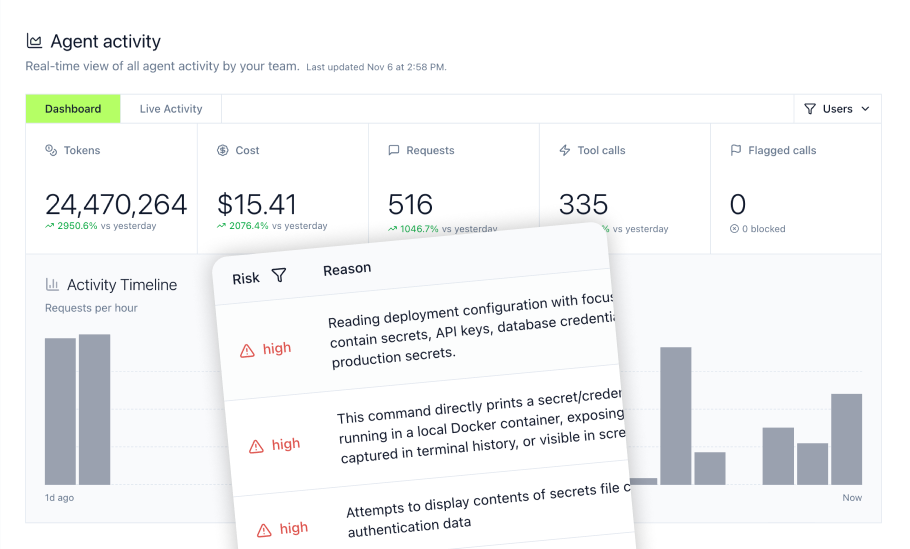
FastAPI has become the framework of choice for building high-performance Python APIs, and the Model Context Protocol extends this capability by enabling AI agents to interact with your APIs directly. For engineering teams building AI-powered applications, combining FastAPI with MCP creates a powerful architecture where AI agents can execute API operations, access business logic, and automate workflows through natural language interactions. This guide shows how to implement FastAPI-based MCP servers that meet enterprise requirements for security, scalability, and governance.
Key takeaways
- FastAPI's async capabilities and automatic OpenAPI documentation make it ideal for building high-performance MCP servers that AI agents can interact with
- MCP standardizes how AI agents discover and invoke FastAPI endpoints, eliminating the need for custom integration code in every AI application
- Enterprise deployments require centralized authentication, audit trails, and access controls that local MCP servers cannot provide
- MintMCP's gateway architecture enables one-click deployment of FastAPI MCP servers with automatic OAuth protection and enterprise monitoring
- Hosted connectors eliminate the need for teams to manage infrastructure while maintaining complete audit trails for compliance
- FastAPI MCP integration reduces manual API management tasks while providing AI agents with real-time access to business data and operations
- Type hints and Pydantic models in FastAPI automatically generate MCP tool schemas that AI agents use to understand available operations
Why FastAPI for enterprise MCP servers
FastAPI provides the ideal foundation for building MCP servers that expose business APIs to AI agents. The framework's native async support, automatic validation, and OpenAPI schema generation align perfectly with MCP's requirements for tool definition and execution.
Traditional API frameworks require significant boilerplate to expose functionality to AI agents. You need custom serialization logic, manual schema definitions, and extensive error handling code. FastAPI eliminates this overhead through its design principles built on Python type hints and Pydantic models for automatic validation.
MCP protocol requirements
MCP defines how AI agents interact with external systems through a standardized protocol. MCP servers expose functionality as tools with defined inputs, outputs, and descriptions. AI clients discover these tools at runtime and invoke them based on user requests.
The protocol supports three interaction patterns:
Tool Invocation
AI agents call tools with structured arguments. FastAPI endpoints receive these calls, execute business logic, and return results.
Schema Discovery
AI agents query available tools and their schemas. FastAPI's automatic schema generation provides this metadata without manual documentation maintenance.
Error Handling
Failed operations return structured error information that AI agents can interpret and act upon.
Why enterprise teams need MintMCP infrastructure
MCP prioritizes developer convenience over enterprise security. The protocol supports OAuth and other authentication methods, but implementation is optional. This creates significant risks for enterprise deployments.
Running FastAPI MCP servers locally on developer machines introduces these problems:
- Credential Sprawl: API tokens stored in configuration files across hundreds of developer laptops
- No Audit Trail: Zero visibility into which endpoints AI agents access or what actions they perform
- Access Control Gaps: No centralized way to revoke access or enforce role-based permissions
- Compliance Violations: Inability to demonstrate SOC2, HIPAA, or GDPR compliance without comprehensive logging
Enterprise teams require infrastructure that provides authentication, authorization, audit logging, and governance controls—capabilities that local MCP servers simply cannot deliver.
Understanding MintMCP gateway architecture for FastAPI
MintMCP's enterprise gateway solves the deployment challenge by running MCP servers in managed infrastructure with centralized security controls. Rather than asking every team member to manage local installations, administrators configure FastAPI MCP connectors once and provide governed access through Virtual MCP servers.
How the gateway works
The gateway operates as a proxy layer between AI agents and your FastAPI MCP servers:
- Connector Registration: Administrators add FastAPI MCP servers as connectors through the MintMCP console
- Virtual Server Creation: Connectors are bundled into Virtual MCP servers with curated tool collections for specific teams
- Unified Authentication: Team members authenticate with MintMCP and complete downstream OAuth flows only when required
- Request Routing: AI agents send tool requests to the Virtual MCP endpoint, which routes them through the gateway
- Audit Logging: Every interaction flows through MintMCP, creating comprehensive audit trails
This architecture provides critical benefits for operations:
- Deploy Once, Use Everywhere: Register FastAPI connectors once and share across multiple Virtual MCP servers tailored to different teams
- Centralized Credential Management: Administrators configure authentication at the connector level instead of managing tokens across individual machines
- Complete Observability: Monitor which endpoints agents access, what operations they perform, and track usage patterns
- Enterprise Security: SOC2 Type II certified infrastructure with encryption, access controls, and compliance-ready logging
Three deployment patterns for FastAPI MCP
MintMCP supports three approaches to deploying FastAPI MCP connectors, each suited to different enterprise requirements:
Remote MCP Connectors
Point the gateway at a remotely hosted FastAPI MCP server that you maintain. This option works when you have existing infrastructure and want MintMCP to handle authentication and routing. Use remote connectors when you need to keep FastAPI servers in your own VPC while gaining MintMCP's governance layer.
Hosted MCP Connectors
Supply the standard STDIO configuration for your FastAPI MCP server and let MintMCP run it in managed infrastructure. This approach gives you control over the server code while MintMCP handles container lifecycle, scaling, and monitoring. Hosted connectors work well when you want to focus on application logic rather than operations.
Custom MCP Connectors
Build and deploy your own FastAPI MCP server implementation with specialized functionality. Package the artifacts and deploy onto MintMCP's managed runtime for complete control over features and integration logic. Use custom connectors when you need to extend functionality with internal APIs or implement specialized workflows.
All three patterns enforce the same authentication, authorization, and logging policies described in the gateway architecture documentation.
Building your FastAPI MCP server
This section walks through creating a FastAPI application that exposes business functionality to AI agents through the MCP protocol. The example demonstrates core patterns applicable to any enterprise API.
Project setup and dependencies
Create a new Python project with the required packages:
mkdir fastapi-mcp-server
cd fastapi-mcp-server
python -m venv venv
source venv/bin/activate # On Windows: venv\Scripts\activate
pip install fastapi uvicorn pydantic mcp
The MCP package provides the server implementation while FastAPI handles HTTP routing and request processing.
Implementing the MCP server
Create the main application file that defines MCP tools:
from typing import Any
import mcp.server.stdio as mcp_server
from mcp.server import Server
from mcp.types import Tool, TextContent
import asyncio

# Initialize MCP server
mcp = Server("enterprise-api")

# Define available tools
@mcp.list_tools()
async def list_tools():
    return [
        Tool(
            name="search_customers",
            description="Search customer database by name, email, or company",
            inputSchema={
                "type": "object",
                "properties": {
                    "query": {"type": "string", "description": "Search query"},
                    "limit": {"type": "integer", "description": "Maximum results", "default": 10}
                },
                "required": ["query"]
            }
        ),
        Tool(
            name="create_customer",
            description="Create new customer record",
            inputSchema={
                "type": "object",
                "properties": {
                    "name": {"type": "string"},
                    "email": {"type": "string", "format": "email"},
                    "company": {"type": "string"}
                },
                "required": ["name", "email", "company"]
            }
        )
    ]

# Handle tool invocations
@mcp.call_tool()
async def call_tool(name: str, arguments: dict):
    if name == "search_customers":
        # Your business logic here
        results = await search_customers(arguments["query"], arguments.get("limit", 10))
        return [TextContent(type="text", text=str(results))]

    elif name == "create_customer":
        # Your business logic here
        customer = await create_customer(arguments["name"], arguments["email"], arguments["company"])
        return [TextContent(type="text", text=f"Created customer {customer['id']}")]

    raise ValueError(f"Unknown tool: {name}")

async def main():
    async with mcp_server.stdio_server() as (read_stream, write_stream):
        await mcp.run(
            read_stream,
            write_stream,
            mcp.create_initialization_options()
        )

if __name__ == "__main__":
    asyncio.run(main())
This pattern separates MCP tool definitions from business logic implementation. The MCP layer handles protocol details while your functions contain actual functionality.
Deploying FastAPI MCP servers with MintMCP
Local FastAPI MCP servers work for development but lack the security, monitoring, and governance controls required for enterprise deployments. MintMCP's hosted connector infrastructure solves these operational challenges.
Packaging for hosted deployment
Package your FastAPI MCP server for MintMCP deployment:
Create a Dockerfile:
FROM python:3.11-slim

WORKDIR /app

COPY requirements.txt .
RUN pip install --no-cache-dir -r requirements.txt

COPY . .

CMD ["python", "mcp_server.py"]

Create requirements.txt:
fastapi==0.104.1
uvicorn==0.24.0
pydantic==2.5.0
mcp==0.9.0
Registering the connector in MintMCP
Navigate to the MintMCP console and register your FastAPI MCP server:
- Create Hosted Connector
- Go to MCP Connectors section
- Click "Add Connector"
- Select "Hosted Server" option
2. Configure Server Settings
"mcpServers": {
    "fastapi-api": {
      "command": "npx",
      "args": [
        "-y",
        "your-fastapi-mcp-package"
      ],
      "env": {
        "API_URL": "<your-api-url>",
        "AUTH_TOKEN": "<token>"
      }
    }
  }
3. Set Environment Variable Scopes
DATABASE_URL: Set to "Global" for organization-wide access with a service accountAPI_KEY: Set to "Per-User" to prompt each user for their own credentials- Configure additional secrets as environment variables
4. Deploy and Monitor
- Click "Save" to trigger deployment
- MintMCP builds and launches your container
- Monitor startup logs in the connector detail page
- Verify tools appear correctly in the tool list
The deployment process typically completes within 60-90 seconds. If the server fails to start, check logs for common issues like missing dependencies or configuration errors.
Creating virtual MCP servers for team access
With the FastAPI connector deployed, create Virtual MCP servers that bundle tools for specific teams:
Engineering Team Virtual Server
- Navigate to Virtual MCP Servers
- Click "Create Virtual Server"
- Name it "API - Engineering Full Access"
- Add your FastAPI connector
- Enable all available tools
- Configure tool customization to expose all operations
- Assign to engineering team members
Sales Team Virtual Server
- Create new Virtual Server named "API - Sales Access"
- Add the same FastAPI connector
- Enable limited tools: search_customers, create_customer
- Use tool customization to remove administrative operations
- Assign to sales team members
Analytics Team Virtual Server
- Create Virtual Server named "API - Analytics"
- Add FastAPI connector
- Enable only read operations
- Remove all write operations through tool filtering
- Assign to analytics team members
This pattern implements role-based access control at the tool level, ensuring teams only access capabilities appropriate for their responsibilities.
Connecting AI agents to virtual MCP servers
Once Virtual MCP servers are configured, team members connect their AI agents using the published endpoints. The connection process varies by AI tool:
Claude Desktop Configuration
Add your Virtual MCP URL via the Connectors UI:
- In Claude Desktop, go to Settings → Connectors → Add custom connector
- Paste your VMCP URL (from MintMCP) and finish setup
- This is the officially supported way to use remote MCP servers in Claude Desktop
ChatGPT Custom Actions
Configure the Virtual MCP server as a Custom GPT action:
- Generate OpenAPI specification from the Virtual MCP endpoint
- Create new Custom GPT with generated spec
- Configure OAuth 2.0 authentication pointing to MintMCP
- Team members authenticate when first using the GPT
VS Code and Cursor Integration
Configure the Virtual MCP server in your IDE's MCP settings:
- Open IDE settings
- Navigate to MCP Servers configuration
- Add remote MCP server with Virtual MCP endpoint URL
- Authenticate through MintMCP OAuth flow
Each connection method maintains individual user attribution for audit purposes while routing requests through the centralized gateway.
Implementing enterprise security controls
FastAPI MCP integration introduces security challenges that traditional API security frameworks cannot address. MCP breaks traditional security assumptions through autonomous decision-making, dynamic tool discovery, and unpredictable execution patterns.
Authentication strategy
Enterprise deployments should follow a staged authentication approach through MintMCP's authentication models:
Stage 1: API Keys for Prototypes
Initial proof-of-concept deployments can use API keys for rapid testing. Configure tokens with minimum required scopes and store in MintMCP's encrypted environment variables. Plan migration path to OAuth before production.
Stage 2: OAuth 2.0 for Production
Production deployments require OAuth 2.0 for per-user attribution. Configure MintMCP OAuth integration where each user completes OAuth flow on first Virtual MCP access. Tokens refresh automatically without user intervention, and comprehensive audit trails show which user performed each action.
Stage 3: Enterprise SSO Integration
Large enterprises with centralized identity management need SAML/SSO integration. Integrate MintMCP with Okta, Azure AD, or other identity providers. Users authenticate once with SSO credentials, MintMCP obtains API tokens through configured OAuth flows, and access revocation happens at identity provider level.
MintMCP's authentication architecture supports all three stages, enabling gradual migration as deployment matures.
Tool governance policies
MintMCP provides multiple layers of tool governance through its security framework:
Tool Curation at Virtual Server Level
Not all teams need access to all capabilities. Virtual MCP servers let administrators curate tool collections for different teams using tool customization features.
Real-Time Security Rules
MintMCP's LLM proxy rules enable blocking dangerous operations before they execute. Create rules that block destructive operations, prevent access to sensitive endpoints, require approval workflows for high-risk operations, and flag suspicious patterns for security review.
Create rules through the MintMCP console at the gateway level, applying consistent policies across all Virtual MCP servers.
Audit and compliance requirements
Enterprise FastAPI integrations must maintain detailed audit trails for multiple regulatory frameworks. MintMCP provides pre-built SOC2 compliance through comprehensive logging of all tool invocations with user attribution, access control enforcement with role-based permissions, change management procedures for connector updates, and continuous monitoring through the activity log.
The audit and observability features automatically generate compliance reports demonstrating policy enforcement and access controls required for audits across all regulatory frameworks.
Real-World use cases for FastAPI MCP servers
FastAPI MCP servers enable AI agents to automate business processes across various domains. These examples demonstrate patterns applicable to different enterprise scenarios.
Customer support automation
AI agents handle common support requests by accessing ticketing systems and knowledge bases through FastAPI endpoints. Configure tools that search knowledge bases for solutions, create support tickets when automated resolution fails, update ticket status and priorities, and retrieve customer history for context.
Sales pipeline management
Automate CRM operations through AI agents that interact with sales data. Implement tools that qualify leads based on defined criteria, schedule follow-up tasks for sales representatives, update deal stages in the pipeline, and generate sales forecasts from historical data.
Financial data analysis
Enable AI agents to query financial systems and generate reports through FastAPI MCP tools. Provide capabilities to retrieve revenue metrics for specified periods, compare performance across time periods, analyze expense patterns by category, and generate budget variance reports.
Inventory and supply chain operations
Automate inventory checks and order management through AI-accessible endpoints. Create tools that check current stock levels across warehouses, generate purchase orders when inventory falls below thresholds, track shipment status and delivery estimates, and analyze supply chain performance metrics.
Monitoring FastAPI MCP servers through MintMCP
Production FastAPI MCP servers require comprehensive monitoring to maintain reliability and diagnose issues. MintMCP's observability features provide visibility into every aspect of the system.
Activity log and audit trails
The MintMCP activity log captures every FastAPI MCP interaction including user who initiated each request, timestamp and duration, tool called and arguments provided, response data and status codes, Virtual MCP server used, and success or failure indicators.
This comprehensive logging enables security incident investigation, compliance audit responses, usage pattern analysis, performance optimization, and anomaly detection.
Performance metrics
Monitor these key metrics for healthy FastAPI MCP operations through MintMCP's dashboard:
Request Latency
Track average response time per tool, 95th percentile latency, timeout frequency, and performance trends over time.
Error Rates
Monitor failed requests by error type, authentication failures, rate limit hits, and timeout occurrences.
Usage Patterns
Analyze most frequently called tools, peak usage times, per-user request volumes, and endpoint access frequency.
Resource Consumption
View connector memory usage, request queue depth, concurrent connection count, and scaling events.
Alerts and notifications
Configure proactive monitoring through MintMCP's alerting system for security events, operational issues, and compliance violations. MintMCP supports Slack notification actions for real-time alerting when critical events occur.
Troubleshooting common issues
Authentication and authorization problems
Issue: Users Cannot Authenticate with Virtual MCP Server
Solutions:
- Verify OAuth configuration in MintMCP matches your identity provider settings
- Check redirect URLs are properly configured
- Ensure users have permission to access the Virtual MCP server
- Review MintMCP authentication logs for specific error messages
- Confirm tokens haven't expired
Issue: Tool Calls Return Permission Denied
Solutions:
- Verify user has appropriate permissions in the Virtual MCP server
- Check tool customization settings aren't restricting access
- Ensure environment variables for API authentication are correctly configured
- Review tool governance policies for restrictions
Connector deployment failures
Issue: Hosted Connector Won't Start
Solutions:
- Verify environment variables are correctly configured
- Check container image is accessible from MintMCP infrastructure
- Ensure command and arguments match server specification
- Review connector logs in MintMCP console for startup errors
- Test configuration locally before deploying
Issue: Tools Not Appearing in Virtual MCP Server
Solutions:
- Confirm connector successfully started and is running
- Check MCP server properly implements list_tools handler
- Verify tool customization settings aren't filtering all tools
- Review connector logs for tool registration errors
- Ensure MCP protocol version compatibility
Performance issues
Issue: Slow Response Times
Solutions:
- Check connector resource allocation in MintMCP
- Review activity log for bottlenecks
- Optimize database queries in your FastAPI endpoints
- Implement caching for frequently accessed data
- Consider scaling to multiple connector instances
Issue: Rate Limiting Errors
Solutions:
- Review rate limit configuration in your FastAPI server
- Check MintMCP LLM proxy rules for restrictions
- Implement request throttling in your application
- Distribute load across multiple time periods
- Consider upgrading to higher rate limits if available
Why MintMCP provides superior FastAPI MCP integration
While FastAPI enables building powerful MCP servers, MintMCP delivers the enterprise infrastructure required for secure, scalable production deployments.
One-Click deployment with managed infrastructure
MintMCP provides instant STDIO-based MCP deployment with automatic OAuth protection. Deploy FastAPI MCP connectors in minutes instead of days, without managing container orchestration, load balancing, or high availability infrastructure.
Unified governance across all AI tools
MintMCP's Virtual MCP architecture bundles multiple connectors into manageable endpoints, eliminating complexity of individual tool management. Monitor every AI tool interaction across Claude, ChatGPT, Cursor, and custom agents from a single interface with complete visibility into operations.
Enterprise security and compliance
Pre-built SOC2 Type II certification with complete audit trails for compliance requirements. MintMCP provides SAML and OIDC authentication with existing identity providers, eliminating need to build custom compliance infrastructure.
Real-Time security controls
Block dangerous operations and protect sensitive endpoints instantly through the LLM proxy layer. Create security rules at the gateway level that apply consistently across all Virtual MCP servers, preventing security incidents before they occur.
For engineering teams building production AI applications with FastAPI, MintMCP transforms experimental MCP servers into enterprise-ready infrastructure with security, compliance, and governance capabilities built in.
Frequently asked questions
Can FastAPI MCP servers handle thousands of concurrent AI agent requests?
Yes, FastAPI's async architecture handles high concurrency efficiently when deployed through MintMCP's hosted infrastructure. The platform automatically scales FastAPI instances based on load, enabling thousands of concurrent AI agent interactions. MintMCP's architecture distributes requests across multiple connector instances during peak usage and scales down during quiet periods. Monitor request latency through MintMCP's observability features and the platform adjusts resource allocation automatically.
How do we authenticate AI agents calling our FastAPI MCP server?
Authentication depends on your deployment approach. Production deployments through MintMCP leverage the gateway's authentication layer which supports OAuth 2.0, SAML, and OIDC integration with enterprise identity providers. Configure authentication at the connector level using MintMCP's authentication models and the gateway validates credentials before routing requests to your FastAPI application. Each tool invocation includes user context enabling per-user authorization. For multi-tenant applications, configure environment variables through MintMCP's connector settings that your FastAPI server uses for tenant identification.
What's the recommended way to handle long-running operations in MCP tools?
Long-running operations should use a task-based pattern where your FastAPI MCP tool returns a task ID immediately and processes the operation asynchronously. Provide a separate status checking tool that AI agents can poll for completion. This approach prevents timeout errors and enables AI agents to track progress. Deploy through MintMCP's hosted connectors which automatically handle container lifecycle and scaling for background processing workloads.
How do we prevent AI agents from accessing unauthorized data through our FastAPI endpoints?
Implement multiple authorization layers. First, deploy through MintMCP's Virtual MCP architecture which enables tool-level access control, restricting which endpoints different teams can invoke. Second, use tool customization to filter sensitive operations from certain Virtual MCP servers. Third, implement LLM proxy rules that block access to sensitive endpoints based on user roles. Finally, track every data access attempt through MintMCP's audit logging for security investigations and compliance audits.
Can we integrate our existing FastAPI application with MCP without major refactoring?
Yes, MCP integration requires minimal changes to existing FastAPI applications. Create an MCP server layer that wraps your existing endpoints by implementing the list_tools() and call_tool() handlers. These handlers define tool schemas and route invocations to your existing functions. The pattern separates MCP protocol handling from business logic, enabling gradual adoption. Deploy through MintMCP's hosted connectors which handle infrastructure while your existing FastAPI code continues functioning normally. Start with a few high-value endpoints as MCP tools, validate through MintMCP's activity log, then expand coverage incrementally.