Enterprise AI spending grew 483% from 2024 to 2026 despite per-token prices falling roughly 80% in the same period. The gap between falling unit costs and exploding total bills reveals a structural problem: agentic workflows consume 5 to 30 times more tokens per task than simple chatbots, and most organizations lack the infrastructure to track which agents drive that consumption. Implementing LLM cost optimization alongside an MCP Gateway for governed tool and data access gives teams a centralized foundation for attribution and control, while actual savings depend on workload mix, model choice, caching, routing, and usage patterns.
This article provides a six-tactic optimization playbook covering intelligent routing, semantic caching, context compression, budget enforcement, cost attribution, and centralized governance. Each section includes implementation timelines, ROI benchmarks, and the specific capabilities that differentiate enterprise-ready approaches from stopgap fixes.
Key Takeaways
- Agentic workflows consume 5 to 30 times more tokens per task than simple chatbots, making cost optimization essential even as per-token prices decline
- Intelligent model routing achieves 40 to 70 percent cost reduction by matching query complexity to model tier rather than defaulting to premium models
- Semantic caching can eliminate 30 to 50 percent of provider API calls in repetitive workloads when cache hit rates reach that range
- Budget enforcement must happen at the gateway layer before tokens are consumed; post-hoc billing alerts consistently fire too late to prevent overages
- Cost attribution requires tagging every request with metadata (team, feature, user, environment) from day one; aggregate monthly bills obscure the agents actually driving spend
Understanding the LLM Cost Landscape: Why Optimization Matters for Agent Teams
The math behind exploding AI bills is straightforward. When a single customer support chatbot becomes a multi-step research agent that retrieves documents, queries databases, synthesizes findings, and generates reports, token consumption multiplies at every step. A query that cost $0.02 as a simple prompt-response exchange can cost $0.50 to $2.00 when processed through an agentic workflow with tool calls, context window management, and iterative reasoning.
The Exploding Bill: Common Pitfalls in Unmanaged LLM Usage
The most expensive mistake organizations make is treating LLM costs as a fixed infrastructure expense rather than a variable cost requiring active management. Common pitfalls include:
- Defaulting to premium models for all queries: Using GPT-4 or Claude Opus for classification tasks, simple Q&A, and formatting operations that GPT-3.5 or Claude Haiku handle equally well at a fraction of the cost
- No cache layer for repetitive queries: Customer support teams answering the same 500 questions daily without caching, paying full inference costs on every repeated query
- Agent sprawl without decommissioning: Teams spin up experimental agents that remain active indefinitely, generating API calls months after abandonment
- Retry storms on failed requests: Application-level retry logic compounding with provider-side retries, turning a single failed call into dozens of billed attempts
One enterprise audit documented the sprawl problem directly: 350 of 400 custom GPT agents were inactive yet still generating live API calls. Decommissioning unused agents delivered immediate cost reduction without any technical optimization.
Impact on ROI: Connecting Cost to Business Value
Cost optimization disconnected from business outcomes creates false savings. Aggressive routing that degrades output quality may reduce bills while increasing customer churn. The goal is efficiency, not austerity.
Effective cost management requires:
- Per-agent ROI tracking: Connecting each agent's LLM costs to the business value it generates (tickets resolved, code shipped, reports produced)
- Quality monitoring alongside cost dashboards: Ensuring routing decisions don't silently degrade user experience
- Shared ownership between engineering and finance: Platform teams optimize the stack; FinOps provides real-time visibility; product teams understand cost implications of feature design
Strategic LLM Routing for Cost-Efficiency: Beyond the Cheapest LLM API
Intelligent routing matches query complexity to model cost rather than defaulting to the most capable (and expensive) model for every request. The cheapest LLM API is not always the right choice; the goal is selecting the minimum-cost model that meets quality requirements for each specific task.
Building an Intelligent Router: Factors to Consider
Model routing systems evaluate queries against multiple criteria before selecting a destination:
Complexity classification:
- Simple tasks (classification, entity extraction, formatting): Route to a lower-cost, fast model
- Moderate tasks (summarization, standard Q&A, code completion): Route to a balanced general-purpose model
- Complex tasks (novel problem-solving, multi-step reasoning, long-form generation): Route to a frontier reasoning model`
Context length requirements:
- Short context queries can use smaller, cheaper models
- Long context requirements may justify premium models with larger context windows rather than truncation artifacts
Latency constraints:
- User-facing synchronous requests prioritize speed; batch processing prioritizes cost
- Async batch APIs can offer lower pricing for non-time-sensitive workloads, with discounts and availability varying by provider
Implementation typically involves an LLM-as-judge or embedding-based classifier that evaluates incoming queries and routes them to the appropriate model tier. Teams report 40 to 70 percent cost reduction by moving 60 to 80 percent of requests to cheaper models without user-perceptible quality degradation.
When a Slightly More Expensive Model Saves More in the Long Run
The cheapest model per token is not always the cheapest model per task. A premium model that answers correctly on the first attempt costs less than a cheap model that requires retry loops, human escalation, or error correction.
Quality degradation from over-aggressive routing may only become visible after deployment as production traffic exposes weaker performance on edge cases. Always A/B test routing changes with quality evaluation running in parallel, and set minimum quality thresholds that routing rules cannot violate.
Tracking and Attributing LLM Costs Across Agent Teams
Cost optimization fails without visibility. Organizations that rely on aggregate monthly invoices cannot identify which agents, teams, or features drive spending. Attribution requires tagging every request with metadata from day one.
Granular Visibility: Who's Using What and Why
Effective cost tracking infrastructure provides:
- Per-agent attribution: Each deployed agent has a unique identifier; its token consumption is tracked independently
- Per-user attribution: Individual developers and their tooling (Cursor, Claude Code, Copilot) have separate cost profiles
- Per-team rollups: Engineering teams receive chargeback-ready reports showing their AI infrastructure consumption
- Per-feature breakdown: Product features that trigger LLM calls show cost-per-invocation, enabling informed build vs. buy decisions
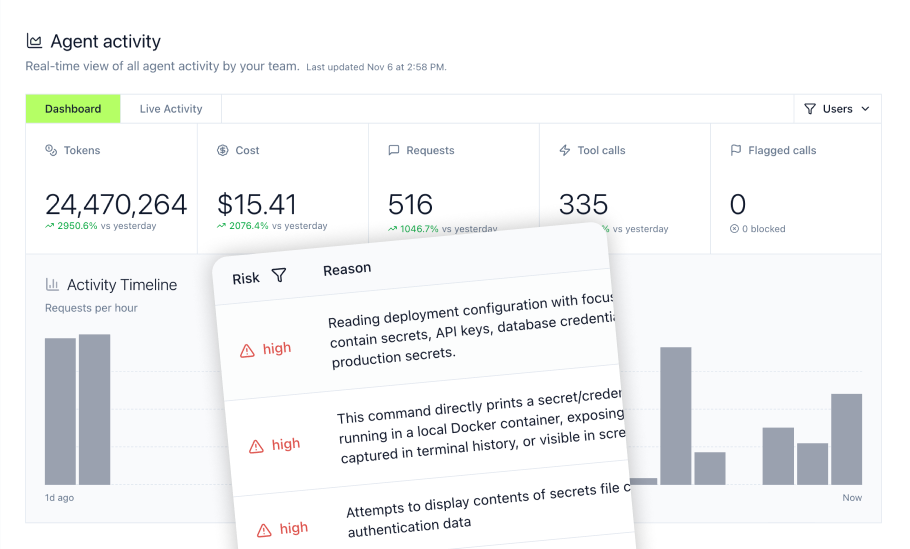
MintMCP's Agent Monitor provides org-level analytics on MCP adoption and usage patterns by team and tool. Combined with the MCP Gateway's conversation-level logging capturing prompts, tool calls, and responses with per-user attribution, teams gain the visibility required to optimize intelligently rather than cut blindly.
Setting Up Cost Monitoring Alerts and Thresholds
Real-time alerts must fire before budgets are exhausted, not after. Effective alerting includes:
- Early warning thresholds: Flag consumption that is tracking above forecast
- Escalation thresholds: Notify team leads before allocated usage is exhausted
- Usage limits where supported: Enforce configured limits before additional requests consume resources`
Teams that rely on provider billing dashboards consistently report that alerts fire after overages occur. Moving enforcement to the gateway layer ensures budgets are respected in real time.
Leveraging Context Compression for Cost Reduction
Context compression reduces the number of tokens processed per request, directly lowering costs without changing model selection or routing logic. LLMLingua and similar compression techniques can achieve up to 20x compression ratios on suitable workloads.
How Context Compression Reduces Costs
Token costs scale with input length. A 50-page document analysis that sends the full document to the model on every query incurs massive input token costs. Compression strategies include:
- Prompt compression: Removing redundant tokens while preserving semantic meaning
- Context distillation: Pre-processing documents into summaries, then querying summaries rather than full text
- Selective retrieval: Using embeddings to identify relevant sections rather than including entire documents
Research from Google and Purdue demonstrated 80.6% output token reduction while maintaining accuracy through optimized prompt engineering.
Governing AI Agents: Preventing Cost Sprawl with Centralized Controls
Ungoverned agent deployments create cost sprawl through unauthorized usage, shadow AI adoption, and abandoned agents that continue generating bills. Centralized governance through an MCP Gateway provides the control layer that prevents these patterns.
The Hidden Costs of Ungoverned Agent Deployments
Without centralized governance, organizations face:
- Shadow AI agents: Developers spinning up agents using personal API keys, invisible to FinOps until monthly personal expense reports
- Privilege escalation: Agents inheriting user credentials that provide broader access (and higher cost ceilings) than the specific task requires
- No decommissioning workflow: Abandoned experiments continue running indefinitely because no system tracks agent lifecycle
- Retry storms and failure cascades: Agents without circuit breakers hammering failing endpoints, multiplying costs during outages
MintMCP's Agent Monitor detects off-gateway MCP usage in developer tools with MDM-pushed enforcement capabilities, addressing shadow AI before it becomes a billing surprise.
Building a Foundation for Secure and Cost-Effective Agent Operations
Cost governance and security governance share infrastructure. Rate limiting per user and team prevents both runaway costs and abuse. Tool-level access control ensures agents can only invoke the capabilities they need, reducing both security surface area and cost exposure.
Effective governance includes:
- Rate limiting per user, team, and agent: Preventing any single principal from consuming disproportionate resources
- Tool-level allowlisting: Agents access only the MCP servers and tools explicitly granted, not a broad service account
- Automatic credential rotation: Reducing blast radius if any single credential is compromised
- Policy-as-code: Governance rules version-controlled and auditable, not manually configured through admin UIs
The Role of Virtual MCPs and Bundles in Cost Management for AI Agents
MintMCP's Bundle architecture provides governance primitives that directly enable cost control. Virtual MCPs (VMCPs) and Agent Bundles create the scoping, attribution, and enforcement layers that cost optimization requires.
Simplifying Governance, Reducing Unnecessary Usage
Virtual MCPs bundle multiple servers with role-based tool access. A sales team's VMCP includes CRM connectors and email tools; a development team's VMCP includes GitHub and CI/CD connectors. Each VMCP creates a governed scope for tool access, policy enforcement, and audit, while centralized monitoring can help teams analyze usage across people and agents.
The Bundle model ties SCIM group membership to curated MCP server lists and custom policy rules. When employees change teams, their MCP access updates automatically through IdP group sync. Departed employees lose access immediately rather than retaining orphaned credentials that continue generating costs.
Per-Agent Identity: A Foundation for Granular Cost Control
Agent Bundles give each deployed agent its own persistent identity with rotatable credentials and permission scope independent of the creator's access level. This architecture enables:
- Per-agent cost attribution: Each agent's token consumption is tracked separately, enabling ROI analysis per deployed agent
- Per-agent usage visibility: Agent identities allow monitored usage and estimated cost to be attributed separately to individual agents
- Per-agent decommissioning: Revoking an agent's credentials stops its cost generation immediately without affecting other agents or human users
- Least-privilege tool access: Agents access only the specific tools their task requires, not broad service accounts with organization-wide permissions
The Agent Bundle approach prevents the common failure mode where a single service account with excessive permissions makes cost attribution impossible. When each agent has its own identity, cost, security, and audit concerns align naturally.
How MintMCP Connects Cost Optimization to Agent Governance
Organizations implementing LLM cost optimization face a fundamental infrastructure challenge: the same visibility, attribution, and enforcement capabilities required for cost control are also the building blocks of secure agent governance. MintMCP addresses this through a two-layer architecture that makes cost optimization and security inseparable.
- MCP Gateway provides governed data and tool connections for the AI systems users already run, including Claude, Cursor, ChatGPT, Gemini, and Copilot. It routes requests, enforces rate limits, logs conversations with per-user attribution, and prevents unauthorized tool access across all these systems through a single control plane.
- Agent Gateway builds on that foundation to provide identities, permissions, memory, and monitoring for agents that work alongside users. For teams deploying long-running agents that hold memory, continue work across days, and operate in Slack or other collaboration platforms, Agent Gateway extends MCP Gateway's governance model to persistent agent identities with their own credentials, scoped permissions, and audit trails.
For teams building AI agents that work alongside employees, MintMCP's Agent Gateway provides the identity, permissions, memory, and monitoring infrastructure that cost governance requires. The MCP Gateway handles governed data and tool connections; the Agent Gateway layer adds the per-agent controls that transform cost management from aspiration to implementation.
Frequently Asked Questions
What is the typical ROI timeline for implementing LLM cost optimization?
There is no universal break-even timeline for LLM cost optimization. ROI depends on baseline token spend, workload mix, cacheability, model-routing opportunities, implementation costs, and whether optimization changes output quality.
How do I prioritize which optimization tactics to implement first?
Start with the highest-impact, lowest-effort changes. Agent inventory audits are a low-complexity first step because they can identify inactive or duplicate workloads before you change production behavior. Prompt caching for stable system prompts is another early optimization where supported by the provider. Basic model routing can then move suitable requests to lower-cost models, with savings validated against quality metrics before broader rollout.
How do cost optimization strategies differ between internal agents and customer-facing AI products?
Internal agents prioritize cost efficiency and can tolerate longer latencies (batch processing, async patterns) and occasional quality variation if users can retry or escalate. Customer-facing products prioritize reliability and quality; cost optimization must never visibly degrade user experience. This typically means customer-facing systems use more conservative routing rules, maintain redundant provider fallbacks, and accept higher per-query costs in exchange for consistent quality.
What metrics should I track beyond total LLM spend?
Effective dashboards include cost-per-completed-task (not just cost-per-query), quality metrics tracked alongside cost metrics, cache hit rates, routing distribution (percentage of traffic going to each model tier), error rates and retry multipliers, and latency percentiles. Cost optimization that increases error rates or degrades quality creates hidden costs that offset API savings.
How do I handle cost optimization for multi-agent systems where agents call other agents?
Multi-agent workflows require end-to-end cost attribution that tracks the full chain of calls. A coordinator agent that invokes three specialist agents must show the combined cost, not just the coordinator's direct token consumption. Implement correlation IDs that propagate through the entire workflow, and build dashboards that aggregate costs by workflow rather than by individual agent.