Choosing the right open source LLM can transform how organizations build AI agents, automate workflows, and process enterprise data. In 2026, the strongest open source LLMs approach or exceed proprietary models on some coding and reasoning benchmarks while offering self-hosting and greater infrastructure control. Deployment requirements, operating costs, and performance vary substantially by model.
The real challenge for enterprises is governance. When teams operate a mix of AI clients, open source models, and custom agents, security teams need visibility into which tools agents call, what data flows through them, and how to enforce consistent access policies. MintMCP's MCP Gateway provides that governance layer, connecting AI agents to enterprise tools through centralized authentication, credential management, and audit logging across mixed model environments.
This guide starts with MintMCP's governance infrastructure, followed by six open source LLMs for enterprise AI deployment in 2026, evaluated by performance benchmarks, licensing terms, deployment requirements, and relevance to agentic workflows.
Key takeaways
- Open source models are competitive with proprietary systems on several coding and reasoning benchmarks, but results vary substantially by benchmark, model version, reasoning mode, and evaluation harness
- DeepSeek-V4-Pro delivers strong coding performance under the MIT license, while GLM-5.2 provides strong reasoning and agentic performance under the same permissive license
- Cost-efficient options like DeepSeek-V4.1-Flash bring strong performance with more efficient inference and MIT licensing
- Enterprise governance requires centralized authentication, tool-level access control, and audit trails through solutions like MintMCP's Agent Gateway for managing agent identities and permissions
- The models covered here use permissive MIT or Apache 2.0 licenses, though organizations should still review the exact license terms and notice requirements before commercial deployment
- Organizations should verify exact licensing terms, benchmark methodology, and hardware requirements for each model before production deployment
1. MintMCP: Enterprise governance for AI agents and open source models
MintMCP provides the infrastructure layer that makes AI agents deployable, governed, measurable, and swappable across mixed open source and proprietary model environments.
Core capabilities
When teams deploy open source LLMs like DeepSeek-V4-Pro or Qwen through AI agents and coding assistants, MintMCP delivers:
- MCP Gateway centralizes authentication through organizational identity providers, curates which tools each role can access, injects credentials per call, and logs activity through governed endpoints
- Agent Gateway gives every autonomous agent its own identity, scoped permissions, credentials, and audit trail, separate from the human who created it
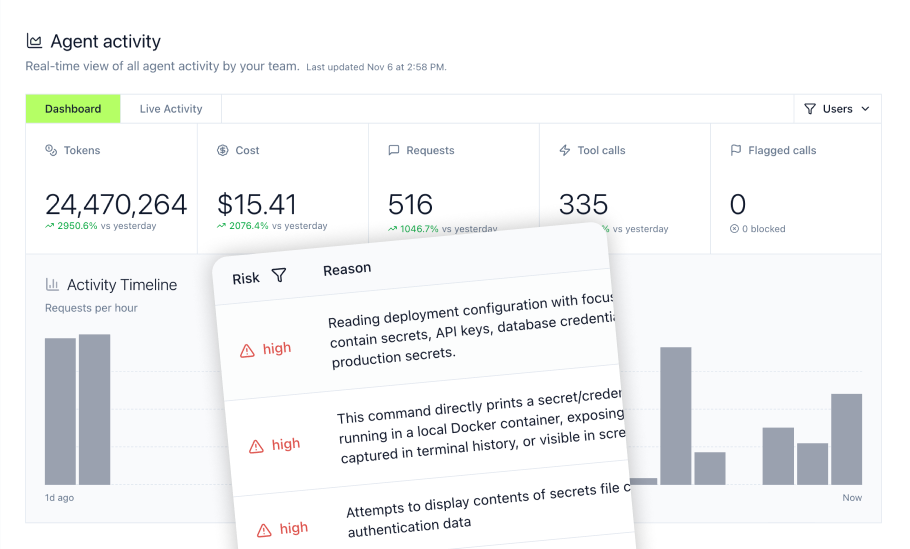
- Agent Monitor provides visibility into supported agent activity, including prompts, commands, file access, MCP tool calls, usage, and token costs
- Guardrails apply runtime controls to supported agent and tool activity with Mint Guard for managed detection, Rules for declarative matching and enforcement, and Gateway Middleware for custom DLP integrations
- Coworker Agents enable long-running agents that work alongside teams through Slack, scheduled triggers, or manual runs, with company-owned memory and sandboxed execution
Primary deployment advantage
MintMCP solves the governance gap that emerges when organizations deploy open source models at scale. Security teams gain visibility into supported agent activity, tool invocations, and access policies across Cursor, Claude Code, and custom agents without rebuilding governance infrastructure for each model.
When teams use open source LLMs through governed MCP connections, they gain enterprise authentication, role-based tool access, credential management, and audit trails.
2. DeepSeek-V4-Pro
DeepSeek-V4-Pro entered preview on April 24, 2026 and reached general availability on August 13, 2026. It uses the MIT license and posts strong software-engineering results, though benchmark comparisons depend on the specific release, reasoning mode, and evaluation harness.
Core specifications
- Parameters: 1.6T total, 49B active
- Context window: 1,000,000 tokens
- License: MIT
- Benchmark performance: 80.6% SWE-Bench Verified, 93.5% LiveCodeBench, 90.1% GPQA Diamond
Architecture highlights
The model uses a hybrid attention mechanism combining Compressed Sparse and Heavily Compressed attention to maintain efficiency across its one-million-token context. Weights ship in mixed FP4/FP8 format for deployment optimization.
Ideal fit
Engineering teams building AI-powered development tools, coding assistants, and automated software workflows. The MIT license permits commercial use, modification, distribution, and sublicensing, provided the required copyright and license notice is retained. For organizations running coding agents through supported platforms, DeepSeek-V4-Pro provides a strong foundation model choice.
3. GLM-5.2 (Z.ai)
GLM-5.2 was Z.ai's June 2026 flagship for long-horizon agentic tasks and complex problem-solving, though it was superseded by GLM-5.3 in August 2026. The model remains notable for its optimization for systems engineering, tool use, and multi-step workflows.
Core specifications
- Parameters: 744B total, 40B active
- Context window: 1,000,000 tokens
- License: MIT
- Benchmark performance: 91.2% GPQA Diamond, 81.0% Terminal-Bench 2.1, 62.1% SWE-Bench Pro
Architecture approach
GLM-5.2 uses reinforcement learning infrastructure enabling iterative refinement and improved tool-based reasoning. A 2-bit quantized variant requires approximately 245GB combined memory for multi-GPU deployment.
Ideal fit
Organizations building complex AI agents requiring sophisticated reasoning, multi-step planning, and tool orchestration. The MIT license and agentic benchmark results make GLM-5.2 suitable for autonomous workflows managed through governed agent infrastructure, where each agent receives scoped permissions and an attributable audit trail.
4. Qwen 3.6 (Alibaba Cloud)
The Qwen family represents a comprehensive open source ecosystem for enterprise AI, combining performance across coding, reasoning, and agents with multilingual support and Apache 2.0 licensing.
Core specifications
- Parameters: Qwen3-235B (235B total, 22B active) and Qwen3.6-27B (27B dense)
- Context window: Up to 262K native, extendable to 1M+
- License: Apache 2.0
- Pricing: Provider-dependent; Alibaba Cloud currently lists Qwen3.6-27B at $0.60/M input and $3.60/M output
- Benchmark performance: Qwen3.6-27B scores 77.2% SWE-Bench, 87.8% GPQA Diamond, 83.9% LiveCodeBench with support for 100+ languages and dialects
Deployment flexibility
The Qwen ecosystem supports:
- Dual-mode operation with thinking mode for complex tasks and non-thinking mode for efficiency
- Quantized variants for local experimentation
- Multi-GPU tensor parallelism for official full-context serving with the 262K native context
- Production deployments through Ollama, llama.cpp, vLLM, SGLang, TensorRT-LLM, and Kubernetes
Ideal fit
Organizations needing multilingual AI capabilities across diverse deployment scenarios. Apache 2.0 provides broad commercial-use, modification, and distribution rights subject to its license terms and notice requirements.
5. DeepSeek-V4.1-Flash
DeepSeek-V4.1-Flash superseded V4-Flash on September 10, 2026. DeepSeek retired the earlier V4-Flash model from its official API and now routes the Flash alias to V4.1-Flash, which uses an updated 552B mixture-of-experts architecture and adds native multimodal capabilities.
Core specifications
- Parameters: 552B total, with 8B active for input and 16B active for output
- Context window: 1,000,000 tokens
- License: MIT
- Benchmark performance: Strong results on coding and reasoning evaluations
Deployment efficiency
The model architecture improves inference efficiency, but self-hosting still requires substantial accelerator and memory resources. The combination of MIT licensing, one-million-token context, and more efficient inference makes V4.1-Flash suitable for high-volume workloads where organizations have appropriate infrastructure or use hosted inference.
Ideal fit
Organizations seeking strong coding and reasoning capabilities with more efficient inference than larger frontier models, particularly through hosted inference or substantial multi-GPU infrastructure. Token usage monitoring can track spending by model, user, agent, and session for cost visibility.
6. Mistral Large 3
Mistral Large 3 combines open weights under Apache 2.0 with managed deployment options, giving organizations flexibility to choose deployment architectures and regions that align with their data residency requirements.
Core specifications
- Parameters: 675B total, 41B active
- Context window: 256K tokens
- License: Apache 2.0
- Benchmark performance: 82.8% LiveCodeBench with enterprise integration support across Azure, Amazon Bedrock, Google Cloud, Snowflake, and IBM watsonx
Deployment options
The model provides a hybrid approach combining open-weight models for self-hosting with commercial managed services. FP8 weights require approximately 710GB VRAM, while INT4 quantization brings requirements to roughly 355GB for 8x H100 deployment.
Ideal fit
Organizations requiring flexible deployment options while maintaining specific data residency or compliance requirements. The hybrid model enables choice between self-hosted and managed deployments.
7. Gemma 4 31B (Google DeepMind)
Gemma 4 31B delivers reasoning and coding performance while supporting substantially smaller hardware configurations than the largest models in this list.
Core specifications
- Parameters: 31B dense
- Context window: Up to 256,000 tokens
- License: Apache 2.0
- Benchmark performance: 84.3% GPQA Diamond, 80.0% LiveCodeBench, 1,451 Arena Elo rating
Hardware accessibility
Quantized Gemma 4 variants can run on consumer GPUs, while Google states that the unquantized bfloat16 model fits on a single 80GB H100. The model family includes smaller variants for on-device deployment.
Ideal fit
Developers and teams wanting to experiment with capable models on existing hardware. Gemma 4 is suitable for development environments, edge deployment, and cost-sensitive production workloads.
Governing open source LLMs for enterprise deployment
Organizations deploying open source LLMs at enterprise scale face critical governance challenges beyond model selection. The NIST AI Risk Management Framework provides a broader framework for managing AI risks across governance, measurement, and operational controls. Security teams also need visibility into which tools agents call, which data flows through them, and how to enforce consistent access policies across diverse AI clients and custom agents.
MintMCP provides the infrastructure layer for governed AI agent deployment:
- MCP Gateway centralizes authentication through organizational IdPs, curates which tools each role can see, injects credentials per call, and logs activity through governed endpoints
- Agent Gateway gives every autonomous agent its own identity, scoped permissions, credentials, and audit trail
- Agent Monitor provides visibility into supported agent activity, including prompts, commands, file access, MCP tool calls, and token costs
- Guardrails apply runtime controls with Mint Guard for managed detection, Rules for declarative matching, and Gateway Middleware for custom integrations
- Coworker Agents enable long-running agents with company-owned memory and sandboxed execution
When teams use open source LLMs through governed MCP connections, they gain enterprise authentication, role-based tool access, credential management, and audit trails without rebuilding governance infrastructure for each model. Visit mintmcp.com to deploy governed AI agent infrastructure.
Frequently asked questions
What defines an open source LLM?
Open source AI requires more than downloadable model weights. Licensing and access to the components needed to study, use, modify, and share a system determine whether a model fits an open source definition. The Open Source AI Definition provides one widely used framework for evaluating these requirements.
Models released under permissive licenses such as MIT or Apache 2.0 generally provide broad rights to use, modify, and redistribute the software or model materials, subject to their respective license conditions. Organizations should review the exact license for each model before commercial deployment.
How do open source LLMs compare in performance to proprietary models?
Open source models now lead or approach proprietary systems on some individual benchmarks, but overall performance still varies significantly by workload, model version, tool access, and evaluation setup. DeepSeek-V4-Pro's 80.6% SWE-Bench Verified score demonstrates strong coding capabilities, while GLM-5.2 posts strong results across reasoning and agentic evaluations.
Organizations should evaluate models on their specific workloads rather than relying on aggregated benchmark scores. Coding benchmarks such as SWE-bench are useful reference points, but benchmark methodology and evaluation conditions matter.
What security considerations are paramount when using open source LLMs in enterprises?
Critical security considerations include credential management to prevent API key sprawl, access control limiting which agents can call which tools, audit trails logging tool invocations for compliance, runtime guardrails blocking prompt injection and risky commands, and agent identity distinguishing human from agent actions. MintMCP's security infrastructure addresses these through SSO, SCIM-driven RBAC, detection policies, and audit trails with tamper-evident access history where supported.
Which open source LLMs work for coding tasks?
DeepSeek-V4-Pro demonstrates strong coding capabilities with 80.6% SWE-Bench Verified and 93.5% LiveCodeBench performance. DeepSeek-V4.1-Flash provides an efficiency-focused alternative for coding and reasoning workloads. Qwen3.6-27B can be quantized for local experimentation while maintaining competitive coding benchmark results.
How can organizations ensure compliance when deploying open source LLMs?
Compliance requires complete audit trails of tool invocations, credential lifecycle events, and access policy changes. Organizations need role-based access control driven by directory groups, runtime controls for detection, and SIEM export for security tooling integration. MintMCP's enterprise features provide audit trails, SSO and SCIM integration, operational controls, and export to OTLP or Splunk HEC for existing compliance workflows.