Agent gateways solve a fundamental infrastructure problem that emerges when AI agents operate across AWS, Azure, Google Cloud, and on-premises systems simultaneously. Without a centralized control plane, each agent needs individual connections to multiple tools and LLMs, creating an explosion of point-to-point integrations with scattered credentials and zero governance visibility. For enterprises running AI agents at scale, this fragmented approach becomes untenable.
The right agent gateway sits between your AI agents and everything they interact with, handling authentication, routing, policy enforcement, and observability for all agent communications. Think of it as what API gateways became for microservices, but purpose-built for autonomous AI agents operating across multi-cloud environments.
Gartner projects that by 2028, 70% of software engineering teams building multimodel applications will use AI gateways to improve reliability and optimize costs. This guide covers the agent gateways purpose-built for multi-cloud enterprise deployments in 2026, examining their approaches to security, governance, and cross-cloud integration.
Key Takeaways
- MintMCP Gateway provides MCP and agent governance with data-permissions-first architecture, SSO and SCIM-driven RBAC, Virtual MCP Bundles, Agent Bundles with per-agent identity, hosted MCP connectors, and two-layer governance
- TrueFoundry Agent Gateway focuses on governed agent execution, policy control, and observability, while its separate AI Gateway provides token budgets, semantic caching, cost attribution, and model routing
- Google Cloud Agent Gateway delivers a managed service integrated with the Google Cloud ecosystem for organizations standardized on GCP
- Sensedia AI Gateway offers vendor-agnostic multi-gateway deployment for enterprises with existing API management infrastructure
- Ping Identity Agent Gateway centers on identity-based security with OAuth 2.0 runtime enforcement for MCP communications
- Solo.io Agent Gateway provides an open-source option for teams requiring full infrastructure control in Kubernetes environments
1. MintMCP Gateway: MCP and agent governance for multi-cloud enterprises
MintMCP Gateway provides governance for Model Context Protocol and agent operations, focused on authentication, tool-level access control, credential management, logging, rule-based policy, and agent identity management. Its data-permissions-first architecture starts with SSO, SCIM-driven RBAC, IdP groups, Virtual MCP Bundles, tool-level policy, and audit logs, then enables agents on top.
Unlike traditional approaches that require weeks of infrastructure setup, MintMCP helps teams deploy governed AI agents across multi-cloud environments with centralized observability, enterprise authentication, and compliance documentation ready for regulated industries.
What makes MintMCP Gateway different
MintMCP solves the M×N integration problem that emerges when multiple agents need access to multiple tools across multiple clouds. The platform's architecture wraps stdio, hosted, HTTP-streamable, and SSE MCP servers behind SSO-fronted remote MCP endpoints with OAuth brokering, SCIM-driven membership, and rule-based policy. This transforms what would be an exponentially complex mesh into a manageable hub-and-spoke model where the gateway provides a single control plane for authentication, authorization, security policies, and observability.
The platform extends beyond MCP Gateway into Agent Gateway territory by giving internal agents first-class identities with M2M auth, scoped tools, independent rotation and revocation, and an "act as agent" flow for connectors that require per-agent OAuth. This means each agent operates with its own credentials and permission scope, never shared service-account keys.
Core capabilities
- Hosted MCP Connectors: MintMCP runs connector instances on the customer's behalf with auto-scaling and sandboxed execution per connector, reducing the infrastructure overhead that typically delays production deployment
- OAuth Brokering: Add enterprise authentication to local and hosted MCP servers, including OAuth 2.x, bearer tokens, headers, and SSO-fronted access without rebuilding each server
- Virtual MCP Bundles: Create team-specific, per-use-case endpoints that expose only the minimum required tools with SCIM-driven membership, curated tool lists, and fine-grained role-based access through VMCP concepts
- Agent Bundles: Give internal agents first-class identities with M2M auth, scoped tools, independent rotation and revocation, and an "act as agent" flow for connectors that require per-agent OAuth
- Custom Gateway Middleware: Runs customer-authored middleware in a JS sandbox with external DLP and guardrails integrations for masking, blocking, and policy enforcement
- Two-Layer Governance: Gateway covers MCP traffic while Agent Monitor covers local non-MCP agent activity including Bash usage, file reads/writes, and prompt submissions via Claude Code and Cursor hooks
Multi-cloud deployment
MintMCP operates as managed SaaS-first with US and EU availability, hosted MCP connectors, pre-configured policies, and self-service access for developers. VPC and self-hosted deployment are available on request.
The platform supports AI tool governance across Claude, Cursor, ChatGPT, Gemini, and Copilot through centralized gateway and Agent Monitor coverage, giving multi-cloud enterprises a single control plane regardless of which AI vendors their teams adopt.
Enterprise integrations
MintMCP provides pre-built connectors for enterprise data sources including:
- Snowflake data warehouse access with natural language queries
- Elasticsearch knowledge base search for documentation and log analysis
- BigQuery for data warehouse analytics
- Salesforce for CRM data access
- GitHub for development workflow integration
Security and compliance
MintMCP is SOC 2 Type II audited with continuous compliance monitoring via Drata. Enterprise SSO, complete audit trails, PII detection, and role-based access control are built into every layer of the platform. Customers handling protected health information can request HIPAA documentation, and MintMCP signs BAAs.
Pricing
Contact for enterprise demonstration and pricing at enterprise@mintmcp.com
Getting started
Visit mintmcp.com/mcp-gateway for the deployment guide
2. TrueFoundry Agent Gateway
TrueFoundry Agent Gateway provides infrastructure for deploying and managing AI agents across cloud environments, with a focus on governance and observability for machine learning platform teams.
Primary focus
TrueFoundry approaches agent infrastructure from an ML platform perspective. Its Agent Gateway focuses on governed execution, policy controls, observability, quotas, and reliable workflow execution, while its separate AI Gateway focuses on model traffic, caching, routing, and cost controls.
Core capabilities
- Centralized execution and registry for AI agents
- Step-level observability across agent, model, and tool interactions
- Agent-level quotas, budgets, RBAC, and policy enforcement
- Configurable retries, timeouts, and fallback paths
- MCP-powered tool execution with audit logging and guardrails
- Framework-agnostic support for LangChain, CrewAI, and custom agents
Where TrueFoundry fits
Organizations with ML platform teams managing AI infrastructure who prioritize governed agent execution, observability, quotas, access control, and reliable workflow execution. Teams can use TrueFoundry's separate AI Gateway for capabilities such as semantic caching and model routing.
Deployment model
Hybrid deployment with managed SaaS control plane and self-hosted options in customer Kubernetes clusters. Air-gapped deployments available via forward proxy configuration.
3. Google Cloud Agent Gateway
Google Cloud Agent Gateway provides a managed service integrated with the Gemini Enterprise Agent Platform, handling routing, authentication, and observability for agents within the Google Cloud ecosystem.
Primary focus
Google Cloud's approach emphasizes integration with native GCP services including Cloud Logging, Cloud Trace, and IAM. The gateway supports mTLS and DPoP authentication with automatic credential management through Google's infrastructure.
Core capabilities
- Native integration with Vertex AI and Gemini models
- Automatic routing to registered agents and MCP servers via Agent Registry
- Model Armor integration for content safety and prompt injection protection
- Cloud Logging and Cloud Trace for observability
- Integrates with Agent Registry to govern registered agents, tools, endpoints, and MCP servers
Where Google Cloud Agent Gateway fits
Organizations already standardized on Google Cloud infrastructure who use Gemini Enterprise or Agent Runtime. The managed service model reduces operational overhead for teams who want agent governance without deploying separate infrastructure.
Deployment model
Google-managed service deployed within GCP. Its Agent-to-Anywhere mode can govern traffic from Google Cloud agents to tools, APIs, MCP servers, and agents outside Google Cloud, although the gateway itself is not deployed directly in AWS or Azure.
4. Sensedia AI Gateway
Sensedia AI Gateway provides vendor-agnostic multi-cloud deployment for enterprises managing AI agent traffic alongside traditional API management, built as an extension of their API management platform.
Primary focus
Sensedia describes its gateway as vendor-agnostic and multi-cloud, supporting governance across multiple agents, models, gateways, and cloud environments. The platform combines AI gateway functionality with existing API management capabilities for organizations that want unified control over both traditional APIs and AI agent traffic.
Core capabilities
- Multi-gateway deployment across cloud providers
- Centralized observability across distributed gateway instances
- Integration with existing enterprise API management infrastructure
- FinOps capabilities for AI cost tracking
- Legacy system integration with AI agents
Where Sensedia fits
Enterprises with existing API management investments who want to extend their current infrastructure to support AI agents rather than deploying a separate gateway. Organizations operating multiple gateway instances across regions and cloud providers who need unified management.
Deployment model
Standalone SaaS offering designed to govern multi-cloud and multi-gateway environments through a centralized layer.
5. Ping Identity Agent Gateway
Ping Identity Agent Gateway centers on identity-based security for MCP communications, extending Ping's identity platform to enforce OAuth 2.0 validation at runtime for agent-to-tool interactions.
Primary focus
Ping Identity approaches agent gateway from an identity and access management perspective, emphasizing delegated least privilege and runtime enforcement of OAuth tokens. The platform validates authentication and authorization at the gateway layer before requests reach MCP servers.
Core capabilities
- Runtime OAuth 2.0 token validation
- Delegated least privilege enforcement
- Integration with Ping Identity Platform for centralized identity management
- Audit trails for compliance requirements
- Support for MCP protocol communications
Where Ping Identity fits
Organizations already using Ping Identity Platform for enterprise identity management who want consistent identity governance extended to their AI agent deployments. Enterprises where identity and access management is the primary security concern for agent communications.
Deployment model
Hybrid deployment integrating with existing Ping Identity infrastructure.
6. Solo.io Agent Gateway
Solo.io Agent Gateway provides open-source gateway functionality for teams requiring full infrastructure control and community-driven development within Kubernetes environments.
Primary focus
Solo.io offers an open-source approach to agent gateway, giving platform engineering teams complete visibility into gateway code and the ability to customize implementations. The gateway integrates with Kubernetes orchestration for teams with existing container infrastructure.
Core capabilities
- Open-source codebase with an optional Solo Enterprise distribution that adds production features and 24x7 support
- Kubernetes-native deployment
- MCP and A2A protocol support
- Extensible architecture for custom integrations
- Self-hosted with full infrastructure ownership
Where Solo.io fits
Platform engineering teams with Kubernetes expertise who require full infrastructure ownership and prefer open-source tools for transparency. Organizations building custom AI agent platforms who need to extend or modify gateway behavior.
Deployment model
Self-hosted on Kubernetes infrastructure. Teams can use the open-source project or Solo Enterprise for agentgateway, which adds a hardened distribution, enterprise features, and 24x7 support.
Multi-cloud security architecture for agent gateways
A defense-in-depth architecture can apply separate controls across three traffic boundaries. The first protects client-to-model communication through controls such as prompt-injection detection and PII filtering. The second protects agent-to-MCP-server communication through tool authorization and parameter validation. The third protects MCP-server-to-external-API communication through authentication, authorization, and rate limiting.
This layered approach addresses the security vulnerabilities that emerge when agents operate across cloud boundaries. Without centralized governance, organizations face fragmented security policies across dozens of individual MCP servers, zero visibility into which agents access which tools, duplicated authentication logic, and inconsistent logging.
Zero trust implementation
Multi-cloud agent gateways should enforce zero trust principles where no default access assumptions exist and mandatory authentication and authorization apply to every request. This means each agent connection must be validated regardless of network origin, each tool call must be authorized against current policy, and each data access must be logged for audit.
MintMCP implements this through its centralized security policies architecture where SSO enforcement, SCIM-driven RBAC, and tool-level policy apply to every agent interaction across all connected clouds.
DLP and guardrails integration
Enterprise deployments require integration with existing data loss prevention and content safety tools. Gateway middleware should support inline integration with systems like AWS Bedrock Guardrails, Google Cloud DLP, Microsoft Purview, Nightfall, and Skyflow for masking, blocking, and policy enforcement before sensitive data reaches external services.
Governance at scale with Virtual MCP Bundles
Traditional agent deployments require separate configuration of plugins, access rules, and credential objects for each team and use case. This creates administrative overhead that slows deployment and increases the risk of misconfiguration.
The Bundle architecture packages tool access, policy enforcement, and audit logging into single governance units per team or role. Each Bundle creates a per-use-case endpoint with SCIM-driven membership, curated tool lists, and fine-grained access policy. When IdP group membership changes, Bundle access automatically syncs without manual reconfiguration.
For example, a data analytics team might have a Bundle that includes read access to Snowflake, Elasticsearch, and BigQuery while blocking write operations. A customer support team might have a different Bundle with CRM read/write access but no database connectivity. Each team sees only the tools relevant to their function through their assigned Bundle endpoint.
Agent Bundles for per-agent identity
Agent Bundles extend the governance model to non-human principals, giving each deployed agent its own rotatable credentials and permission scope independent of the creator's access level. This addresses a critical security gap where agents typically operate with shared service account keys that cannot be rotated or revoked individually.
With per-agent identity, when an agent's behavior needs investigation or an agent is decommissioned, its credentials can be rotated or revoked without affecting other agents or human users. Each agent's actions appear in audit logs under its own identity, enabling attribution and compliance review.
Detecting shadow AI in multi-cloud environments
Agent gateways that only monitor gateway traffic miss a significant blind spot: agents operating outside the governed infrastructure. Developers running local MCP servers, teams using AI coding assistants with direct tool access, and experimental deployments that bypass official channels all create shadow AI that evades governance.
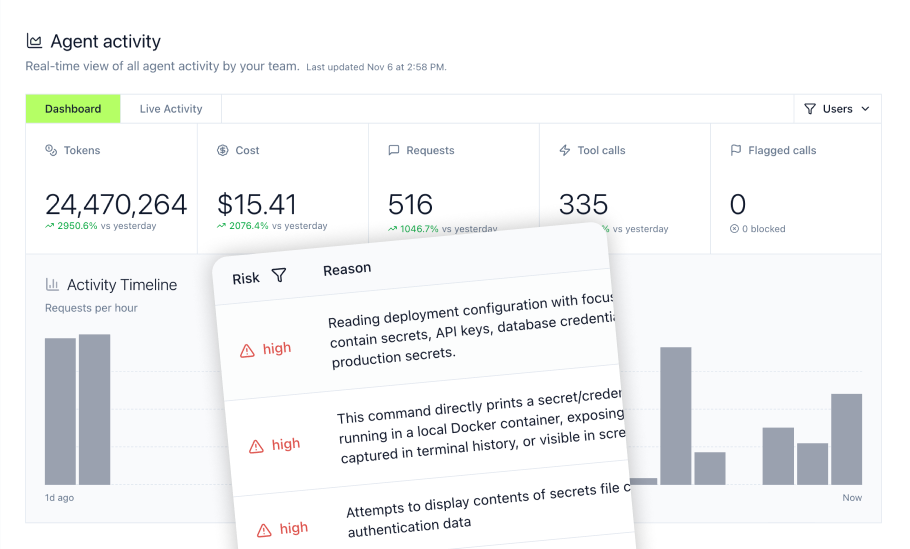
Agent Monitor addresses this gap by tracking agent activity in real-time across the organization, including MCP calls made outside the gateway through hooks in Cursor and Claude Code. This creates two-layer governance where the gateway covers MCP traffic and Agent Monitor covers local non-MCP agent activity.
Shadow AI detection capabilities should include:
- PII exposure identification in agent outputs
- Credential leakage detection for API keys and tokens
- Risky bash command monitoring
- Prompt injection attempt flagging
- Off-gateway MCP usage discovery
For organizations deploying AI coding assistants, this visibility is essential. Coding agents operate with extensive system access, reading files, executing commands, and accessing production systems. Without monitoring beyond the gateway, security teams cannot see what these agents do with that access.
Implementation roadmap for multi-cloud agent gateways
Phase 1: Pilot deployment
Begin with a limited-scope deployment for a small user group accessing a carefully selected set of MCP servers. Choose low-risk use cases like internal knowledge base search or development tool integration. This phase validates architecture, identifies integration challenges, and establishes baseline metrics without organization-wide risk.
Key tasks include agent inventory, identity provider integration, gateway deployment in isolated environment, and observability pipeline configuration. Validate authentication flows, test policy enforcement, and confirm audit logging captures the required data for compliance.
Phase 2: Governance framework
Establish policies for server vetting and approval, define role-based access controls aligned with organizational structure, implement monitoring and alerting for security events, and document operational procedures for ongoing management. Create a governance council including security, legal, and business stakeholders to approve new MCP server deployments.
Configure Virtual MCP Bundles for each team or use case. Set up SCIM sync with your identity provider so Bundle membership stays current as employees change roles. Define tool-update policies to control whether new upstream tools auto-enable or require admin approval.
Phase 3: Enterprise rollout
Expand to additional teams and use cases based on pilot success metrics. Integrate with enterprise identity providers for SSO enforcement. Connect production data sources like data warehouses and enterprise search. Enable self-service access for developers while maintaining centralized governance.
Monitor usage patterns to optimize resource allocation and identify additional integration opportunities. Review cost attribution reports to understand AI spending by team and application. Establish regular security reviews of agent activity logs.
Success metrics
Track deployment velocity, security events detected and prevented, developer satisfaction with tooling access, compliance audit preparation time, and cost per AI interaction. Organizations implementing centralized gateway infrastructure typically see meaningful reductions in time spent on authentication setup when it replaces one-off server-by-server configuration.
ROI considerations for agent gateway deployment
Agent gateways deliver value across three dimensions: cost reduction, risk mitigation, and developer productivity.
Cost optimization
Cost spikes can go undetected when organizations lack per-agent and per-team attribution. Retrieval regressions, longer prompts, repeated retries, and uncontrolled agent loops can increase inference spending before the monthly invoice arrives.
Agent gateways with token budgets, semantic caching, and cost attribution address this blind spot. Intelligent routing and caching can reduce unnecessary inference spending, but the results depend on workload mix, model selection, routing policies, and cache effectiveness.
Risk mitigation
Centralized policy enforcement reduces security incident response time by providing a single point of visibility and control. When an anomaly appears, security teams can review gateway logs rather than investigating each agent and tool connection individually.
Organizations in regulated industries often need traceable records of agent access and actions. Centralized gateway audit records can support investigations and compliance evidence collection, but they must operate alongside the organization's broader security, privacy, retention, and governance controls.
Developer productivity
Without gateway infrastructure, developers spend significant time on authentication setup, credential rotation, and logging implementation for each new agent-to-tool connection. Centralizing these concerns at the gateway layer lets developers focus on business logic rather than infrastructure plumbing.
Self-service access through governed Bundles means developers can start using approved tools immediately without waiting for individual access provisioning. This accelerates time-to-production for new AI agent deployments.
Making your choice: selection criteria
Multi-cloud flexibility
If your organization operates across AWS, Azure, GCP, and on-premises systems, prioritize gateways that support vendor-agnostic deployment. Cloud-native options may provide tighter integration with a single provider but create lock-in that complicates future infrastructure decisions.
Governance model
Evaluate whether the gateway provides MCP-specific governance primitives like Virtual MCP Bundles, Agent Bundles with per-agent identity, and tool-level access controls. Generic API gateway extensions may lack the agent-aware features needed for comprehensive governance.
Operational model
Consider whether you want managed SaaS-first deployment with hosted connectors and pre-configured policies, or self-hosted infrastructure with full control. Each approach trades operational overhead against customization flexibility.
Observability depth
Agent gateways should provide real-time dashboards showing server health, usage patterns, tool call tracking, and security alerts. Verify the gateway integrates with your existing monitoring infrastructure and provides the audit trail depth your compliance requirements demand.
Protocol support
The critical question is whether your gateway handles STDIO-based MCP servers, which represent a large share of community-built servers but are difficult to deploy without proper infrastructure. Solutions that only support remote HTTP or SSE servers limit ecosystem access and require rebuilding existing STDIO tools.
Deploy AI agents with enterprise governance across every cloud
Multi-cloud enterprises face a fundamental choice when deploying AI agents: build fragmented point-to-point integrations with scattered credentials and zero visibility, or implement a centralized control plane that provides unified authentication, policy enforcement, and observability from day one.
MintMCP addresses this through two connected capabilities. MintMCP Gateway provides governed data and tool connections for the AI systems users already run, including Claude, Cursor, ChatGPT, Gemini, and Copilot. This MCP Gateway foundation handles the explosion of M×N integrations across clouds by wrapping stdio, hosted, HTTP-streamable, and SSE MCP servers behind SSO-fronted remote MCP endpoints with OAuth brokering, SCIM-driven membership, and rule-based policy.
Building on this foundation, MintMCP is helping define the Agent Gateway category as the control layer for identities, permissions, memory, and monitoring for agents that work alongside users. Agent Bundles give each deployed agent its own first-class identity with M2M auth, scoped tools, independent rotation and revocation, and an "act as agent" flow for connectors that require per-agent OAuth. This means agents operate with their own credentials and permission scope, never shared service-account keys.
The platform's data-permissions-first architecture means security, compliance, and observability are built in from the start, not bolted on afterward. With Virtual MCP Bundles, Agent Bundles, hosted MCP connectors, and two-layer governance covering both gateway traffic and local agent activity through Agent Monitor, MintMCP provides the governance foundation that makes production agent deployment possible across regulated industries.
Teams can deploy governed AI agents with centralized control, complete audit trails, and the compliance documentation that enterprises require as initiatives such as NIST's AI Agent Standards Initiative work toward voluntary guidance, interoperable protocols, and industry-led standards for autonomous systems.
Visit mintmcp.com to start your free trial with no sales call needed.
Frequently asked questions
What is an agent gateway and why is it essential for multi-cloud enterprises?
An agent gateway is infrastructure that sits between AI agents and everything they interact with, including other agents, LLM models, and external tools. For multi-cloud enterprises, gateways solve the M×N integration problem where each agent needs connections to multiple tools across multiple clouds. Without centralized control, organizations face scattered credentials, fragmented security policies, and zero visibility into agent behavior. The gateway transforms this chaos into a manageable hub-and-spoke model with unified authentication, policy enforcement, and observability across all cloud environments.
How do agent gateways address shadow AI and off-gateway activity?
Agent gateways that only monitor gateway traffic miss agents operating outside governed infrastructure, including developers running local MCP servers and AI coding assistants with direct tool access. Comprehensive solutions like MintMCP provide two-layer governance where the gateway covers MCP traffic and Agent Monitor covers local non-MCP agent activity through hooks in tools like Cursor and Claude Code. This detects PII exposure, credential leakage, risky commands, and prompt injection attempts regardless of whether the agent routes through the gateway.
What security and compliance standards should an enterprise agent gateway meet?
Enterprise agent gateways should be SOC 2 Type II audited and provide continuous compliance monitoring, data encryption in transit and at rest, comprehensive audit trails for regulatory requirements, and integration with existing identity providers for SSO enforcement. Organizations in healthcare should verify HIPAA documentation availability and BAA signing capability. The gateway should support inline DLP integration with tools like AWS Bedrock Guardrails, Microsoft Purview, and Nightfall for content filtering before sensitive data reaches external services.
How do agent gateways integrate with existing enterprise identity providers?
Agent gateways support OAuth 2.0, SAML for enterprise SSO, OpenID Connect for modern identity providers, and API token management for service accounts. Leading implementations like MintMCP provide SCIM-driven membership sync so Bundle access automatically updates when IdP group membership changes. This eliminates manual access provisioning and ensures agent permissions stay current with organizational changes. Per-agent identity through Agent Bundles gives each agent its own rotatable credentials independent of human user access.
What is the Bundle architecture and how does it simplify multi-cloud AI governance?
The Bundle architecture packages tool access, policy enforcement, and audit logging into single governance units per team or role. Each Virtual MCP Bundle creates a per-use-case endpoint with SCIM-driven membership, curated tool lists, and fine-grained access policy. Instead of configuring separate plugin, access rule, and credential objects for each integration, administrators define Bundles that automatically apply consistent governance. Agent Bundles extend this model to non-human principals, giving each agent its own identity, credentials, and permission scope.