Fintech startups face a critical infrastructure decision in 2026: how to connect AI agents to banking systems, payment processors, and customer data without creating compliance nightmares or security gaps. As AI could add $200 to $340 billion in annual value to the global banking industry, choosing the right agent gateway determines whether your startup captures that value or gets blocked by audit failures.
The right MCP gateway transforms how fintech teams deploy AI agents for fraud detection, compliance automation, and customer support. Instead of building point-to-point integrations that fragment security policies across dozens of tools, an agent gateway provides centralized authentication, real-time monitoring, and enterprise-grade compliance from day one.
This guide ranks the 10 agent gateways that fintech startups should evaluate in 2026, with specific attention to regulatory compliance, deployment speed, and integration depth with financial services infrastructure.
Key takeaways
- MintMCP Gateway provides enterprise MCP infrastructure with SSO and SCIM-driven RBAC, Virtual MCP Bundles, Agent Bundles with M2M auth, hosted MCP connectors, tool-level policy, and audit logs
- Bifrost offers open-source performance with in-VPC deployment options for teams requiring full infrastructure control
- Portkey provides managed MCP gateway infrastructure with unified authentication and team-based workspaces
- Peta focuses on vault-based security architecture with human-in-the-loop approval workflows
- Gravitee Agent Mesh unifies API, event streaming, and agent management in a single platform
- TrueFoundry combines LLM serving with MCP gateway capabilities for teams running model infrastructure
- ContextForge (IBM) delivers open-source gateway functionality with Apache 2.0 licensing
- Docker MCP Gateway provides container-native isolation for Kubernetes-fluent teams
- Tyk AI Studio extends API gateway capabilities with MCP protocol support
- Zapier MCP offers rapid integration access through 9,000+ apps
1. MintMCP Gateway: enterprise MCP infrastructure for fintech
MintMCP Gateway provides enterprise infrastructure for Model Context Protocol focused on authentication, tool-level access control, credential management, logging, rule-based policy, and agent governance. The platform's data-permissions-first architecture starts with SSO, SCIM-driven RBAC, IdP groups, Virtual MCP Bundles, tool-level policy, and audit logs, then enables agents on top.
For fintech startups handling sensitive financial data, MintMCP addresses the compliance burden that comes with phased EU AI Act obligations and financial regulations like the GENIUS Act and MiCA. The platform helps teams turn MCP servers and hosted connectors into governed production services with centralized observability and enterprise authentication.
Why fintech startups choose MintMCP
MintMCP solves the fundamental challenge fintech teams face when connecting AI agents to payment processors, CRM systems, and databases. The platform's architecture wraps stdio, hosted, HTTP-streamable, and SSE MCP servers behind SSO-fronted remote MCP endpoints with OAuth brokering, SCIM-driven membership, and rule-based policy.
This reduces fragmented security policies and visibility gaps that create audit failures when managing connections between AI agents and financial systems.
Core capabilities
- Hosted MCP Connectors: MintMCP runs connector instances with auto-scaling and sandboxed execution per connector, reducing infrastructure overhead for lean fintech engineering teams
- OAuth Brokering: Add enterprise authentication to local and hosted MCP servers, including OAuth 2.x, bearer tokens, headers, and SSO-fronted access without rebuilding each server
- Virtual MCP Bundles: Create team-specific endpoints that expose required tools with SCIM-driven membership, curated tool lists, and fine-grained role-based access for compliance officers versus trading desk analysts
- Agent Bundles: Give internal agents first-class identities with M2M auth, scoped tools, independent rotation and revocation, and an "act as agent" flow for connectors requiring per-agent OAuth
- Custom Gateway Middleware: Runs customer-authored middleware in a JS sandbox with external DLP and guardrails integrations for masking, blocking, and policy enforcement
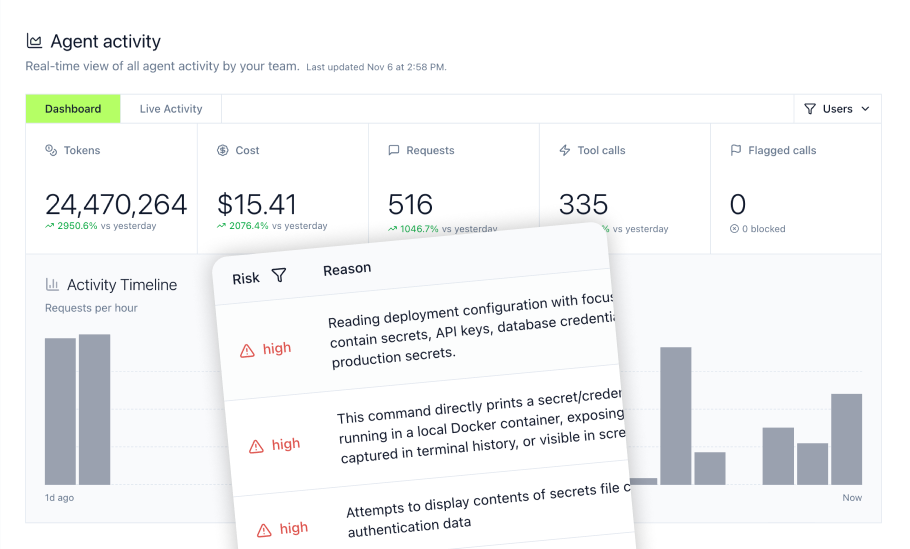
- Real-Time Monitoring: Live dashboards showing server health, usage patterns, tool call tracking, and security alerts across all MCP connections
Fintech integrations
MintMCP provides pre-built connectors for critical fintech infrastructure:
- Snowflake data warehouse access for transaction analytics and risk modeling
- Elasticsearch integration for log analysis and fraud pattern detection
- Stripe server for payment processing automation
- Salesforce connector for customer relationship management
- SIEM export capabilities for Microsoft Sentinel and Splunk
Security and compliance
MintMCP is SOC 2 Type II audited, compliant with HIPAA standards, and penetration tested. The platform provides:
- Complete audit trails for every agent action
- PII detection and blocking
- Role-based access control at the tool level
- Data encryption in transit and at rest
MintMCP signs BAAs. Visit the MintMCP Trust Center for full compliance documentation.
Deployment
Deploy quickly with managed SaaS-first delivery in US and EU regions, hosted MCP connectors, pre-configured policies, and self-service access for developers. VPC and self-hosted deployment available on request.
2. Bifrost (Maxim)
Bifrost provides an open-source enterprise AI gateway with a focus on performance and compliance features. The platform emphasizes low-latency operations and in-VPC deployment options for organizations requiring full infrastructure control.
Primary focus
Bifrost targets fintech teams that need to self-host their gateway infrastructure while maintaining compliance with SOC 2, GDPR, and HIPAA requirements. The platform reports 11 microseconds overhead at high request volumes, which matters for latency-sensitive trading and fraud detection workloads.
Technical capabilities
- Virtual keys for per-consumer governance including budgets, rate limits, and model access
- Immutable audit logs designed for compliance documentation
- MCP gateway functionality with tool filtering per virtual key
- Automatic failover across LLM providers
Where Bifrost fits
The platform serves teams with DevOps resources who want to operate their own gateway infrastructure. The Go-based architecture and Docker deployment model require infrastructure expertise but provide deployment flexibility.
For fintech startups without dedicated DevOps engineers, the self-hosted model adds operational overhead compared to managed alternatives.
3. Portkey MCP Gateway
Portkey provides managed MCP gateway infrastructure with unified authentication and workspace organization. The platform targets teams deploying multiple MCP servers that need centralized access control.
Primary focus
Portkey's architecture routes tool calls across different MCP servers within single sessions while maintaining consistent authentication. Teams can organize MCP access by workspace with environment isolation.
Technical capabilities
- Single token for agents to access multiple MCP servers
- OAuth2 and SSO integration including Okta and Azure AD
- Team-based workspaces with environment isolation
- Central dashboard for server registration and traffic monitoring
Where Portkey fits
The platform serves enterprise teams with established identity provider infrastructure who need to integrate MCP access with existing SSO deployments. Portkey's subscription-based model suits organizations with predictable agent usage patterns.
4. Peta (Agent Vault and Gateway)
Peta positions itself as security-focused MCP infrastructure with a vault-based architecture for credential management. The platform emphasizes zero-trust principles for AI agent deployments.
Primary focus
Peta stores API keys server-side, providing agents with short-lived tokens rather than direct credential access. The platform's Peta Desk feature enables human-in-the-loop approval for high-risk operations through a desktop approval surface.
Technical capabilities
- Vault-based secret storage with token-only agent access
- Human approval workflows for sensitive operations
- Per-tool and per-agent policy enforcement
- Detailed audit logging for agent actions
Where Peta fits
The platform serves fintech teams in highly regulated environments where human approval workflows are required for certain transaction types or data access patterns. The vault architecture addresses credential hygiene requirements common in banking and insurance.
5. Gravitee Agent Mesh
Gravitee provides unified management for APIs, event streams, and AI agents within a single platform.
Primary focus
Gravitee's Agent Mesh extends their existing API management capabilities to cover agent-to-agent communication and MCP traffic. Teams already using Gravitee for API gateway can add agent governance without deploying separate infrastructure.
Technical capabilities
- Unified control plane for APIs, Kafka streams, and AI agents
- Shared policy groups for rate limiting, prompt templating, and security
- Traffic management and usage quotas for agent communication
- Pre-built AI flows for common governance patterns
Where Gravitee fits
The platform serves enterprise teams with existing Gravitee deployments who want to extend their API management investment to cover agent infrastructure. The unified approach reduces vendor sprawl for organizations standardized on Gravitee.
6. TrueFoundry MCP Gateway
TrueFoundry combines AI infrastructure with MCP gateway capabilities, providing LLM serving alongside tool access governance. The platform targets ML platform teams managing both model hosting and agent deployments.
Primary focus
TrueFoundry's architecture unifies model inference and MCP server management in a single control plane. The platform reports low latency overhead optimized for high-volume agent workloads.
Technical capabilities
- Unified LLM serving and tool serving in one control plane
- MCP Server Groups for team and project isolation
- Interactive playground for testing agent-to-tool calls
- Multi-region support for geographic redundancy
Where TrueFoundry fits
The platform serves ML platform teams who manage model infrastructure and want to add MCP governance without introducing separate vendors. The all-in-one approach suits organizations building comprehensive AI platforms.
7. ContextForge (IBM)
ContextForge provides open-source MCP gateway functionality under Apache 2.0 licensing. The IBM-backed project offers gateway, proxy, and registry capabilities for teams building self-hosted infrastructure.
Primary focus
ContextForge federates multiple MCP servers under a single endpoint and can wrap REST or gRPC APIs as virtual MCP tools. The Python-based architecture deploys via pip or Docker.
Technical capabilities
- Federation of multiple MCP servers under unified endpoint
- REST and gRPC API wrapping as MCP tools
- Redis-backed federation for load balancing
- Built-in rate limiting, JWT auth, and OpenTelemetry observability
Where ContextForge fits
The platform serves technical teams with Python expertise who want open-source infrastructure without licensing costs. The project's IBM backing provides enterprise credibility while maintaining open governance.
Note that open-source projects require teams to operate the runtime, scaling, and security infrastructure themselves.
8. Docker MCP Gateway
Docker's MCP Gateway provides container-native management for MCP servers, leveraging Docker's orchestration capabilities for gateway infrastructure.
Primary focus
Each MCP server runs in an isolated container with defined resource limits. The platform uses Docker's standard tooling for deployment and lifecycle management.
Technical capabilities
- Container isolation with CPU and memory limits per server
- Cryptographically signed container images for supply chain security
- Docker Compose and Kubernetes deployment options
- Integration with Docker Hub catalog for pre-built tools
Where Docker fits
The platform serves DevOps teams with existing Docker and Kubernetes infrastructure who want to manage MCP servers using familiar container tooling. The security sandbox model provides isolation without specialized MCP expertise.
9. Tyk MCP Gateway
Tyk extends its established API gateway platform with MCP gateway capabilities. The platform targets organizations already using Tyk for API management.
Primary focus
Tyk MCP Gateway manages MCP traffic alongside existing REST and GraphQL APIs, reducing integration work for teams with existing API infrastructure. Policy controls can apply authentication, access control, rate limiting, and observability to MCP requests.
Technical capabilities
- Automatic MCP tool generation from REST and GraphQL APIs
- Policy-driven data transformations and filtering
- MCP policies managed alongside existing API policies
- Observability for MCP JSON-RPC requests
- On-premises deployment option
Where Tyk fits
The platform serves organizations with established Tyk API gateway deployments seeking to add agent capabilities. The mature API management foundation provides proven reliability for production workloads.
10. Zapier MCP
Zapier extends its integration platform to support MCP, enabling agents to access its ecosystem of 9,000+ app integrations without custom connector development.
Primary focus
Zapier turns any existing Zapier integration into an MCP tool accessible by AI agents. The platform handles OAuth and credential management through its existing infrastructure.
Technical capabilities
- MCP tool access to 9,000+ app integrations
- OAuth handled by Zapier with no credential exposure to agents
- No-code Zap creation for custom MCP tools
- Fully hosted with no infrastructure management
Where Zapier fits
The platform serves fintech startups needing rapid integration with CRMs, payment gateways, and business applications. The no-code approach suits non-technical founders and small teams without dedicated DevOps resources.
Note that Zapier's task-based pricing can scale with agent usage volume, and latency may be higher than self-hosted alternatives.
Selecting an agent gateway for fintech: key criteria
Compliance requirements
Fintech startups face regulatory pressure from multiple directions. The EU AI Act timeline brings major obligations into force from August 2, 2026, while MiCA authorization rules continue to reshape crypto-asset service provider requirements. Fintech startups face regulatory pressure from multiple directions. The EU AI Act timeline shows phased obligations for AI governance, while MiCA authorization rules continue to reshape crypto-asset service provider requirements. For fintech teams, the practical requirement is governed access, clear audit trails, and role-based controls for every agent action.
Evaluate gateways based on:
- Audit trail completeness for regulatory review
- SOC 2 Type II attestation or equivalent
- PII detection and masking capabilities
- Role-based access control at the tool level
Deployment speed versus control
Purpose-built managed gateways like MintMCP provide fast deployment with hosted connectors and pre-configured governance. Self-hosted open-source options require infrastructure setup but offer full control.
Consider your team's timeline:
- Series A startups often need production deployment within weeks
- Larger teams with DevOps resources may prefer infrastructure ownership
- Regulated industries may require specific deployment models for data residency
Authentication architecture
MCP gateways handle authentication differently:
- Some broker OAuth and wrap servers with enterprise SSO
- Others require manual OAuth configuration per server
- Per-agent identity models enable independent credential rotation
For fintech, per-agent identity matters when different agents access different data scopes, such as customer service agents versus risk analysis agents.
Integration depth
Assess which data sources your AI agents need:
- Payment processors (Stripe, PayPal integrations)
- Data warehouses (Snowflake, BigQuery)
- CRM systems (Salesforce, HubSpot)
- Security monitoring (SIEM export capabilities)
Implementation approach for fintech startups
Phase 1: Pilot deployment (2 to 4 weeks)
Start with limited scope: 10 to 50 users accessing 3 to 5 MCP servers for low-risk use cases. Internal knowledge base search or development tool integration validates architecture without production risk.
Phase 2: Governance framework (4 to 8 weeks)
Establish policies for server vetting, define role-based access controls aligned with organizational structure, implement monitoring and alerting for security events, and document operational procedures. Create governance approval processes for new MCP server deployments.
Phase 3: Production rollout (8 to 12 weeks)
Expand to additional teams based on pilot metrics. Integrate with enterprise identity providers for SSO enforcement. Connect production data sources including data warehouses and payment systems. Enable self-service access for developers while maintaining centralized governance.
Success metrics
Track deployment velocity, security events detected, developer satisfaction, compliance audit preparation time, and cost per AI interaction. Organizations implementing governed agent infrastructure report meaningful reductions in time spent on authentication setup when centralized gateway infrastructure replaces server-by-server configuration.
Deploy governed AI agents in your fintech startup
Fintech startups building AI-powered products need infrastructure that scales with growth while maintaining the compliance posture investors and regulators expect. MintMCP Gateway provides the foundation: SSO-driven authentication, SCIM-based role management, Virtual MCP Bundles for team-specific access, Agent Bundles for per-agent identity, and complete audit trails for every tool invocation.
The platform's hosted MCP connectors cover critical fintech integrations, including Stripe for payment processing, Snowflake for transaction analytics, and Salesforce for customer data. Custom Gateway Middleware enables inline DLP integration with existing security tools.
For teams deploying Claude, Cursor, ChatGPT, Gemini, and Copilot, MintMCP provides centralized governance through the gateway plus Agent Monitor coverage for local non-MCP agent activity.
Start your free trial at mintmcp.com to deploy governed AI agents in your fintech startup.
Frequently asked questions
What is an agent gateway and why do fintech startups need one?
An agent gateway provides centralized infrastructure for connecting AI agents to tools and data sources. For fintech startups, this means governed access to payment processors, customer databases, and compliance systems. Without a gateway, organizations face fragmented security policies across individual MCP servers, zero visibility into which agents access which tools, and duplicated authentication logic. Gateways transform this N-to-N complexity into a manageable hub-and-spoke model with unified audit trails.
How do agent gateways help with fintech compliance requirements?
Agent gateways provide the audit infrastructure regulators expect. Complete logging of tool invocations, role-based access control, and PII detection capabilities address requirements from the EU AI Act, GDPR, and PCI-DSS. AI agents with proper governance infrastructure can support compliance and fraud workflows by automating routine checks while maintaining full audit trails.
What authentication methods do MCP gateways support for fintech use cases?
Enterprise gateways support OAuth 2.x, SAML for enterprise SSO integration, OpenID Connect for modern identity providers, bearer tokens, and API token management for service accounts. For fintech, per-agent identity models matter when different agents require different data scopes. MintMCP's Agent Bundles provide M2M auth with independent credential rotation per agent.
How quickly can a fintech startup deploy an agent gateway?
Deployment speed varies by approach. Managed services like MintMCP Gateway accelerate deployment with hosted connectors and pre-configured governance controls. Self-hosted open-source solutions require additional time for infrastructure setup and security configuration. Most fintech startups can achieve pilot deployment within 2 to 4 weeks with managed services, with full production rollout over 8 to 12 weeks.
Can agent gateways work with coding assistants like Cursor and Claude Code?
Yes. Platforms like MintMCP provide two-layer governance: the MCP gateway covers tool invocations while Agent Monitor covers local non-MCP activity including bash commands, file operations, and prompt submissions. This addresses security challenges specific to coding agents that operate with extensive system access in fintech development environments.